


Water Softener Installation in Allen: What’s Included and What It Costs
Whole-home softeners that treat water where it enters your house, usually installed the same day.
What’s Covered on This Page
- Decide Whether Your Water Needs Softening
- Know What a Professional Installation Includes
- Compare Whole-House Softening to Treating Only the Water Heater
- Recognize When DIY Installation Falls Short
- Understand What Drives Your Installation Cost
- Can a water softener cause low water pressure?
- Can a plumber service a water softener once it’s installed?
- How easy is it to install a water softener myself?
Decide Whether Your Water Needs Softening
Hard water means your water carries a lot of dissolved calcium and magnesium. Hard water is a common North Texas complaint, but you don’t have to guess. Your home will usually tell you.
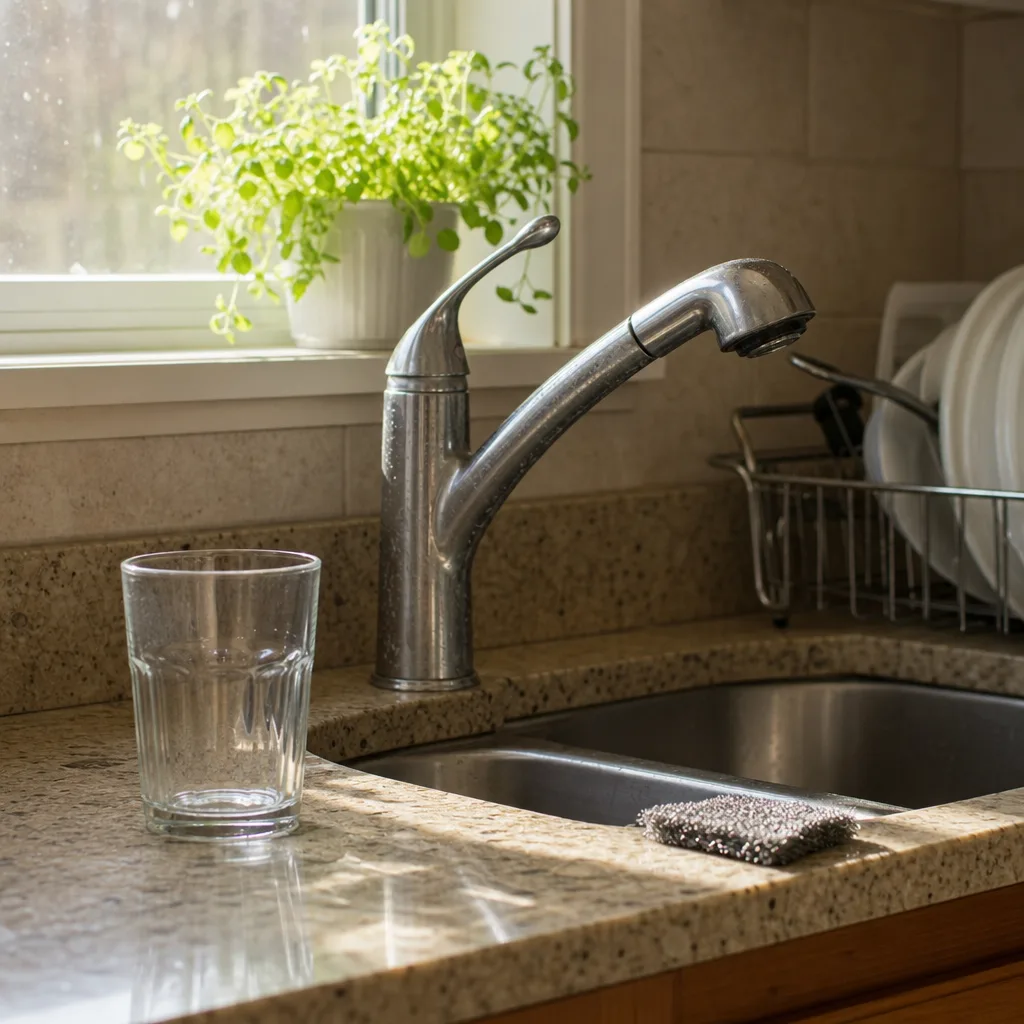
- White or chalky crust builds up on faucets, showerheads, and the edges of your sink.
- Your glasses and dishes come out of the dishwasher cloudy or spotted.
- Soap and shampoo don’t lather well, and you feel like you need more of them.
- Your shower glass gets a film that’s hard to scrub off.
- Your tank water heater makes popping or rumbling sounds, which can mean mineral sediment has settled in the bottom.
- Your skin feels dry or your hair feels dull after a shower.
Picture this. You wipe down the kitchen faucet on Sunday, and by Friday there’s a white ring around the base again. That’s scale. It’s the same buildup that collects where you can’t see it, inside your water heater, your dishwasher, and your pipes. That’s the wear a softener is built to stop.
Before you buy anything, confirm it. You have three easy options. You can look up the yearly water quality report your water utility publishes, which lists hardness for your area. You can grab a hardness test strip from a hardware store. Or you can have a technician test your water at the tap. We offer water testing, and it’s worth doing because hardness is only one part of the picture. A test tells you how hard your water is, and that number is what decides the right softener size.
Now for the honest part. A softener is the wrong tool in some cases, and you deserve to hear that from the person who installs them.
- If your water tastes or smells like chlorine, a softener won’t change that. A carbon filtration system is the better fit.
- If you see orange or brown stains in sinks and toilets, iron is likely the cause. Iron filtration handles that better than a softener alone.
- If you want cleaner drinking water from one tap, a reverse osmosis system under the kitchen sink may be all you need.
- If your test comes back soft and you aren’t seeing scale, you don’t need a softener. Save your money.
- If you’re watching your sodium closely, ask about keeping a drinking tap unsoftened, since a salt-based softener adds a small amount of sodium to the water.
Some homes need more than one fix, like a softener paired with a carbon filter. That’s fine, as long as each piece solves a problem you have. If your signs line up with the first list and a test confirms hard water, a whole-home softener is the right call, and the next step is getting it installed the right way.
Know What a Professional Installation Includes
A softener only works as well as it’s hooked up. The tank and the salt are the easy part. The connections are what keep your water running, your drain clean, and your home dry. So before you compare quotes, it helps to know what a full install should cover.
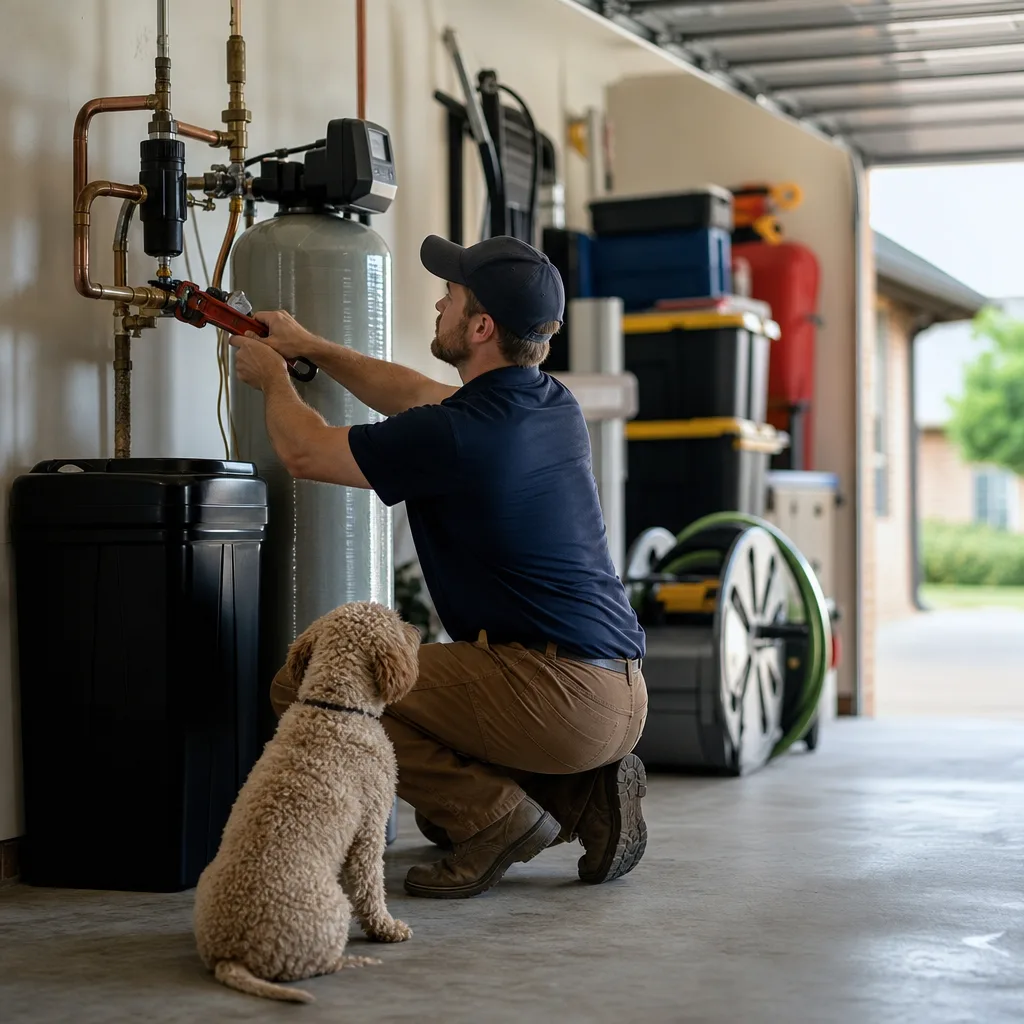
When we install a whole-home water softener, we put it at the main supply line. That way every faucet, shower, and appliance in your home gets softened water. We connect it with a bypass and a drain line, then start it up and test it. Most jobs finish the same day.
Here’s what’s included in our installation:
- The softener and materials. You aren’t sent off to buy parts.
- Professional installation at your main water supply.
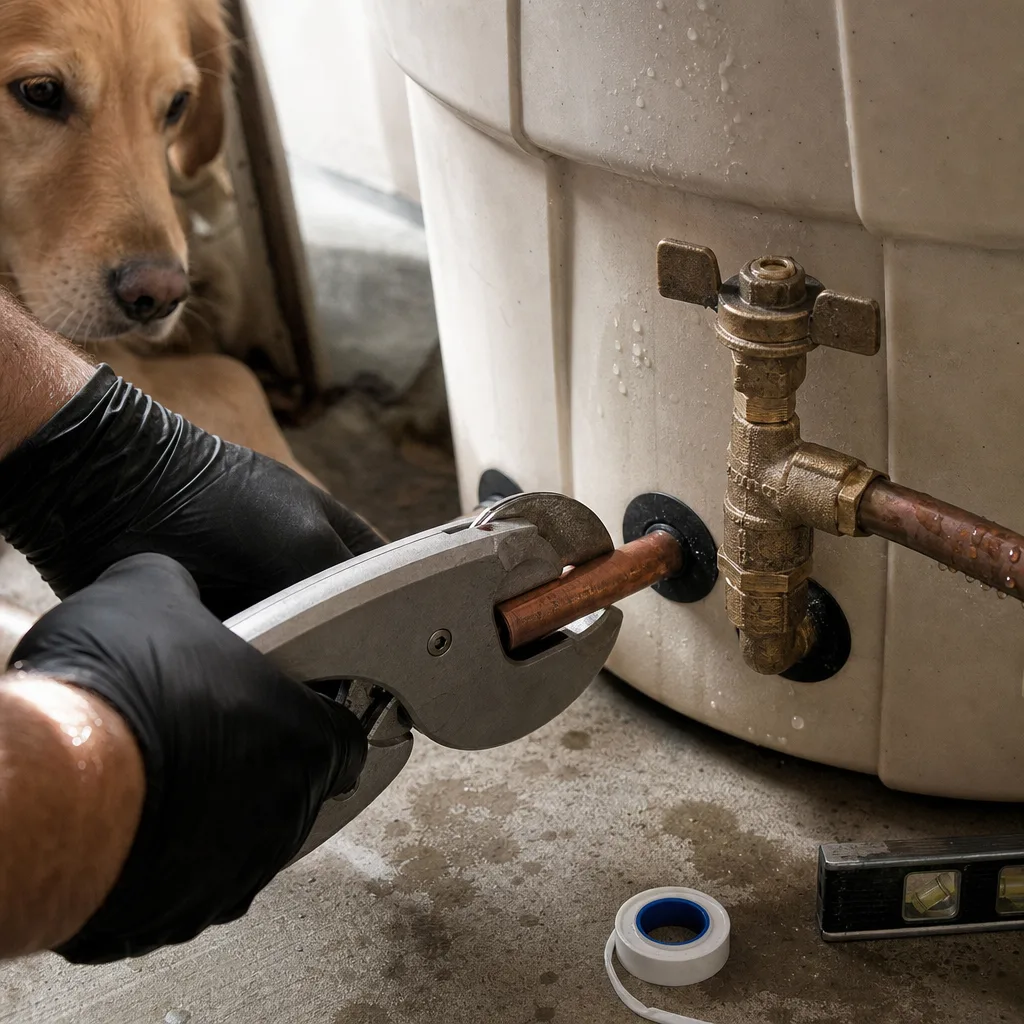
- Bypass connection. A bypass is a valve that routes water around the softener. If the unit ever needs service, you flip it and still have running water in the house.
- Drain connection. A softener rinses out the minerals it catches, and that rinse water needs a proper place to go. A good drain setup has a gap between the line and the drain, so dirty water can’t get pulled back into your system.
- Startup and testing. The unit gets set up for your water and checked for leaks before we call it done.
- Haul-away of your old unit, if you’re replacing one.
It’s just as important to know what isn’t included, so nothing catches you off guard. These items aren’t part of a standard install:
- A plumbing loop, if your home doesn’t already have one. A loop is a pre-plumbed connection, often in the garage, that’s built for a softener. Some homes were built with one. Many weren’t. Without a loop, new piping has to be run to reach your main line.
- Electrical work. Most softeners have a control head that needs power. If there’s no outlet near the install spot, that’s separate work.
- Code corrections. If existing plumbing doesn’t meet current code, fixing it is extra.
- Permits, unless your quote says they’re included.
Most of these come down to your home’s setup. Things like softener size and type, the condition of your plumbing, how easy it is to reach a drain, and whether you need a pre-filter or a loop all change the scope of the job.
Our licensed and insured technicians walk through these points with you before any work starts, with upfront flat-rate pricing, so you know exactly what’s covered.
Compare Whole-House Softening to Treating Only the Water Heater
Some homeowners ask a fair question: if the water heater is the expensive thing scale ruins, why not just protect that? It’s a real option. But it only solves part of the problem, so you should know exactly which part before you choose it.
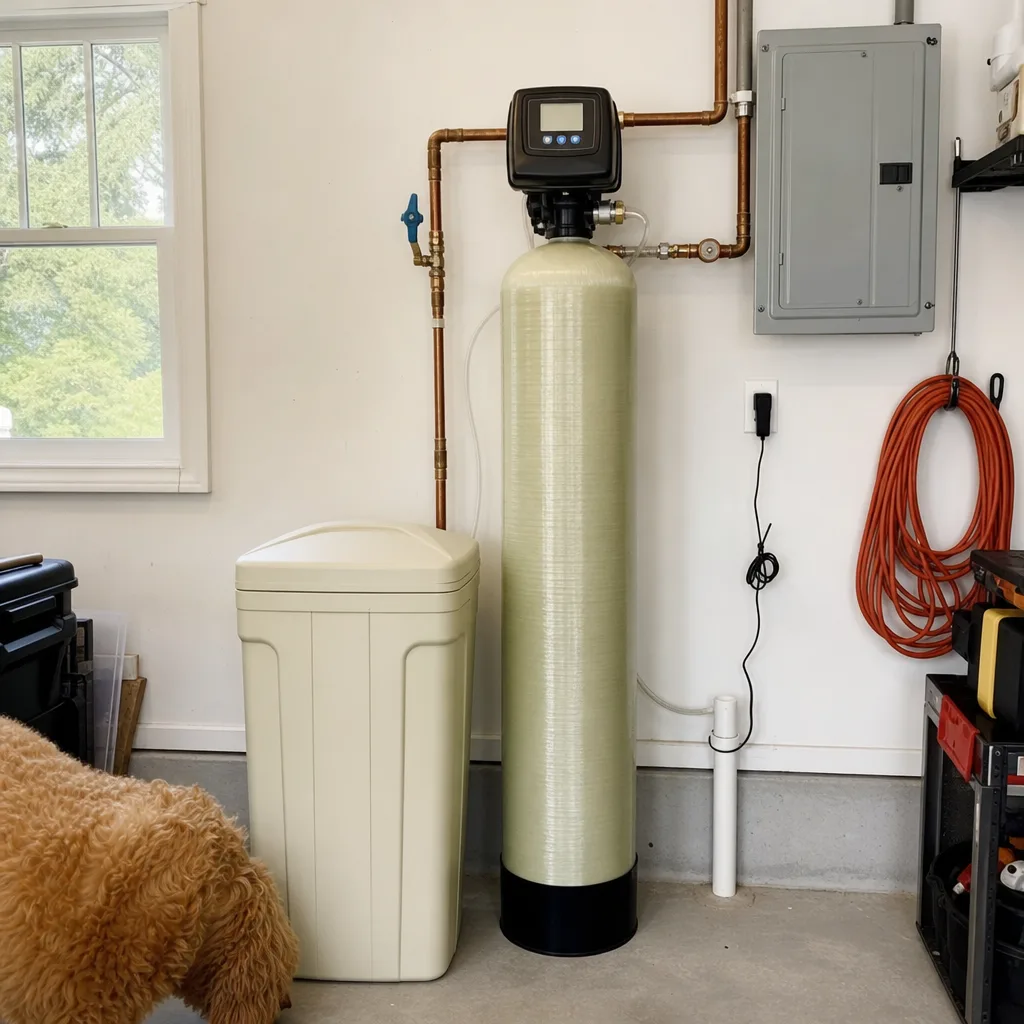
A whole-house softener sits on your main supply line, so every drop that enters your home gets softened. A water heater-only setup treats just the cold line that feeds your tank. Only your hot water gets softened. Your cold water stays hard.
Here’s what that means in daily life.
- Your water heater is protected either way. That’s where the hot-only approach does its best work, because heat is what makes minerals drop out and harden in the tank.
- Your toilets, outdoor spigots, and cold kitchen tap still get hard water with a hot-only setup. The white ring around your faucet base can keep coming back.
- Your shower mixes hot and cold, so you only get partly softened water there. Spots on shower glass usually get better, but they may not go away.
- Your dishwasher and washing machine depend on how they’re plumbed. Many pull from the hot line, and some use both. A hot-only setup can leave them only partly covered.
- Your ice maker and fridge water stay hard, since they run off cold water. Some people like that. Others don’t.
So who is a hot-only setup right for? It can make sense if your scale problem is mostly in the water heater, if you want your cold drinking water left unsoftened, or if you’d rather run a smaller unit that uses less salt. If the sodium concern from earlier applies to you, keeping a cold tap unsoftened with a whole-house system is another way to get there.
Whole-house softening makes more sense if you’re seeing scale all over the house. That means spotty dishes, crusty fixtures, stiff towels, and soap that won’t lather. Treating only the hot side won’t fix most of that. You’d be paying to solve one symptom and living with the rest.
Where your water heater sits matters too. Lots of North Texas homes have the water heater in the garage, and that’s often a workable spot for a small unit near the tank. Other homes have it up in the attic. A softener up there is harder to reach for salt and service. It also needs a safe drain, and an attic is a tough place to put one. For attic setups, putting the softener at the main line is usually the more practical choice.
Here’s one more honest point. If you only want to slow sediment buildup in the tank and you aren’t bothered by spots anywhere else, keeping up with regular water heater maintenance may hold you over for now. That’s a fair choice if hard water isn’t really bugging you yet.
For most Allen homes with hard water showing up in more than one room, whole-house softening is the fix that matches the problem. That’s because the scale doesn’t stop at the water heater. If you’re not sure which side of the line you’re on, your water test result and where the scale shows up in your home will tell you.
Have questions? We’re happy to help.
Call Today, Get Service Today. Xtreme Air Services — Allen is ready to help.
Recognize When DIY Installation Falls Short
Let’s be straight with you. Some people can install a softener themselves and do a fine job. If you’re handy and your home is already set up for one, you may not need us. Here’s how to tell which side of that line you’re on.
DIY can work if all of these are true:
- Your home already has a softener loop, so you’re connecting to fittings that are already there instead of cutting into your main line.
- There’s a working outlet close to where the unit will sit.
- A drain is close by, with room to keep the air gap we talked about earlier.
- You’re swapping an old unit for a new one in the same spot, and you’ve tested your water so you know what size to buy.
- You’re comfortable shutting off your main water, working with pipe fittings, and checking for slow leaks over the next few days.
If that’s you, go for it. Read the manual twice, set the control head to your water test number, and keep an eye on every joint for the first week.
DIY starts to fall short the moment the job stops being plug-and-play. These are the signs it’s time to hand it off:
- There’s no loop. Now you’re cutting into the line that feeds your whole house. One bad joint there doesn’t drip. It floods.
- Your pipes are older. Many North Texas homes built from the 1950s through the 1990s have copper or older pipe that’s harder to tie into cleanly than the PEX you’ll see in newer subdivisions.
- There’s no good drain nearby. Running a drain line the wrong way, or skipping the air gap, can send dirty rinse water back toward your supply.
- The only workable spot is in the attic or tight against a wall where a leak would go unnoticed.
- You’d need to add an outlet. Electrical work isn’t a weekend add-on to a plumbing job.
- Your city requires a permit for the work, and you’re not sure how to pull one or pass the inspection.
Leaks are the real risk. Most Allen homes sit on slab foundations, so water from a bad fitting in the garage or a utility closet spreads across the floor and under the walls instead of dripping into a basement. It can soak drywall and baseboards before you ever notice. A small, slow leak at a fitting is the kind of thing that’s easy to miss and costly to clean up.
Weather matters too. A softener in an unheated garage sits right next to pipes that can freeze during a hard North Texas cold snap. Placing it well and protecting the lines around it is part of doing the job right.
There’s also the setup most people skip. A softener that isn’t set for your water’s hardness will either waste salt or let hard water slip through. Either way, you won’t get what you paid for, and you may not realize it for months.
So here’s the plain rule. If your home has a loop, power, and a drain right there, DIY is a fair choice. If any piece is missing, the money you’d save is small next to the cost of a leak under your floors. That’s when a licensed and insured plumber earns the fee.
Watch Our Video
See How We Handle Water softener installation in Allen
Xtreme Air Services — Allen
Understand What Drives Your Installation Cost
Let’s talk numbers, because you shouldn’t have to guess. A water softener installation with us typically runs $1,200-$3,500. Our most common job is a whole-home softener at the main supply with a bypass and drain line, connected and tested, and that job usually lands at $1,700-$2,600.
That’s a wide spread, and it should be. Two homes on the same street can need very different jobs. Here’s what pushes your price toward one end or the other.
- Softener capacity and type. A bigger household or harder water needs a unit that can catch more minerals between cleanings. Your water test number and how many people live in your home decide the size. A unit that’s too small runs out fast. One that’s too big costs more than you need to spend.
- Condition of your existing plumbing. Clean, easy-to-reach pipe at the main line keeps the job simple. Worn or corroded pipe near the tie-in point may need to be replaced before the softener goes on.
- Drain access. If a drain sits right next to the install spot, that part of the job is quick. If the drain line has to travel across a garage or through a wall, it takes more material and more time.
- Added pre-filters or a loop. A sediment or carbon pre-filter protects the softener and handles problems it can’t. If your home has no loop, running new pipe to your main line adds to the cost.
- Code upgrades. If something nearby doesn’t meet current code, it has to be fixed to do the job right. That’s more common in older homes than in newer subdivisions.
Remember the items we listed earlier as not included in a standard install. If your home needs any of them, they show up as separate lines on your quote. You’ll see them before you say yes, not after the work is done.
There’s a $26-$99 service-call fee to come out and look at your setup. If you go ahead with Xtreme Air Services, that fee is credited toward the job. So you aren’t paying twice just to find out what your home needs.
If the full cost at once is hard to swing, we offer flexible financing on qualifying installations and larger jobs, on approved credit. It’s worth asking about if you’d rather spread the cost out than wait another year of scrubbing faucets and wearing out your water heater.
One tip that applies to anyone you hire: get the whole price in writing before work starts, and make sure it names the softener size, any pre-filter, and whether a loop or permit is part of it. A quote that’s vague on those points is the one that grows later. Ours comes as upfront flat-rate pricing, so the number you approve is the number you pay.
Call 469-299-8996
Frequently Asked Questions
Common questions about Water softener installation
Can a water softener cause low water pressure?
Yes, but it usually means something needs attention, not that softeners are the problem. A clogged sediment filter ahead of the unit, a dirty resin bed, or a valve stuck mid-cycle can all slow your flow. If your pressure dropped right after installation, the bypass valve may not be fully open. A quick check during startup and testing catches this before it becomes a daily annoyance.
Can a plumber service a water softener once it’s installed?
Yes, a licensed plumber can service a softener, including resetting it for your water hardness, checking the bypass valve, and clearing the drain line. Softeners don’t need much upkeep beyond adding salt, but if you notice hard water symptoms coming back, a service call can check whether the unit needs reprogramming or a resin bed cleaning.
How easy is it to install a water softener myself?
It depends on whether your home already has a softener loop, a nearby drain, and power at the install spot. If all three are in place, swapping in a new unit is a reasonable weekend project for someone comfortable with basic plumbing. Without a loop, you’re cutting into your main water line, and a bad joint there can flood a garage or utility closet fast on a slab foundation.
Ready to Get Started?
Call (469) 299-8996 Today, Get Service Today.