


What Are the Most Common Commercial Refrigeration Problems?
Walk-ins that will not hold temperature, ice machines losing output, short-cycling compressors, icing evaporator coils, and climbing utility bills.
What’s Covered on This Page
Walk-In Coolers and Freezers That Won’t Hold Temperature
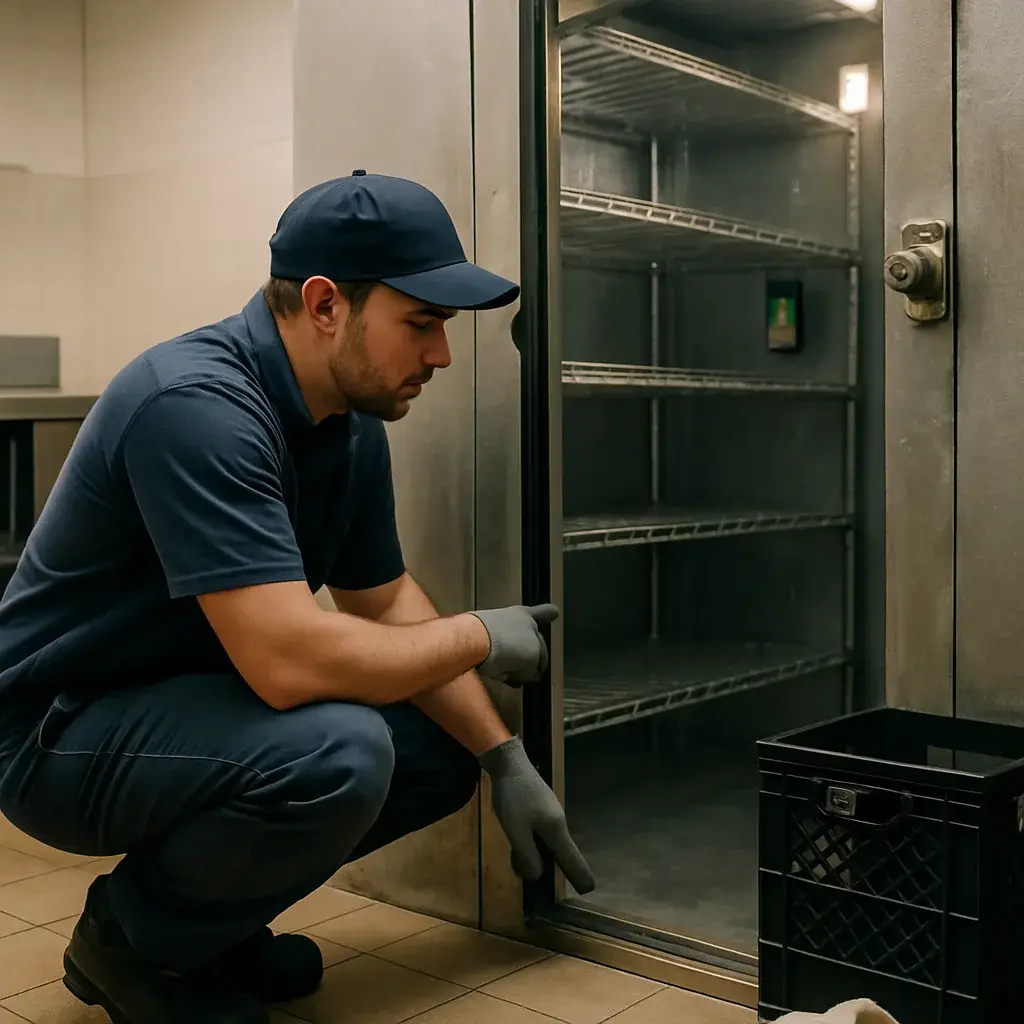
Restaurant and grocery owners quickly notice this. Maybe the walk-in cooler shows 42 degrees instead of 36. Or the freezer has frost building up inside. Sometimes it drifts slowly over weeks. Other times, a door left open overnight means the whole unit loses temperature by morning.
This usually comes from a few places. Door gaskets wear out, so they stop sealing. That’s common for units opened many times a day. Evaporator coils can ice over if airflow gets blocked. Or a defrost cycle isn’t working right. Condenser coils outside (or on the roof) collect grease, dust, and cottonwood here in North Texas. A dirty coil can’t shed heat like it should. Refrigerant charge problems, a bad door heater strip, or a control board misreading a sensor also cause the same symptom. Your unit won’t hold its temperature.
A technician checks door seals and hardware. We pull coil temperatures and pressures. We inspect the evaporator for ice. We also check the condenser for blocked airflow. For commercial refrigeration calls, we usually check the compressor’s run cycle. This points to a specific part. Walk-in cooler repair and walk-in freezer repair both start with this root-cause check. We do this before we replace anything.
- Door gaskets and door heaters that keep warm, humid air out.
- Evaporator and condenser coils, cleaned or repaired for proper airflow.
- Refrigerant leak detection when pressures are low.
- Control boards and sensors that tell the compressor when to run.
Not every temperature change means a failed part. A walk-in that just got a big delivery, or had its door propped open during a rush, might read warm for an hour or two. It will settle back down. We’d rather tell a business owner to watch it for a bit. If it’s still off the next day, a diagnostic visit makes sense. This is the part people overthink.
We also handle cold storage installation and ice machine repair. If a walk-in issue leads to a bigger discussion about your cold-storage setup, you make one call. Not several. Our commercial refrigeration page explains what a repair visit involves and what shapes the cost.
Ice Machines Losing Output or Running Without Producing Ice
Most calls about an ice machine start the same way. The bin fills slower than it used to, or the machine runs all day and barely makes a batch. Sometimes it just stops producing ice. The compressor keeps humming along like nothing’s wrong. That last one throws people off because the unit sounds fine. But it isn’t doing its job.
A few things usually cause this. A dirty condenser coil can’t shed heat. So the refrigeration cycle slows down. Hard water is a big factor across North Texas kitchens. Mineral scale builds up on the evaporator plate and water lines. That buildup insulates the surface where ice is supposed to form. A worn water inlet valve or a clogged water filter can also starve the machine. In some kitchens, the ice machine sits next to a fryer or dishwasher, meaning ambient heat works against the compressor all shift long.
- Slower bin fill or noticeably smaller ice batches
- Unit running constantly but the bin staying low
- Cloudy or oddly shaped cubes (this usually points to water quality or flow)
- Short cycling (the machine starts and stops more often than normal)
- Water pooling under or around the unit
It’s worth knowing this before you assume the machine is done for. A unit that looks broken is often just scaled up or low on refrigerant. Both are repairs, not replacements. We won’t tell you a machine needs to go if cleaning and a refrigerant check bring it back to spec. On the other hand, if the compressor is worn out or the evaporator plate is cracked, we’ll say that too. Pushing more repairs into an old unit doesn’t serve you.
When we get called out for ice machine repair, we check refrigerant charge, water flow, and incoming water quality. Then we clean or descale as needed. We run the unit through a full cycle to confirm output before we leave. If a walk-in cooler or walk-in freezer feeds the same kitchen, we’ll look at those systems too. They often share the same water and power setup.
You can see how this fits into the bigger picture of keeping a kitchen’s cold chain running on our commercial refrigeration service page. That covers walk-ins, RTUs, and the rest of what we handle for restaurants and stores.
Compressors That Short-Cycle or Won’t Start
A compressor that clicks on and off every few minutes, or one that hums and won’t start at all, is a common call we get for walk-in coolers, freezers, and reach-ins. It’s also one of the more misunderstood problems (because the fix can be small, or it can be the start of a bigger conversation).
Short-cycling usually means the compressor runs a minute or two, shuts off, then starts again a few minutes later. Your staff might notice the unit sounds like it’s working harder. Or the box temperature drifts a few degrees before it catches back up. A compressor that won’t start at all is more obvious. You hear a hum or a click from the relay, and then nothing. Product temps start climbing right away.
- A dirty or blocked condenser coil that’s causing the compressor to overheat and cut out.
- A weak or failed start capacitor that can’t give the compressor the jolt it needs.
- Low refrigerant charge from a slow leak, which makes the system work outside its normal range.
- A failing start relay or contactor that doesn’t reliably close the circuit.
- Voltage supply issues, including loose connections or a breaker not delivering full power.
A short-cycling compressor can be a thirty-minute capacitor swap. It might also be an early sign the compressor itself is wearing out. There’s no way to tell which it is over the phone. We check the electrical readings, test the capacitor and relay under load, look at the coil, and verify the refrigerant charge before we tell you what’s happening.
On a service call, a licensed technician from Xtreme Air Services walks through that same process. We do it on site the same day whenever we can get there. You’ll get what we found explained in plain terms before any repair starts. You also get a written price before we touch the unit. That way, you’re making a decision with all the facts, not guessing. If you want to see what typically makes that price go up or down, our pricing page explains it in detail. For the full range of our commercial refrigeration work, that page covers walk-in coolers, freezers, and ice machines side by side. A lot of the same electrical and refrigerant issues show up across all three, by the way.
Not sure what your Commercial refrigeration project needs? Ask us.
Call Today, Get Service Today. Xtreme Air Services is ready to help.
Evaporator Coils Icing Up
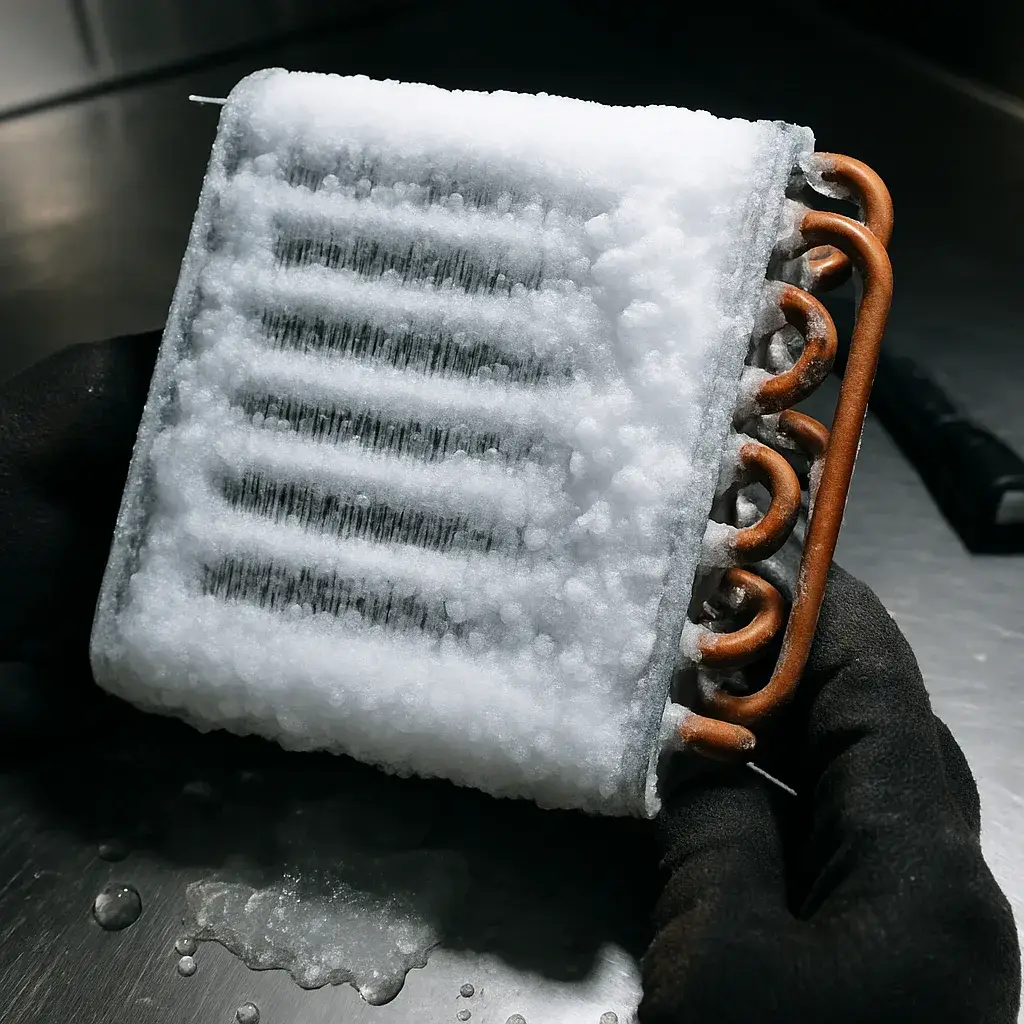
A frosted-over evaporator coil is a common call for walk-in coolers and freezers. You’ll see ice on the coil fins inside the unit. Sometimes it spreads to the floor as it melts. Your food won’t hold temperature like it should. Airflow gets weaker as the ice thickens, so the whole box struggles to cool evenly.
Coils ice up for a few reasons. Figuring out the right one matters more than just chipping ice off. A defrost timer or heater that isn’t cycling right is a common cause. A worn or unsealed door gasket lets warm, humid air pour in every time the door opens. Low refrigerant charge can also drop coil surface temperature too low. Airflow blockage, like boxes stacked against the return vent or product pushed too close to the coil, does it too.
We’ve noticed coils ice up that had nothing to do with the refrigeration system itself. Sometimes it’s shelving or inventory blocking the return air path. The unit runs and runs, chasing a temperature it can never reach. No amount of refrigerant or new parts fix that until the airflow is clear.
Melting ice can also mean the coil was recently defrosted. Everything could be working fine, by the way. So ice alone isn’t always a sign something’s broken. That’s why we check the defrost cycle, the gasket seal, refrigerant levels, and airflow as a set. We don’t check just one thing at a time. Chipping ice off a coil and walking away doesn’t tell you why it formed, and we won’t call a job finished on that basis alone.
- What we check: defrost timer and heater function, door gasket condition, refrigerant charge, and airflow around the coil and return vent
- What we look for: ice pattern and location, which often points to whether the cause is mechanical, electrical, or just stock placement
- What we do next: repair or replace the failed part, verify the fix by watching a full defrost cycle before we consider the call closed
This falls under the commercial refrigeration work we handle for restaurants, grocery accounts, and cold storage across the Dallas-Fort Worth area. We cover walk-in coolers, walk-in freezers, and their running systems. If cost comes up during a visit, we quote it flat-rate before any repair starts.
Utility Costs Climbing Without an Obvious Cause
Your power bill keeps going up with no obvious reason. It’s a common question we get for walk-in coolers, freezers, and rooftop refrigeration units. The equipment might still be running fine. Food stays cold. But the utility bill shows your unit is working harder than it should.
It’s almost never one big failure. Usually, it’s a lot of small things adding up and pulling extra electricity every month. A condenser coil covered in kitchen grease and dust can’t shed heat well, for instance. So the compressor runs longer to hit the right temperature. Worn door gaskets on a walk-in let cold air escape, forcing the system to cycle more often. Frost buildup on an evaporator coil blocks airflow too. Low refrigerant charge, a control board that’s off-calibration, or an aging compressor losing efficiency all show up the same way: higher power draw for the same output.
- Condenser coils caked with dust, grease, or kitchen exhaust residue
- Door seals or gaskets that don’t close tight anymore
- Frost or ice buildup on evaporator coils that block airflow
- Refrigerant charge that’s dropped below the system’s design level
- Aging compressors that draw more current than they used to
- Thermostats or controls that have drifted out of calibration
A rising bill can have more than one of these problems at once. Finding the actual issue takes a real inspection, not just a guess over the phone. Our technicians look at the coils, the seals, the refrigerant charge, and the controls as one system. We don’t just jump to the compressor, because that compressor is often reacting to a different problem somewhere else.
Sometimes a repair fixes it. Other times, especially with older equipment where several parts are wearing down together, replacement is the better option. That decision depends on your specific system, its age, and what’s driving the cost. Our commercial refrigeration team will walk you through all of that before any work gets approved.
Costs for the diagnostic and repair work depend on the parts and how big the issue is. We have a separate page explaining what goes into our pricing, so you won’t find us guessing here.
Ready to Get Started?
Call 972-288-2263 Today, Get Service Today.