


Central Air Conditioning Repair in Allen
Central AC problems diagnosed and fixed right the first time, with clear pricing on what drives the cost.
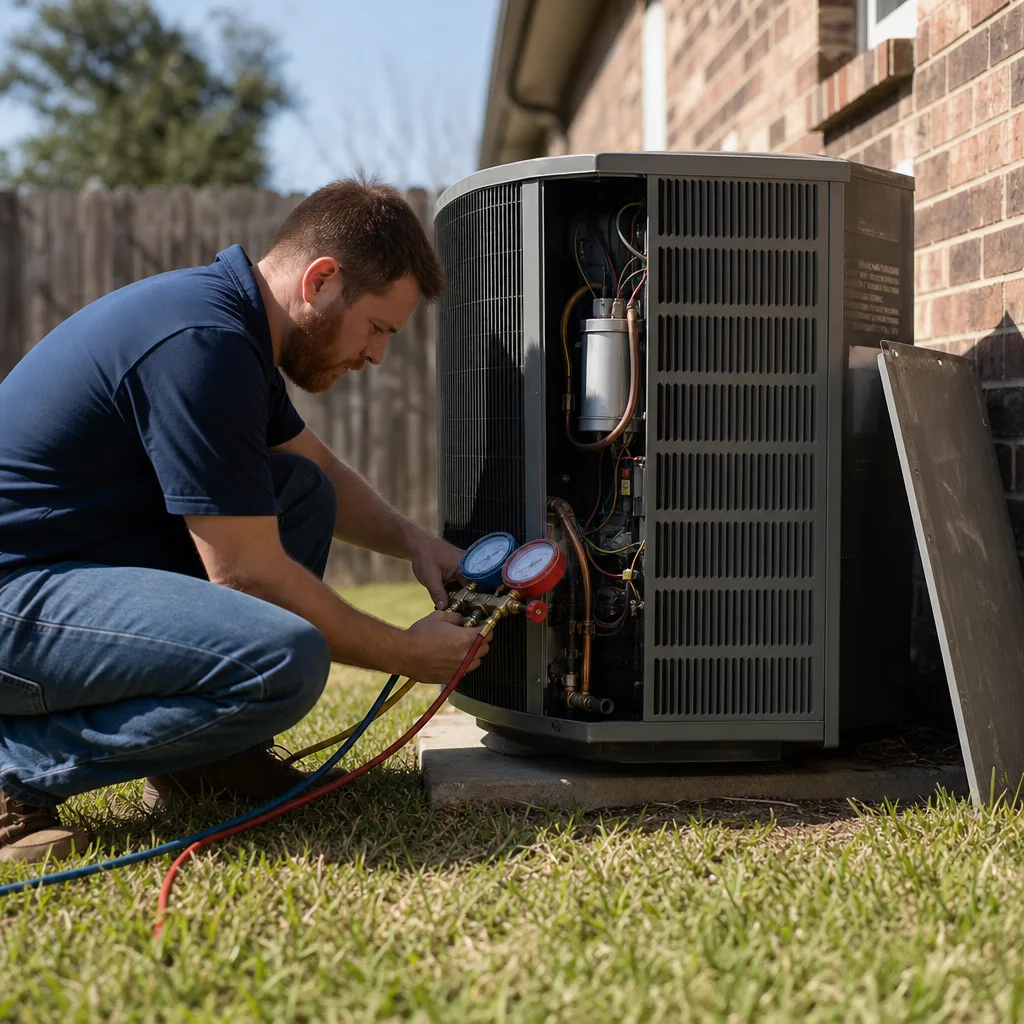
What’s Covered on This Page
- Signs Your Central Air System Needs a Repair Call
- Why Allen’s Long Cooling Season Wears Out AC Components
- Check These Two Things Before You Call for Repair
- What Drives the Cost of an AC Repair Up or Down
- Permits and Paperwork: What Repair Does Not Require
- What is the average lifespan of a central AC unit?
- How do I know if I should repair my AC or if it needs something bigger?
- What should I ask before hiring someone to fix my AC?
Signs Your Central Air System Needs a Repair Call
Your AC almost always tells you something’s wrong before it quits for good. The trick is knowing what you’re looking at. Here’s what each warning sign tends to point to, so you can tell us exactly what’s going on when you call.
- Warm or barely cool air from the vents. The system runs but the house keeps heating up. A low refrigerant charge from a leak, a dirty coil, or an outdoor unit that isn’t running right are common causes.
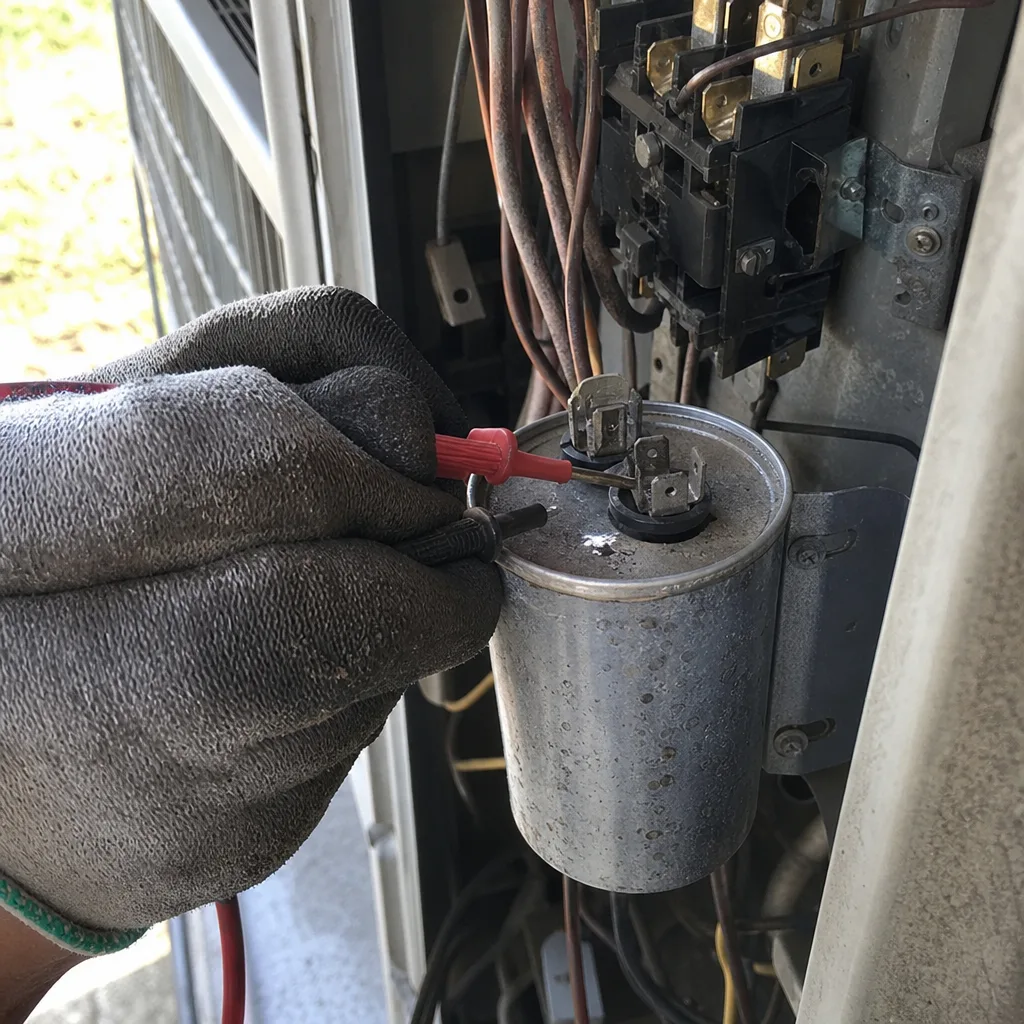
- The outdoor unit hums but the fan won’t spin. That steady hum with no movement often means a failed capacitor, the small part that gives the motors a kick to start, or a worn-out fan motor.
- Weak airflow, even with the fan on high. A tired blower motor, a frozen indoor coil, or leaky ductwork can all cut the air coming out of your registers.
- Ice on the copper line or the indoor coil. Ice in July sounds strange, but it’s a classic sign of low refrigerant or an airflow problem. It won’t fix itself.
- Water around the indoor unit or a damp spot on the ceiling. Your AC pulls a lot of water out of the air. If the drain line clogs, that water backs up and spills over.
- The system turns on and off every few minutes. Short cycling wears out parts fast and can come from a bad sensor, an electrical fault, or a unit that’s struggling to keep up.
- Grinding, squealing, rattling, or clicking. New noises usually mean a motor bearing, a loose part, or an electrical part that’s starting to fail.
- A breaker that keeps tripping. One trip can be a fluke. Repeat trips point to an electrical problem in the AC that needs a trained eye.
- A higher electric bill with no change in how you use the AC. A system that’s working harder than it should usually has a part that isn’t doing its job.
In a lot of Allen homes, the indoor unit sits up in the attic. That matters for two of these signs. Attics here get brutally hot in summer, which is hard on motors and electrical parts. And when a drain line backs up in the attic, you may not see it until there’s a stain on the ceiling below.
Here’s the good news. Most of these problems come down to a single common failure, and most calls get it fixed on the first visit. A bad capacitor, a clogged drain line, or a refrigerant leak is a repair, not a reason to replace your whole system.
The longer a struggling system runs, the more it can strain the parts that are still good. A frozen coil or a motor that won’t start puts extra load on the rest of the system. That’s especially true when it’s running all day in Texas heat. That’s why it pays to make the call when you first notice something’s off, not after the house hits 85 degrees.
Why Allen’s Long Cooling Season Wears Out AC Components
Your AC in Allen doesn’t get a few easy months of work. It runs from the first warm spells of spring until fall finally cools off, and on the worst summer days it may barely shut off at all. Every one of those hours puts wear on real, physical parts. The good news is that they wear out one at a time, not all at once. That’s why a breakdown is usually one tired part, not the end of your system.
Here’s where the long season does its damage:
- Capacitors. Heat is their worst enemy. A capacitor that sits in a hot outdoor unit all summer slowly loses strength until one day it can’t start the motor. It’s one of the most common summer failures, and it’s a small part to replace.
- Contactors. This is the switch that tells your outdoor unit to turn on and off. Every cycle makes a tiny spark. After thousands of cycles, the contact points get burned and pitted, and the unit may not start, or it may not shut off.
- Fan and blower motors. Long run hours wear out bearings. You’ll often hear it first as a squeal or grind before the motor quits.
- Outdoor coils. Cottonwood fluff, grass clippings, dust, and leaves pile up on the outside of the unit. A clogged coil can’t get rid of heat, so the whole system runs hotter and longer, which stresses every other part on this list.
- Refrigerant lines and coils. Years of vibration and expansion in the heat can open up small leaks at joints and in the coil. A slow leak drains the system’s charge a little at a time.
- Drain lines. Your AC pulls water out of humid air all season long, and that steady moisture lets algae and slime build up inside the line until it clogs.
Then there’s storm season. North Texas thunderstorms bring hail that can flatten the thin metal fins on your outdoor coil and choke off airflow. Power flickers and lightning nearby can also hit the electrical side of your system, like the control board or the capacitor. If your AC started acting up right after a big storm, mention that when you call. It helps narrow things down fast.
The ground under your outdoor unit matters too. Much of North Texas sits on clay soil that swells when it’s wet and shrinks when it’s dry. Over time, that movement can tilt the pad your condenser sits on. A leaning unit puts strain on the copper lines and can make the inside parts work against gravity. It’s a slow problem, but it’s worth checking if your unit doesn’t look level.
Put all of this together and you can see why a system that’s only a few years old can still need a repair in July. It’s not a sign you got a bad unit. It’s a sign that one part reached the end of its life sooner because of how hard Texas makes it work.
This also tells you something useful about your options. When one worn part fails, replacing that part usually gets your system back on track. It’s a different conversation when several parts are wearing out at the same time on an older unit. That’s something we’ll talk through with you, with the price in front of you before any work starts.
Check These Two Things Before You Call for Repair
Before you pick up the phone, take five minutes and check two things: your thermostat and the power to your system. Sometimes an AC that seems dead is just set wrong or switched off. Both checks are free, and you don’t need any tools. If one of them fixes it, you don’t need us, and that’s a good day.
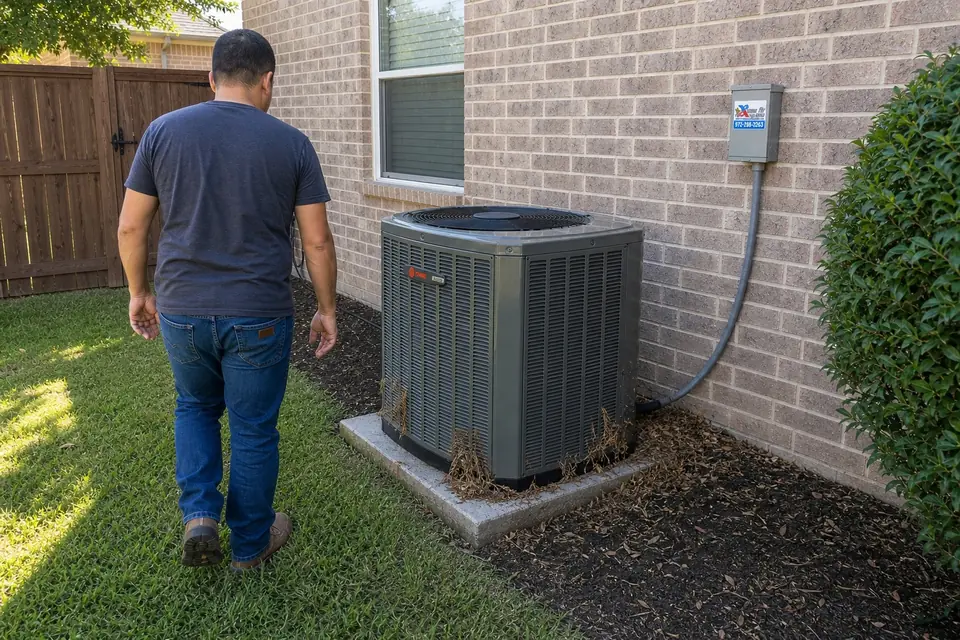
1. Your thermostat. It’s the brain of the system. If it isn’t asking for cold air, your AC won’t make any.
- Make sure it’s set to Cool, not Heat or Off.
- Set the temperature a few degrees below what the room feels like right now.
- Check the fan setting. On means the fan blows all the time, even when the system isn’t cooling, so the air can feel warm. Auto runs the fan only while the system is cooling.
- Look at the screen. If it’s blank or dim, put in fresh batteries.
- If you have a smart or programmable thermostat, check that a schedule, away mode, or someone else using the app isn’t holding the temperature up.
- After you change a setting, give it about five minutes. Many systems wait a few minutes before the outdoor unit starts back up.
2. The power. Your central air usually has more than one power source: one for the outdoor unit and one for the indoor unit. If either one is off, the system won’t cool.
- Go to your electrical panel and find the breakers marked AC, condenser, furnace, or air handler. A tripped breaker often sits in the middle, not fully on or off. Flip it all the way off, then back on.
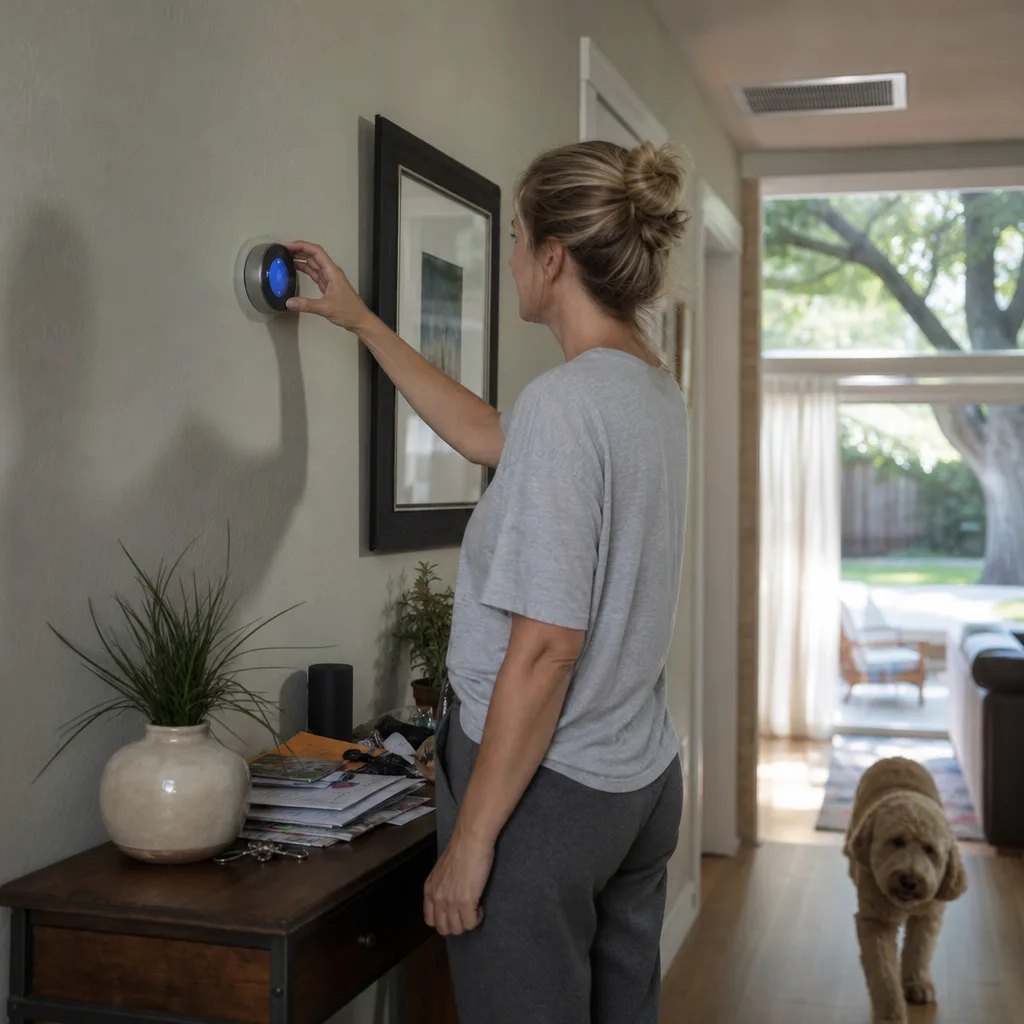
- Look at the gray box on the wall near your outdoor unit. That’s the outdoor shutoff. Make sure it’s switched on or fully pushed in. It can get bumped during yard work.
- If your indoor unit is in the attic, as it is in a lot of Allen homes, there’s often a switch on or near it that looks like a regular light switch. It’s easy to knock off while moving boxes or holiday decorations. Make sure it’s on.
Reset a breaker once, not over and over. If it trips again right away or after a short run, leave it off. As we covered above, repeat trips point to an electrical problem inside the AC. Flipping it back on won’t fix that.
One more quick look while you’re up there: if you see water sitting in the pan under the attic unit, your system may have shut itself off on purpose. Many systems have a safety switch that turns off the cooling when the drain backs up. That’s a drain line problem, not a thermostat or power problem.
It’s also worth pulling out your air filter. A clogged filter won’t stop the system from turning on, but it can choke the airflow enough to make the house feel like the AC isn’t working. If it’s gray and packed with dust, swap it.
If the thermostat is set right, the power is on, and the house is still getting warmer, you’ve ruled out the simple stuff. What’s left is inside the system itself: a part, a leak, or a motor that needs a trained hand. When you call, tell us what you already checked. It saves time and helps us get to the real problem faster.
Have questions? We’re happy to help.
Call Today, Get Service Today. Xtreme Air Services — Allen is ready to help.
What Drives the Cost of an AC Repair Up or Down
Most central AC repairs with Xtreme Air Services fall in a typical range of $150-$700. Our most common job costs $150-$400. That job is finding the failed part, repairing or replacing it, and making sure your system runs right. Most calls are a single common failure fixed on the first visit, like the worn parts covered above.
You’ll know the price before we touch anything. We use upfront flat-rate pricing that you approve before work starts. You won’t watch a meter run while the tech works in your attic.
Here’s what’s included in a standard repair:
- Diagnosis, so you know exactly what failed and why
- Labor to make the repair
- The standard replacement part
- Testing to confirm your system is cooling the way it should
- Cleanup before we leave your home
Some things aren’t part of that standard price. Extra failed parts, major components, code upgrades, and permits are quoted on their own if your repair needs them. You’ll see that price and say yes or no before anything happens.
There’s a $26-$99 service-call fee to get a technician to your door. If you go ahead with the repair, that fee is credited toward it, so you’re not paying twice.
So what moves your price up or down? A few honest factors:
- How big the failure is. A part that’s just worn out is a smaller job than one that failed and damaged something next to it.
- Part cost and availability. Some parts are simple and easy to get. Others cost more or take longer to track down.
- Equipment age and brand. Parts for some systems cost more than others, and older equipment can be harder to find parts for.
- Whether more than one part has failed. One tired part is one repair. Two or three failing at once on the same system adds up.
- Timing. A lot of companies charge more after hours. We don’t. There’s no extra charge for nights or weekends, so you don’t have to suffer through a hot Saturday in Allen just to save money.
That last point matters more here than in most places. When your AC quits on a 100-degree Sunday, waiting until Monday to avoid a surcharge isn’t a real choice. With us, the price for a Sunday call is the same as a Tuesday.
Waiting can also change your price in a way you don’t see on the bill. As we covered earlier, a struggling system strains the parts that are still good. A $150-$400 fix can become a bigger job if a second part gives out while the first one is limping along.
What about financing? It isn’t usually needed for a smaller repair like this. If your system needs a larger repair or a replacement, financing is available, and we’ll walk you through your options with the numbers in front of you.
Before you hire anyone for an AC repair, ask three things. Is the price set before the work starts? What’s included, and what would cost extra? Does a night or weekend visit cost more? Any company should give you a straight answer to all three. Ours are above.
Watch Our Video
See How We Handle Central air conditioning repair in Allen
Xtreme Air Services — Allen
Permits and Paperwork: What Repair Does Not Require
Good news if your AC just needs a part. A typical central air repair usually doesn’t come with a stack of city paperwork. Swapping a worn part for the same kind of part is repair work, not a new installation. In most North Texas cities, that kind of fix doesn’t need a permit or an inspection before your house gets cool again.
This is one more reason a single failed part is a small problem, not a big project. Here are some repairs that usually stay simple:
- Replacing a capacitor or contactor with a matching part
- Swapping a worn fan motor or blower motor
- Clearing a clogged condensate drain line
- Cleaning a dirty outdoor or indoor coil
- Finding and fixing a refrigerant leak, then recharging the system
- Repairing a loose or burned wire inside the unit
The rules change when a job grows. Putting in a whole new outdoor unit, replacing the indoor system, adding new wiring or a new circuit, or moving equipment to a new spot usually counts as new work. That kind of job often needs a permit from the city. The City of Allen sets its own permit rules, so the exact answer depends on what your system needs. If your repair crosses that line, we’ll tell you before any work starts. Permits and any code upgrades are quoted on their own, as covered above, so you’re never surprised by a permit charge on your final bill.
Older homes sometimes run into this. If a tech opens up a unit and finds wiring or parts that don’t meet today’s code, fixing them can turn a simple repair into a bigger job. You’ll hear about it, see the price, and make the call yourself.
Even without a permit, there’s paperwork you should expect from any company that works on your AC. It protects you, and it’s fair to ask for it:
- A Texas HVAC license. AC contractors in Texas are licensed through the Texas Department of Licensing and Regulation. Ours is HVAC License #TACLA29023C, and you can look it up yourself.
- Proof of insurance. If something goes wrong in your attic, you shouldn’t be the one paying for it. Xtreme Air Services is licensed and insured.
- A written price you approve before work starts. That’s how our upfront flat-rate pricing works.
- A clear record of what was fixed. Ask which part failed and what went in its place. That helps a lot if your system acts up again down the road.
- Certified refrigerant handling. Federal rules require technicians who work with refrigerant to be certified. If your repair involves a leak or a recharge, it’s fair to ask.
Be careful with anyone who wants cash, won’t put a price in writing, or can’t give you a license number. A real repair is a real job, even if it’s a small one. You deserve to know who’s in your home and what you’re paying for.
For most calls, the paperwork stays short: one approved price, one repair, and a system that’s cooling again. That’s what a repair should look like.
Frequently Asked Questions
Common questions about Central air conditioning repair
What is the average lifespan of a central AC unit?
Most central AC units last about 12-15 years, though Allen’s long cooling season can shorten that. Your system runs from early spring through fall, sometimes nearly nonstop on the hottest days. That extra wear means parts like capacitors and contactors can fail sooner than they would in a milder climate. Regular upkeep and quick repairs when something first acts up help you get the most years out of your unit.
How do I know if I should repair my AC or if it needs something bigger?
Most AC problems come down to one worn part, like a capacitor, contactor, or clogged drain line, and that’s a repair, not a replacement. The conversation changes when several parts are failing at once on an older unit. If that’s the case, we’ll walk you through the price and your options before any work starts, so you’re deciding with full information, not guessing.
What should I ask before hiring someone to fix my AC?
Ask three things: is the price set before work starts, what’s included versus extra, and does a night or weekend visit cost more. A trustworthy company should answer all three without hesitation. You should also ask for a Texas HVAC license number and proof of insurance before anyone starts work on your system.
Ready to Get Started?
Call (469) 299-8996 Today, Get Service Today.