


Refrigerant Recharge / Leak Repair in Carrollton: Fix the Leak, Not Just the Symptom
The leak found and repaired before any refrigerant goes in – because a recharge alone won't keep your home cool.
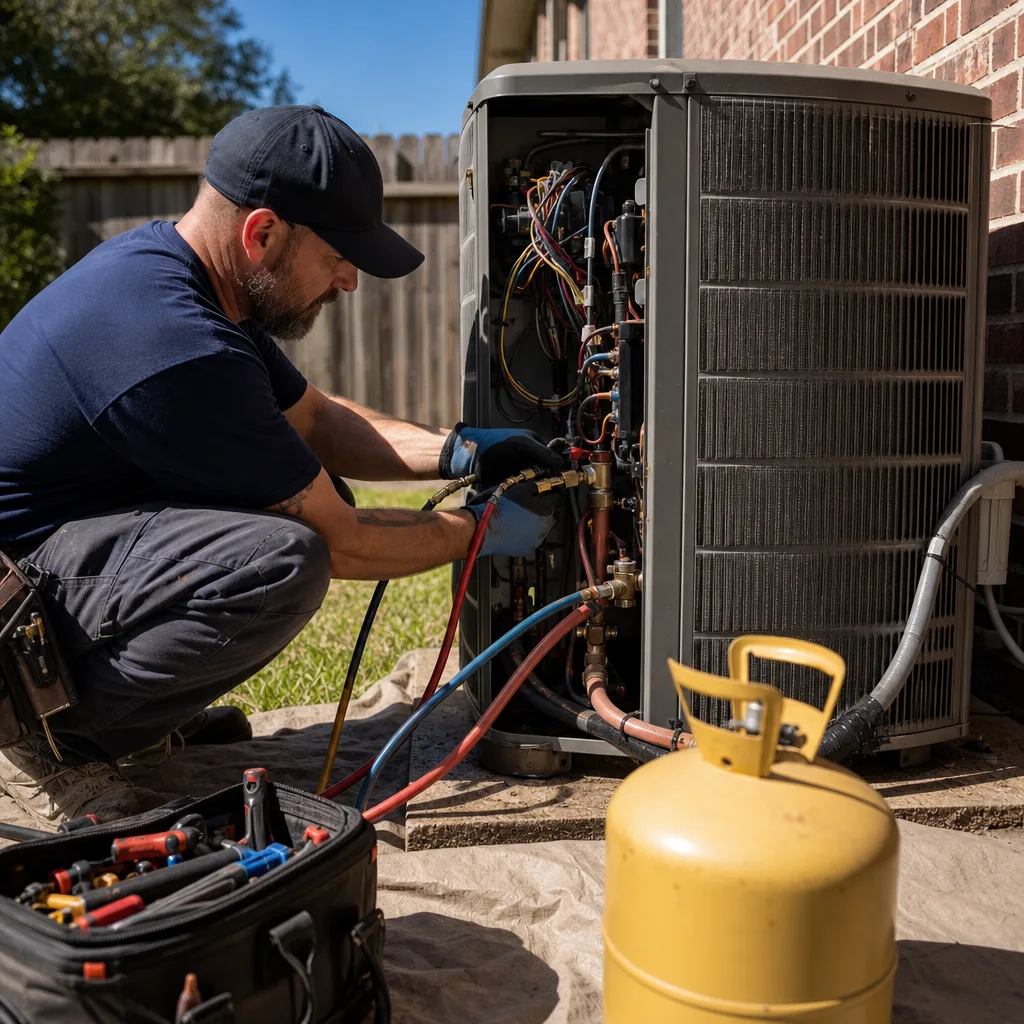
What’s Covered on This Page
- Signs Your AC System Is Low on Refrigerant
- Why Topping Off Refrigerant Without Fixing the Leak Does Not Work
- How Carrollton’s Long Cooling Season Wears Down Refrigerant Lines
- When It Is Not a Refrigerant Problem
- What Happens During a Refrigerant Recharge and Leak Repair Visit
- Can a leaking AC coil be repaired, or does it need to be replaced?
- Is it safe to try to fix a refrigerant leak myself?
- Why does adding refrigerant cost so much if it’s just a refill?
Signs Your AC System Is Low on Refrigerant
Your AC doesn’t burn through refrigerant the way a car burns gas. It moves the same charge around a closed loop for years. When the charge drops, it went somewhere, and these signs are how a leak tells on itself.
- The air from your vents feels cool-ish, not cold. Hold your hand to a supply vent. If it feels more like a breeze than real AC, the system may not have enough refrigerant to pull heat out of the air.
- It runs all afternoon and never catches up. You set the thermostat to 74, and by 5 p.m. it’s still reading 79 with the system going nonstop.
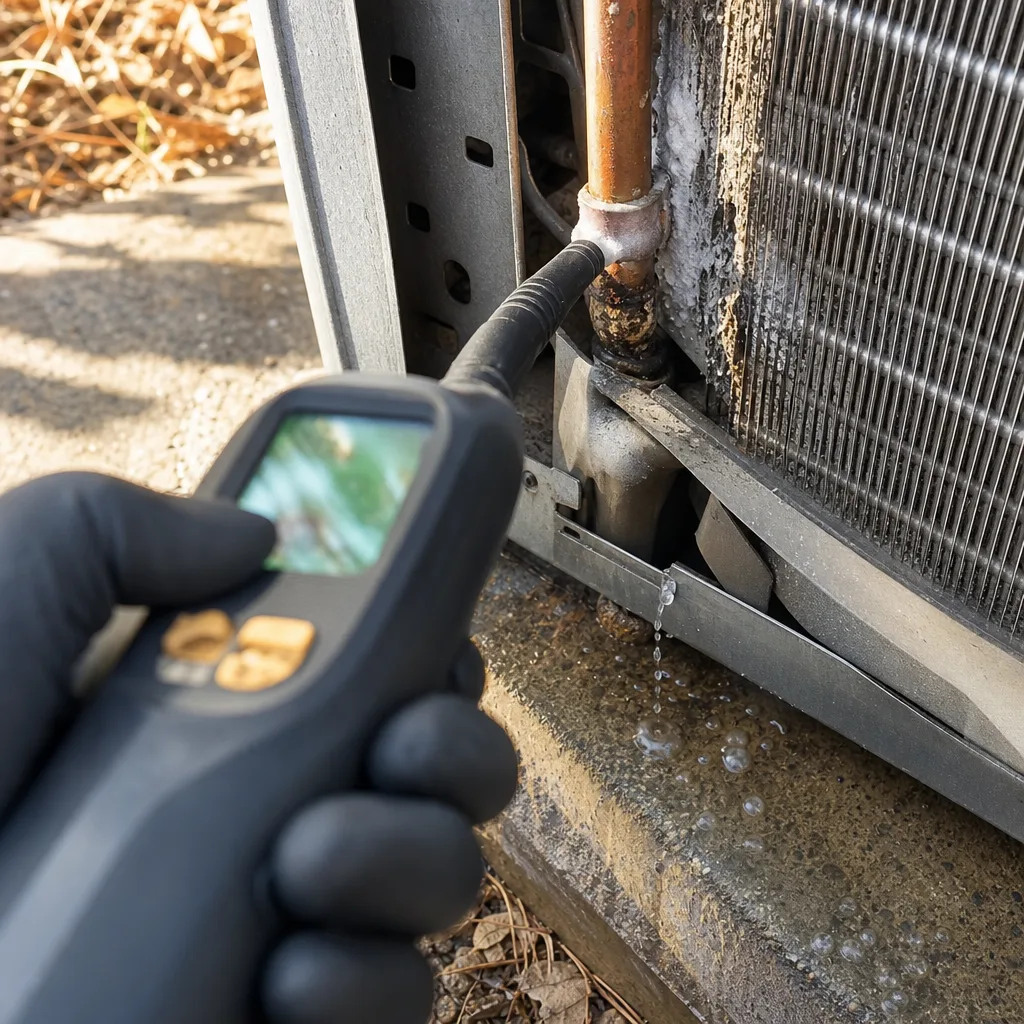
- There’s ice where there shouldn’t be. Look at the larger insulated copper line going into your outdoor unit, or at the indoor coil if you can see it. Frost or ice there in the middle of a Texas summer is a classic low-charge sign.
- You find water around the indoor unit. When that ice melts, it can overflow the drain pan and drip where it shouldn’t.
- You hear a hiss or a bubbling sound. A steady hiss near the lines or coil can be refrigerant escaping through a small hole.
- You spot oily residue on fittings or joints. Refrigerant carries oil with it, so a greasy patch on a copper joint often marks the leak spot.
- Your electric bill climbs for no clear reason. A system that’s short on charge has to run longer to do the same job, and you pay for every extra hour.
In Carrollton, a lot of homes have the air handler and coil up in the attic, where summer temperatures run far hotter than outside. That makes some of these signs easy to miss, because you’re not up there looking for ice or oily joints. Most people notice the warm house first and everything else later.
Here’s the honest part. A clogged air filter, a thermostat set to the wrong mode, a tripped breaker, or a dirty outdoor coil can cause weak cooling too. A filthy filter can even make a coil freeze up just like low refrigerant does. Before you assume the worst, swap the filter, check that the thermostat says Cool, and make sure the outdoor unit is running. If that fixes it, you didn’t need a refrigerant call at all.
If the filter’s clean, the settings are right, and you’re still seeing lukewarm air, ice, or hissing, that’s when it’s time to have the charge and the lines checked. If someone adds refrigerant without finding where it went, you’ll likely be dealing with these same signs again next summer. The symptom is the clue. The leak is the real problem.
Why Topping Off Refrigerant Without Fixing the Leak Does Not Work
Adding refrigerant without fixing the leak is like pumping up a tire with a nail still in it. It feels fine for a while. Then it’s flat again, and you’re paying for the same fix twice.
Since your system doesn’t use up refrigerant, a low charge means there’s a hole somewhere. A top-off doesn’t close that hole. It just refills what already leaked out and gives the leak more to lose.
Here’s how it usually plays out. Your house won’t cool in June. Someone adds refrigerant, and the air turns cold again. You feel relieved. By August, during the long stretch of Carrollton heat when your AC barely gets a break, the vents are blowing lukewarm air again. The leak never went anywhere. It just took a few weeks to drain the system back down.
That cycle costs you more than just the refill:
- You keep buying refrigerant. Each top-off means paying for refrigerant you’ll lose again. Many systems use R-410A, and newer equipment uses a different type of refrigerant called A2L, so the right refrigerant isn’t always quick or easy to get.
- Your compressor works harder. The compressor is the pump at the heart of your outdoor unit. Running on a low charge can make it run hot and strain. That can turn a leak repair into a much bigger repair, because a compressor is a major part.
- Guessing the charge can go wrong both ways. If nobody knows how much leaked out or how fast it’s leaking, it’s easy to add too much or too little. Either one hurts how well your system cools.
- The leak can get worse. Small leaks often grow. A tiny pinhole this summer can be a bigger repair next summer.
There’s also the refrigerant itself. It isn’t something you want leaking into the air, and federal rules require technicians who handle it to be certified. Topping off a known leak over and over just sends more of it outside.
A real refrigerant repair works in the right order. First, find where the refrigerant is escaping. Then repair or replace the part that failed. Then add the correct charge and make sure the system is running right. When the leak is fixed first, the refrigerant you pay for stays in your system and keeps cooling your home.
So if you’ve already had your system topped off once and the warm air is back, don’t just order another refill. The fact that it came back is your answer. The leak is still there, and finding it is what finally ends the cycle.
How Carrollton’s Long Cooling Season Wears Down Refrigerant Lines
Refrigerant leaks don’t just happen at random. They show up where metal gets worked the hardest. In Carrollton, your AC may start running in spring and keep going well into fall, often for hours a day. Every one of those hours adds wear to the copper lines, joints, and coils that hold your refrigerant.
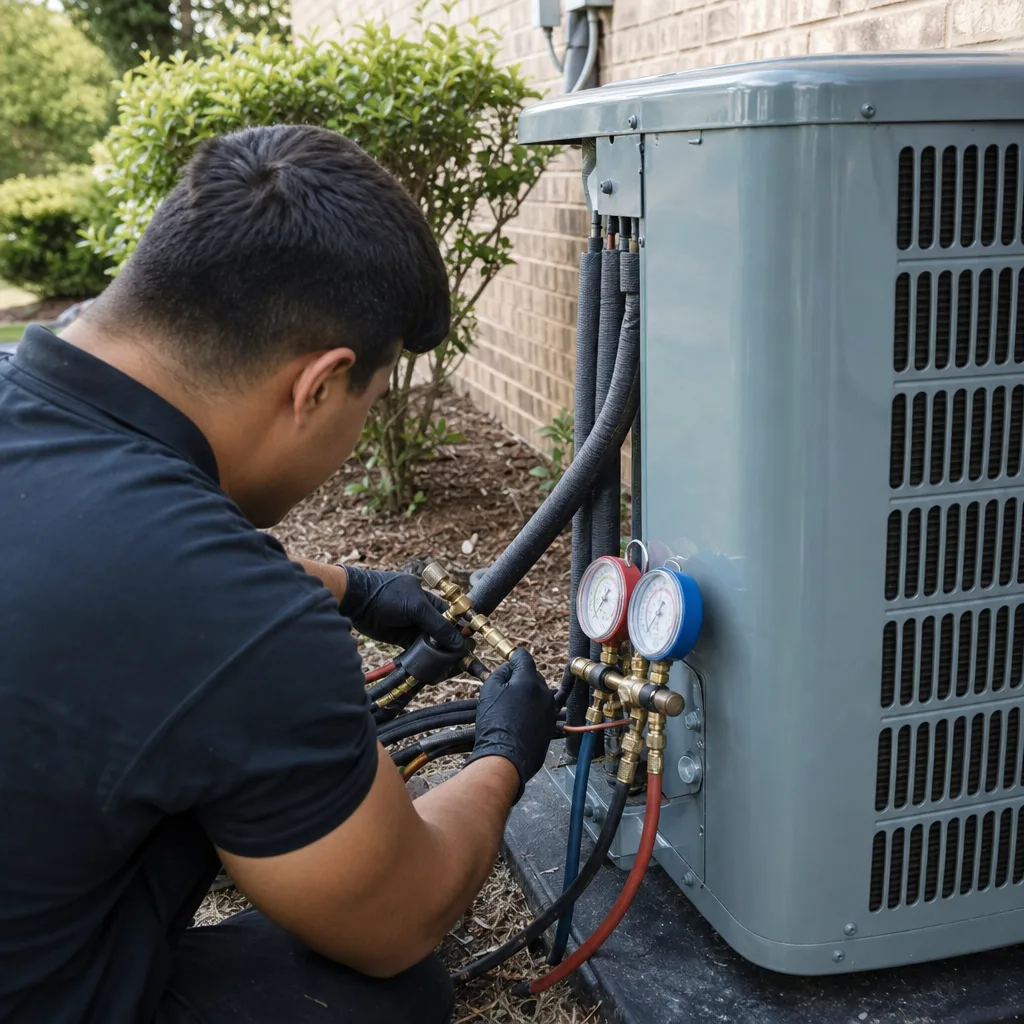
Each time your system turns on, the copper heats up and cools down. Each time, the outdoor unit hums and shakes a little. One cycle does nothing. Thousands of cycles over a long North Texas summer are a different story. Here’s where that wear tends to turn into a leak:
- Joints and fittings. The spots where two pieces of copper are joined grow and shrink a tiny bit with every heat cycle. Over time, a weak joint can open just enough to let refrigerant seep out.
- Line sets that rub. The copper lines running from the outdoor unit into your home can touch siding, a wall, or a wood beam in the attic. Steady shaking over months can rub a thin spot right through the copper.
- Service valves. These are the small ports a technician hooks gauges to, a lot like the valve on a bike tire. The tiny seal inside can wear out and leak slowly.
- The outdoor coil. North Texas hail can dent the thin fins and tubing on your outdoor unit. A string trimmer or a lawn mower that gets too close can nick a tube, too.
- The indoor coil. Over the years, the copper tubes inside the indoor coil can form pinholes from corrosion. These holes are so small you can’t see them, but they still let refrigerant escape.
The ground under your outdoor unit plays a part, too. Much of the DFW area sits on clay soil that swells when it’s wet and shrinks when it dries out. After a dry summer or a wet spring, the pad your outdoor unit sits on can settle or tilt. When the unit shifts, it pulls on the copper lines and puts stress on the joints where they connect. That steady strain can open a leak that wasn’t there the year before.
Older homes add their own wrinkle. If your system and its copper lines have been through many Texas summers, the metal has had more time to wear and corrode. Newer homes aren’t immune, though. A line set that was strapped too loosely or runs too close to framing can start rubbing in its first few seasons.
So why does this matter to you? A leak search shouldn’t be a guess. A careful technician checks the places where wear happens: the joints, the valves, the outdoor coil, the indoor coil, and any spot where the lines touch something they shouldn’t. Some leaks are easy to find, like a greasy joint right at the outdoor unit. Others hide inside a coil and take more time and testing to track down.
Knowing where your leak is also tells you what the fix will be. A loose valve seal is a small repair. A worn spot on a line can often be fixed in place. A coil with corrosion pinholes is a bigger decision. That’s why finding the exact spot comes before anyone talks about adding refrigerant. Once you know where it’s leaking, you know what you’re paying for and why.
Ready when you are – get in touch today.
Call Today, Get Service Today. Xtreme Air Services — Carrollton is ready to help.
When It Is Not a Refrigerant Problem
A warm house doesn’t always mean a refrigerant leak. You’ve already ruled out the filter, thermostat, and breaker. These are the other common look-alikes and how to spot each one. None of them gets fixed by adding refrigerant.
- The outdoor fan won’t spin. If the outdoor unit hums but the fan on top sits still, or the unit won’t start at all, a failed capacitor is a common cause. A capacitor is a small part that gives the motors a jolt to get them going. It’s an electrical problem, not a leak. It also stores electricity after the power is off, so it isn’t a part to poke at yourself.
- Barely any air comes out of the vents. Low refrigerant gives you air that moves fine but isn’t cold. Very weak airflow is a different story. That usually points to the blower motor inside the air handler, or to something blocking the air.
- The system shut off, and there’s water near the indoor unit. Many systems have a safety switch that turns off cooling when the condensate drain line backs up. Humid summers help algae and sludge clog that line. In attic installs, that switch protects your ceiling from water damage. Clearing the drain line is the fix.
- The indoor coil is coated in dust. Over time, dust and pet hair can build up on the indoor coil. Air can’t pass through well, and the coil can freeze. That looks a lot like low refrigerant, but the fix is cleaning the coil.
- One or two rooms are hot, and the rest are fine. Low refrigerant cools the whole house poorly, not just one room. Uneven rooms point to ductwork. In Carrollton attics, a duct that’s crushed, torn, or pulled loose from its fitting can pour your cold air into the attic instead of the bedroom.
- It’s just extremely hot outside. On a 105-degree afternoon, a system that’s working right may fall a few degrees behind and catch up after sunset. If the vent air is still cold and the house recovers in the evening, your system may be doing exactly what it was built to do.
Here’s a simple way to sort it out. A refrigerant leak usually builds slowly. The air gets a little less cold over days or weeks, but it keeps moving. A sudden stop, very little air, one hot room, or a system that shuts off with water nearby all point to something else.
This matters for your wallet. If anyone suggests adding refrigerant, ask what they measured and where they found the leak. A good answer means they checked the pressures and looked for the source. It also means they ruled out the parts above first. If they can’t tell you, you may be about to pay for refrigerant your system doesn’t need, while the real problem keeps going.
Sometimes it’s hard to tell from inside the house. A capacitor problem and a low charge can both leave you with a warm living room on a July afternoon. When the signs are mixed, a proper diagnosis is what tells you which problem you have before you spend money fixing the wrong one.
Watch Our Video
See How We Handle Refrigerant recharge / leak repair in Carrollton
Xtreme Air Services — Carrollton
What Happens During a Refrigerant Recharge and Leak Repair Visit
A real refrigerant repair follows three steps: find the leak, fix it, then charge the system and prove it’s cooling right. Here’s what each step looks like, so you know what you’re paying for and can spot a visit that skips one.
It starts with questions. When did the cooling get weak? Has anyone added refrigerant before? Have you seen ice or water? Your answers help narrow the search. Next comes a quick check of the basics covered above, so nobody chases a leak that isn’t there.
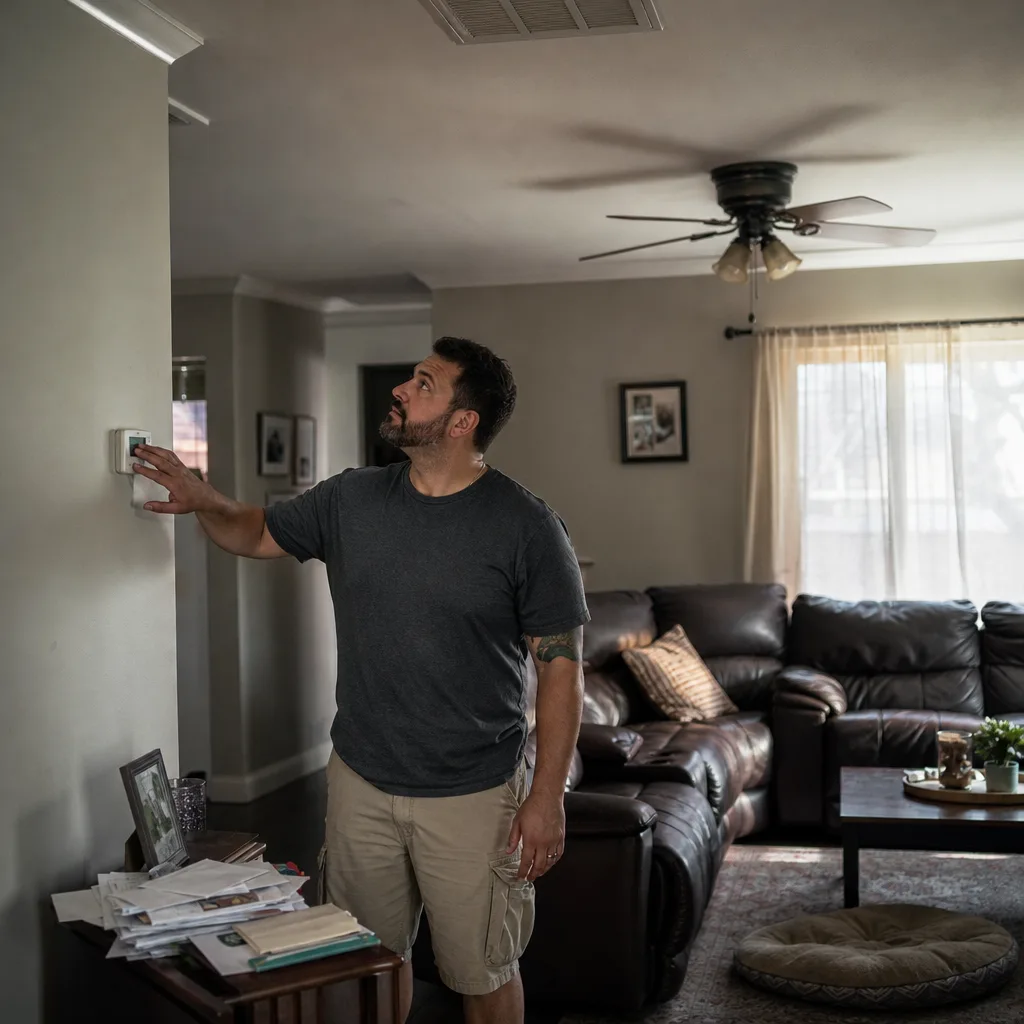
Then the technician hooks gauges to the service ports on your outdoor unit. Those readings show how the refrigerant is moving through your system. Paired with temperature readings on the copper lines, they tell a trained tech whether the charge is low or whether something else is going on. This is the measuring step. If someone skips it and goes straight to adding refrigerant, they’re guessing.
If the numbers point to a low charge, the leak search begins. A proper search can include any of these:
- An electronic leak detector, a handheld sniffer that beeps near escaping refrigerant.
- Soap bubbles brushed on joints and valves. A leak blows bubbles you can see.
- A pressure test, where the system is filled with dry nitrogen and watched to see if the pressure drops.
- A close look at the wear spots: joints, valves, both coils, and any place the lines rub.
With a leak at the outdoor unit, this part can go fast. A pinhole inside an indoor coil in a hot Carrollton attic takes more time and patience. Either way, you should hear where the leak is before any repair starts.
Once we know what failed, you get an upfront flat-rate price, and you approve it before any work begins. No meter running. The price covers diagnosis, labor, and the standard replacement part, plus testing and cleanup. If more than one part has failed, or the fix calls for a major component like a new coil, that gets quoted separately so you can decide with the full picture. Most calls turn out to be a single common failure fixed on the first visit.
The repair itself depends on the spot. A worn valve seal can be swapped. A leaking joint can be resealed. A rubbed line can often be repaired in place. A coil with corrosion pinholes is usually replaced, not patched.
Then comes the step that separates a lasting repair from a quick refill. The repaired section should be pressure tested again. Next, a vacuum pump pulls the air and moisture out of the system, because moisture left inside can harm the compressor. After that, refrigerant goes in by weight on a scale, matched to what your system is built to hold. The right amount is measured, not guessed.
Last, the system runs while the technician checks the pressures, the line temperatures, and the air coming out of your vents. You should walk away knowing where the leak was, what was fixed, and that your AC is cooling the way it should.
There’s a $26-$99 service-call fee, and it’s credited toward the repair if you go ahead with Xtreme Air Services. Nights and weekends cost the same as a weekday, so a July evening breakdown doesn’t come with a bigger bill.
Frequently Asked Questions
Common questions about Refrigerant recharge / leak repair
Can a leaking AC coil be repaired, or does it need to be replaced?
Most leaking coils need to be replaced, not patched. Coil leaks usually come from tiny corrosion pinholes in the copper tubing, and those spots are too thin and spread out to seal reliably. A worn valve seal or a rubbed line set can often be fixed in place, but a coil with corrosion damage is a different repair decision. That’s why finding the exact leak spot matters before anyone talks about cost.
Is it safe to try to fix a refrigerant leak myself?
No, refrigerant work is not a do-it-yourself job. Federal rules require technicians who handle refrigerant to be certified, since it isn’t something you want leaking into the air. Finding a leak also takes tools like electronic leak detectors or a nitrogen pressure test, plus a vacuum pump to clear moisture before recharging. Simple steps like swapping a dirty filter or checking your thermostat setting are fine to try first, since those can mimic a leak without being one.
Why does adding refrigerant cost so much if it’s just a refill?
The cost isn’t really about the refrigerant itself, it’s about finding and fixing what let it escape. A proper visit includes measuring pressures, searching for the leak with tools like soap bubbles or a nitrogen test, repairing or replacing the failed part, then pulling a vacuum and weighing in the correct charge. Skipping straight to a refill without that process just means paying for refrigerant that leaks right back out, often within weeks.
Ready to Get Started?
Call (469) 269-6099 Today, Get Service Today.