


Reverse Osmosis System Installation in Carrollton
Find out if reverse osmosis fits your water problem before you buy – then a licensed installation.
What’s Covered on This Page
- Know What Reverse Osmosis Installation Includes
- Decide Between Point-of-Use RO and Whole-Home Water Treatment
- Check Your Carrollton Tap Water Before You Decide
- What Happens During Your Installation Visit
- Ask These Questions Before You Hire Anyone
- Can the RO system feed my fridge’s ice maker too?
- Will installing an RO system make a mess of my kitchen?
- Do I need a hole drilled in my countertop for the RO faucet?
- How long until I can drink water from the new system?
Know What Reverse Osmosis Installation Includes
When you’re comparing quotes, the real question isn’t just the price. It’s what that price buys you. An RO system only works well if every connection is right: the cold water feed, the drain line, the faucet, and the membrane that does the filtering. A low quote that leaves out the drain hookup or skips testing isn’t a better deal. It’s a different job.
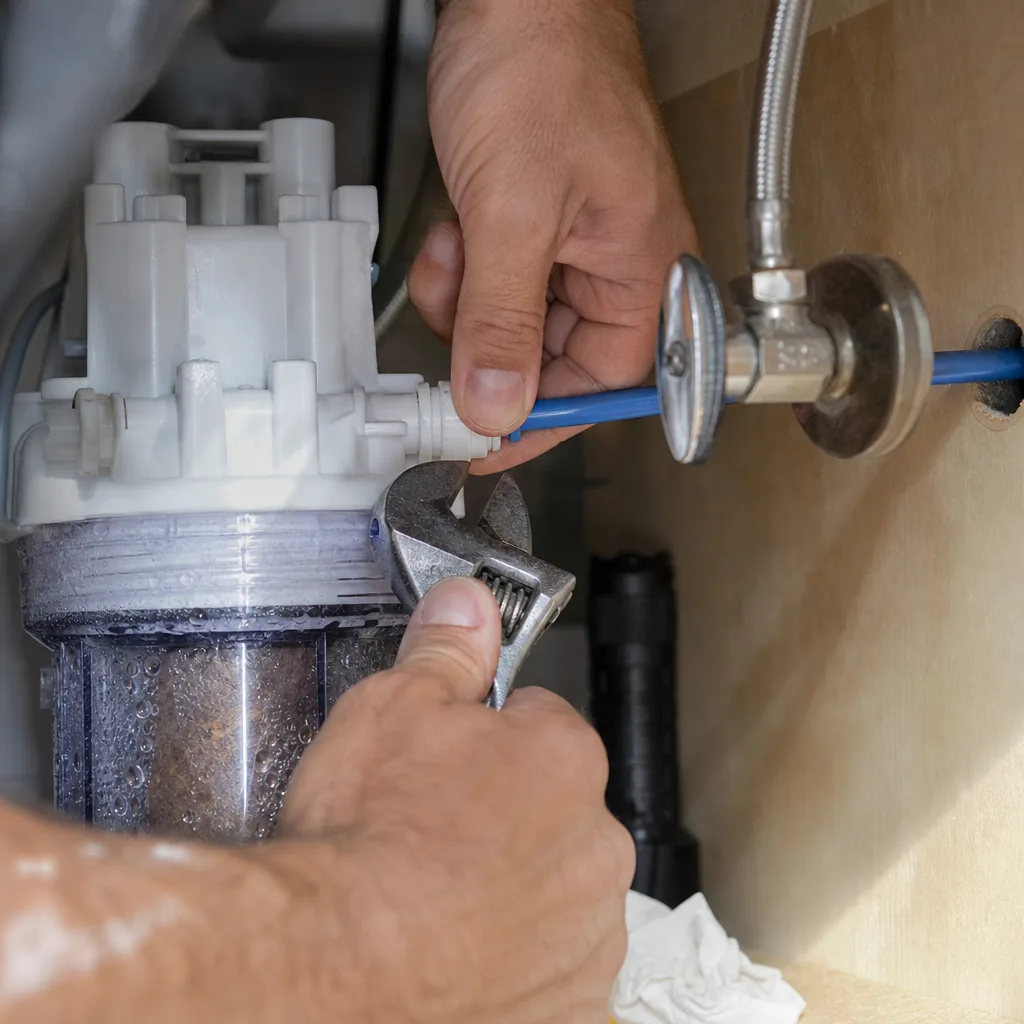
Here’s what our most common job looks like. We install an under-sink RO drinking-water system with its own faucet, membrane, and drain connection, then test it for proper output. Most of these jobs finish the same day.
- Included: the RO system and materials, professional installation, the faucet, all connections, startup, and testing.
- Not included unless your quote states it: a dedicated water line if the run is extensive, cabinet modifications, code corrections, and permits.
Those exclusions aren’t fine-print traps. They cover work some kitchens need and most don’t. If your sink cabinet has room, a cold water line close by, and a drain we can tie into, you’re likely looking at a straightforward install. If the plumbing under your sink is older, cramped, or already patched together, we’ll tell you what we see and what it would take before anything gets done.
Our typical price range for RO work is $300-$1,200, and the most common under-sink install runs $475-$850. These are the things that move your price up or down within that range:
- System stages and capacity. More filter stages and a higher daily output cost more.
- Faucet and tank type. Your faucet style, and whether the system uses a storage tank or a tankless design, both change the price.
- Condition of your existing plumbing. Worn or outdated shutoff valves and fittings may need attention first.
- Drain and supply access. Easy access under the sink keeps things simple. Hard-to-reach lines take more work.
- Added remineralization. This optional stage puts some minerals back into the water after filtering. Some people like how it tastes.
There’s also a $26-$99 service-call fee. If you go ahead with the work, it’s credited toward your job. Financing usually isn’t offered for a smaller job like this one, though it is available on larger repairs and replacements.
Before you hire anyone, ask three things. Is the faucet included? Is the drain connection included? Will they test the system before they leave? If the answer to any of these is no or unclear, you’re not comparing the same job. With us, you get upfront flat-rate pricing that you approve before work starts, so you know your number before the first fitting goes on.
Decide Between Point-of-Use RO and Whole-Home Water Treatment
Before you book an RO install, figure out where your water problem shows up. That one question tells you whether you need a system at one sink, a system for the whole house, or both.
A reverse osmosis system is point-of-use. It sits under one sink, usually in the kitchen, and treats only the water that comes out of its own small faucet. That’s the water you drink, cook with, fill the coffee maker with, and pour into ice trays. It does a great job there. It does nothing for the water going to your showers, washing machine, dishwasher, or water heater.
Whole-home treatment, like a water softener or a whole-home filtration system, works at the point where water enters your house. Every tap and appliance gets treated water. That’s the right tool when the problem is the hard water itself, which is common across North Texas.
Here’s how to sort it out by what you’re seeing:
- Your drinking water tastes or smells off, and you’re tired of hauling cases of bottled water home. An under-sink RO system is built for this.
- You see white crust on faucets and showerheads, spots on glasses after the dishwasher, or soap that won’t lather well. That’s hardness, and it’s a whole-home problem. A softener addresses it. RO alone won’t.
- Your water heater is losing performance, or your appliances seem to wear out early from scale. Again, that’s whole-home territory.
- You’ve got both: hard-water buildup around the house and drinking water you don’t love. Many homes end up with a softener for the house and RO at the kitchen sink.
Let’s be straight about one thing. If your only complaint is spotty dishes and a crusty showerhead, an RO system isn’t the answer, no matter how nice the faucet looks. You’d spend money and still be scrubbing scale off the shower glass. In that case, start with a softener and see if you even want RO afterward. Plenty of people find they’re happy without it.
The opposite is true, too. If your house doesn’t have scale issues and you just want clean, great-tasting water to drink, you don’t need to treat every gallon that runs through your home. Treating only the water you drink keeps the job smaller and simpler.
There’s also a good reason the two often go together. Hard water is tough on the RO membrane, the fine filter that does the main work. When water is softened before it reaches the RO system, the membrane has less mineral buildup to deal with. So if you already have a softener, RO is an easy add. If you’re planning both, it makes sense to talk about them at the same time so the setup works as one system.
Not sure what’s in your water? That’s what water testing is for. We offer water testing, water softener installation, and whole-home water filtration installation along with RO, so you can get a straight answer about which one matches your problem instead of guessing. You won’t get pushed toward the bigger job if a single sink system is all you need.
Check Your Carrollton Tap Water Before You Decide
The best RO decision starts with a simple question: what’s in the water coming out of your kitchen tap? You can get a rough answer for free. A real test gives you a clear one.
Start with the yearly water quality report from the city of Carrollton. Every public water system has to publish one. It lists what the city tested for and how the results compare to federal limits. It’s worth a few minutes of reading, because it tells you whether the water leaving the treatment plant meets safety standards.
That report has limits, though. It describes the water the city sends out. It doesn’t describe the water after it travels through your service line, your home’s pipes, and your faucet. It also can’t tell you whether you like the taste. Water can pass every safety test and still taste flat, salty, or a little like a swimming pool.
A test at your own tap fills that gap. A good water test looks at a few key things:
- Total dissolved solids, or TDS. This is the amount of minerals, salts, and other material dissolved in your water. RO systems are built to bring this number down, so it’s the clearest sign of how much an RO system would change your water.
- Hardness. This shows how much calcium and magnesium is in your water. If it’s high, your RO membrane will work harder, and that changes how the system should be set up.
- Chlorine taste and odor. Cities disinfect their water, and some people notice the taste more than others. Carbon filters inside most RO systems handle this well.
- Anything specific you’re worried about. If you’ve heard about a certain contaminant, ask about it by name so the test covers it.
Here’s why the numbers matter. Say your TDS reading comes back high and your hardness is high too. That points to RO at the kitchen sink, with a softener ahead of it to protect the membrane, as covered above. Now say your TDS is moderate and your only complaint is a faint chlorine taste. A simpler carbon filter might be all you need.
Your test results also give you a starting point. When an RO system is installed and tested, comparing the TDS at the RO faucet to your regular tap shows you, in plain numbers, that the system is doing its job. Without a before reading, you’re just trusting that it works.
If you’d rather skip the guesswork, our team offers water testing, so your decision rests on what’s in your water instead of what’s in an ad. Once you see your results, the right choice is usually pretty clear.
Need help with Reverse osmosis system installation?
Call Today, Get Service Today. Xtreme Air Services — Carrollton is ready to help.
What Happens During Your Installation Visit
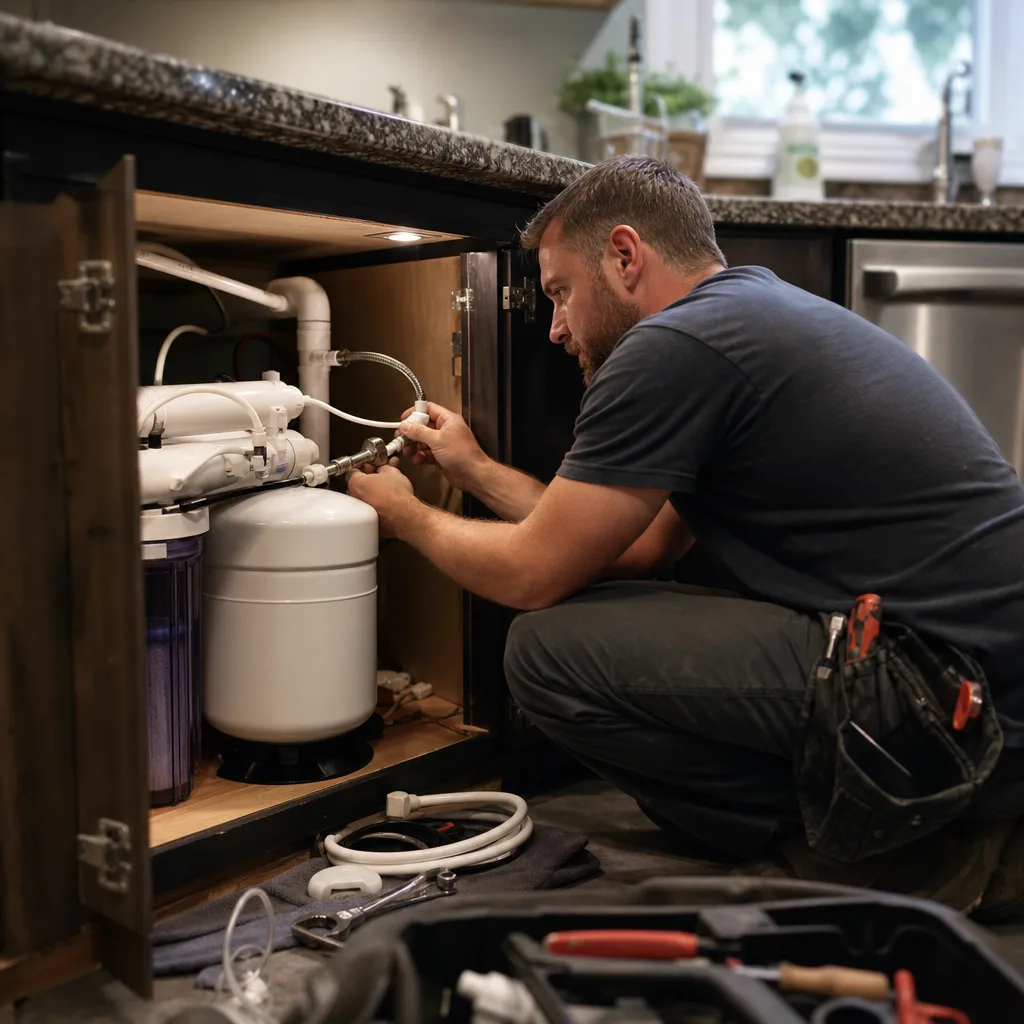
An under-sink RO install is a one-visit job for most kitchens, and most of ours finish the same day. Here’s what a proper install looks like, so you know what’s happening under your sink and why each step matters.
Before your visit, clear everything out of the cabinet under your kitchen sink. Cleaning sprays, trash bags, and that bin of extra sponges all need to go somewhere else for a few hours. It gives the installer room to work and saves time. If you’re hoping to use an existing hole in your sink for the new faucet, such as an old sprayer or soap dispenser spot, say so up front.
- A look under the sink first. A good installer checks that there’s room for the filter unit and storage tank, finds the cold water line and shutoff valve, and looks at the drain pipe. This is when any issue with older or patched plumbing comes up. With us, you approve the flat-rate price before any work starts.
- Tapping the cold water supply. The water is shut off, and a small feed valve is added to the cold line. RO systems run on cold water only, since hot water can damage the membrane.
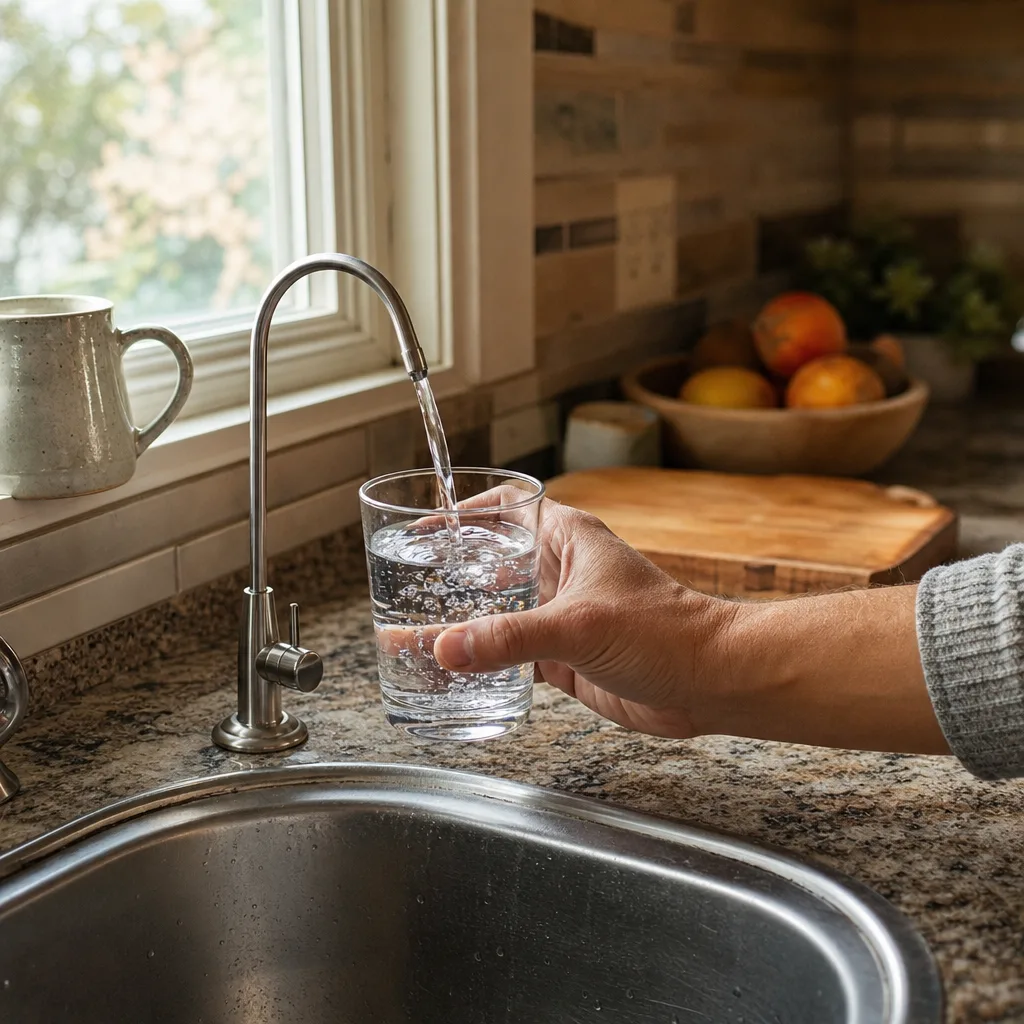
- Mounting the faucet. The RO faucet goes in an existing hole or a new one drilled in the sink or countertop. Stone counters take extra care here, so ask how it’ll be handled if you have granite or quartz.
- Making the drain connection. RO sends a small stream of rinse water down the drain as it filters. A fitting called a drain saddle clamps onto your sink drain pipe above the trap to carry it away. If this step is done poorly, you can get gurgling, odors, or leaks.
- Mounting the system and tank. The filter housings get secured to the cabinet wall, the tank is set in place, and all the tubing is connected to the supply, drain, tank, and faucet.
Startup is where a rushed job shows. New filters and a new membrane need to be flushed before you drink the water, so the first tank or two is usually run down the drain. That flushing clears loose carbon dust and gets the membrane ready to work. Every connection should then be checked for drips while the system is under pressure, not just when it’s first turned on.
Startup and testing are part of every RO install we do, and the system is tested for proper output before we call the job done. That’s also when your before-and-after water reading, covered above, shows you in plain numbers that the system is working.
Before the installer leaves, ask three quick questions. Where is the shutoff for the RO system? Which filters get changed, and about how often? What should you watch for under the sink in the first week? A small drip at a fitting is easy to fix early and a hassle if it sits. Knowing the answers means you’re not guessing six months from now when the water starts to taste different.
Watch Our Video
See How We Handle Reverse osmosis system installation in Carrollton
Xtreme Air Services — Carrollton
Ask These Questions Before You Hire Anyone
An RO system looks like a small job. It’s a box under the sink and a skinny faucet on top. It still ties into your cold water line and your drain, though. That means whoever installs it is working on your home’s plumbing. A few direct questions up front will tell you whether you’re talking to someone careful or someone in a hurry.
- Are you licensed and insured? You want a real plumbing contractor, not a handyman with a kit from a big-box store. If a fitting under your sink lets go, insurance is what protects your cabinets and floors.
- Did you ask about my water before recommending a system? A good installer wants to know your hardness and TDS, or offers to test, before naming a system. Someone who quotes the same setup to every house without asking hasn’t thought about your membrane, your softener, or your taste complaint.
- Are the replacement filters standard sizes? Some systems use common filter sizes you can buy from several places. Others use proprietary cartridges that only fit one unit. Ask now, because you’ll be buying filters for years.
- Where will the tank and filters sit? Ask how much cabinet space the system will take and what’s left for your trash can and cleaning supplies. If you have a garbage disposal, ask how everything will fit around it.
- Does my job need a permit, and who handles it? Most under-sink installs are simple. If your kitchen needs a longer water line or other plumbing changes, ask whether a permit applies and whether it’s in your quote.
- Can it feed my fridge’s ice maker or water dispenser? Many people want RO water there too. It’s usually an added line, so ask up front if you want it, rather than finding out after the install.
- Who do I call if something seems off later? Get a real phone number for a local company. You don’t want a website form or a crew from two counties away.
Pay attention to how the questions get answered, not just what the answers are. A straight answer sounds like this: “Your drain is easy to reach, your shutoff valve is old and should be replaced first, and here’s the price for both.” A vague answer sounds like this: “We’ll see when we get there.” With a vague answer, the real price usually shows up after the work is done.
Also, watch out for anyone who pushes a whole-house system when you told them your only issue is drinking water, or who tries to sell you RO to fix crusty showerheads. As covered above, those are different problems with different fixes. Someone who listens to which problem you have is someone you can trust under your sink.
Here’s how we answer those questions. Our technicians are licensed, insured, and background-checked. Our team handles water testing, water softeners, and plumbing too, so if your kitchen needs more than a standard install, you hear it from the same people. You’ll see an upfront flat-rate price and approve it before any work starts. We’re right here in Carrollton on East Trinity Mills Road, so the number you call is a local team that answers.
Call 469-269-6099
Frequently Asked Questions
Common questions about Reverse osmosis system installation
Can the RO system feed my fridge’s ice maker too?
Yes, but it usually needs an extra line run from the system to your fridge. Most kitchens don’t have this set up from the start, so mention it when you book. Adding it during the original install is simpler than coming back later to tie into a finished system.
Will installing an RO system make a mess of my kitchen?
No, a standard under-sink install stays contained to the cabinet below your sink. You’ll want to clear out cleaning supplies and bins beforehand so there’s room to work. Most jobs finish the same day, and the only new opening is the small faucet hole on your countertop.
Do I need a hole drilled in my countertop for the RO faucet?
Maybe, depending on your sink setup. If you have an old sprayer or soap dispenser hole that’s no longer used, the RO faucet can often go there instead. If not, a new hole gets drilled, and stone counters like granite or quartz need extra care during that step.
How long until I can drink water from the new system?
Plan on a few hours after installation before you get full flow. The storage tank needs time to fill completely, and the first tank or two gets flushed down the drain to clear the new filters and membrane before you drink from it.
Ready to Get Started?
Call (469) 269-6099 Today, Get Service Today.