


Water Softener Installation in Frisco: What’s Included and What It Costs
Whole-home softeners that treat water where it enters your house, usually installed the same day.
What’s Covered on This Page
- What a Whole-Home Softener Install Includes
- Signs Frisco Homes Need a Water Softener
- What Drives Softener Installation Cost Up or Down
- Why Installation Involves Licensed Plumbing Work
- When a Water Softener Isn’t the Right Fix
- Does a plumber have to install my water softener, or can any installer do it?
- How long does a water softener installation take?
- Can I install a water softener myself to save money?
What a Whole-Home Softener Install Includes
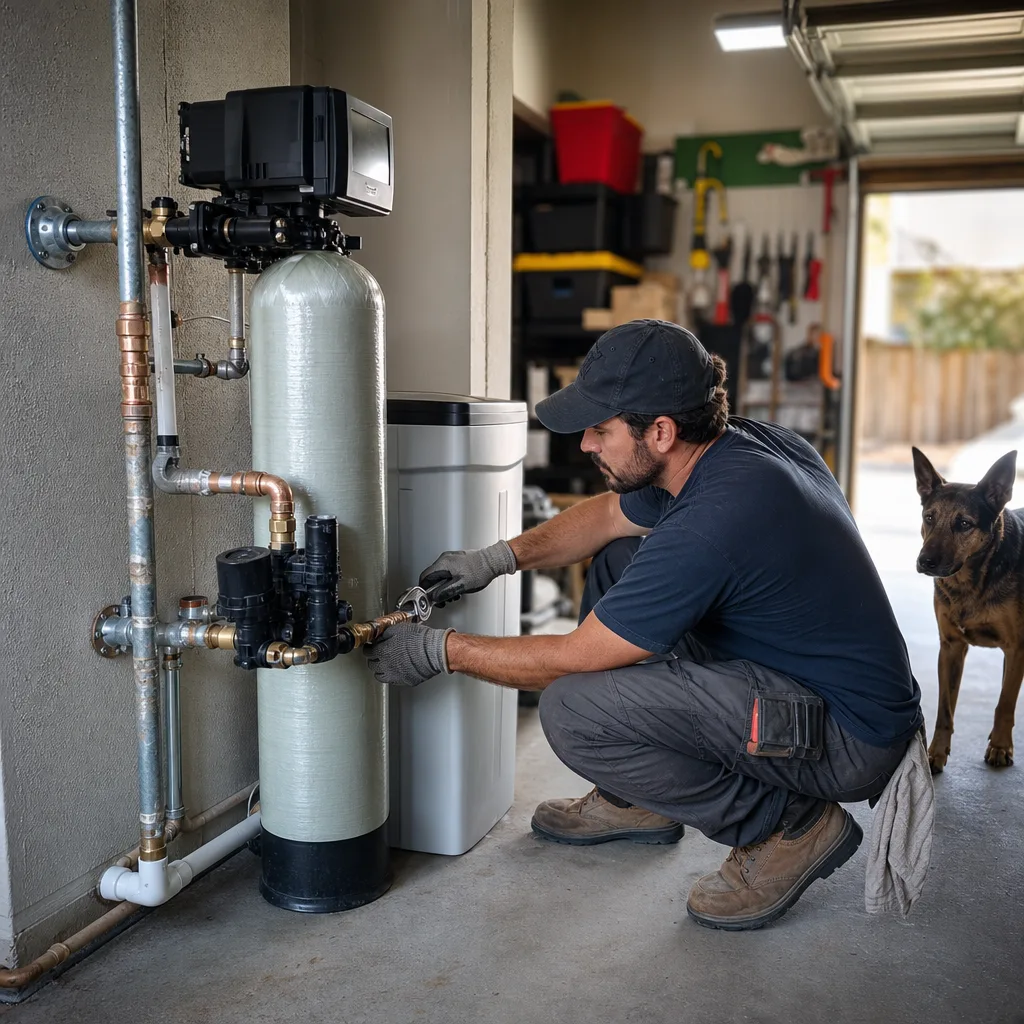
A whole-home softener treats your water once, where it enters the house. That means your water heater, shower, dishwasher, and faucets all get soft water, not just the kitchen sink. Most jobs finish the same day, so you aren’t left with your water off overnight.
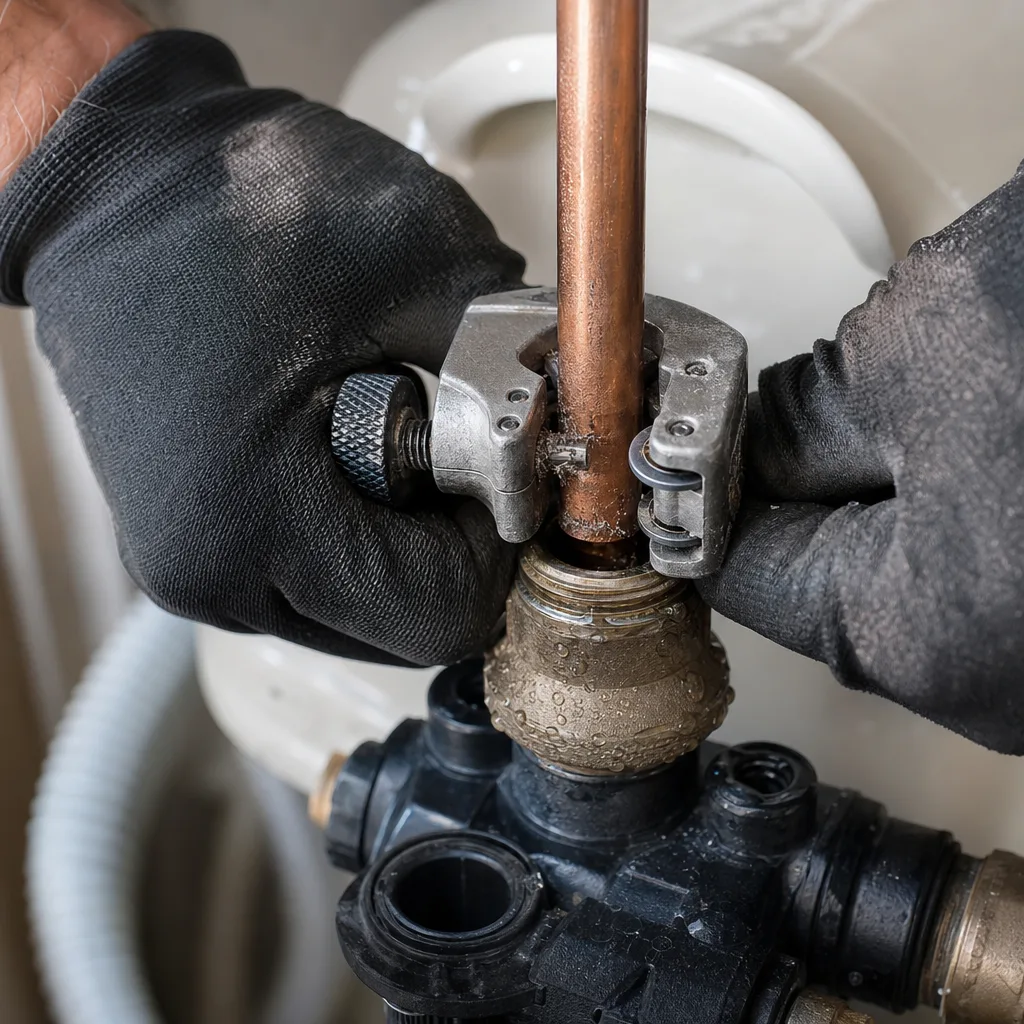
Here’s what’s included in the job:
- The softener and materials. We size the unit to your home and your water use, because a softener that’s too small runs out of soft water before it can recharge.
- Professional installation at your main supply. This is the spot where your water comes into the house, before it reaches your water heater or fixtures.
- A bypass connection. This valve lets you route water around the softener. If the softener ever needs service, you still have running water in the house.
- A drain connection. Your softener flushes itself clean on a schedule, and that rinse water needs a proper place to go. We run the drain line so it empties correctly and can’t back up into your water supply.
- Startup and testing. We fill the brine tank, set the softener for your water’s hardness and your household size, and run it through a cycle. Then we check for leaks and make sure soft water is reaching your taps.
- Haul-away of your old unit. If you’re replacing a softener, we take the old one with us.
Some homes need extra work before a softener can go in. We’d rather you hear about it now than see it as a surprise on the bill, so here’s what’s not included unless your quote lists it:
- A plumbing loop, if your home doesn’t already have one. A loop is a section of pipe built to give a softener a place to tie in. Many homes already have one, often in the garage. If yours doesn’t, it has to be added.
- Electrical work. Most softeners plug into a standard outlet. If there isn’t one near the install spot, that’s a separate job.
- Code corrections. If we find existing plumbing that doesn’t meet current code, fixing it is extra.
- Permits, unless your quote says they’re included.
These are the same things that move the price up or down: the size and type of softener, the condition of your plumbing, how easy it is to reach a drain, and whether you need a pre-filter or a new loop. For our most common job, a whole-home softener at the main supply with a bypass and drain line, the price is $1,700-$2,600.
You’ll see all of this before any work starts. Our upfront flat-rate pricing lists what’s in the job and what’s not, so you can decide with the full picture. If we spot something that needs a loop, an outlet, or a code fix, we’ll show you what we found and explain it in plain English. Then the decision is yours.
Signs Frisco Homes Need a Water Softener
Hard water is a common North Texas problem, and it doesn’t hide for long. It leaves clues all over your home. You don’t need a lab to spot most of them. You just need to know where to look.
Here are the signs that point to hard water:
- White, chalky crust on your faucets and showerheads. That’s mineral scale. If your showerhead sprays sideways or has clogged holes, scale is usually the reason.
- Spots on dishes and glasses, even right out of the dishwasher. A cloudy film on your glass shower door that comes back days after you scrub it is the same problem.
- Soap that won’t lather. Hard water fights soap, so you use more shampoo, more dish soap, and more detergent to get the same clean.
- Dry, itchy skin and dull hair after a shower. Soap residue that won’t rinse off is often the cause.
- Laundry that feels stiff or looks faded sooner than it should.
- A water heater that pops, rumbles, or knocks. Minerals settle at the bottom of the tank and form a crust. The heater has to work harder to push heat through it, and those sounds are the warning.
- A ring in your toilet bowl or crust around your tub drain that keeps coming back.
One sign on its own might not mean much. But if you’re nodding along to three or four of these, hard water is very likely the cause. A softener fixes it at the source.
Don’t assume a newer home is safe. Scale starts building the first day water runs through your pipes. It doesn’t matter if your house is 2 years old or 30. A brand-new water heater, dishwasher, and fixtures are exactly what a softener protects, so it often makes sense to soften before the buildup starts.
If you’re not sure what’s in your water, start with a water test. It shows how hard your water is and whether anything else needs attention. That way you buy the right equipment the first time, not a softener for a problem it can’t solve.
The test also helps with sizing. How hard your water is and how much your family uses are what decide the right softener for your home. Those numbers matter more than any sales pitch. A household of five with very hard water needs a different setup than a couple with mild hardness, and getting that right is what keeps soft water coming out of every tap.
What Drives Softener Installation Cost Up or Down
Most whole-home softener installs we do fall between $1,200 and $3,500. That’s a wide range, and it should be. Two houses on the same street can need very different work. Where your home lands depends on a handful of things you can often check yourself before anyone shows up.
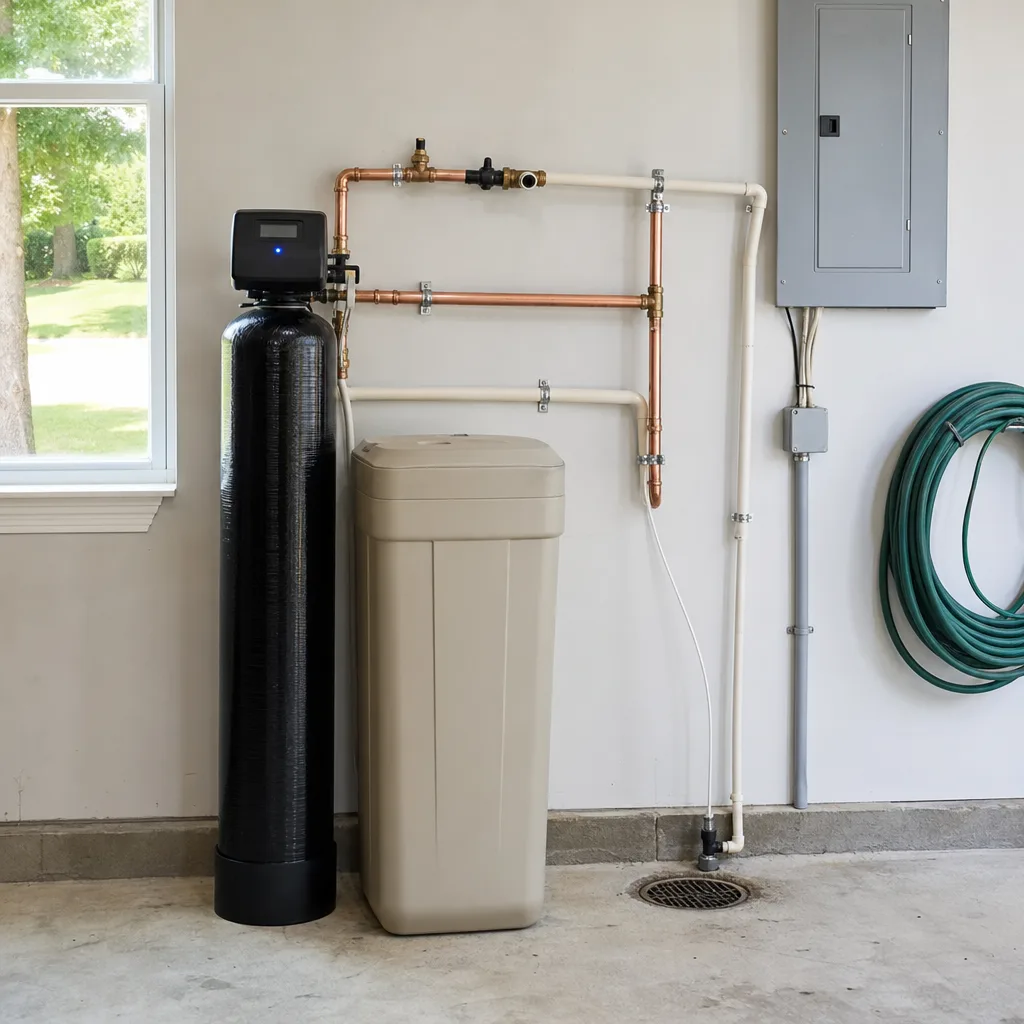
Softener size and type. This is the biggest piece. A bigger household with harder water needs a softener that can hold more minerals between recharges, and a larger unit costs more. The type matters too. Some setups use two tanks so one can recharge while the other keeps working, which helps busy households that run water all day. A water test and your family’s daily use tell us which size and type makes sense, so you’re not paying for more softener than you need.
The shape your plumbing is in. If your pipes and shutoff valve near the install spot are in good condition, the job goes smoothly. If we find corroded fittings, a valve that won’t close all the way, or old pipe that can’t safely take a new connection, that has to be fixed first. It adds time and parts.
How far the drain is. Your softener needs somewhere to send its rinse water. A floor drain or laundry standpipe a few feet away keeps things simple. If the nearest drain is across the garage or on the other side of a wall, the line gets longer and the work takes more effort.
Extra filters. Some homes need more than softening. If your water carries sand or grit, a sediment pre-filter keeps it from clogging the softener. If chlorine taste is a problem, a carbon filter may get added in front. Each one adds to the total, and we’ll only suggest one if your water calls for it.
A missing loop or code fixes. If your home doesn’t have a softener loop, adding one is the largest extra on many jobs. Bringing old plumbing up to current code can also add to the price.
- Your price usually stays lower when you already have a loop, an outlet nearby, and a drain close to the install spot.
- It also stays lower when you’re swapping an old softener for a new one in the same place, since the connections are already there.
- It tends to climb when you need a bigger or twin-tank unit, a new loop, a long drain run, extra filters, or plumbing repairs before the softener can go in.
No matter who you call, ask a few questions before you agree to anything. Is the loop included if I need one? Are permits part of the price? Will you take the old unit away? Is the price fixed, or can it change once the work starts? Clear answers up front protect you from a bill that grows halfway through the job.
When we come out, there’s a $26-$99 service-call fee. If you go ahead with Xtreme Air Services, that fee is credited toward the job. If the total is more than you want to pay at once, flexible financing is available on qualifying installations and larger jobs, on approved credit.
Have questions? We’re happy to help.
Call Today, Get Service Today. Xtreme Air Services — Frisco is ready to help.
Why Installation Involves Licensed Plumbing Work
A softener looks like a simple appliance. It’s a couple of tanks and a control valve. But installing one means opening up the main water line that feeds your whole house. Every faucet, toilet, shower, and your water heater sits downstream of that connection. If it’s done wrong, the problem doesn’t stay in the garage. That’s why this is plumbing work, and why it’s worth having a licensed plumber do it.
Your main line is under pressure all day and all night, even when nobody’s running water. A fitting that’s a little loose might hold for a week. Then it starts to drip, or it lets go while you’re at work. Here’s what a licensed plumber is checking for that a quick DIY job often misses:
- The right fittings for your pipe. Copper, PEX, and older galvanized pipe each need the correct connectors. Joining two different metals directly can cause corrosion at the joint over time, and that’s where leaks start.
- A shutoff valve that works. The job starts by closing your main valve. If an old valve won’t seal, or cracks when it’s turned, you need someone who can handle it on the spot instead of a flooded garage and a wait for help.
- Protecting your drinking water. The drain line has to be set up so rinse water can never be pulled back into your supply. Getting that gap right is a health issue, not just a tidy install.
- Pressure and flow after the install. A softener that’s undersized or hooked up wrong can leave you with weak pressure at the shower. We check flow at your fixtures before we leave.
There’s also the water heater to think about. It’s one of the main things a softener protects, and it’s also the first thing hurt by a bad install. Debris knocked loose while cutting into old pipe, or a leak near the tank, can cause problems you won’t notice right away.
Now, the honest part. Not everything about owning a softener needs a pro. Adding salt to the brine tank is your job, and it’s easy. So is plugging the unit in, resetting the clock after a power outage, and running a manual recharge. If you already have a loop, a bypass, and a drain right there, and you’re comfortable with plumbing, you may be able to swap a like-for-like unit yourself. Just know you’re taking on the risk of a leak on a line that never shuts off.
When our team does the install, you get licensed and insured technicians who are background-checked, working under the oversight of our master plumber, Larry Breedlove. We’re a full plumbing company, not just a softener seller, so if we open the wall and find an old valve or a corroded fitting, we can fix it the same visit. And because we handle water heaters too, we’re looking at the whole system, not just the new tank in your garage.
Call 469-490-3595
Watch Our Video
See How We Handle Water softener installation in Frisco
Xtreme Air Services — Frisco
When a Water Softener Isn’t the Right Fix
A softener is the right fix for hard water. It isn’t the right fix for everything, and sometimes it’s the wrong thing to buy right now. These are the cases where we’d tell you to hold off or go a different way.
You already own a softener and the hard water came back. Don’t replace it yet. Check the brine tank first. If there’s salt in it but your water still feels hard, push a broom handle down into the salt. If it hits a hard crust, that’s a salt bridge. The salt has formed a shell, and the water underneath can’t reach it, so the softener can’t recharge. Breaking up the crust with the handle often fixes the problem for free. If that’s not it, a stuck valve, a worn part, or a control that’s set wrong is a repair job, not a reason to buy a whole new unit.
Your only problem is one fixture. A crusty showerhead can soak overnight in a bag of white vinegar. Spotty glasses may just need rinse aid in the dishwasher. If that’s your whole list, you may not need a softener yet. Keep an eye out for more signs before you spend the money.
Your water pressure is weak at every tap. A softener won’t raise your pressure. If the whole house runs weak, the cause is somewhere else, like a failing pressure regulator or a problem in your supply line. Fix that first. Adding a softener to a low-pressure home can make things feel a little weaker, because the water has to pass through the tank on its way in.
Your water heater is already on its way out. If it’s leaking at the base or the tank is rusting, a softener won’t save it. Soft water protects a heater going forward, but it can’t undo damage that’s already done. Replace the heater first, then add the softener, so the new tank starts clean and stays that way.
You’re on a strict low-sodium diet. A softener swaps hard minerals for a small amount of sodium. For most people, that’s not a concern. If your doctor has told you to watch your salt closely, ask them first. Some people use potassium chloride in the brine tank instead of regular salt. Another common setup is to soften the whole house and add a reverse osmosis system at the kitchen sink for drinking and cooking water.
You rent, or you’re moving soon. A whole-home softener becomes part of the plumbing. If you rent, you’ll need your landlord’s okay, and they may want to handle it themselves. If you plan to move in a few months, you’d be paying for an upgrade you’ll barely use.
In each of these cases, the honest answer is the same. Fix the real problem first. A softener does its best work in a home where the plumbing, the pressure, and the water heater are already in good shape.
Frequently Asked Questions
Common questions about Water softener installation
Does a plumber have to install my water softener, or can any installer do it?
A licensed plumber should handle it, because the job means opening your home’s main water line. That line stays under pressure day and night, so a loose fitting or a bad connection can turn into a leak or flood. A licensed plumber knows how to match fittings to your pipe type, check your shutoff valve, and set up the drain line so rinse water can never backflow into your drinking water.
How long does a water softener installation take?
Most whole-home softener installs finish the same day, so your water isn’t shut off overnight. The visit covers connecting the unit at your main supply, adding the bypass and drain lines, then filling, testing, and checking every tap before the crew leaves. If your home needs extra work, like adding a plumbing loop or fixing an old valve, that can add time to the visit.
Can I install a water softener myself to save money?
You can, but only in the right situation, and you take on real risk. If your home already has a loop, a bypass, and a drain in place, and you’re comfortable with plumbing, swapping a like-for-like unit yourself is possible. Simple upkeep like adding salt, plugging in the unit, or running a manual recharge is also fine to do yourself. Cutting into your main water line without plumbing experience is where most DIY problems start, since that line never shuts off on its own.
Ready to Get Started?
Call (469) 490-3595 Today, Get Service Today.