


HVAC System Maintenance in Dallas: What’s Included, What It Costs
A full inspection, cleaning and safety check on every visit, so you know exactly what you're paying for.
What’s Covered on This Page
- What a Maintenance Visit Includes and What It Doesn’t
- Why Dallas Summers Make Maintenance More Than a Formality
- Signs Your System Needs a Maintenance Check Now
- When You Don’t Need a Maintenance Visit Yet
- How Often Dallas Homes Need HVAC Maintenance
- How long does a maintenance visit usually take?
- Can I do any part of the maintenance myself to save money?
- What should I ask before booking a maintenance appointment?
What a Maintenance Visit Includes and What It Doesn’t
You should know what you’re paying for before anyone climbs into your attic. Here’s the plain version.
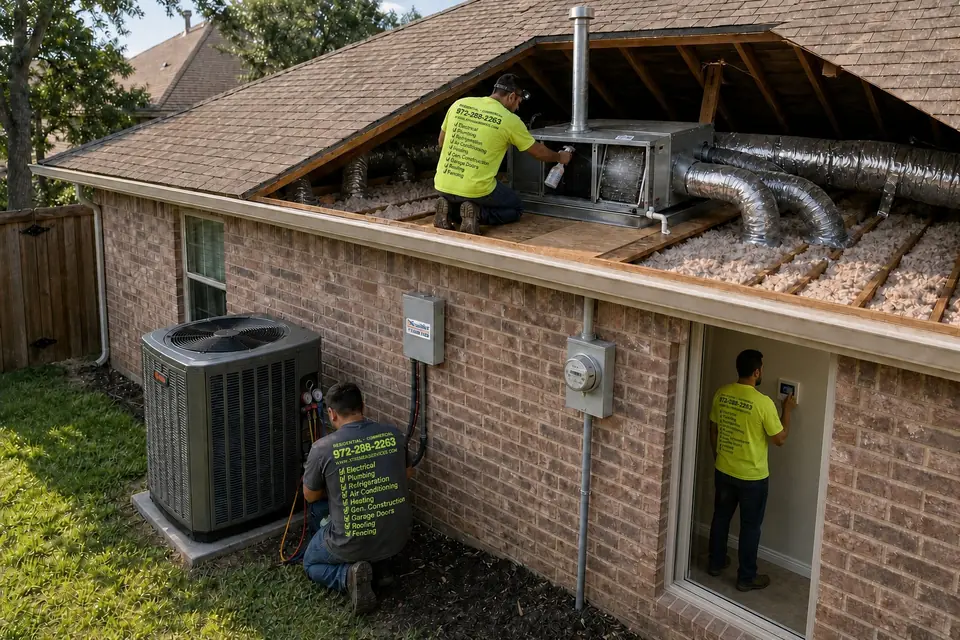
Our most common maintenance job is routine service on one system. That’s one AC and heating setup, not your whole house’s worth of equipment. It includes three things:
- A full inspection. Your technician looks over the system so small problems get caught while they’re still small.
- A cleaning. Dust and buildup make your system work harder in a Dallas summer, so getting them out is part of the job.
- A performance and safety check. This tells you whether your system is running the way it should and whether anything about it is unsafe.
For that visit, the typical price is $100 to $200. Our wider range for maintenance work is $100 to $300, and where you land depends on a few honest factors.
- How many systems or units you have. A two-story home with a second system upstairs means two units to service, not one.
- How easy the equipment is to reach. A lot of Dallas homes have the air handler up in the attic, and a tight attic opening or a long crawl takes more time.
- How much buildup or neglect there is. A system that’s gone years without service usually needs more cleaning than one that’s checked every year.
- Whether it’s a one-time visit or part of a maintenance plan.
A maintenance visit doesn’t include repair parts or corrective work. If your technician finds a worn part or a problem that needs fixing, you’ll get a separate quote for it. You decide. We work with upfront flat-rate pricing, so you approve the price before work starts. No meter running and no surprise line items. If you’d rather wait or get a second opinion, that’s your call, and the maintenance you paid for is still done.
There’s also a $26 to $99 service-call fee. If you go ahead with a repair through Xtreme Air Services, that fee gets credited toward the repair. So you’re not paying twice to have us come out.
A few related jobs are their own services, so they aren’t part of a standard tune-up. Air duct cleaning is one. Full system replacement is another. If you’re asking about a filter change, ask when you book so you know what’s covered. We’d rather answer the question up front than have you guess.
One more thing on budget. Financing isn’t typically offered for a smaller job like routine maintenance. It’s available on larger repairs and replacements, so if a visit turns up something bigger, you’ll have options to talk through.
Why Dallas Summers Make Maintenance More Than a Formality
In a lot of places, an AC runs a few hours on a hot afternoon. In Dallas, it can run most of the day from late spring well into fall, and on triple-digit days it may barely shut off. That’s the real reason maintenance here isn’t just a box to check. Every hour of run time adds wear, and when your system never gets a break, small problems grow up fast.
Here’s what a Dallas summer does to the parts that keep you cool.
- The capacitor. This small part gives your outdoor fan and compressor the push they need to start. Heat wears it down over time, and a weak one can keep working for a while before it quits. Finding it weak on a mild spring day beats finding it dead on a July evening.
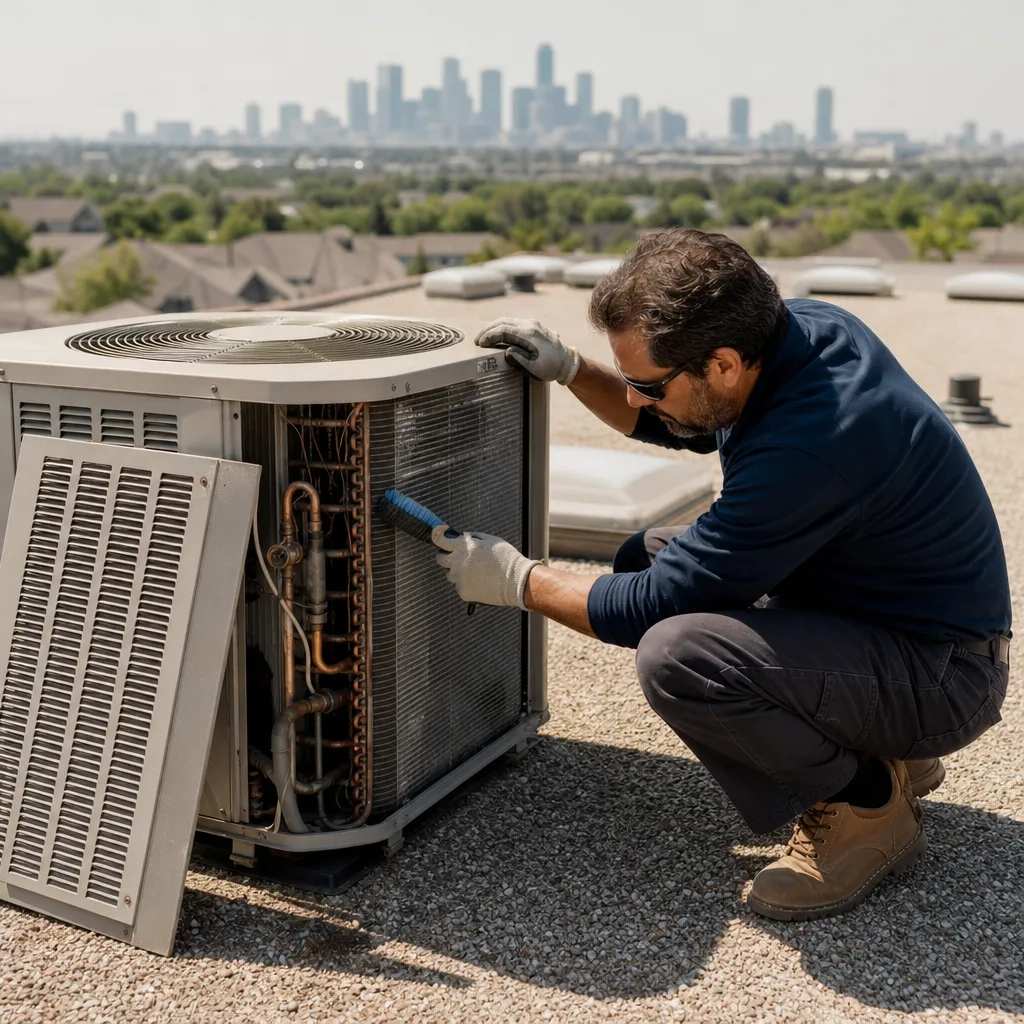
- The outdoor coil. Your outdoor unit’s job is to dump the heat pulled out of your home. When grass clippings, cottonwood fluff, and dust coat that coil, it can’t shed heat well. Your system runs longer, and your electric bill climbs.
- The condensate drain line. Your AC pulls water out of the air all summer, and on muggy Dallas days that’s a lot of water. If the drain line clogs with slime or sludge, the water backs up. With the air handler up in the attic, a backup can show up as a water stain on the ceiling below.
- Attic heat. Equipment and ductwork in a Dallas attic bake all summer long. That heat is hard on wiring, on the foam insulation around refrigerant lines, and on duct connections. A loose or torn duct in the attic can pull superheated air right into your system.
- Hail and storms. Spring hail can flatten the thin metal fins on your outdoor unit. Bent fins block airflow the same way dirt does.
The ground matters too. North Texas clay soil swells when it’s wet and shrinks during dry spells. Over time, that movement can make an outdoor unit’s pad settle out of level, which puts strain on the refrigerant lines running to it. It’s not an emergency, but it’s worth a look.
Winter has its own catch. Dallas winters are mild most of the time, but a hard cold front can roll in fast. If your furnace or heat pump has sat idle since spring, the first cold night is a rough time to find out the igniter or flame sensor needs attention. On a gas furnace, the heating checkup is also a safety check, including carbon monoxide testing. That’s not something you want to skip when the windows are shut tight.
Timing makes a big difference. Have the cooling side checked in spring, before the real heat settles in. Have the heating side checked in fall. That way, if something turns up, it’s a scheduled fix you have time to think about, not a breakdown with your family sweating it out.
This goes double if your home is one of the many older Dallas houses with equipment that’s already been through a long run of summers. An older system has less room for error, so small problems matter more.
Maintenance won’t make your system last forever, and nobody honest will tell you it will. What it does is move the surprise. Instead of a dead AC on the hottest night of the year, you get a heads-up during a planned visit, with time to decide what to do about it.
Signs Your System Needs a Maintenance Check Now
Your system usually tells you something’s off before it quits. The trick is noticing the small stuff while it’s still small. If any of these sound familiar, don’t wait for your next planned visit. Get it looked at now.
- Your electric bill jumped and your habits didn’t. If last July’s bill and this July’s bill are far apart with the thermostat set the same, your system is working harder to do the same job.
- It runs and runs. On a normal summer afternoon your AC should cycle off now and then. If it barely stops and the house still isn’t hitting the number on the thermostat, something’s slowing it down.
- It turns on and off every few minutes. Quick, choppy cycles are hard on the parts and usually point to a problem worth finding early.
- The air feels weak or not very cold. Hold your hand up to a vent. If the airflow is soft or the air feels cool instead of cold, that’s a sign.
- One room is always hotter than the rest. Some difference between rooms is normal, especially upstairs. A room that’s suddenly much worse than it used to be isn’t.
- Your home feels sticky. Your AC should pull moisture out of the air. If it’s 74 inside and still feels clammy, it isn’t doing that part of its job.
- You hear new sounds. Buzzing, rattling, clicking that doesn’t stop, or a grinding noise from the outdoor unit are all worth a look.
- You see ice. Frost on the copper line running to your outdoor unit, or on the indoor coil, is never normal in a Dallas summer.
- You smell something. A musty smell when the system kicks on often points to moisture inside it. The first dusty smell when you turn on the heat in fall is common and fades fast. A smell that hangs around doesn’t.
Before you call, check a few things yourself. They’re free and they fix more problems than you’d think. Look at your air filter. If it’s gray and packed with dust, swap it and give the system a day. Check that your thermostat is set to cool or heat, not just fan, and change the batteries if it has them. Make sure the breaker for your system hasn’t tripped. If one of these clears things up, great. You just saved yourself a visit.
Some signs mean it’s time for a repair, not a tune-up. A burning smell, a breaker that keeps tripping, or a system that won’t turn on at all needs a technician to find the cause. Water pooling near the air handler or a fresh ceiling stain falls in the same group. Don’t wait on those until your next maintenance visit.
Even with no warning signs, a system that hasn’t been serviced in over a year is due. That’s especially true if you’ve just bought a home and don’t know when the last owner had it checked. A quick visit tells you where you stand before the heat sets in.
Call 469-213-3107
Ready when you are – get in touch today.
Call Today, Get Service Today. Xtreme Air Services — North Dallas is ready to help.
When You Don’t Need a Maintenance Visit Yet
Not every home needs a technician right now. If you’re trying to figure out whether a visit is worth your money this month, here’s the honest answer. You can usually wait if one of these fits you.
- Your system was checked within the last year and runs fine. If the cooling side was serviced last spring and your home is comfortable, your bills look normal, and none of the warning signs above apply, you don’t need a second cooling checkup this summer. For most homes, one cooling visit and one heating visit a year is plenty. If someone tells you a home system needs a tune-up every few months with no reason given, ask why.
- Your system was installed in the last few months. New equipment has fresh parts and a clean coil. Unless something seems off, a first full checkup can wait until the next season comes around.
- A technician just worked on it. If your system had a repair recently and the tech looked it over while they were there, booking a separate tune-up a few weeks later usually doesn’t buy you much.
- You’ve already decided to replace it soon. If a new system is coming in the next few weeks, a full cleaning on the old one doesn’t make much sense. One exception: if you rely on an older gas furnace to get through a cold snap before the swap, the safety side of a heating checkup still matters.
Waiting doesn’t mean ignoring it. A few easy habits keep your system in good shape between visits, and none of them need a technician.
- Keep about two feet of open space around your outdoor unit. Trim back shrubs, and point the mower so grass clippings don’t blow onto the coil.
- After a storm or a heavy cottonwood season, pick leaves and fluff off the top and sides of the outdoor unit by hand.
- Keep your supply vents and return grilles clear. A couch or rug pushed over a return makes your system work harder.
- Stay on your filter schedule. A fresh filter between visits does more for your system than almost anything else you can do.
Some things are best left alone, even if you’re handy. Don’t pull the panels off your outdoor unit or air handler, and don’t try to add refrigerant. Those parts carry high voltage, and refrigerant work calls for EPA certification. If you’ve got a gas furnace, leave the burners and the venting to a pro.
So the real rule is simple. If your system had its yearly checkup, runs well, and isn’t showing any of the signs above, you can wait. Put a reminder on your calendar for the next season and get on with your summer. A good tech would rather tell you that than sell you a visit you don’t need.
Watch Our Video
See How We Handle HVAC system maintenance in Dallas
Xtreme Air Services — North Dallas
How Often Dallas Homes Need HVAC Maintenance
For most Dallas homes, the answer is the one cooling visit and one heating visit a year we covered above. How that looks in your home depends on what kind of equipment you have, how many systems you run, and what’s going on inside your house.
- You have a heat pump. A heat pump cools in summer and heats in winter with the same outdoor unit, so it rarely gets a long break. Both yearly visits land on the same machine, and skipping one means that equipment goes a full year of hard work without a look.
- You have a gas furnace and a central AC. These are two different jobs. The AC gets its checkup before the heat sets in, and the furnace gets its own visit before the first cold front, including the safety side we covered earlier.
- You have two systems. Each system needs its own schedule. In a two-story Dallas home, the upstairs unit usually has the tougher summer, because heat rises and that unit often sits in a hot attic right above it. Don’t let the downstairs visit stand in for both.
- Your system has been through a lot of summers. Older equipment doesn’t need extra tune-ups, but it does need you to keep both visits. Many of the 1950s through 1990s ranch homes around Dallas have systems with little room left for wear, so a skipped year matters more.
Some homes don’t need more tune-ups. They just need more attention between visits, and most of that comes down to the air filter.
- Pets that shed, especially dogs and cats that spend most of the day indoors.
- A remodel, new flooring, or drywall work. Construction dust gets pulled straight into your return.
- Someone in your family with allergies or asthma.
- A thin, cheap filter. Thin filters fill up faster than thicker pleated ones.
If any of those fit your home, check your filter every month during the long cooling season and change it when it looks gray. That’s a two-minute job you can do yourself, and it keeps dust from building up on the parts your technician cleans at each visit.
Businesses follow a different schedule. A rooftop unit cooling a shop or office for long hours every day takes on wear much faster than a home system. Commercial preventive maintenance is its own service, so if you’re asking about a building, tell us when you call and we’ll talk through the right schedule for it.
If keeping track of two visits a year sounds like one more thing to forget, ask about our preventative maintenance plans when you call. Whether you book a one-time visit or join a plan is one of the things that affects your price, so it’s worth asking which fits your home.
Missing one year won’t ruin your system. Two or three years in a row is a different story. That’s how dirt builds up on the coils, a weak part keeps getting weaker, and a small fix turns into a breakdown on a 105-degree afternoon. A steady yearly schedule is what keeps those problems small, scheduled, and cheaper to handle.
Frequently Asked Questions
Common questions about HVAC system maintenance
How long does a maintenance visit usually take?
Most routine maintenance visits on one system take about 60 to 90 minutes. It can run longer if your system hasn’t been serviced in years or if the air handler is tucked in a tight attic space. A tech working in a hot Dallas attic in summer will also need a few extra minutes to work safely.
Can I do any part of the maintenance myself to save money?
Yes, checking and changing your air filter is the one maintenance task you can safely handle yourself. Swap it when it looks gray or dusty, especially during the long Dallas cooling season. Don’t open the outdoor unit or air handler panels, since those carry high voltage and refrigerant work needs EPA certification.
What should I ask before booking a maintenance appointment?
Ask exactly what’s included, whether filter changes are covered, and how the price is set before the technician arrives. Our visits run on upfront flat-rate pricing, so you approve the cost before any work starts. It’s also worth asking whether a maintenance plan makes sense if you want both a spring and fall visit scheduled ahead of time.
Ready to Get Started?
Call (469) 213-3107 Today, Get Service Today.