


What Problems Does Generator Annual Service Catch?
The faults a yearly generator service actually turns up on Sunnyvale properties, and why they matter before an outage.
What’s Covered on This Page
- Battery Weakness Is a Common Focus of Generator Annual Service
- Oil and Filter Wear Happens Even When the Generator Barely Runs
- A Successful Manual Start Doesn’t Confirm the Automatic Transfer Switch Works
- Pests and Debris Can Affect Outdoor Generator Enclosures Between Uses
- Repair Work Found During the Visit Is Quoted Separately From the Service
Battery Weakness Is a Common Focus of Generator Annual Service
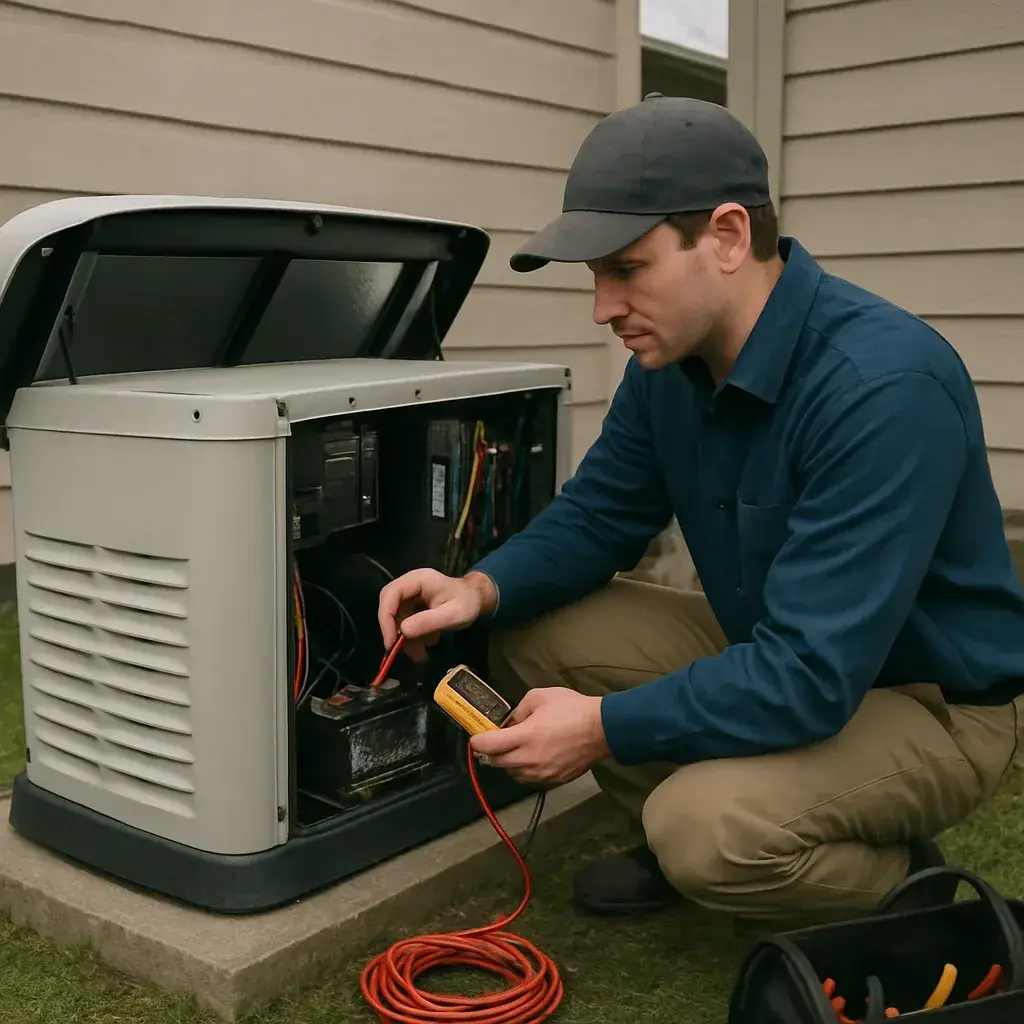
A weak battery is the most common thing we find during a generator annual service call across the Dallas-Fort Worth area. The generator can sit there looking fine in the yard, then hesitate, crank slow, or fail to start when the transfer switch calls for it. Most homeowners never spot that on their own. The unit only has to prove itself during an outage.
Standby generator batteries work differently than a car battery. They sit in a trickle-charge state for months, waiting for one moment to matter. Texas heat is hard on any lead-acid battery, and a generator pad in full sun through a Sunnyvale or Rockwall summer will age a battery faster than one sitting shaded in Frisco or Allen. Corrosion at the terminals, sulfation from long idle periods, and normal age all chip away at cranking power before the battery fully dies. A battery can look fine and still not have enough punch left to turn over the engine during an actual outage.
This is why the start-sequence test is part of our generator annual service instead of just an oil change and a walk-around. We run the transfer switch through its paces and watch how the unit starts, not just whether the battery reads a voltage on a meter. A battery with an acceptable resting voltage can still fail under the real load of cranking a cold engine. That difference only shows up when we put it through the motion the generator would go through during a storm.
The performance and safety check that comes with the visit covers the battery along with the rest of the starting system, connections, and terminals. If we find corrosion building up, we’ll note it during the inspection. What we won’t do is quietly swap a battery and call it part of the service. Battery replacement, like any other repair work we find, gets quoted to you separately before we do anything, the same way it would for a blown fuse or a bad transfer relay. That’s how our generator annual service visit stays a flat, predictable inspection rather than a surprise bill.
If you want us to look closer at battery age or connection wear between annual visits, that’s a fair ask worth mentioning during your appointment rather than assuming it’ll show up on its own. A battery that’s five or six years old is worth a conversation even if it’s still starting the unit fine today.
Oil and Filter Wear Happens Even When the Generator Barely Runs
Most standby generators in North Texas sit quiet for months, then run a self-test for twenty minutes a week. Oil doesn’t wear out just from hours on the clock. It breaks down from sitting, from heat swings, and from the short exercise cycles the generator runs on its own. A generator in a Frisco backyard that’s never seen a real outage can still have oil that’s gone bad.
Every time the engine starts and runs that weekly self-test, it heats up, then cools back down before it’s fully warmed through. That start-stop pattern lets condensation build inside the crankcase. Mix that with Texas humidity most of the year, and the oil picks up moisture it wouldn’t get from steady, sustained running. Over a year, that moisture and the byproducts of combustion break down the oil’s ability to protect the engine, even if the generator only logged a few actual hours.
The air filter tells a different story. Generators live outside, usually against the side of the house or on a pad near the property line, and they pull in whatever’s in the air around them: mowed grass clippings, cottonwood fluff in spring, construction dust if you’re in a newer Prosper or Celina subdivision still being built out. None of that requires the generator to run long to build up. A filter can look fine at a glance and still restrict airflow enough to strain the engine when it finally carries a real load during an outage.
What we notice on these visits is oil that’s darker or thinner than it should be for the hours logged, filters with a fine gray film of dust packed into the pleats, and sometimes a musty smell from moisture sitting in the housing. None of that means anything’s failed. It’s just what a year of sitting outside in North Texas does to an engine that’s mostly idle (and that’s the part people overthink).
Our annual visit changes the oil and filter regardless of what the hour meter shows, because hours aren’t the whole story here. We also run the transfer switch and start sequence to confirm the generator picks up the load the way it’s supposed to, not just that the engine turns over. A generator that starts fine but stumbles on transfer is still a generator that won’t carry your house through a storm.
If we find something during the inspection that goes past a standard oil and filter service, like a battery on its way out or a fitting that needs attention, we’ll quote that separately before doing any of it. The annual visit itself is the inspection, the oil and filter change, and the performance and safety check. Anything beyond that is your call, priced and explained before we touch it.
A Successful Manual Start Doesn’t Confirm the Automatic Transfer Switch Works
Most homeowners test their generator by walking out, pressing the manual start button, and watching the engine fire up. That tells you the engine runs. It tells you nothing about whether the unit will take over your house the next time the power drops. Those are two different jobs, done by two different parts, and mixing them up is one of the most common misunderstandings we run into with backup power.
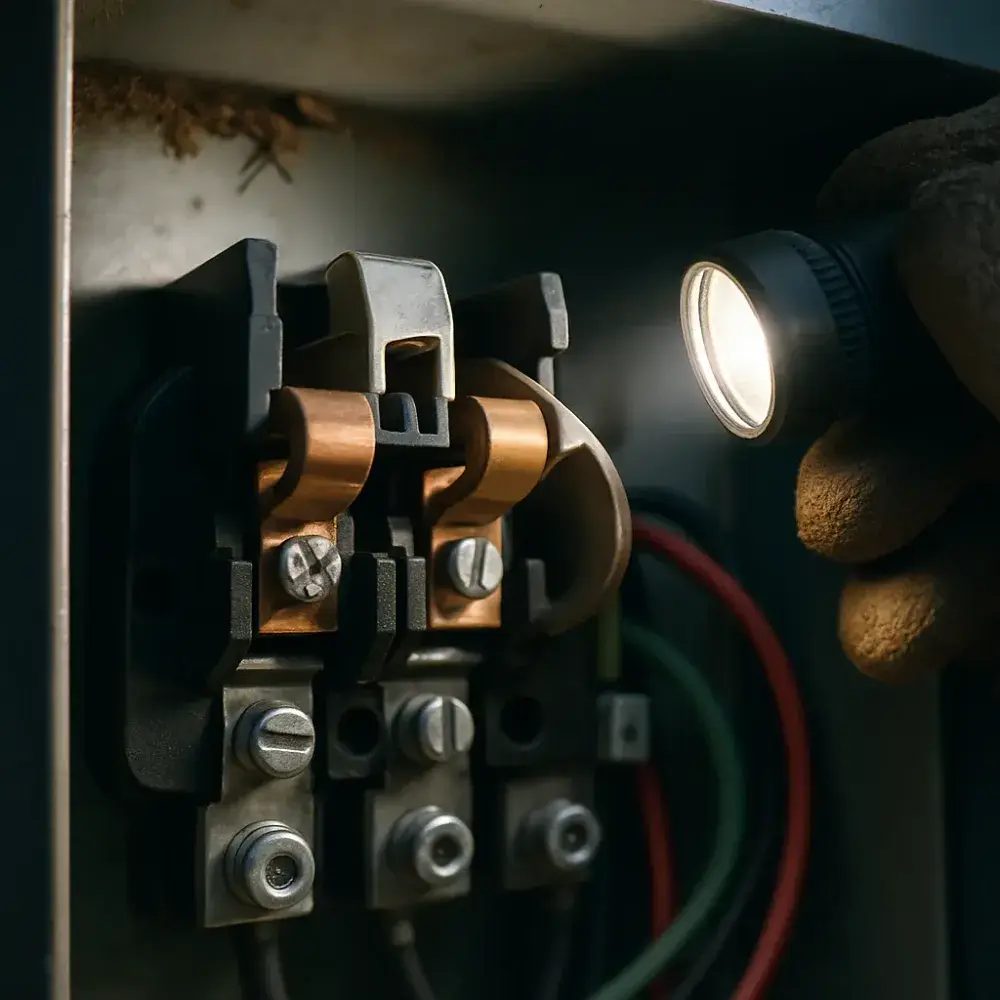
The engine and the automatic transfer switch operate on separate logic. A manual start just cranks the motor. It skips the sensing circuit that watches your utility line, the relay that decides power is gone, and the switching mechanism that moves your panel from grid power to generator power without you lifting a finger. A generator can start every time you push the button by hand and still fail to transfer automatically when a storm knocks out the grid at 2am. We’ve opened transfer switch cabinets in Sunnyvale and Rockwall and found corrosion building up on the contacts from years of North Texas humidity, sitting quietly behind a unit that always started fine on command.
This is why our yearly visit includes a transfer and start-sequence test as its own step, separate from the oil and filter service. We cut simulated power to the panel and watch the whole sequence happen the way it would during a real outage: the controller sensing the loss, the engine starting on its own, and the switch physically moving load over to the generator. Then we let it sense utility power coming back and watch it transfer home and shut the engine down. If any part of that chain hangs up, that’s what matters, because the engine running isn’t the point. The point is your lights coming on without anyone home to flip anything.
We’ve also seen wiring at the transfer switch chewed by rodents nesting near the cabinet’s warmth, and control boards that pass every self-check but hesitate on the actual transfer signal under load. Neither shows up on a manual start. Both show up on a proper transfer test.
Here’s the limit worth knowing: this yearly visit checks the equipment as it’s set up today. If your transfer switch is old or was installed by someone else years back, we test what’s there and tell you plainly what we find, but we can’t promise a switch nearing the end of its life will keep passing that test indefinitely. Any repair work the visit turns up gets quoted and approved separately before we touch anything.
Watch Our Video
See How We Handle Generator Annual Service in Sunnyvale
Xtreme Air Services — Serving Sunnyvale and surrounding areas
Thinking about Generator annual service? Let’s talk.
Call Today, Get Service Today. Xtreme Air Services is ready to help.
Pests and Debris Can Affect Outdoor Generator Enclosures Between Uses
Most standby generators sit outside for months without running a full cycle, and that quiet time is when small critters and yard debris move in. During our annual visits across the Dallas-Fort Worth area, we regularly find wasp nests tucked behind the exhaust louvers, spider webs strung across the control panel, and mud dauber tubes packed into air intake vents. None of that is a sign anything was done wrong. It’s just what happens when a metal enclosure with warm, dry air pockets sits next to landscaping for eleven months at a time.
Rodents are the bigger concern. Mice and rats chew on wire insulation for nesting material, and a generator’s control wiring is an easy target if there’s any gap around a conduit or door seal. We’ve opened enclosures and found chewed low-voltage wires that would have kept the unit from starting during an outage, which is the whole reason the transfer and start-sequence test is part of every visit. If we find chewed wiring, we’ll point it out and quote the repair separately since it falls outside the standard inspection.
Leaves, grass clippings, cottonwood fluff, and pollen are the other common find, especially on units set near trees or close to a fence line. This debris tends to collect around the cooling fins and air filter, and in enough volume it can restrict the airflow the unit needs to run at full load. A generator that’s been sitting since last storm season can build up a surprising amount of debris in the housing, even with a solid-looking cabinet.
None of this means a generator needs attention more than once a year in typical conditions. It does mean a once-a-year inspection is doing real work rather than just checking a box. Our visit includes a full inspection, so debris and pest damage get caught and documented, not just the oil and filter change. We can’t promise a generator will stay pest-free between visits. Wildlife doesn’t work off a maintenance schedule, and a unit near a wood pile or dense shrubs will always draw more interest from bugs and rodents than one on an open concrete pad. What we can tell you is that the inspection is built to catch it before it turns into a no-start situation during a power outage, which is the one time a generator has to work.
If you notice increased insect activity around your unit between service visits, trimming back vegetation a foot or two from the enclosure and keeping the area clear of leaf litter goes a long way. Anything beyond that is part of what we check during our generator annual service visit rather than something we’d ask a homeowner to inspect on their own.
Repair Work Found During the Visit Is Quoted Separately From the Service
The annual visit covers a set list: oil and filter change, a full inspection, the transfer and start-sequence test, and a performance and safety check. That’s what the visit price includes. If a technician finds something the generator needs beyond that list, we don’t fold it into the same charge or start fixing it without asking you first. We write it up as a separate, flat-rate repair quote and go over it with you before any work happens.
This comes up more than you’d think. A generator that’s been sitting most of the year can develop a weak battery, a corroded terminal, or a small coolant leak that never shows up until someone runs the load test. We’ve seen units pass a quick glance but stumble the moment the transfer switch kicks the load over. That’s the whole reason we run the test instead of just eyeballing the unit.
When that happens, the technician explains what was found, in plain language, and what fixing it would involve. You get a number in writing before you approve anything. There’s no pressure to say yes on the spot and no work started on your account without your sign-off. If the fix is small, like a filter or a sensor, we can often handle it the same visit. If it’s bigger, like a transfer switch issue, we’ll schedule it separately so it gets the attention it needs instead of being rushed at the end of a maintenance stop.
We’ll also tell you plainly if something looks fine but is getting old. A battery at four or five years, for instance, doesn’t need to be replaced during the visit, but we’ll mention it so it’s not a surprise at the worst time, like the middle of a summer storm outage. It’s not our job to talk you into replacing parts that are still doing their job.
One thing worth knowing going in: the service call fee for the annual visit gets credited toward any repair you decide to move forward with, so you’re not paying twice to get the same problem looked at and then fixed. For homeowners weighing whether an annual visit is worth booking at all, our generator annual service page lays out what’s included and what typically runs extra, so there’s no guessing before we’re standing in your driveway.
We back every repair we do with our workmanship warranty on the labor, plus the manufacturer’s warranty on any parts installed, the same as we do on the rest of our HVAC, electrical, and generator work.
See our full generator annual service in Sunnyvale for what the complete job involves.
Ready to Get Started?
Call 972-288-2263 Today, Get Service Today.