

What People Commonly Ask About Generator Sizing / Consultation
Straight answers to the questions Sunnyvale homeowners ask before sizing a standby generator.
What’s Covered on This Page
- Generator Sizing Recommendations Are Based on Circuit and Appliance Load, Not a Square-Footage Guess
- Air Conditioner and Heat Pump Startup Surge Is a Common Sizing Factor
- Whole-Home and Essential-Circuits-Only Sizing Are Two Different Calculations
- Panel Age and Capacity Can Affect What’s Installable
- Gas Line and Propane Tank Capacity Can Limit Generator Size
- What’s the most common mistake people make before asking for a sizing consultation?
- Will you need to see my electrical panel, or can this be sized from a floor plan?
- Will you recommend a bigger generator than I need?
- Does having two AC units mean I need double the generator capacity?
- What if I want to keep something less common running, like medical equipment or a freezer?
Generator Sizing Recommendations Are Based on Circuit and Appliance Load, Not a Square-Footage Guess
A lot of people call us assuming a bigger house needs a bigger generator, the same way a bigger house needs a bigger AC system. Backup power doesn’t work that way. A 3,500 square foot home with a couple window units and a gas stove can need less generator capacity than a 1,800 square foot home running a well pump, a sump pump, and a home office with three monitors. Square footage measures space. It doesn’t measure amps.
What actually drives the number is your electrical panel and what’s on it. We look at circuits, not floor plans. That means checking the AC condenser’s starting and running watts, the refrigerator, the furnace blower, any well or sump pumps, and anything else you’d want alive during an outage, like medical equipment or a garage full of freezers. Some of these draw far more power just to start than they do to keep running, and that startup surge matters as much as the steady load.
Priorities factor in too. Two homes with identical electrical panels can end up with two different recommendations, simply because one owner wants whole-house coverage and the other only wants the kitchen, a bedroom, and the internet running. Neither answer is wrong. It just changes the math.
- What runs on your panel now, including major appliances, pumps, and HVAC equipment
- Which circuits you want backed up versus which ones you can live without during an outage
- Startup power spikes from motors like AC compressors and well pumps, not just their running wattage
- Whether you’re leaning toward whole-home standby power or a more limited setup
If your goal is whole-home coverage, that changes both the recommendation and the conversation, since we’re then sizing for everything on the panel at once instead of a chosen subset. We’ll tell you plainly if what you’re describing needs more generator than you were expecting, because undersizing a generator just moves the frustration from the storm to the day you actually need it.
Air Conditioner and Heat Pump Startup Surge Is a Common Sizing Factor
One thing that trips people up more than anything else is the surge an air conditioner or heat pump pulls the moment it kicks on. A generator that looks big enough on paper can still stall or shut down the second the compressor tries to start.
Here’s what people usually notice first. They add up the running watts listed on their AC unit, pick a generator that covers that number, and figure they’re done. Then during a real outage the lights dim hard, the generator bogs down, or the unit simply won’t fire up. It’s confusing, because the math looked right.
The reason is startup draw. A compressor, whether it’s in a central air conditioner or a heat pump, needs a short burst of extra current just to get the motor spinning. That starting draw can run two to three times higher than the unit’s normal running draw, and it only lasts a second or two. We size that surge into the calculation, not just the steady running load, because a generator sized only for running watts will struggle every single time that compressor cycles on.
This is exactly what we look at during a generator sizing consultation. We calculate the home’s total load, then look specifically at the compressor’s starting draw for the AC or heat pump, along with anything else that has a motor, like a well pump or a refrigerator. We also talk through whether a soft-start device makes sense for the compressor, since that can lower the surge the generator has to handle. It changes what size generator actually makes sense for the home.
If a home has two AC units, an older heat pump, and a couple of other motor-driven appliances, running through the actual starting loads for each one matters more than eyeballing a total watt count off a spec sheet. We’d rather walk through the real numbers with you than hand over a size that looks fine on paper until the first hot afternoon it’s actually needed.
Standby generator installation, transfer switch work, and load testing are separate steps we handle once a size is settled, but the sizing conversation itself comes first and stands on its own.
Whole-Home and Essential-Circuits-Only Sizing Are Two Different Calculations
People come to us with two different questions that sound alike but aren’t. One is what size generator runs my whole house? The other is what size generator keeps my important stuff running? Those two questions lead to different math, different equipment, and different budgets, so we ask which one you’re trying to solve before we calculate anything.
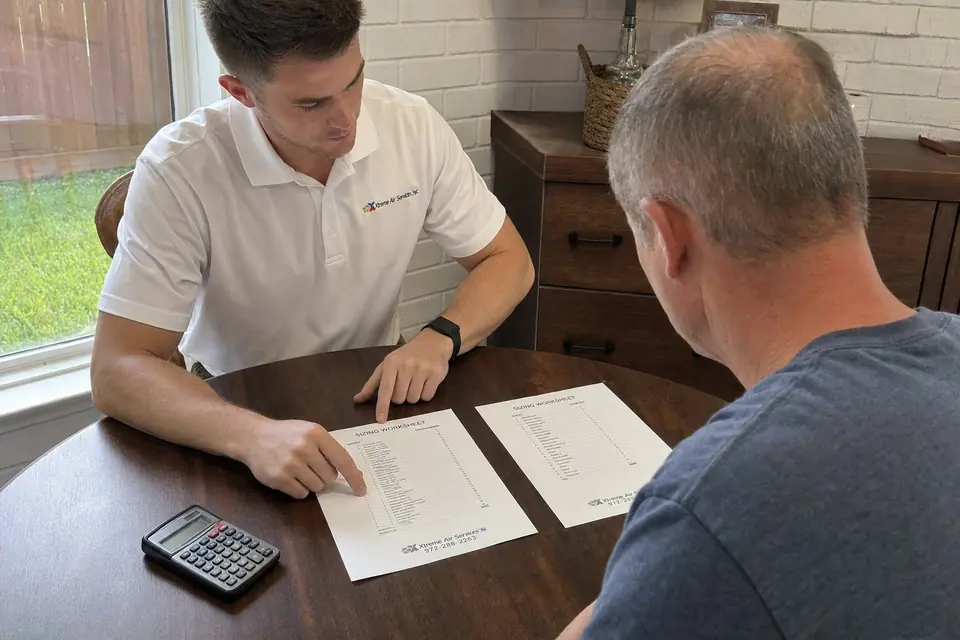
A whole-home calculation adds up every major load in the house: your AC condenser and air handler, your electric water heater or furnace blower if you have one, your kitchen appliances, and every outlet and light circuit in the panel. Central air conditioning is usually the biggest single number in that math, especially on a Texas summer afternoon when the compressor is working hard. Whole-home sizing means nothing shuts off during an outage. It also means a bigger, more expensive generator.
An essential-circuits calculation is narrower on purpose. We work with you to pick a shorter list, maybe the refrigerator, a few lights, the garage door, a well pump if you have one, or the AC on a smaller unit, and size the generator to that load instead of the whole panel. This is done through a transfer switch wired to only those circuits, so the rest of the house stays dark during an outage while the essentials keep running.
- Whole-home: every circuit in the panel stays live, sized to the highest combined load in the house
- Essential-circuits: a defined, smaller list of circuits stays live, sized to just that list
- The transfer switch, not just the generator, is what decides which circuits get power
- Central AC load is often the deciding factor in which path makes sense for the budget
Essential-circuits isn’t just a cheaper version of whole-home. It’s a different design with its own transfer switch wiring and its own generator size, so switching plans later isn’t a small change. That’s why we walk through this at the front end instead of after equipment is already picked out.
Neither path is automatically the right call. A smaller home with a window unit or two might get everything it needs from an essential-circuits setup. A larger home running central air off one or two systems usually needs the whole-home number to deliver what people picture when they hear backup power. We lay out both during the consultation so you’re deciding with real numbers instead of a guess.
Need help with Generator sizing / consultation?
Call Today, Get Service Today. Xtreme Air Services is ready to help.
Panel Age and Capacity Can Affect What’s Installable
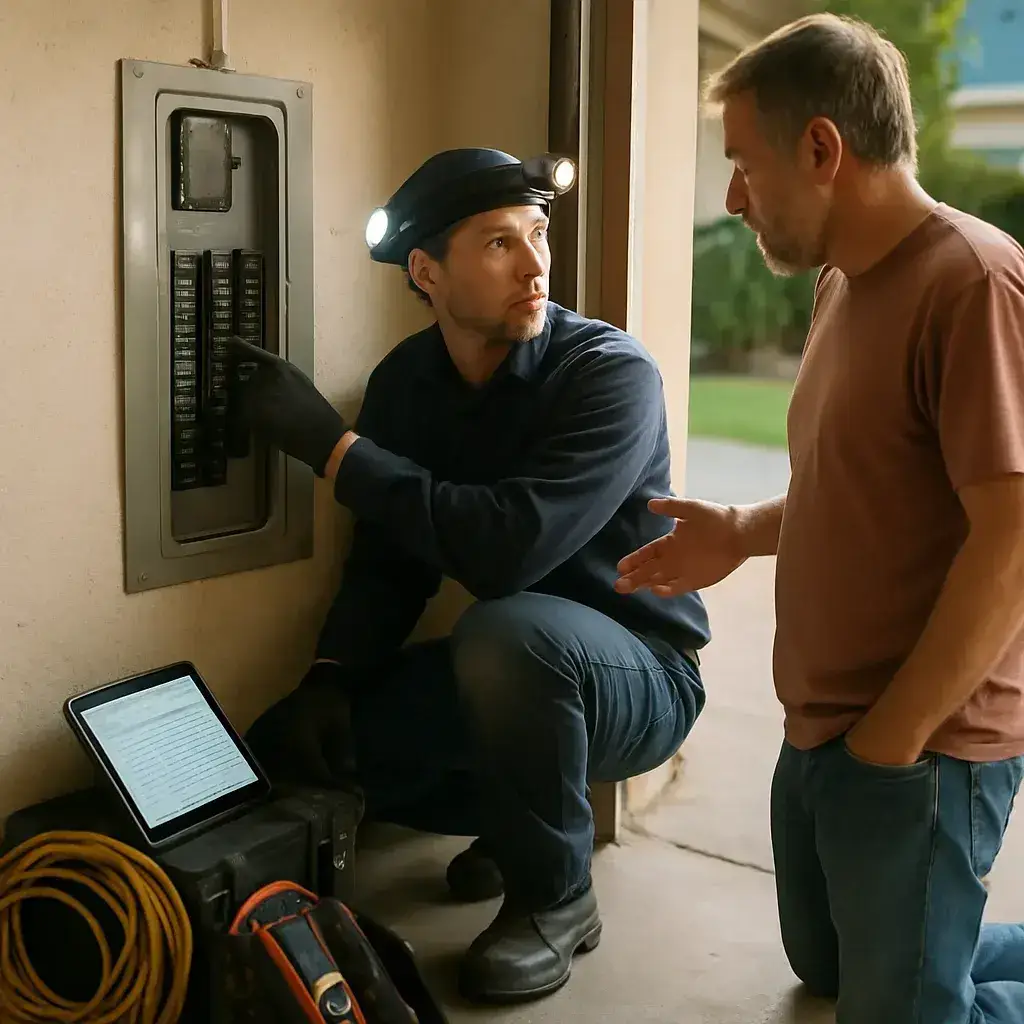
A lot of homeowners assume sizing a generator is only about the equipment outside the house. But the panel inside your garage or utility room matters just as much. Older panels, especially ones original to homes built decades ago across North Texas, sometimes don’t have the capacity or physical space for a transfer switch without some rework.
During a generator sizing consultation visit, we look at your panel’s age, amperage rating, and how much room is left inside it. A 100-amp panel from an older subdivision carries less headroom than a newer 200-amp panel, and that changes what backup setup makes sense for the loads you want covered.
Going into this, people are often unsure whether their home can even support the generator size they had in mind. Panels get added onto over the years as homeowners add pools, workshops, or EV chargers, and a panel that once had plenty of open capacity ends up close to full. That’s not a problem with the home, it’s just what happens as electrical demand grows over 20 or 30 years.
We check panel capacity as part of the sizing consultation itself, alongside the transfer switch installation and generator pad placement questions. If the panel needs attention before a generator can go in the way you want, we’ll tell you that plainly rather than size around a problem that shows up later. In some cases panel work becomes part of the plan. We offer electrical panel replacement and upgrade as a separate service if that turns out to be the right path, but it’s only added when the panel itself is the limiting factor.
- Panel amperage rating (60, 100, 150, or 200 amp are common across DFW homes)
- How much open breaker space is left inside the panel
- Whether a transfer switch can be added without a panel change
- Age and condition of the panel itself, since older panels sometimes have outdated breakers or bus bars
This is one of the more genuinely case-by-case parts of sizing a generator. Two homes on the same street, built the same year, can have completely different panel situations depending on what work’s been done since. We won’t tell you a panel is fine over the phone. We’ll walk into the garage, open the panel cover, and look for ourselves before we say anything definite about what our generator sizing consultation can recommend for your setup.
Gas Line and Propane Tank Capacity Can Limit Generator Size
Fuel supply is one of the most common surprises we run into during a backup power assessment. A homeowner has already picked a generator size in their head, usually based on square footage, and finds out the existing gas line or meter can’t feed it. Bigger standby generators simply need more fuel volume than most homes are currently set up to deliver.
On natural gas, the limiting factor is usually the gas meter and the line running to where the generator will sit. Older homes in established neighborhoods across Dallas, Mesquite, and Garland were often plumbed decades ago for a furnace, a water heater, and a gas range, which is a modest load. A 20kW or 22kW standby generator can call for several hundred cubic feet of gas per hour, on top of everything already running. If the existing line or meter wasn’t sized for that, the generator won’t get enough fuel to produce its rated output, and it may not run at all under a full load.
On propane, the limit is usually tank size and whether it’s above ground or buried. A smaller tank can supply a portable or lower-output unit fine, but a larger whole-home standby generator running through an extended outage will draw down a small tank fast. Continuous run time on propane depends directly on tank capacity, not just the generator’s rated size.
Fuel supply gets checked as part of the sizing conversation, not treated as an afterthought once equipment is already picked out. We look at current meter capacity, measure the existing line, and calculate the combined demand of the generator plus the appliances already running on that same gas system. For propane, we look at tank size and placement relative to where the unit will sit.
When the supply comes up short, there are a few real paths forward, and we’ll lay them out plainly rather than push toward the most expensive one. Sometimes the fix is a larger gas meter through the utility company. Sometimes it’s a shorter run of larger-diameter gas line. Other times, the more practical answer is choosing a smaller generator that the existing supply can support, or moving to a bigger propane tank if propane is already the fuel source. Each of those comes straight out of the load and fuel calculation we do during the consultation.
- Older gas lines and meters were sized for household appliances, not for an added generator load
- Propane tank size and placement affect how long a generator can run during an extended outage
- A smaller generator that matches the existing fuel supply is sometimes the more workable choice than upsizing gas service
See our full generator sizing and consultation service in Sunnyvale for what the complete job involves.
Frequently Asked Questions
Common questions about Generator Sizing / Consultation in Sunnyvale
What’s the most common mistake people make before asking for a sizing consultation?
Most people assume a bigger house automatically needs a bigger generator, the same way it needs a bigger AC system. That’s not how backup power works. A smaller home running a well pump and a home office can need more generator capacity than a much larger home with simple appliances. Square footage doesn’t tell us what’s on your electrical panel. We’d rather walk through your actual circuits with you than start from a guess based on home size. We have handled plenty of these across Sunnyvale over the years.
Will you need to see my electrical panel, or can this be sized from a floor plan?
We need to look at your panel, not your floor plan. Floor plans measure space, but they don’t tell us anything about amps, circuits, or what appliances and equipment you’re running. During the consultation we check things like your AC condenser, refrigerator, furnace blower, and any well or sump pumps, since those are the loads that drive the sizing number.
Will you recommend a bigger generator than I need?
No. We size to the circuits and appliances you tell us matter, not to a bigger number than your home requires. If you’re only backing up a few rooms, the recommendation reflects that shorter list. If your goal is whole-home coverage, the number goes up because we’re sizing for everything on the panel at once. Either way, the size we land on matches what you’ve told us you want running.
Does having two AC units mean I need double the generator capacity?
Not automatically. Two AC units, an older heat pump, or other motor-driven appliances each have their own starting draw, and that draw doesn’t just add up in a simple way. We run through the actual starting loads for each unit instead of doubling a single number off a spec sheet. That’s a more accurate way to land on a size that holds up the first time it’s needed.
What if I want to keep something less common running, like medical equipment or a freezer?
We factor that in as part of the consultation. Anything you’d want alive during an outage, including medical equipment or a garage full of freezers, gets added to the load calculation alongside standard items like the refrigerator and AC condenser. Priorities like these are part of why two homes with identical panels can end up with two different generator recommendations.
Ready to Get Started?
Call 972-288-2263 Today, Get Service Today.