


What Problems Come Up Most Often With Dryer Vent Cleaning?
The dryer vent problems we see most often, from long dry times to crushed hose and pest nesting.
What’s Covered on This Page
- Longer Drying Times Are the Most Common Sign People Notice
- Exterior Vent Caps Are a Common Entry Point for Birds and Pests
- Crushed or Kinked Vent Hose Behind the Dryer Can Limit Airflow
- Roof-Terminated and Long Vent Runs Take More Time to Service
- Clogged Vents Are a Recognized Fire Risk in National Fire Data
Longer Drying Times Are the Most Common Sign People Notice
You load the dryer, run a normal cycle, and pull out clothes that are still damp. So you run it again. Maybe a third time. That’s the sign we hear about most from homeowners across Sunnyvale and the rest of the DFW Metroplex before they book a dryer vent cleaning.
Here’s why it happens. Every load of laundry sheds lint. The lint trap in the dryer door only catches part of it. The rest travels down the vent line. Over time it builds up along the walls of the duct. This narrows the path the hot, moist air needs to escape. Less air movement means the dryer has to work harder and longer to pull moisture out of your clothes.
Vent length and routing make a real difference here. A short, straight shot to an outside wall clears lint differently than a vent that runs up through the attic and out the roof with a couple of turns. Longer runs and roof terminations give lint more surface area to catch on. So homes with those setups tend to notice slower drying sooner.
Another thing we’ve noticed: the dryer’s own settings can mask the problem for a while. Sensor-dry cycles adjust run time based on moisture. A partially blocked vent might just mean a longer cycle rather than a load that comes out wet. That’s why some homeowners don’t notice anything unusual until the drying time has crept up gradually over months.
When we come out for a dryer vent cleaning, we clear the lint and debris from the full vent line. We test airflow and exhaust before we leave. You know the path is open again, not just visually clear near the wall opening. If we find something during the visit that needs more than a standard cleaning, like a damaged section of duct, that’s handled as its own conversation and its own quote.
This is also a job we handle as straightforward air duct cleaning work. We do it alongside HVAC duct and vent cleaning for homes that want both looked at the same visit.
If you want to see what a visit like this typically runs, our dryer vent cleaning pricing page breaks down the range and what moves it.
Exterior Vent Caps Are a Common Entry Point for Birds and Pests
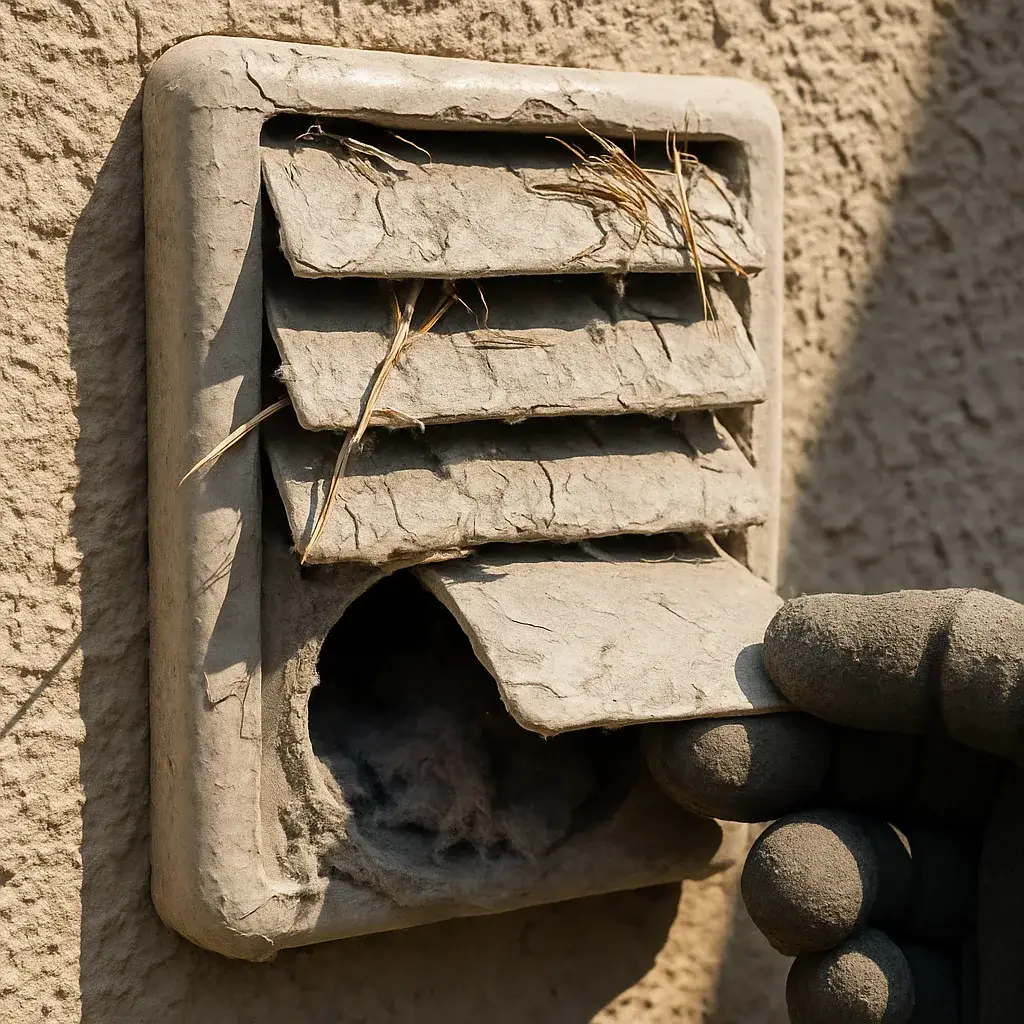
The vent cap outside your home is usually the first thing we look at. It’s a small hood, often with a flapper or louvers. It mounts where the dryer vent exits the wall or roof. In Sunnyvale and across the DFW Metroplex, that cap takes a beating. Summer heat cycles crack plastic housings. Wind and hail knock caps loose or bend the flapper so it won’t close all the way. A cap that hangs open or has a broken flapper gives birds and small pests an easy way in (especially on homes with roof terminations near tree lines or open fields).
You’ll usually notice a flapper that doesn’t swing shut. Or a cap that’s visibly bent or missing pieces. Sometimes it’s nesting material bunched at the opening. Occasionally, it’s a scratching or fluttering sound near the vent when the dryer isn’t running. This means the exterior hardware took weather damage or wasn’t sealed tight to begin with.
- Flapper stuck open or missing entirely
- Cracked or dented plastic or metal cap housing
- Nesting material or feathers at the vent opening
- Cap mounted loosely and rattling in the wind
One thing we get asked about is mesh screens homeowners add over the cap to keep birds out. We don’t recommend them. Lint catches on the mesh fast. A clogged screen restricts exhaust airflow the same way a blocked vent line does. It solves one problem and creates another.
During our dryer vent cleaning visit, we clear lint and debris the full length of the line. We check that exhaust is moving properly. This includes looking at the exterior termination and flapper action. If the cap itself is cracked, undersized, or needs to be replaced or resealed, that’s outside the scope of the cleaning. That gets quoted as a separate repair. You can see what’s included and what isn’t on our dryer vent cleaning service page before you book.
Crushed or Kinked Vent Hose Behind the Dryer Can Limit Airflow
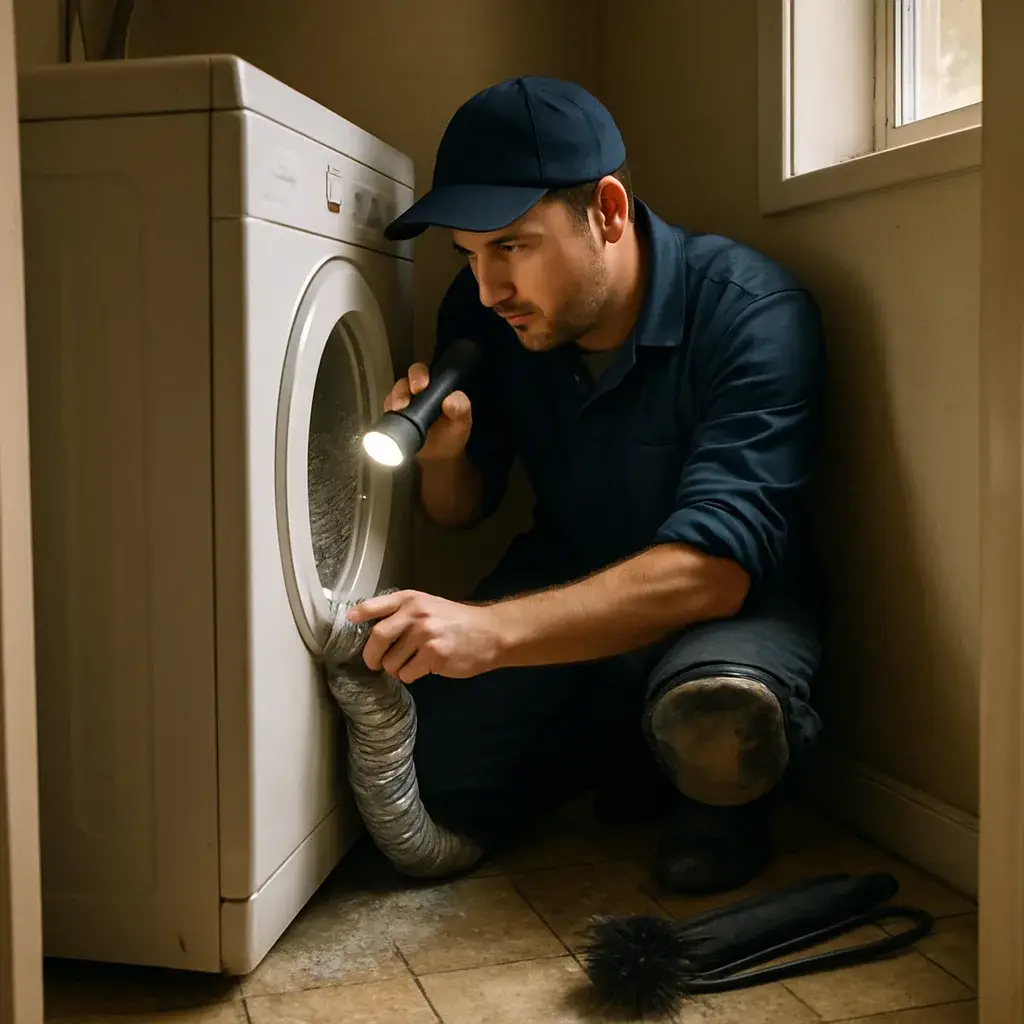
A crushed or kinked hose behind the dryer is one of the most common things we find when we pull a machine away from the wall. Homeowners usually notice it as clothes that take two cycles to dry. Maybe a hot laundry room. Or a burning smell that wasn’t there before. The dryer runs fine on paper, but the exhaust has nowhere to go.
This happens because most dryers get pushed back close to the wall after a move or a delivery. The flexible hose behind it gets pinched in the process. Many older homes in Sunnyvale and across the Dallas area still have the foil or plastic accordion-style hose instead of rigid or semi-rigid metal duct. That accordion style folds easily. Once it’s folded, lint builds up right at the crease instead of moving through.
We also see this in newer subdivisions where the laundry room is tight. The dryer sits just inches from the wall. There’s barely room for a straight run. So the hose bends sharp right where it connects to the wall vent. That bend is exactly where lint likes to collect first.
When we’re on site for dryer vent cleaning, checking the hose behind the machine is part of the visit. We clear the line and test airflow at the exterior termination to confirm exhaust is moving the way it should. If the hose itself is crushed, damaged, or the wrong type for a safe, code-compliant run, that’s a separate repair from the cleaning. We’ll quote it on its own rather than bundle it in.
It’s worth knowing this isn’t always fixed by cleaning alone. A hose that’s physically bent or pinched behind a dryer that sits close to the wall can restrict airflow even right after a full cleaning. Moving the dryer out a few extra inches or swapping to rigid duct sometimes matters more than the cleaning itself.
General pricing for the cleaning visit and what moves the cost is on our pricing page, if you want the range before you call.
Ready when you are – get in touch today.
Call Today, Get Service Today. Xtreme Air Services is ready to help.
Roof-Terminated and Long Vent Runs Take More Time to Service
Not every dryer vent takes the same amount of time to clean. The biggest reason is where the vent ends up outside the house. A short run to a nearby exterior wall is a straightforward job. A vent that climbs through the attic and terminates on the roof is a different project.
We see roof terminations often in homes where the laundry room sits in the middle of the house instead of against an outside wall. That layout is common in both older slab homes around Sunnyvale and some newer subdivisions built with the laundry room tucked off a hallway. When that’s the setup, the vent has to run through the attic, sometimes 20 feet or more, before it reaches open air on the roof.
Longer runs mean more turns. More turns mean more spots where lint settles instead of blowing straight through. A vent with two or three 90-degree bends holds more lint at each bend than a straight shot to a wall cap. Roof access itself adds time too, since it means getting on the roof safely and working from up there instead of standing at a wall cap with a ladder.
- Vent length and how many turns it makes between the dryer and the outside
- Roof termination versus a wall cap on the side of the house
- How much lint and debris has built up along the way
- How easy the vent is to reach from the attic, a closet, or behind the dryer
None of this is a reason to put the job off. It’s just a reason the appointment for a roof-terminated vent in a two-story house runs longer than one for a single-story home with the laundry room against an outside wall. We look at the routing before we start so you know what the visit involves. Vent length and routing are two of the main things that move the price, which we break down on our dryer vent cleaning pricing page.
If your home was built with an attic-run vent system, or you’re not sure where your vent terminates, that’s a normal question to ask before scheduling. It helps us plan the visit correctly the first time.
Clogged Vents Are a Recognized Fire Risk in National Fire Data
The National Fire Protection Association tracks home clothes dryer fires every year. Failure to clean the dryer or its vent shows up as the leading factor across that data. That’s not a scare number we made up. It’s the reason dryer vent cleaning gets treated as a safety task and not just a maintenance nice-to-have.
Here’s the mechanism behind it. Lint builds up inside the vent line a little at a time. You usually can’t see it because most of the run is hidden in a wall, attic, or behind the machine. As lint collects, airflow drops. The dryer has to work harder and run hotter to push air through a narrower path. That heat gets trapped right around a material that burns easily. A vent that looks fine from the wall cap can still be packed with lint for most of its length.
What people usually notice before they ever think about the vent itself is a dryer taking longer to finish a load. Clothes come out hotter than normal. Or a burning smell that isn’t tied to anything in the load. Some notice none of it, because the buildup happens slowly and the dryer still technically runs.
This is one reason vent length and routing matter so much to how a job gets scoped. A short, straight run to an outside wall behaves differently than a long run that snakes through an attic and terminates on the roof. Roof terminations especially tend to hide buildup longer, since they’re harder to see and harder to reach.
When we do a dryer vent cleaning visit, we clear lint and debris from the full line, not just the accessible end. We test airflow and exhaust before we call it done. That test is what tells us the line is clear, not just that it looks better where we can reach it. If you want the full rundown on how that visit works alongside our other air duct cleaning services, our dryer vent cleaning page walks through it.
We’ll say plainly that not every clogged vent is a fire waiting to happen tomorrow. Risk builds with buildup, run length, and how often the dryer gets used. But the data is consistent enough that we don’t treat this as optional advice. We won’t tell a customer it’s fine to skip if we find a vent packed with lint during a visit.
Ready to Get Started?
Call 972-288-2263 Today, Get Service Today.