


Refrigerant Recharge / Leak Repair vs. Replacement: How We Help You Decide
Most leaks get repaired for $250 to $800 rather than replaced – the cost math behind that call, and the point where a failing major component makes replacement the better answer.
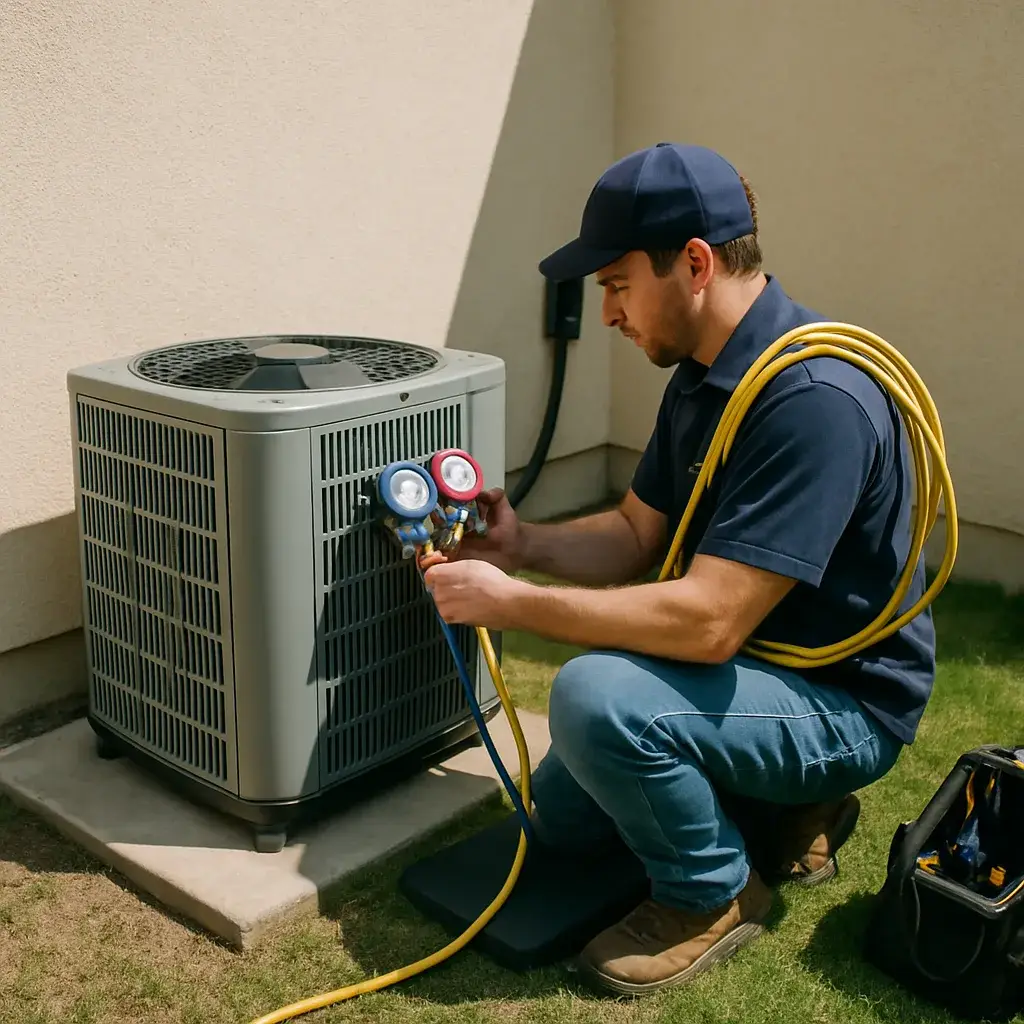
What’s Covered on This Page
- The Short Answer on Repair vs. Replacement
- The Factors That Decide It
- A Way to Think About the Cost Math
- When We’d Recommend a Repair
- When We’d Recommend Replacement Instead
- Related Links
- How do you decide whether my system needs a repair or a replacement, before you come out?
- What do homeowners get wrong most often when thinking about repair vs. replacement?
- Will you push me toward a replacement if a repair would work?
- When would you tell me to replace instead of doing the repair job?
- Is financing available if this turns into a replacement instead of a repair?
The Short Answer on Repair vs. Replacement
A refrigerant leak by itself almost never means you need a new system. It means a joint, coil, or line has a hole or a bad seal. Once we find it, we repair it and add refrigerant back to the correct level. That’s the whole job for most calls. Pricing for this category runs $250 to $1,500, but the common leak-repair-and-recharge job lands at $250 to $800.
What moves the price inside that range is pretty simple. It depends on how hard the leak is to reach, whether the part is on the truck or needs to be ordered, how old the equipment is, and if we find more than one failed component. Nights and weekends don’t add anything; we charge the same either way. Every visit starts with a $26 to $99 service call fee. That fee gets credited toward the repair if you move forward with us.
- Included in the flat repair price: diagnosis, labor, the standard replacement part, and a test run before we leave to confirm the fix holds.
- Not included: additional failed parts we find along the way, major components like a compressor or coil, code upgrades, or permits (those get quoted separately if needed).
- Financing isn’t typically set up for a job this size, but it’s available if the visit turns into a larger repair or a replacement.
If the leak is in a coil rather than a line or fitting, or the system is old and uses a refrigerant that’s getting harder to source, we’ll tell you straight. A repair might buy you a season or two, not a decade. We won’t push a repair just to avoid the bigger conversation. And we won’t push a replacement on a system that’s fixable. You can read more on our page about how we handle the R-410A and newer A2L refrigerants used in most current systems.
The Factors That Decide It
Most refrigerant leaks get repaired, not replaced. If we find the leak, the part is available, and the rest of the system is in decent shape, recharging and fixing the leak is usually the $250 to $800 job. Replacement gets recommended when the numbers or the system’s condition stop making repair worth it.
- How bad the leak is and where it’s located – a small fitting leak is a different job than a leak inside a coil.
- Whether the failed part is even available – older units sometimes use parts that are hard to source.
- The age and brand of the equipment – a 14-year-old system gets weighed differently than a 4-year-old one.
- Whether more than one component has failed at the same time.
- The refrigerant type in the system – R-410A and newer A2L refrigerants behave differently in cost and handling than older refrigerants.
A lot of homeowners don’t hear this until after they’ve paid for a diagnostic somewhere else: if your system runs on an older refrigerant that’s being phased out, recharging it can cost more per pound. It also gets harder to source every year. That’s a real factor in the repair-or-replace conversation. We’ll tell you straight if your unit is in that spot instead of just quoting the recharge and moving on.
Cost matters too. The $250 to $800 range covers diagnosis, labor, and the standard replacement part, plus testing and cleanup. It does not cover additional failed parts, major components, code upgrades, or permits; those get quoted separately if we find them. The service call itself runs $26 to $99. That fee gets credited toward the repair if you move forward with us.
None of this is a phone-guess situation. The extent of the leak, part availability, and how the rest of the system is holding up all get confirmed at your house, not before. You can read more about how we handle this job on our service page.
A Way to Think About the Cost Math
Most jobs like this run $250 to $800. The full range for this type of call is $250 to $1,500, depending on what we find. That’s the number to hold in your head while you think through the decision.
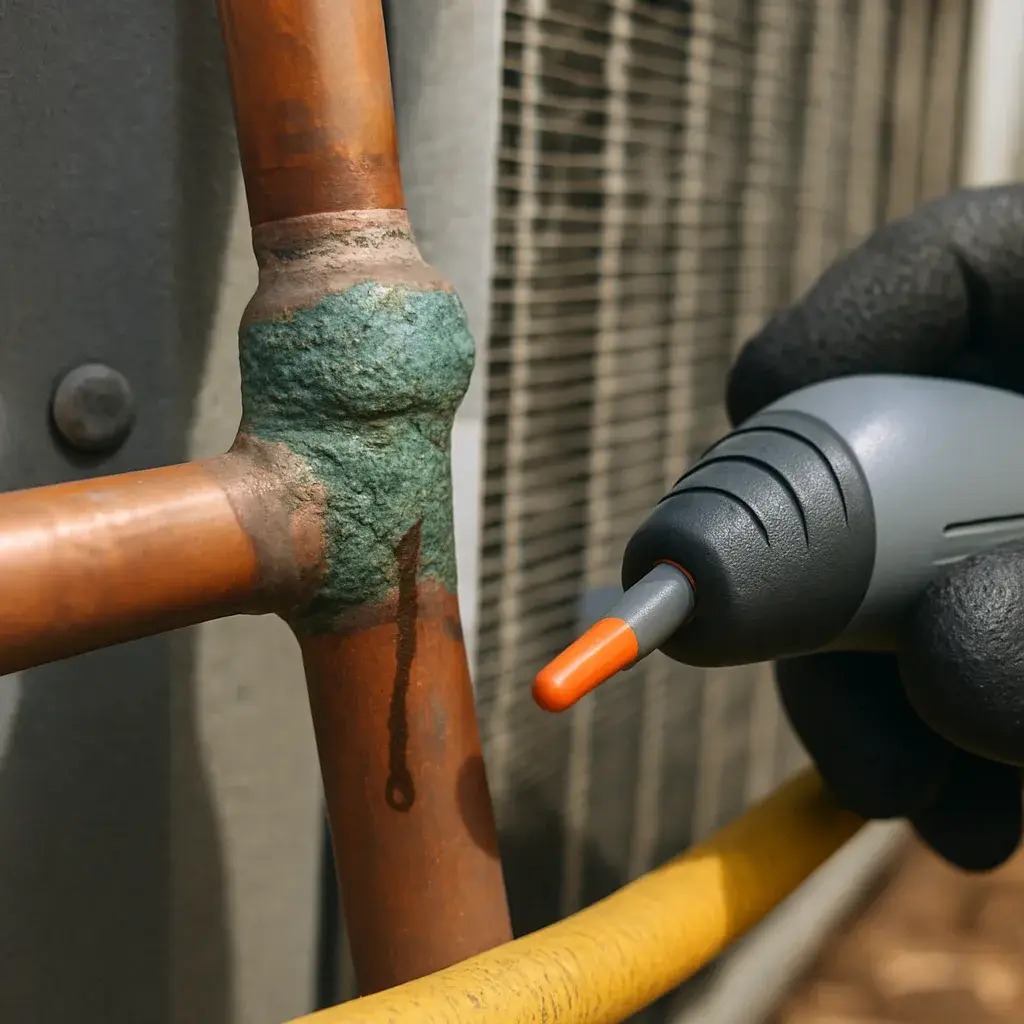
Here’s the math we walk through with you. A single leak, one bad valve or a pinhole in a coil, fixed and recharged, usually lands on the lower end. If the system uses R-410A or the newer A2L refrigerants, that affects both the repair cost and how much sense a recharge makes on an older unit. Refrigerant type and availability shift what parts and materials cost, after all.
A few things move the number up: how bad the leak is, whether the part is easy to get or has to be ordered, the age and brand of your equipment, and whether more than one component failed at the same time. None of that changes with the time of day. We charge no extra for nights or weekends. An after-hours call doesn’t tip the math against you.
What’s included in that price: diagnosis, labor, and the standard replacement part, plus testing the system afterward and cleaning up. What’s not included: additional failed parts we find along the way, major components like a compressor, code upgrades, or permits. Those get quoted separately, in writing, before we touch anything.
There’s also a $26 to $99 service-call fee to get a technician out. That fee gets credited toward the repair if you move forward with us. So if you’re on the fence about even having someone look at it, that fee isn’t wasted money if you decide to fix the problem.
The math gets simpler once you put a real number next to it. If your recharge and repair lands around $400 and a replacement would run several thousand, and the rest of your system is in decent shape, repair usually wins. If you’re facing a second or third leak on a unit that’s already old, that same $400 to $800 repair might just be buying a few more months. We’ll tell you what we find and let you decide with real numbers in front of you, not a guess.
Financing isn’t typically needed for a job this size; it’s more common on larger repairs and full replacements. You can see the fuller breakdown, including how repair and replacement compare side by side, on our service page.
Ready when you are – get in touch today.
Call Today, Get Service Today. Xtreme Air Services is ready to help.
When We’d Recommend a Repair
We’d recommend a repair when the system has one clear leak point, the unit isn’t too old, and the parts needed are still easy to get. Most calls like this fall between $250 and $1,500. The most common version of this job lands between $250 and $800. That covers locating the failed part, repairing or replacing it, adding refrigerant, and testing to confirm the system holds and cools correctly.
A repair makes the most sense on a system with a single, findable leak in a coil, line, or fitting. This is especially true for newer equipment or a unit that’s otherwise been reliable. If your home uses R-410A or the newer A2L refrigerants, we factor that into the recharge cost. These refrigerants aren’t priced or handled the same as the older stuff. One thing we’d tell you plainly: if a technician finds more than one failed component, or the leak is in a part that’s hard to source for your specific unit, the repair number can climb fast. At some point, replacement starts making more financial sense.
- Single leak point in a coil, line set, or fitting rather than multiple failure areas.
- Equipment age and brand where parts are still stocked or easy to order.
- No other major components showing signs of failure during the diagnostic.
- A system that’s been running fine otherwise, with this as an isolated issue.
Our diagnostic and repair pricing includes the labor, the standard replacement part, and testing and cleanup when we’re done. It doesn’t include additional failed parts we find along the way, major components like a compressor, code upgrades, or permits. Those get quoted separately before we touch anything. We charge a $26 to $99 service call fee to come out. That gets credited toward the repair if you move forward with us. Financing isn’t typically part of a job this size, but it’s there for larger repairs and replacements if the numbers end up pointing that direction.
If you want the fuller breakdown of what drives cost up or down on this kind of call, our team walks through it on our page. You can see it before we ever set foot on your property.
When We’d Recommend Replacement Instead
We’d steer you toward replacement when the leak points to a bigger problem than one bad part. A single failed schrader valve or a small line leak is a repair. A cracked evaporator coil on a 14-year-old system, or a second leak showing up a year after the first, is a different conversation.
Refrigerant type matters here too. Older systems running R-22 are working with a refrigerant that’s been phased out. It gets harder to source every year. That pushes the cost up fast if a recharge is even possible. Most systems we work on now use R-410A or newer A2L refrigerants. Those are more available and predictable to service.
This job itself typically runs $250 to $1,500. Most single-failure calls landing between $250 and $800. That covers diagnosis, labor, and the leaking part, plus testing and cleanup. It does not cover a second failed component, a major part like a compressor or coil, code upgrades, or permits. Those get quoted separately if we find them during the visit.
So the price of the repair itself isn’t usually what tips the decision. What tips it is what we find once we’re looking at the system. Equipment age and brand, whether one component failed or several, and how hard the specific part is to source all factor in. A 16-year-old unit with a failed condenser coil and a compressor showing wear is a case where putting more money into it doesn’t buy you much time.
We’ll walk you through what we find during the diagnostic visit before we touch anything. We give you a flat-rate quote either way. If replacement makes more sense, we’ll tell you that plainly instead of recharging a system that’s likely to leak again soon after. That’s part of what we cover in more detail on our air conditioning repair page, including what a full system evaluation looks like.
One thing worth knowing upfront: the $26 to $99 service call fee applies either way. But it’s credited toward the work if you move forward with us. Financing isn’t typically part of a smaller recharge and repair job, but it is available if the conversation turns to a full AC replacement.
For the full picture on what the repair involves before you decide, our refrigerant recharge and leak repair page covers each step.
Frequently Asked Questions
Common questions about Refrigerant recharge / leak repair
How do you decide whether my system needs a repair or a replacement, before you come out?
We look at where the leak is, whether the part is available, and how old the equipment is. A leak in a fitting or line usually points to repair, typically $250 to $800. A leak inside a major component, or an older unit already stacking up other issues, tips the conversation toward replacement. We confirm all of this at your house, not over the phone.
What do homeowners get wrong most often when thinking about repair vs. replacement?
The biggest misunderstanding is thinking any refrigerant leak means the whole system is done. Most leaks are a single failed joint, coil seal, or fitting, fixed and recharged for $250 to $800 on the same visit. Replacement only comes up when the leak sits in a major component or the system is old and already showing other problems. A leak by itself isn’t a verdict on the equipment.
Will you push me toward a replacement if a repair would work?
No. We won’t recommend a replacement on a system that still makes sense to fix, and we won’t push another repair just to avoid a harder conversation about an aging unit. If the leak is inside a coil, or the refrigerant type is getting hard to source, we’ll say so plainly. You decide with real numbers in front of you, not a guess.
When would you tell me to replace instead of doing the repair job?
I’d lean toward replacement when the leak is inside a coil rather than a fitting, when the refrigerant is getting hard to source, or when more than one component has failed at once. On an older system already stacking up issues, a $400 to $800 repair might only buy a few months. In that case, putting that money toward a system with a longer road ahead usually makes more sense.
Is financing available if this turns into a replacement instead of a repair?
Financing isn’t typically set up for a job this size, since most recharge and leak repairs land between $250 and $800. If the visit turns into a larger repair or a full replacement, financing options become available at that point. We’ll go over that alongside the number itself, so it isn’t a surprise later in the conversation.
Ready to Get Started?
Call 972-288-2263 Today, Get Service Today.