


Central Air Conditioning Installation in Dallas: Get the Size Right for Texas Summers
Central air sized to your home from day one, with what's included, what isn't, and the permits explained up front.
What’s Covered on This Page
- Signs Your System Needs Full Installation, Not Another Repair
- Why Correct Sizing Matters More Than Matching Your Old Unit
- What Happens During a Central AC Installation
- Permits and Licensing Requirements for Dallas Installations
- What Drives Central AC Installation Cost in Dallas Homes
- What is the $5,000 rule for AC units?
- How much does it cost to install central AC in a 2000 sq ft house?
- Are HVAC prices going up in 2026?
Signs Your System Needs Full Installation, Not Another Repair
Every repair call starts with the same question in your head: do I fix this again, or is it time to start over? Here’s how to tell. You don’t need to be an HVAC tech to spot most of these. You just need to know what you’re looking at.
- The big parts are failing on an older system. A dead compressor or a leaking indoor coil on a unit that’s well into its second decade is a tough repair to justify. You’d be putting a costly new part into a system where everything around it is just as worn.
- Your system runs on R-22 refrigerant. Older systems often use this refrigerant, and it’s become scarce and expensive to refill. If yours has a leak, each recharge gets harder to pay for.
- You’re calling for repairs every summer. One fix is normal. A new problem each July, from a fan motor to a capacitor to a leak, means the whole system is wearing out together.
- It can’t keep up on hot afternoons. If the thermostat says 74 but the house sits at 79 by late afternoon, your system may be undersized, worn out, or both. Dallas summers don’t let up, so a struggling unit runs nonstop and still loses.
- Your bills keep climbing. Older, less efficient equipment burns more power to move the same heat out of your home, and you see it on every bill.
- The house feels sticky. A system that cools but doesn’t pull moisture out of the air leaves you clammy even when the number looks right.
- Your outdoor and indoor parts don’t match. If one side was swapped years ago and the other is original, they may not be working well together. A new condenser and coil installed as a matched pair fixes that.
There’s also a Dallas twist. Many homes here have the air handler and ductwork up in the attic, where summer heat bakes everything. Equipment and connections up there wear hard. When a system has spent many summers in that heat, the parts you can’t see are often as tired as the ones that just failed.
Now the honest side. Plenty of problems don’t need a new system at all. If your AC is fairly new and you’ve got a bad capacitor, a worn contactor, a clogged drain line, a frozen coil from a dirty filter, or a failed fan motor, repair it. Those are normal parts that wear out, and fixing them can give you years more of good cooling. A newer system with one problem isn’t a replacement job, and nobody should tell you it is.
The gray area is a mid-age system with a mid-size repair. That’s where it helps to have someone lay out both options side by side: what the repair costs, what replacement costs, and how much life the old system realistically has left. Then you make the call with real numbers in front of you, not a guess and a sales pitch.
Why Correct Sizing Matters More Than Matching Your Old Unit
The easiest way to size a new AC is to read the label on the old one and order the same thing. It’s also one of the most common ways people end up with a system that never feels right. Your old unit’s size tells you what someone picked years ago. It doesn’t tell you what your home needs today.
AC size is measured in tons. One ton means the system can pull about 12,000 BTUs of heat out of your home every hour. More tons isn’t automatically better. The goal is a system that fits how much heat your house gains on a hot Dallas afternoon.
Here’s why the old number can be off:
- It may have been wrong from day one. Plenty of systems were sized with a quick rule of thumb, like a certain number of square feet per ton, instead of a real calculation.
- Your house has changed. New windows, added attic insulation, a sealed-up attic, or a converted garage all change how much cooling you need.
- The old unit was sized to work around problems. Leaky attic ducts can push someone to go bigger to make up the difference, when sealing the ducts would have been the better fix.
A lot of Dallas homes built between the 1950s and 1990s are slab-on-grade ranch houses that have had decades of updates. Even if your house is the same size on paper, it can need quite a bit more or less cooling than it did when the original system went in.
Getting the size wrong costs you either way. A system that’s too small runs nonstop on the hottest days and still can’t keep up. A system that’s too big cools the air fast, then shuts off before it’s had time to pull the moisture out. It also turns on and off over and over, which wears parts faster and wastes power. You end up paying more up front for a bigger unit and getting a home that feels clammy anyway.
The right way to size a system is a cooling load calculation. That’s a room-by-room look at what makes your home gain heat: how much insulation you have, which way your windows face, how much sun hits the house, how tight it’s sealed, and where the ductwork runs. Cooling load calculation is one of the services we offer, and it’s what tells you the right tonnage for your home as it is now.
Size affects price too. Tonnage and efficiency are two of the biggest things that move the cost of a new system up or down. A correctly sized unit means you’re not paying for capacity you’ll never use.
If your home’s cooling needs swing a lot between a mild spring day and a 105-degree August afternoon, it’s worth asking about a variable-speed system. Instead of running full blast or not at all, it can slow down on easier days. That means steadier temperatures and better moisture control.
What Happens During a Central AC Installation
The new equipment matters, but how it’s hooked up matters just as much. Most of the steps that decide how well your AC cools, how quietly it runs, and how long it lasts happen in your attic and along the copper lines. You won’t see most of them once the job’s done.
For a standard like-for-like job that uses your existing connections, here’s what a proper installation includes, in roughly the order it happens.
- Taking out the old system safely. The refrigerant in your old unit has to be recovered with the right equipment, not let out into the air. Then the old condenser and coil come out. Haul-away of the old unit is included in our standard installation.
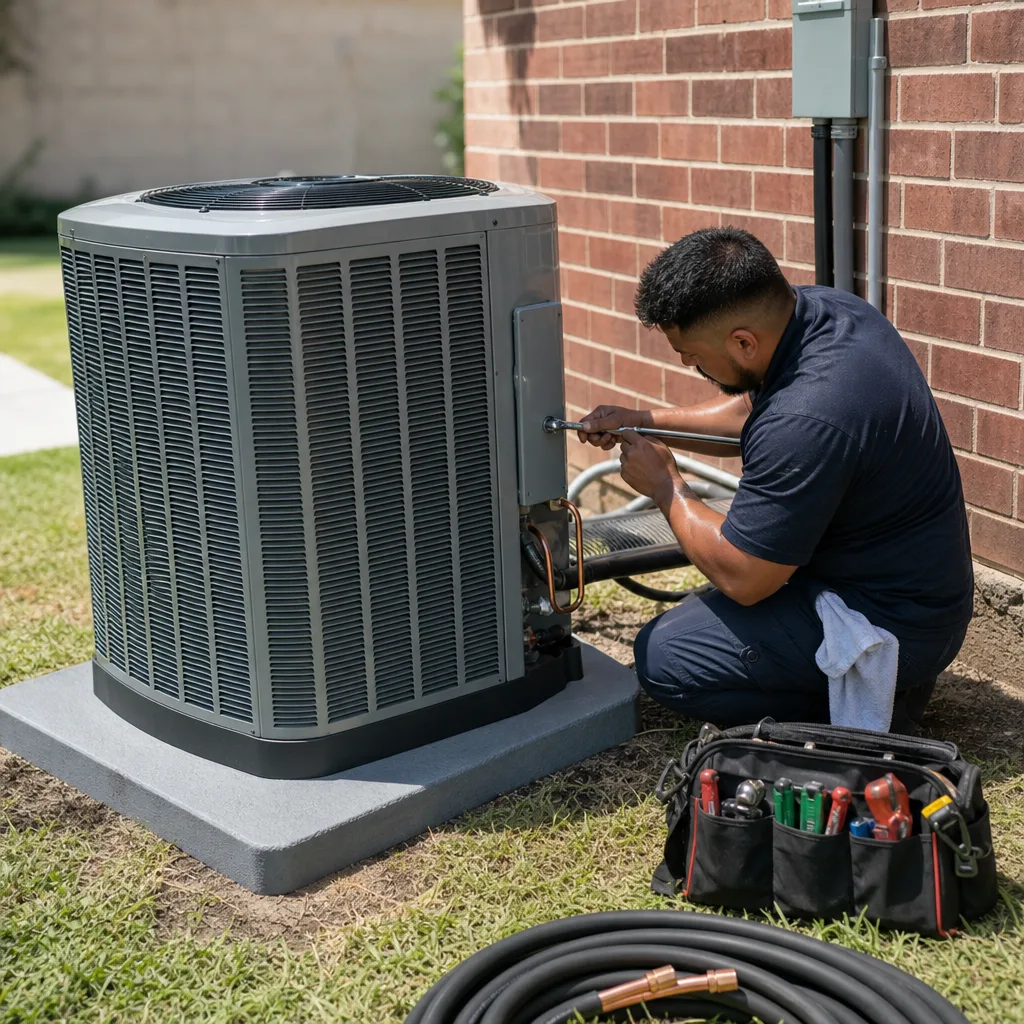
- Setting the new outdoor unit. The condenser needs a solid, level pad. North Texas clay soil swells when it’s wet and shrinks in a drought, so an old pad that has tilted or sunk should be leveled before the new unit goes on it.
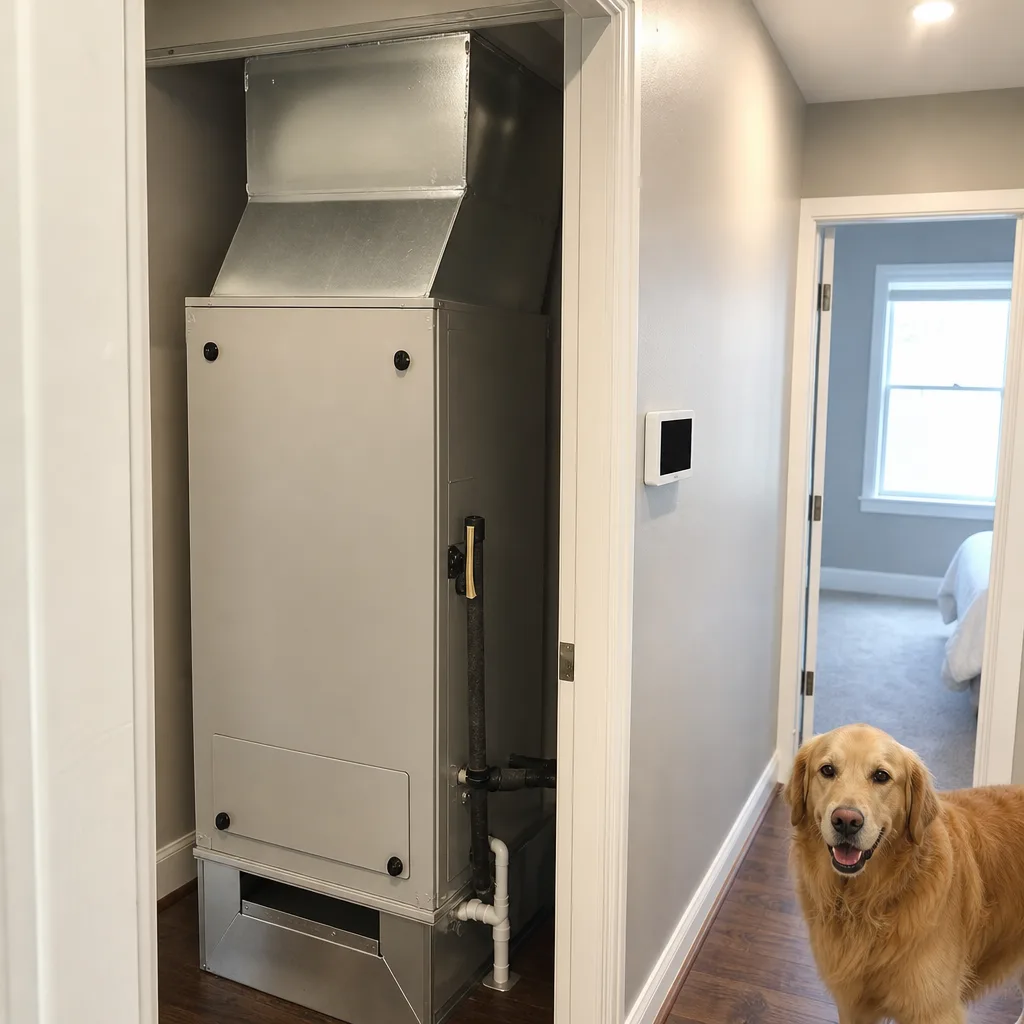
- Installing the new indoor coil. In many Dallas homes, the coil sits on top of the furnace or air handler up in the attic. Our standard installation includes a new condenser and a new coil, so the inside and outside parts are a matched pair.
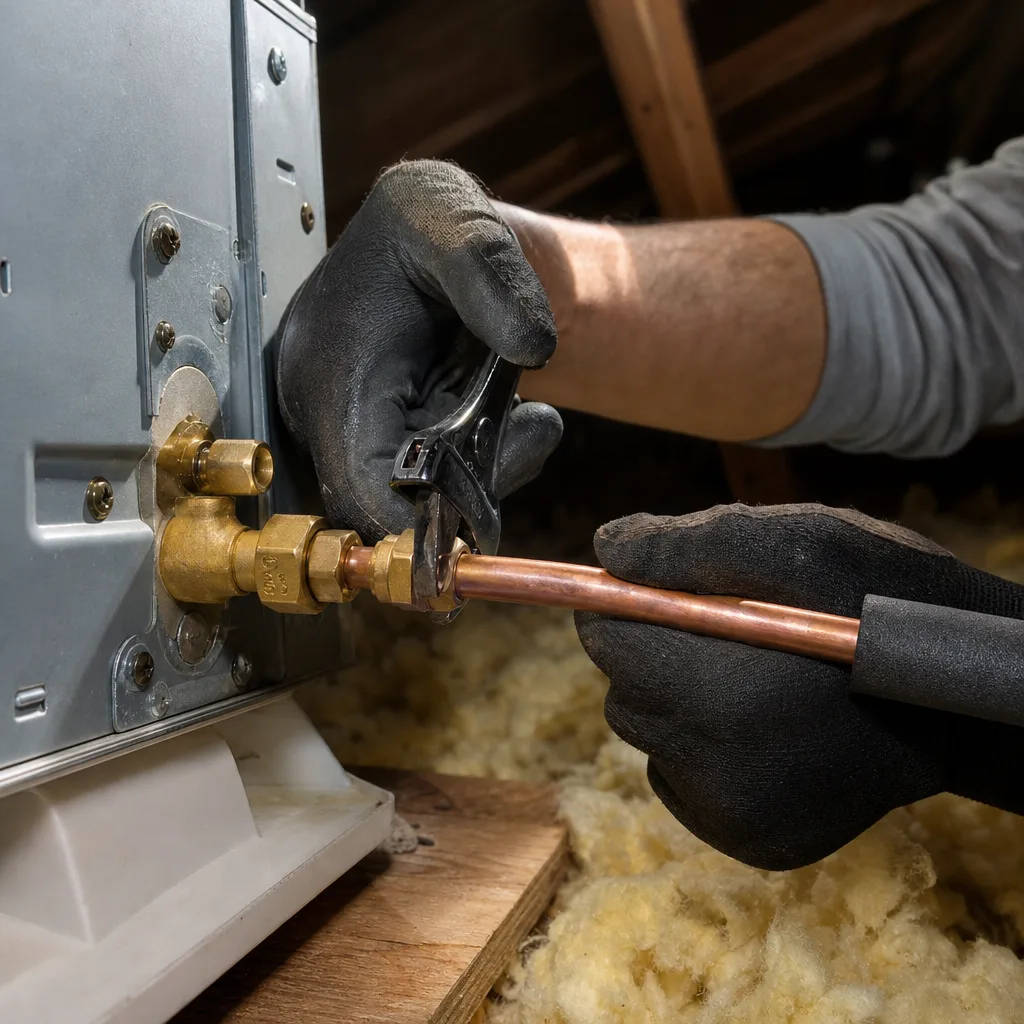
- Connecting the refrigerant lines. The copper lines between the indoor and outdoor parts get brazed together. Then they’re pressure-tested with nitrogen to catch leaks before any refrigerant goes in.
- Pulling a vacuum. A vacuum pump draws air and moisture out of the lines. Moisture left inside can slowly damage the compressor. This step takes patience, and it’s the one most likely to get rushed.
- Charging the system. The system gets the right amount of refrigerant for its size and line length, checked against the manufacturer’s specs.
- Hooking up power and the drain. The new equipment connects to your existing electrical disconnect and condensate drain line. In an attic, a drain pan and a safety switch help keep an overflow from turning into a stained ceiling.
- Startup and testing. The system runs while the installer checks airflow, pressures, how much cooler the air comes out than it goes in, and whether the thermostat is controlling it correctly.
Some work isn’t part of a standard installation. Duct, electrical, or plumbing changes, code corrections, and permits aren’t included unless your quote says so. If your attic ducts leak badly or your wiring needs updating to meet code, that’s separate work. You should see it written out and priced before anything starts. It’s also worth asking directly whether the permit is covered.
Getting your home ready is simple. Clear a path to your attic access and around the outdoor unit. Leave room in the driveway for equipment, and keep pets in a closed room while doors are open and people are going in and out.
Before the installer leaves, you can check the work with a few plain questions. Did you pressure-test and pull a vacuum on the lines? What were the readings at startup? How much cooler is the air coming out of the vents than the air going in? A careful installer will be glad to show you. If you get vague answers, that tells you something about the steps you can’t see.
Have questions? We’re happy to help.
Call Today, Get Service Today. Xtreme Air Services — North Dallas is ready to help.
Permits and Licensing Requirements for Dallas Installations
Putting in a new central AC isn’t a handyman job in Texas. The work has to be done under a state-issued air conditioning and refrigeration contractor license. Replacing a system in the City of Dallas generally means pulling a permit and passing an inspection. Both protect you, so here’s what to look for.
In Texas, HVAC contractors are licensed by the Texas Department of Licensing and Regulation, which most people call TDLR. That license tells you the company answers to the state for the work it does in your home. Our HVAC license number is TACLA29023C. You can look up any contractor’s license on the TDLR website in about a minute. That includes ours, and it includes anyone else who’s given you a quote.
A few things are worth checking before you sign:
- The license number is printed on the quote or the company’s paperwork, and it comes up as active when you look it up.
- The company is insured. If someone gets hurt in your attic or a ceiling gets damaged, you don’t want that landing on your homeowner’s policy.
- The people handling refrigerant are certified to do it. Ask about this directly. Recovering the old refrigerant the right way is part of a legal installation.
The permit is the city’s way of having a second set of eyes look at the job. An inspector can check the things that are easy to get wrong and hard for you to see. That means the electrical disconnect at the outdoor unit, how the equipment is set in the attic, and how the condensate drain is routed. For a homeowner, that inspection is a free double-check on the installer’s work.
Skipping the permit can come back around later. When you sell your house, a buyer’s inspector may ask about the system’s install date and whether the work was permitted. Some insurance claims can get harder if a major system went in without one. An installer who suggests skipping it to save a little time or money isn’t doing you a favor.
Your address matters, too. A Dallas mailing address doesn’t always mean the City of Dallas issues your permit. Highland Park and University Park sit right inside Dallas but run their own permit offices, and nearby cities like Addison, Richardson, and Garland do the same. Your installer should know which office covers your home before the job is scheduled. If they don’t ask, bring it up.
Permits aren’t part of a standard installation price unless your quote says so, as covered above. Have the quote spell out who pulls the permit, whether the fee is included, and when the inspection will happen. Then nothing about it surprises you after the new system is already running.
If you’d like to talk through permits for your address, call and talk to a real person. Our technicians are licensed and insured, and they’re background-checked and drug-tested. We’ll tell you plainly what your job needs before any work starts.
Call 469-213-3107
Watch Our Video
See How We Handle Central air conditioning installation in Dallas
Xtreme Air Services — North Dallas
What Drives Central AC Installation Cost in Dallas Homes
Here are our real numbers. A central air conditioning installation with Xtreme Air Services typically runs $5,500 to $13,000. Our most common job is a standard like-for-like replacement that uses your existing connections with no major modifications, and it runs $7,000 to $10,000. That price covers a new condenser and coil, equipment and materials, professional installation, standard connections, startup and testing, and haul-away of the old unit.
A range that wide can feel frustrating when you just want a number. The spread exists because no two Dallas homes need exactly the same system or the same amount of work. These are the things that move your price up or down:
- Size and capacity. A larger system costs more than a smaller one. This is why the load calculation covered above matters. The right tonnage keeps you from paying for cooling your home will never use.
- Efficiency. SEER2 is the rating that tells you how much cooling you get for each dollar of electricity. A higher SEER2 system costs more up front and costs less to run through a long Dallas summer. A variable-speed system sits near the top of the range for the same reason.
- Brand and model. Different product lines come with different features and price points, even at the same size.
- Ease of access. A roomy attic with a pull-down ladder is a simpler job than a tight space in an older ranch home where the crew has to work around low rafters in serious heat. Hard-to-reach equipment takes more time.
- Condition of what’s already there. Ductwork, wiring, and plumbing that need updates add to the job. You read earlier that those changes sit outside a standard installation, so they show up as separate line items.
- Code upgrades, permits, and custom fabrication. If your setup needs to be brought up to current code, or a part like a transition piece has to be built to fit your space, the price goes up.
The point isn’t to land at the bottom of the range. The point is to know why your number is what it is. A fair quote lets you see the equipment, the efficiency rating, and any extra work, each one written out. If a quote just says “new AC system” with a single total, ask for the details before you sign.
Three questions help you compare quotes side by side. What size and SEER2 rating is this system, and how did you choose them? Which items here go beyond a standard installation? Is the permit included? When two companies answer those questions clearly, you can see whether you’re comparing the same job.
If we come out first to look at your current system, there’s a $26 to $99 service-call fee. That fee is credited toward the repair if you proceed with Xtreme Air Services. You’ll see our upfront flat-rate price before any work starts, so there’s no meter running.
A new system is a big expense to take on in one summer. We offer flexible financing on qualifying installations and larger jobs, on approved credit. That can make it possible to install the right-sized, more efficient system now instead of settling for the cheapest box that fits.
Frequently Asked Questions
Common questions about Central air conditioning installation
What is the $5,000 rule for AC units?
It’s a rule of thumb some technicians use to decide between repair and replacement. You multiply the repair cost by the age of your unit in years, and if that number is above $5,000, replacement usually makes more financial sense than another repair. It’s just a quick gut check, not a hard rule, so weigh it alongside how many big parts are failing and whether your system still uses older R-22 refrigerant.
How much does it cost to install central AC in a 2000 sq ft house?
The cost depends on the tonnage your home needs, not just its square footage. A 2000 sq ft house in a Dallas-area subdivision could need anywhere from a 3-ton to a 4-ton system depending on insulation, attic sealing, window placement, and duct condition. That’s why a proper cooling load calculation matters more than a square-footage guess. Size, efficiency rating, and the condition of your existing ductwork and wiring are what really set the final price.
Are HVAC prices going up in 2026?
Equipment costs tend to move with manufacturer pricing, material costs, and efficiency standards, which can shift from year to year. Rather than guessing at future prices, the smarter move is getting a written quote now that breaks out equipment, SEER2 rating, and any extra work like duct or electrical changes. That way you know exactly what you’re paying for today instead of trying to time the market.
Ready to Get Started?
Call (469) 213-3107 Today, Get Service Today.