


A/C System Repair in Allen: Fix the Part, Not the Whole System
Warning signs explained, quick checks to try first, and a repair price that tells you what's included.
What’s Covered on This Page
- Signs Your A/C Needs Repair Right Now
- Old System Doesn’t Always Mean Replacement
- What Happens During a Repair Visit
- What’s Included in Your Repair Cost
- Checks You Can Do Before Calling a Technician
- What’s the most common A/C repair you see in Allen?
- How do I know if an AC repair company in Allen is reputable?
- Why does my A/C only act up on the hottest days?
Signs Your A/C Needs Repair Right Now
Your A/C usually warns you before it quits. The trick is knowing which warnings mean you need A/C system repair today and which can wait a day. Here’s what to watch for, and what each sign usually means.
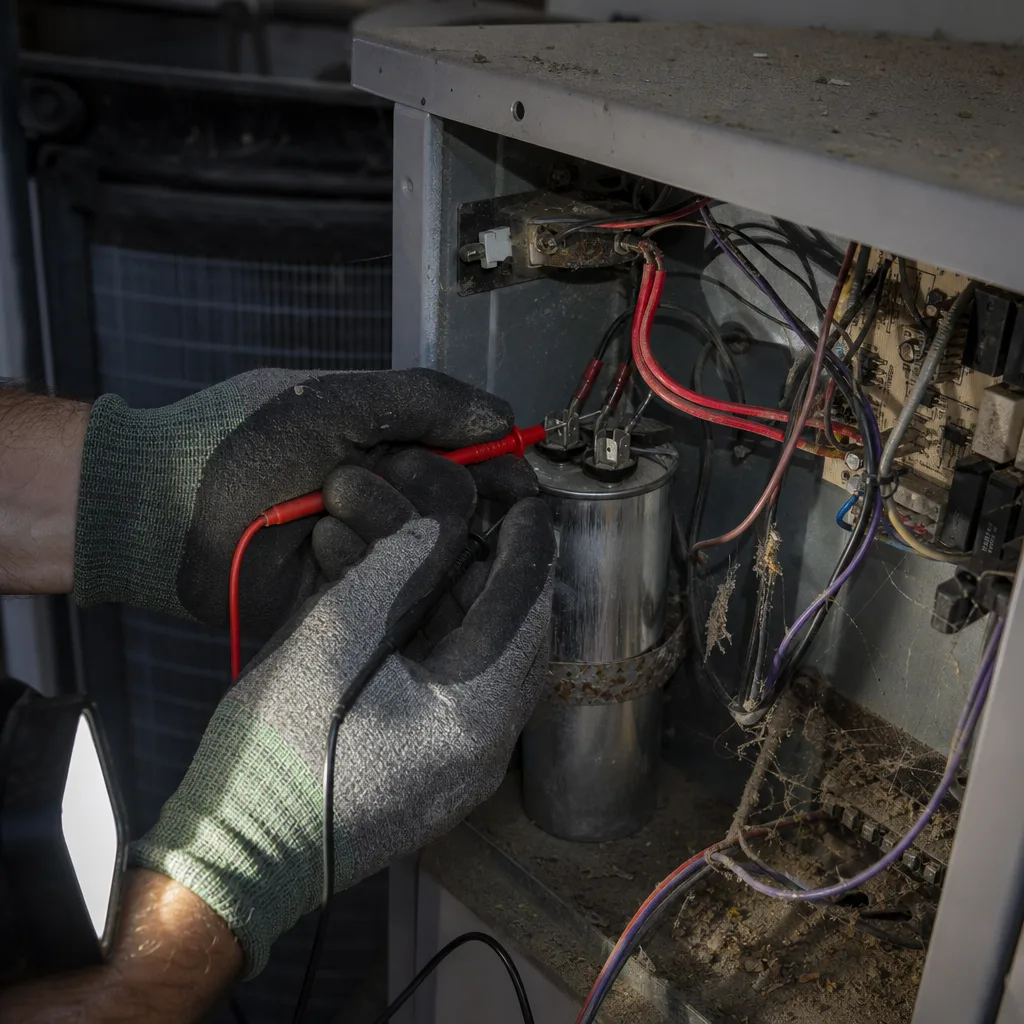
- Warm or lukewarm air from the vents. The fan is running, but the air isn’t cold. This often points to the outdoor unit not doing its job. A failed capacitor, a bad fan motor, or low refrigerant from a leak are common causes.
- The outdoor unit hums but the fan won’t spin. That steady hum with no movement often means a capacitor or fan motor has given out. It’s a call-today sign, because the system is straining every time it tries to start.
- Weak airflow. Air barely comes out, even with the fan on high. A clogged filter, a struggling blower motor, or a frozen coil can all choke off airflow.
- Ice on the copper lines or the indoor coil. Ice in July sounds strange, but it’s a real sign. It usually means low refrigerant or too little air moving across the coil.
- Water where it shouldn’t be. Many Allen homes have the indoor unit in the attic. If the drain line clogs, water can fill the drain pan and show up as a stain on your ceiling. Catch it early and it’s a drain problem, not a drywall problem.
- Short cycling. The system turns on, runs a few minutes, shuts off, and starts again. This wears parts out fast and can come from an electrical fault, a sensor problem, or a unit that’s overheating.
- New noises. Buzzing, clicking, grinding, or squealing that wasn’t there last week usually means something electrical or mechanical is wearing out.
- A burning or electrical smell, or a breaker that keeps tripping. Don’t keep resetting it. That’s a sign of an electrical problem that needs a technician today.
- A power bill that jumps for no clear reason. If your usage hasn’t changed but your bill has, your system may be running longer to keep up because a part is failing.
North Texas summers make all of this worse. When it’s over 100 degrees outside and your attic is even hotter, a weak part doesn’t get a break. A capacitor that was limping along in May can fail on the first hot week in June. That’s why a small sign is worth paying attention to now, not after the house hits 85 inside.
Here’s the good part. Most of these signs point to one common failure that can be found and fixed on the first visit. The longer a struggling system runs, the more likely a second part gets dragged down with the first. Calling early keeps your repair simple.
And if your A/C acts up at 9 p.m. on a Saturday, you don’t have to wait for Monday to save money. Xtreme Air Services charges no extra for nights or weekends, so the right time to call is when you notice the problem.
Old System Doesn’t Always Mean Replacement
If your A/C has some years on it, you might expect to hear that it needs replacing. That’s not always true. Age alone doesn’t decide it. What matters is what broke, how many parts failed, and how the rest of the system is holding up.
A lot of common failures are small parts. A capacitor, a contactor, a fan motor, or a clogged drain line can stop an older system cold. When the part is replaced, the system can go right back to cooling your home. Replacing a whole system because a capacitor failed is like buying a new car because the battery died.
Repair usually makes sense when:
- One part failed and the rest of the system checks out.
- The part is easy to get and fairly inexpensive.
- Your system cooled your home well before this problem started.
- You weren’t planning to replace it soon and want more time to save or shop.
Replacement starts to make more sense when:
- A major component, such as the compressor or a coil, has failed on an older unit.
- Several parts have failed at once, or you’ve had repair after repair over the last couple of summers.
- Your system uses an older refrigerant that’s no longer made, so a leak gets more costly to fix every time.
- Your home never stays comfortable, even when everything is technically working.
Those are the same things that move the price of a repair up or down: how serious the failure is, what the part costs and how easy it is to find, the age and brand of your equipment, and whether more than one component is involved. A simple repair covers diagnosis, labor, the standard replacement part, testing, and cleanup. Extra failed parts, major components, code upgrades, and permits aren’t part of that. They’d be quoted on their own, so you know the full picture before you decide.
That’s why we give you upfront flat-rate pricing that you approve before any work starts. You’ll hear what’s wrong and what it costs to fix in plain English. If a repair is the smart call, we’ll tell you. If you’re looking at a big repair on a tired system, we’ll lay out both options so you can weigh them without anyone pushing you.
If replacement does turn out to be the better choice, you’re not starting over with someone new. Xtreme Air Services is a Trane Comfort Specialist and handles A/C replacement too. Financing is available on larger repairs and replacements, so a big job doesn’t have to wait until you can pay for it all at once.
North Texas summers are hard on equipment, so an older system that limps through June can be in rougher shape by August. That’s one more reason a quick fix today often costs less than waiting. A single worn part is usually a simple repair. Once a struggling unit drags a second part down with it, the repair-or-replace math gets a lot harder.
What Happens During a Repair Visit
A repair visit has three simple jobs. Find the part that failed, fix or replace it, and make sure your system runs right before anyone leaves. Here’s how that plays out, start to finish.
It starts with the phone call. You talk to a real person, tell them what’s going on, and we work to get a licensed, background-checked technician to your door the same day. The more you can share on that call, the better. Saying “it’s blowing warm air and the outside unit is humming” gives the technician a head start before they ever pull into your driveway.
A few minutes of prep on your end can save time once the technician gets there:
- Clear a path to the outdoor unit, and move anything stacked against it.
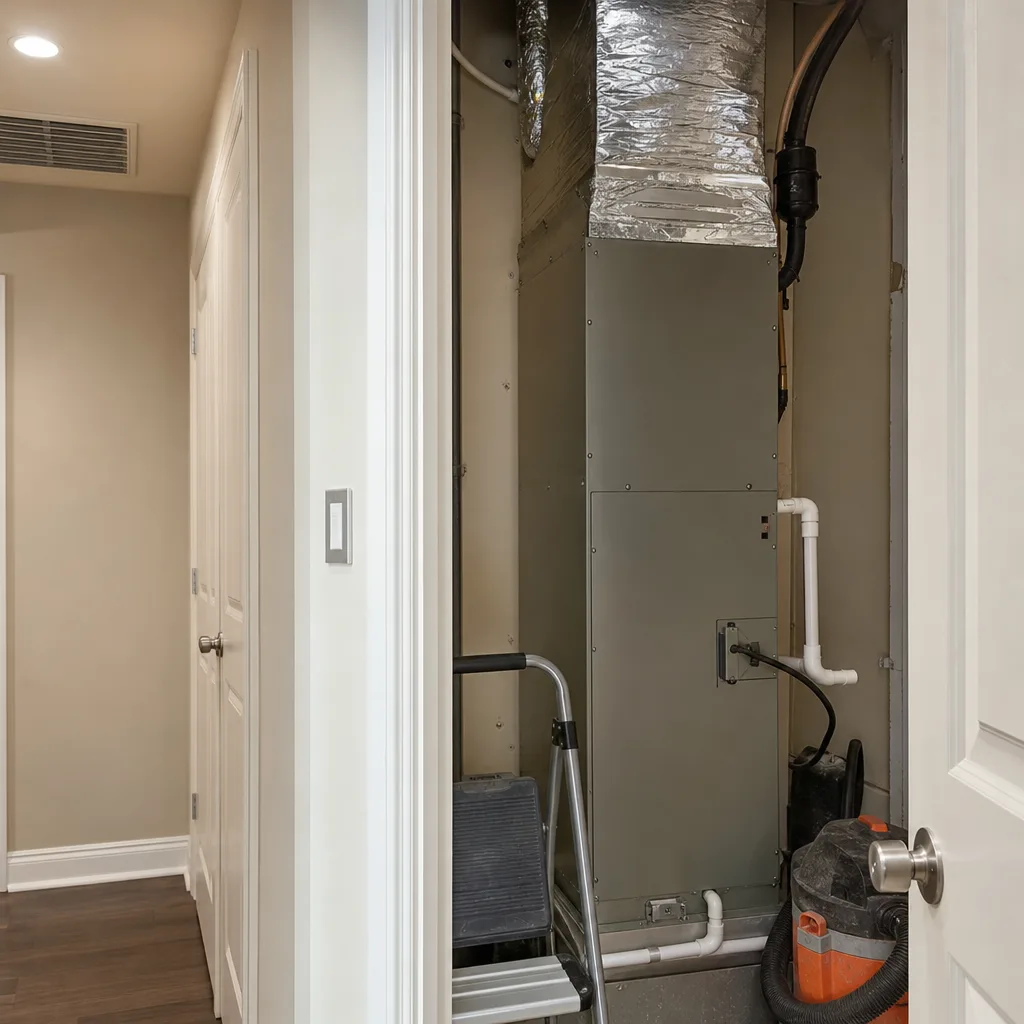
- Make sure the attic hatch or closet with the indoor unit is easy to reach. In many Allen homes that means a pull-down attic ladder in a garage or hallway.
- Write down what you noticed and when it started, like a noise, a smell, ice, or water on the ceiling.
- Put pets in another room so the technician can move between the attic, the thermostat, and the outdoor unit freely.
Next comes the diagnosis, and this is the part that matters most. A good technician doesn’t guess and start swapping parts. They work through the system in order: the thermostat and the power going to the unit, the capacitor and contactor that help it start, the fan motors, the refrigerant side, the coils, and the drain line. The goal is to find the real cause, not just the loudest symptom. A frozen coil, for example, might be the thing you can see, but the actual problem could be a dirty filter or a refrigerant leak.
Once the problem is found, you’ll get the upfront flat-rate price we covered above, and nothing gets fixed until you say yes. The service-call fee is $26-$99, and it’s credited toward the repair if you go ahead with Xtreme Air Services. So you’re not paying twice just to get someone out to your house.
Then the repair itself. Most calls come down to a single common failure that gets fixed on the first visit. A bad capacitor or a clogged drain line is often handled the same day. If a part is harder to find, the technician will tell you plainly how long it should take to get it, so you aren’t left waiting and wondering.
The visit isn’t done when the new part goes in. The system gets tested to confirm it’s running correctly. That means cool air coming from your vents, the outdoor fan spinning, no new noises, and water draining where it should. Testing and cleanup are both part of the job, so you shouldn’t be left with a mess in the attic or on your floors.
By the end, you should know what broke, why it broke, what was done, and whether anything else on your system is worth keeping an eye on. If something isn’t clear, ask. A technician who’s done the job right won’t mind walking you through it.
Not sure what your A/C system repair project needs? Ask us.
Call Today, Get Service Today. Xtreme Air Services — Allen is ready to help.
What’s Included in Your Repair Cost
Here’s the number you came for. A/C repairs with Xtreme Air Services typically run $150-$700. The most common job is finding one failed part, repairing or replacing it, and confirming the system runs right. That job typically runs $150-$400. Most calls come down to that single common failure, so most folks land in that range.
Where your repair falls depends on the cost factors we covered earlier. A swapped capacitor or a cleared drain line sits near the low end. A harder-to-find part or a second failed component pushes it higher. Anything outside the standard repair, like a major component or a permit, gets its own quote before you decide.
It also helps to know how A/C companies charge in general, because two quotes for the same repair can be built very differently.
- Hourly pricing means you pay for time plus parts. If the technician runs to the supply house or the job takes longer than expected, the bill grows, and you won’t know the total until the work is done.
- Flat-rate pricing means you get one price for the whole job before work starts. If the repair takes longer than planned, that’s on the company, not you.
We use upfront flat-rate pricing, so there’s no meter running while someone works in your 130-degree Allen attic. You hear the price, you say yes or no, and that’s the price.
Timing matters too. A lot of Allen A/C failures happen on the first brutal weekend of summer, when the system has been working hard for days. With some companies, that weekend call costs extra. With us, it doesn’t, because nights and weekends cost the same as a Tuesday morning.
Most repairs in this range are small enough to handle without financing, so it’s not typically offered for this kind of job. If your repair turns into a bigger one or you decide on replacement, financing is available then.
Whoever you call, ask these questions before anyone opens up your unit:
- Is the price flat-rate for the whole job, or hourly plus parts?
- Is there a service-call fee, and does it count toward the repair if I go ahead?
- Do you charge more for nights, weekends, or holidays?
- What’s not included in this quote, and when would I hear about extra costs?
- Can you show me the part that failed and explain why it failed?
- Is your company licensed for HVAC work in Texas, and what’s the license number?
A company that’s doing right by you will answer every one of those without hesitating. Ours is HVAC License #TACLA29023C, issued through the Texas Department of Licensing and Regulation, and you’re welcome to look it up. Our technicians are licensed, insured, and background-checked, and they’ll walk you through the price before any work starts.
Call 469-299-8996
Watch Our Video
See How We Handle A/C system repair in Allen
Xtreme Air Services — Allen
Checks You Can Do Before Calling a Technician
Some A/C problems aren’t repairs at all. Before you pay for a service call, take ten minutes and run through these checks. If one of them gets your system cooling again, you’ve saved yourself the trip fee, and that’s a good day.
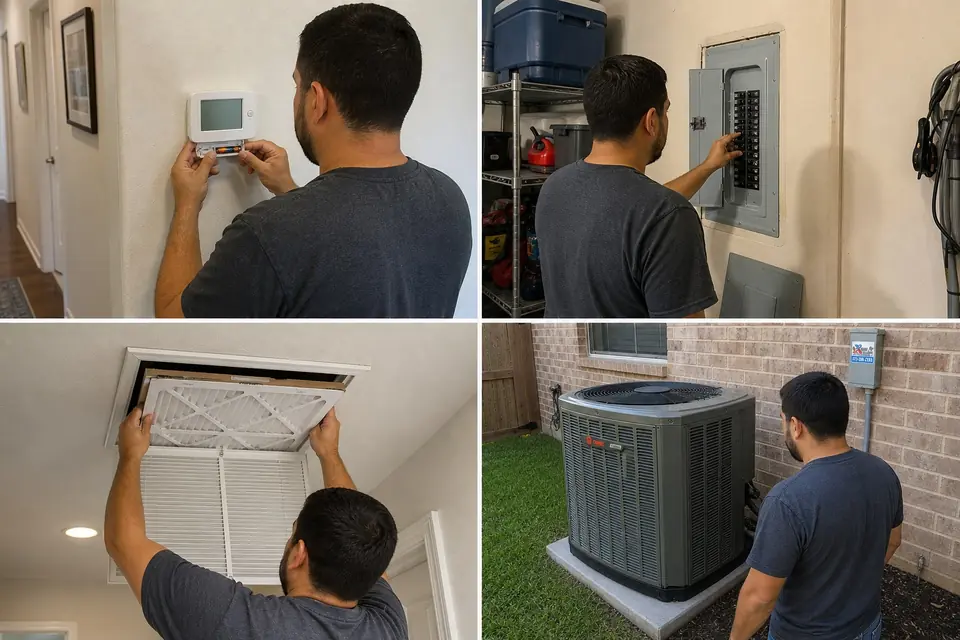
- Look at the thermostat first. Make sure it’s set to Cool, not Heat or Off, and that the temperature is set a few degrees below what the room is now. If the screen is blank or dim, put in fresh batteries. A dead thermostat can look exactly like a dead A/C.
- Check the breakers. Your system usually has two, one for the indoor unit and one for the outdoor unit. If one has tripped, flip it all the way off, then back on, one time. If it trips again, leave it off. That’s one of the electrical signs we covered above, and it needs a technician.
- Pull the air filter and hold it up to a light. If you can’t see light through it, swap it out. A clogged filter chokes airflow, and in an Allen summer, when the system runs most of the day, a filter can load up faster than you’d expect.
- Walk out to the outdoor unit. Clear away grass clippings, leaves, and anything leaning against it. It needs room to breathe. If the fins look caked with dirt or cottonwood fluff, rinse them gently with a garden hose from the outside in. Don’t use a pressure washer, because it bends the fins.
- Check the drain safety switch. Many systems have a small float switch on the drain pan or drain line by the indoor unit. When the line clogs and water backs up, that switch shuts the A/C off so it won’t overflow onto your ceiling. If the pan in your attic has standing water, that’s likely why your system went quiet. Shut the system off and call. The water is a warning that the drain line is clogged.
- If you see ice on the copper lines or the indoor coil, turn the system to Off and set the fan to On. Let the ice melt for a few hours before you try cooling again. Chipping at the ice can puncture the coil, so let it thaw on its own. If the ice comes back, something is still wrong.
Here’s where your part ends. Don’t open the panels on the outdoor unit or touch the capacitor. A capacitor holds an electrical charge even after the power is off, and it can hurt you badly. Don’t add refrigerant yourself, either. If your system is low, it has a leak. Topping it off doesn’t fix the leak, and handling refrigerant takes EPA certification for good reason.
If you’ve checked everything and your system is cooling again, you’re all set. Keep an eye on it for a day or two. If the same problem comes back, it wasn’t just a filter or a breaker. It was a symptom, and the part behind it is still wearing out.
If nothing on this list made a difference, you haven’t wasted your time. You’ve ruled out the simple stuff, and you can tell the technician exactly what you already tried. That helps them get to the real problem faster.
Frequently Asked Questions
Common questions about A/C system repair
What’s the most common A/C repair you see in Allen?
The most common repair is a failed capacitor or a clogged drain line. These two issues cause a lot of the warm-air and water-leak calls we get, especially when the outdoor unit hums but the fan won’t spin. Both are usually fixed on the first visit.
How do I know if an AC repair company in Allen is reputable?
Check that they’re licensed through the Texas Department of Licensing and Regulation and willing to share their license number. Ask if the technicians are background-checked, whether pricing is flat-rate or hourly, and if a service-call fee gets credited toward the repair. A company confident in its work will answer all of this without hesitation.
Why does my A/C only act up on the hottest days?
A weak part that limps along in cooler weather often fails once North Texas hits its first 100-degree stretch. A capacitor or fan motor under strain all day in attic heat has no break to recover. That’s why a small warning sign in May can turn into a no-cool emergency by June.
Ready to Get Started?
Call (469) 299-8996 Today, Get Service Today.