


A/C System Repair in Carrollton: Fix It Right the First Visit
Warning signs explained, quick checks to try first, and a repair price that tells you what's included.
What’s Covered on This Page
- Most A/C Repairs Are One Failed Part, Not a New System
- Signs Your A/C Needs a Repair Call Now
- Check These Three Things Before You Call
- What’s Included in a Standard Repair Visit
- What Drives the Repair Cost Up or Down
- What is the $5000 rule for HVAC systems?
- Is it worth repairing an old AC unit, or should I just replace it?
- Can I run my AC on fan-only mode while I wait for a repair?
Most A/C Repairs Are One Failed Part, Not a New System
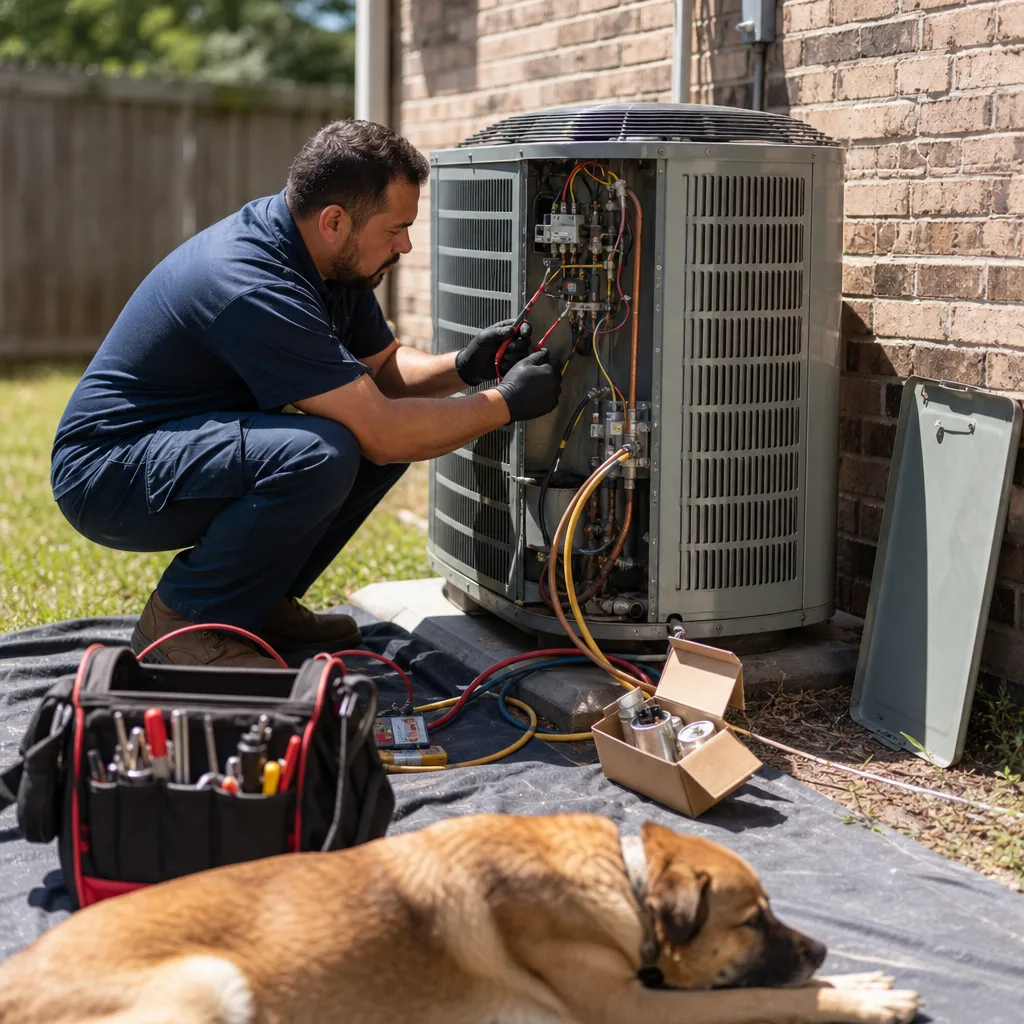
Your house is getting warmer by the hour. The vents are blowing warm air, or the outdoor unit hums but won’t kick on. It’s easy to jump straight to the worst case and assume you need a whole new system. Usually you don’t. An air conditioner is a set of parts working together, and when one gives out, the whole thing stops cooling. Swap or fix that one part, and your home cools down again.
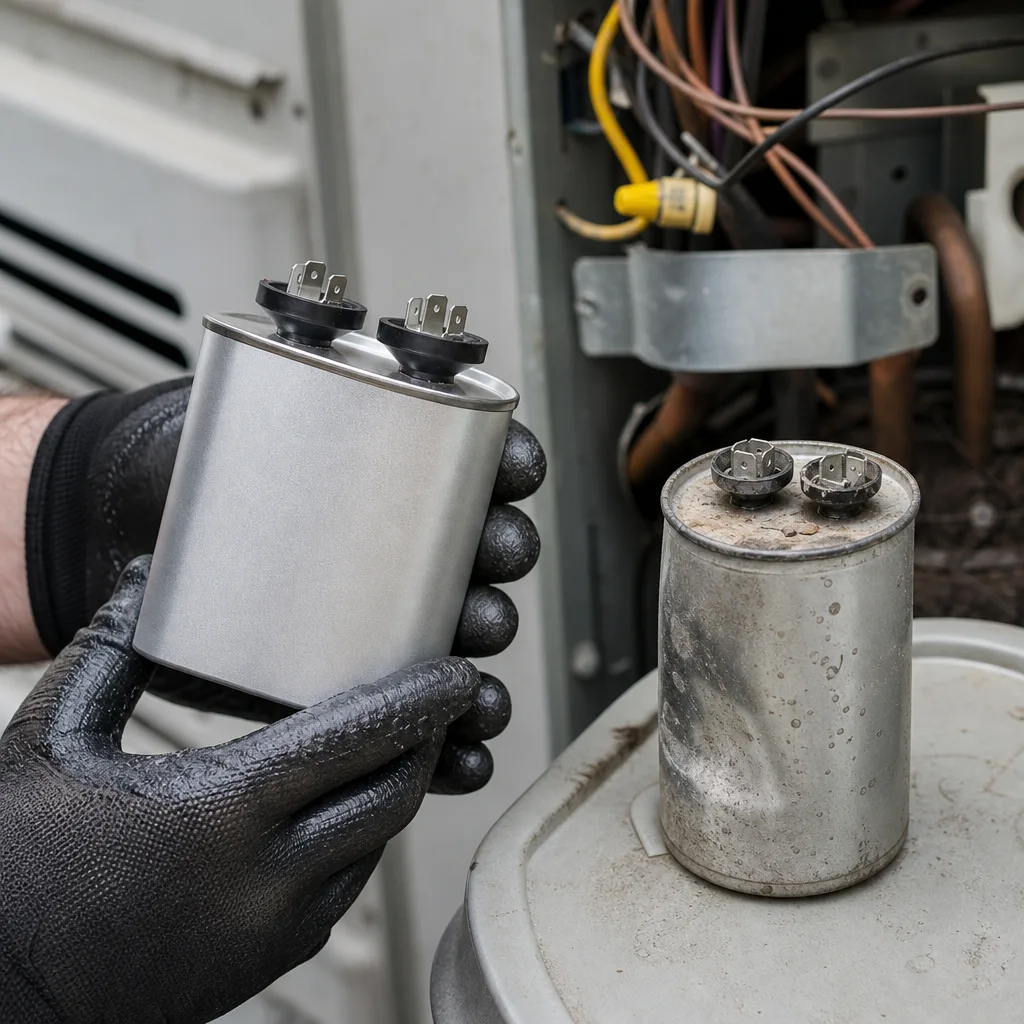
That’s what A/C system repair means for us. We find the part that failed, repair or replace it, and then check that the system runs the way it should. Most calls come down to a single common failure, and we fix it on the first visit.
These are the kinds of single parts that can stop your AC cold:
- A capacitor, the small part that gives the motors their starting kick. When it fails, the unit may hum but won’t start.
- A fan motor or blower motor. If it’s not moving air, you get weak airflow or none at all.
- A clogged drain line. Water backs up, and many systems shut off to keep it from spilling.
- A frozen coil. Ice builds up on the indoor coil and blocks cooling until the cause is found.
- A refrigerant leak. Low refrigerant means warm air, and the leak has to be fixed, not just topped off.
- A thermostat or electrical problem that keeps the system from getting the signal to run.
Our most common repair runs $150-$400. Most A/C repairs we do fall between $150-$700. That price covers the diagnosis, the labor, the standard replacement part, testing, and cleanup. If we find more than one failed part, or the problem is a major component, a code upgrade, or a permit, we’ll quote that separately so you can decide before we go further.
What moves the price up or down? How bad the failure is, what the part costs and whether it’s easy to get, how old your equipment is and what brand it is, and whether more than one part has failed. Timing doesn’t change it. We charge no extra for nights or weekends, so a breakdown at 9 p.m. on a Saturday costs the same as one on a Tuesday morning.
The service call is $26-$99. If you go ahead with the repair, that fee is credited toward the job. You get our upfront flat-rate price first. Nothing starts until you say yes, and there’s no meter running while you think it over.
There are times when a new system makes more sense, like when several big parts have worn out at once. When that happens, we’ll tell you straight and walk you through your options. Financing is available on larger repairs and replacements. But don’t start there. Start by finding out what broke.
Call 469-269-6099
Signs Your A/C Needs a Repair Call Now
Some AC problems can wait a few days. Others get worse, and cost more, the longer the system keeps running. In a North Texas summer, a small problem on a 100-degree afternoon can turn into a hot house by bedtime. Here’s how to tell which kind you’ve got.
Call for a repair today if you notice any of these:
- Warm air from the vents while the thermostat is set to cool. The system is running, but something’s keeping it from cooling.
- The outdoor unit hums but the fan doesn’t spin, or nothing happens at all when the thermostat calls for cooling.
- Ice on the copper lines outside or on the indoor unit. A frozen coil won’t fix itself, and the cause has to be found.
- Water where it shouldn’t be, like a wet spot on the ceiling, a drip near the indoor unit, or a full overflow pan.
- A burning or hot electrical smell coming from the vents or the unit.
- Loud new noises, like grinding, screeching, banging, or a steady hiss near the refrigerant lines.
- A breaker that keeps tripping for the AC.
- The system runs nonstop and the house never gets cool, or it clicks on and off every few minutes.
Each of these usually points back to one of the single failed parts covered above. That’s the good news. Catching it early often keeps one bad part from wearing out the parts around it.
Pay extra attention to water if your indoor unit sits in the attic, which is common in homes across Carrollton. When that unit is right above your ceiling, a clogged drain line doesn’t just stop your cooling. It can soak the drywall below. A brown stain on the ceiling under the attic hatch or near a hallway return is worth a call the same day.
Not sure which side of the line you’re on? Jot down what you’re seeing before you call. Is the air warm or just weak? Is the outdoor fan spinning? Is there ice or water anywhere? When did it start? Those few details help our technician show up ready to work on the right thing, which means your home gets cool again faster.
Check These Three Things Before You Call
Before you pay for a visit, take five minutes and check these three things. Sometimes the fix is a setting or a switch, and you’ll have cool air again without us. If none of them helps, you’ve still saved time, because you can tell our technician what you’ve already ruled out.
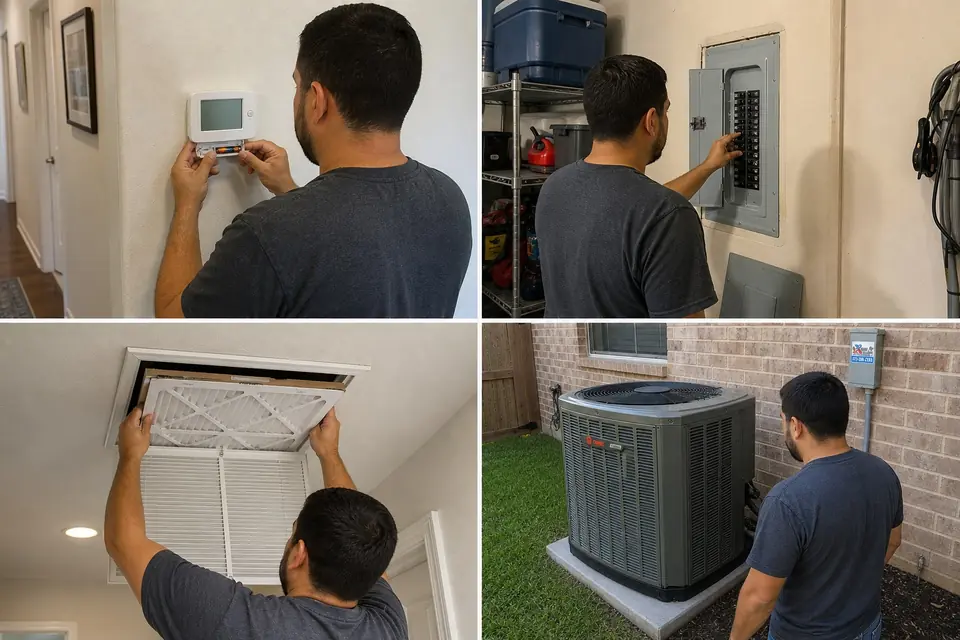
1. The thermostat settings. You’ve already tried fresh batteries if the screen was blank. Now look at the settings themselves. Make sure the mode says Cool, not Heat or Off. Someone in the house may have bumped it, or a schedule may have kicked in. Set the temperature at least three degrees below what the room feels like right now, so the system gets a clear call to run. If the fan switch says On instead of Auto, the blower runs all the time, even when the outdoor unit isn’t cooling. That can make it feel like the AC is blowing warm air when it’s really just moving room air around. Switch it to Auto and give it 10 to 15 minutes.
2. The breakers and the outdoor shutoff. Your AC usually has two breakers in the main panel, one for the indoor unit and one for the outdoor unit. Look for any that sit in the middle or the off position. If one has tripped, turn it fully off, then back on, one time only. Then check the gray shutoff box mounted on the wall near your outdoor unit. Someone mowing or doing yard work can bump it, so make sure it’s pushed in or switched on.
3. The drain pan under the indoor unit. Many systems have a small safety switch in or near the drain pan. When water backs up, that switch shuts the AC off on purpose so it won’t overflow. If you can safely reach your indoor unit, whether it’s in a closet, a garage, or up in the attic, look for standing water in the pan underneath. If the pan is full, that’s likely why your system stopped. You can soak up the water with towels or a wet vac, but the clog in the drain line is still there. It’ll fill back up unless the line gets cleared.
While you’re outside at the breaker box, glance at the outdoor unit too. Grass clippings, leaves, or a fence built too close can choke off the airflow it needs to shed heat on a hot afternoon. Clear away anything loose from around the sides. Don’t spray it down or poke inside it while it’s running.
If you’ve checked all three and the house still isn’t cooling, you’ve done your part. The problem is past what a homeowner should chase. At that point it’s usually one of the failed parts covered above, and a technician with the right tools can find it quickly.
Not sure what your A/C system repair project needs? Ask us.
Call Today, Get Service Today. Xtreme Air Services — Carrollton is ready to help.
What’s Included in a Standard Repair Visit
When you book a standard A/C system repair, you’re paying for one complete job, not a pile of separate charges. That job covers four things, and all four sit inside the flat-rate price you approve before any work starts.
- Diagnosis. The technician finds the part that failed. You’re paying for an answer, not a guess, so you don’t end up replacing parts that were fine.
- The repair. That means the labor and the standard replacement part. The broken part gets repaired or replaced right there.
- Testing. After the fix, the system gets checked to make sure it runs the way it should. A unit that starts up isn’t the finish line. It has to cool your home.
- Cleanup. Your floors, closet, or attic get left the way they were found.
If the technician finds something outside that standard job, like a second failed part, you’ll get a separate quote before anything else happens. You stay in charge of every dollar.
You should know who’s coming into your home, too. Our technicians are licensed and insured, and every team member is background-checked and drug-tested. Our HVAC work is done under Texas license #TACLA29023C. Same-day service is available, so in most cases the person fixing your AC is at your door the day you call, not sometime next week.
A few minutes of prep helps the visit go faster:
- Clear a path to the indoor unit. If it’s in a hall closet, move the coats and boxes. If it’s in the attic, make sure the pull-down ladder works and nothing’s stacked under the hatch.
- Clear a path to the outdoor unit and the breaker panel, too. Unlock the side gate if it’s closed.
- Put pets in another room. Doors and gates will be open while the technician goes back and forth.
- Have your notes handy. The details you jotted down earlier, plus anything you already ruled out with the three checks above, go straight to the technician.
Attic access matters more than you might think. In a Carrollton summer, an attic can get far hotter than it is outside. A clear ladder and an open walkway mean the technician spends that time fixing your system, not moving boxes in the heat.
Before the technician leaves, it’s fair to make sure the job is really done. Here’s what to look for:
- Ask what failed and why. You should get a plain-English answer you could explain to someone else in your family.
- Feel the air at a vent near the thermostat. After the system has run a while, it should feel noticeably cool, not just moving.
- Watch it run for a bit. It should start, cool, and shut off on its own, not click on and off every few minutes.
- Ask if anything else looked worn. Hearing about a weak part now is better than finding out on the next 100-degree day. Whether you act on it is your call.
A good repair visit leaves you with cool air, a clear answer about what went wrong, and no surprises on the bill. That’s the standard you should expect from anyone you let fix your AC, including us.
Watch Our Video
See How We Handle A/C system repair in Carrollton
Xtreme Air Services — Carrollton
What Drives the Repair Cost Up or Down
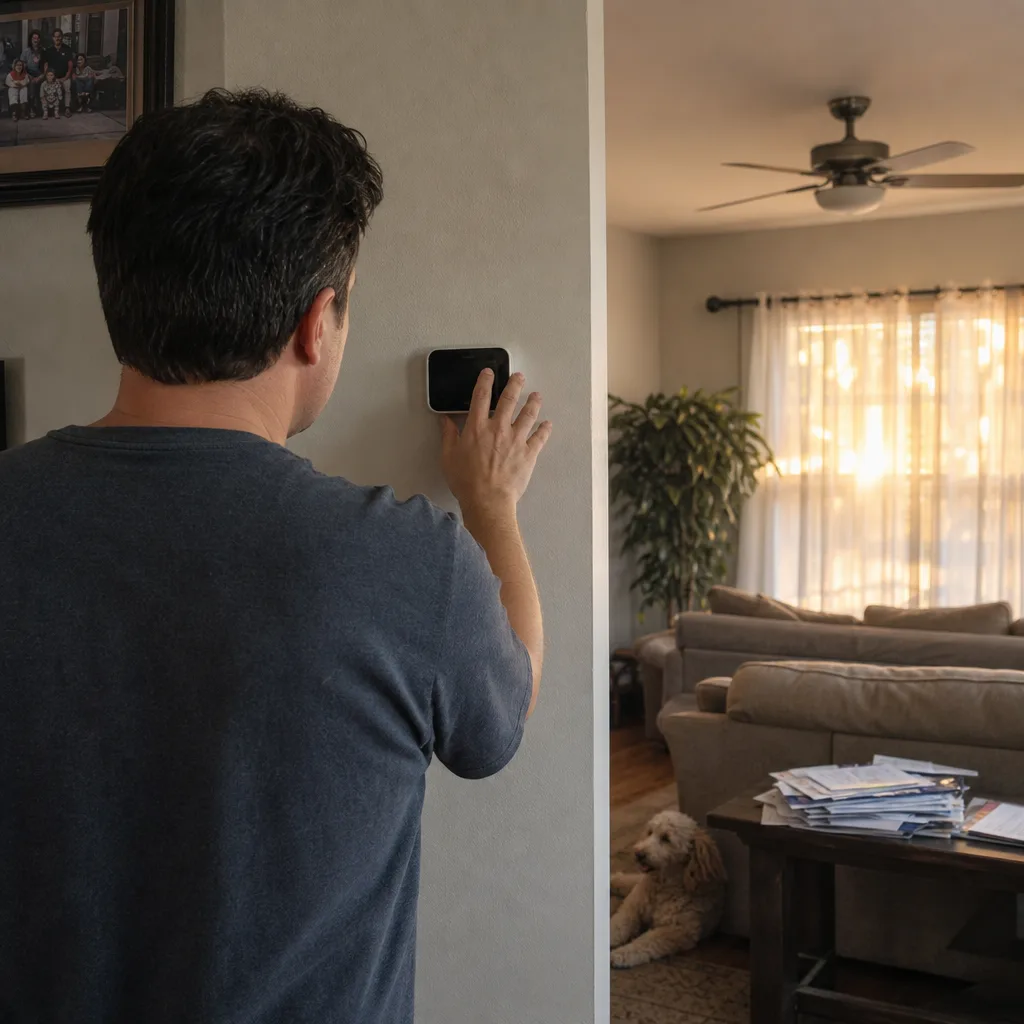
Two neighbors on the same street can call about the same problem, warm air from the vents, and get two very different bills. That’s not a trick. It comes down to which part failed and what it takes to fix it. Here’s how each factor plays out, so the price you hear makes sense.
Which part failed. This is the big one. A capacitor is small, cheap, and quick to swap. A blower motor costs more and takes longer. A compressor, the pump that moves refrigerant through the system, is a major component, so it’s quoted on its own. The symptom can look the same in all three cases. The bill can’t. That’s why the diagnosis matters so much. You want the real cause found, not the most expensive guess.
The part itself. Some parts fit lots of systems and are easy to get. Others are made for one model, so they cost more and may need to be ordered. When a part has to be ordered, ask how long it’ll take, so you can plan for a fan or a cooler room in the meantime.
Your system’s age and make. Newer equipment often uses parts that are simple to find. Older systems can need parts that are harder to track down. Some were built for a type of refrigerant that’s no longer made, which makes topping them off cost more. If your unit has been running since your house was new, ask about this up front.
One bad part or more. A failing part doesn’t always fail alone. A weak capacitor makes the motors strain every time they start. A clogged filter can help a coil freeze. In a Carrollton summer, when the system runs hard from morning to night, one tired part can wear out the parts around it. That’s the main reason a small problem caught early usually costs less than one left running for a week.
What doesn’t move the price: the clock. With no extra charge for nights or weekends, you don’t have to sweat through a Saturday to save money.
Whoever you call, ask these questions before you say yes:
- What part failed, and how do you know?
- Is this price for the whole job, including the part, labor, and testing?
- If you find something else wrong, will you stop and quote it before doing more?
- Does the service-call fee count toward the repair?
- Given my system’s age, does this repair make sense, or should I think about my options?
A company that’s doing right by you will answer every one of these in plain English, before any work starts. If you get a vague answer or a price that keeps changing, that tells you something too.
Most of the time, the answer is one failed part and one clear price. Our licensed and insured technicians will find it, show you what it costs, and fix it once you approve. Same-day service is available, and your neighbors across North Texas have trusted us with thousands of reviews.
Call 469-269-6099
Frequently Asked Questions
Common questions about A/C system repair
What is the $5000 rule for HVAC systems?
The $5000 rule is a simple way to decide between repair and replacement: multiply the repair cost by the age of your system, and if that number tops $5,000, replacement usually makes more sense. For example, a $600 repair on a 10-year-old unit comes to $6,000, which leans toward replacing. A $300 repair on a 5-year-old unit comes to $1,500, which leans toward fixing it. We’ll walk you through where your numbers land before you decide anything.
Is it worth repairing an old AC unit, or should I just replace it?
It depends on what broke and how old your system is, not just its age alone. A single worn part, like a capacitor or fan motor, is almost always worth fixing even on an older unit. Repair stops making sense when several major parts are failing at once or the repair cost rivals what a new system would cost. We’ll give you a straight answer on which situation you’re in before any work starts.
Can I run my AC on fan-only mode while I wait for a repair?
Running the fan alone won’t cool your home, but it won’t hurt anything either. Setting the thermostat fan switch to On just circulates room-temperature air through your vents without the outdoor unit running. It can help move air around a stuffy room, but it’s not a fix for warm air coming from a failed cooling part. If your home is heating up fast, that’s a sign to call rather than wait it out.
Ready to Get Started?
Call (469) 269-6099 Today, Get Service Today.