


Central Air Conditioning Repair in Fort Worth
Central AC problems diagnosed and fixed right the first time, with clear pricing on what drives the cost.
What’s Covered on This Page
- Signs Your Central Air Conditioner Needs Repair
- What a Repair Visit Includes and What It Costs
- How to Verify a Repair Company Before You Hire
- Repairing Older Fort Worth Homes vs. Newer Systems
- Quick Checks Before You Call for Repair
- What temperature should I set my AC at in Fort Worth summers?
- What is the 3 minute rule for AC?
- How long does it usually take to get a repair technician out in Fort Worth?
Signs Your Central Air Conditioner Needs Repair
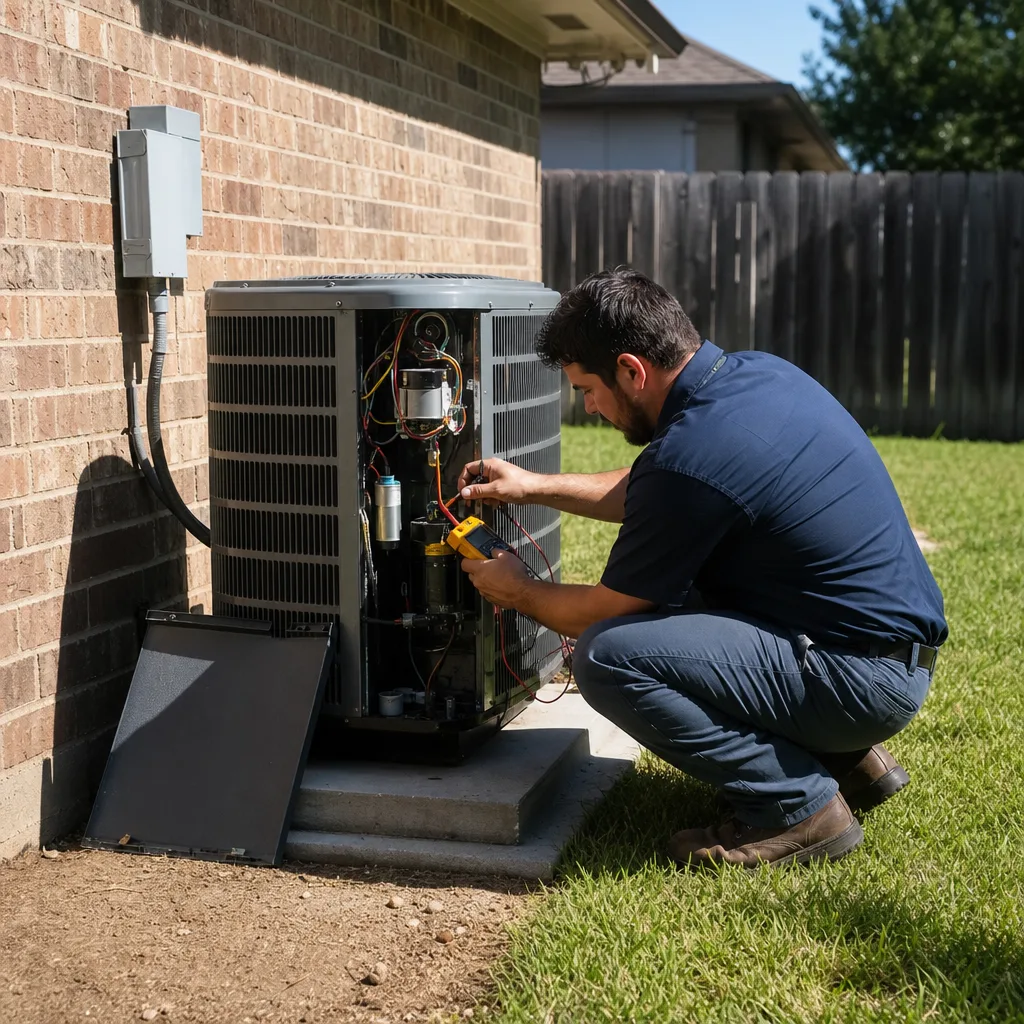
Your AC almost always tells you something’s wrong before it quits. The trick is knowing what each warning sign means. Here’s what to watch for, and what’s usually behind it.
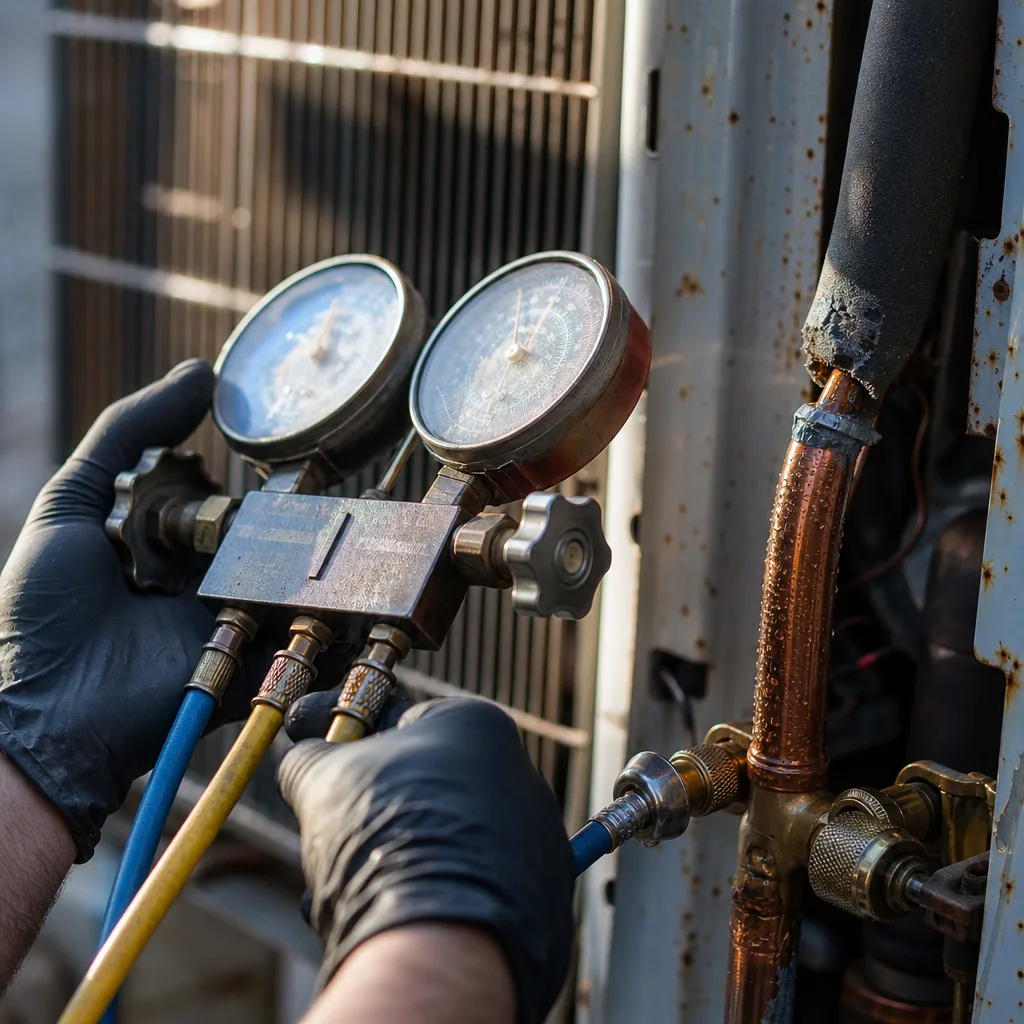
- Warm air from the vents. The fan runs, but the air feels like it’s coming from outside. A bad capacitor (the small part that gives the motors their starting kick) or an outdoor fan motor that won’t spin is a common cause. Low refrigerant from a leak is another.
- Weak airflow. Some rooms barely get a breeze. This can be a clogged filter, a struggling blower motor, or a problem in the ducts.
- Strange noises. Buzzing, clicking, grinding, or squealing isn’t normal. Buzzing often points to an electrical part. Grinding or squealing usually means a motor or bearing is wearing out.
- Ice on the copper lines or the indoor coil. It sounds backwards, but a frozen AC is a sick AC. Low refrigerant and poor airflow are the usual reasons.
- Water where it shouldn’t be. If your air handler sits in the attic, a clogged drain line can back up and drip through your ceiling. A water stain over a hallway or closet is worth a look right away.
- Short cycling. The system turns on and off every few minutes and never finishes a full cooling cycle. This wears parts out fast and can come from a thermostat issue, a frozen coil, or an electrical fault.
- It won’t turn on at all. Nothing happens when you lower the thermostat. That could be the thermostat, a tripped breaker, a failed capacitor, or a control board.
- Your bills climb but the house stays warm. If the system runs nonstop and still can’t keep up, a part is likely failing and forcing everything else to work harder.
In a Texas summer, your AC runs long, hard hours. A part that’s starting to fail can limp along for a while, then give out on the hottest afternoon of the year. That’s why a small sign today is worth taking seriously. A weak capacitor caught early is a quick swap. Left alone, it can make the compressor strain, and that’s a much bigger repair.
Before you call, take a minute for the easy stuff. Make sure the thermostat is set to cool and the temperature is set below the room temperature. Check that the batteries aren’t dead. Look at your air filter. If it’s gray and packed with dust, a fresh one may bring your airflow right back. If one of these fixes it, great. You don’t need us.
If the easy checks don’t solve it, you’re likely dealing with a failed part. The good news is that most repair calls come down to a single common failure that gets fixed on the first visit. One bad part usually doesn’t mean your whole system is done.
What a Repair Visit Includes and What It Costs
A central AC repair visit with us covers three jobs: find the part that failed, repair or replace it, and make sure your system runs correctly before we leave. For most single-part repairs, that comes to $150-$400. Across all central AC repairs, the typical range is $150-$700.
You’ll know the price before any work starts. We use upfront flat-rate pricing, so there’s no meter running while the technician works. You see the number, you say yes or no, and then we get to work.
Here’s what’s included in a repair price:
- Diagnosis, so you know what failed and why
- Labor to make the repair
- The standard replacement part
- Testing to confirm your system is cooling the way it should
- Cleanup, so your home looks the way we found it
Some things aren’t included unless we quote them separately. These include extra parts that turn out to be failing, major components, code upgrades, and permits. If the technician finds one of these, you’ll hear about it and get a separate price first. You decide. Nothing gets added to your bill without your okay.
There’s a $26-$99 service-call fee to send a technician to your home. If you go ahead with the repair with Xtreme Air Services, that fee is credited toward the repair. You aren’t paying twice.
So why can one repair cost more than another? A few things move the price up or down:
- How bad the failure is. A worn capacitor is a smaller job than a failed motor.
- Part cost and availability. Some parts cost more, and some are harder to get.
- Your equipment’s age and brand. Older systems can need parts that are harder to find.
- Whether more than one part has failed. One weak part can wear down the parts around it.
- After-hours timing. Many companies charge more for nights and weekends. We don’t. There’s no extra charge for nights or weekends, so you won’t pay more because your AC quit on a Saturday night.
That last point matters in a Texas summer. When the house is getting hot after dinner, you shouldn’t have to sweat it out until Monday to avoid an overtime bill.
Whoever you call, it’s fair to ask a few questions before work begins:
- Will I get the full price before you start?
- Is the trip fee credited toward the repair?
- Do you charge more for nights or weekends?
- What does the price include, and what would cost extra?
- Can you show me the part that failed?
Clear answers to those questions tell you a lot about a company. You should never feel rushed into saying yes.
Financing usually isn’t offered for a smaller repair like this. If your system needs a larger repair or a full replacement, financing is available, and we’ll walk you through the options so you can pick what fits your budget.
How to Verify a Repair Company Before You Hire
You can check almost any AC repair company in about five minutes. Look up the license, ask about insurance, read recent reviews, and watch how the technician explains the problem. A good company won’t mind any of it. A company that gets cagey is telling you something.
Start with the license. In Texas, air conditioning contractors have to be licensed by the Texas Department of Licensing and Regulation, or TDLR. Ask for the license number, then look it up on the TDLR website. You’ll see whose name it’s under and whether it’s active. If a company can’t give you a number, that’s your answer.
Ask about insurance next. Your AC equipment sits in a hot attic and on a slab outside. A technician can get hurt, and a ceiling or a refrigerant line can get damaged. If the company carries liability insurance, those costs aren’t yours. It’s fine to ask to see proof.
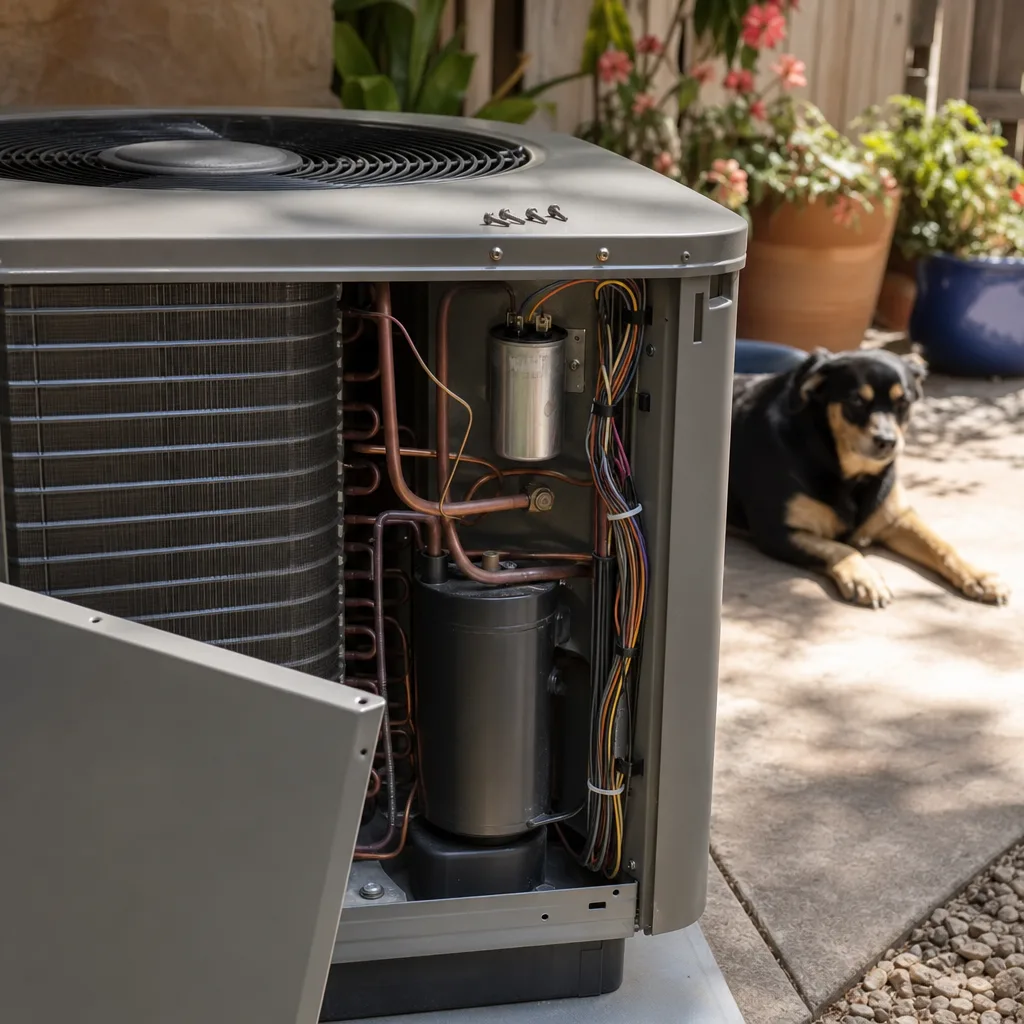
Check refrigerant know-how. Anyone who adds refrigerant or opens the sealed system needs EPA certification. If your AC is blowing warm and the plan is just to add refrigerant every summer without finding the leak, ask why. Refrigerant doesn’t get used up. If it’s low, it’s leaking somewhere.
Then read the reviews. Skip the star count for a minute and read the newest ones. Look for comments about showing up when promised, explaining the problem clearly, and fixing things right the first time. Pay attention to how the company answers the bad reviews, too.
Watch for red flags once someone’s at your door:
- They push a full system replacement before running a real diagnosis.
- They won’t give you a price before they start working.
- They won’t show you the part that failed or explain why it failed.
- They knocked on your door after a North Texas hail storm offering a deal on the spot.
- They want cash only and won’t leave anything in writing.
Here’s the honest part. If your system is old and the repair would cost close to what a new one would, a good technician should tell you that, even though the repair is the easier sale. If your AC only needed a new filter or a reset breaker, a good company should tell you that too. A company that’s straight with you about the small stuff is usually straight with you about the big stuff.
You can put us through the same test. Xtreme Air Services is licensed and insured, under HVAC License #TACLA29023C. Look it up on the TDLR website. Our technicians are background-checked and drug-tested before they ever step into your home. We’re a Trane Comfort Specialist, and we’ve earned a 4.8-star rating across more than 2,900 reviews on Google, Angi, and HomeAdvisor. Every job is backed by our 100% satisfaction guarantee.
Have questions? We’re happy to help.
Call Today, Get Service Today. Xtreme Air Services — Fort Worth is ready to help.
Repairing Older Fort Worth Homes vs. Newer Systems
The age of your home and your AC changes what a repair looks like. A 1970s ranch house and a five-year-old subdivision home can both lose cooling on the same July afternoon. The cause, the parts, and the smart next step are often different.
Around Fort Worth, a lot of homes are slab-on-grade ranch houses built between the 1950s and the 1990s. Others sit in newer subdivisions with much newer equipment. Here’s how a repair tends to differ between the two.
If your home or system has some years on it, a few things come up more often:
- Older refrigerant. Many older systems run on R-22, a refrigerant that isn’t made for new equipment anymore. What’s left costs more. If your R-22 system has a leak, the repair is still possible, but refrigerant cost becomes a bigger part of the decision.
- Harder-to-find parts. An older or discontinued model may need a part that takes longer to track down. Sometimes a compatible substitute part works fine. Your technician should tell you which one you’re getting.
- Tired ductwork. Ducts in older attics have been through decades of summer heat. Joints loosen and seal tape dries out. Your AC may be working fine while cool air leaks into the attic before it reaches your rooms.
- A shifting pad. North Texas clay soil swells when it’s wet and shrinks when it’s dry. Over the years, that movement can tilt the outdoor unit’s pad and put strain on the copper lines running to the house.
None of these mean an older system can’t be repaired. Plenty of older units have years left after one good fix. Age just means your technician should look past the one failed part and tell you how the rest of the system is holding up.
A newer home brings different problems. Many recent systems use variable-speed motors and electronic controls. That means the system can slow down and speed up instead of running only full blast or off. You get steadier temperatures and better humidity control. It also means more of the repairs are electrical. A failed sensor, a circuit board, or a communication problem between the thermostat and the equipment can shut everything down, even when the big parts are fine.
Those repairs take a technician who knows how the system talks to itself. Guessing gets expensive fast. As a Trane Comfort Specialist, our team works with high-efficiency and variable-speed equipment, not just basic single-speed units.
No matter how old your home is, the attic is hard on equipment. In a Fort Worth summer, attic temperatures climb well past what’s outside. Motors, wiring, and drain lines up there wear out sooner than parts that live in cooler spots.
So when should age change the plan? If your system is older, uses R-22, and needs a major part like a compressor, that’s the time to compare repair against replacement. We’ll give you both numbers and let you decide. If it’s a single worn part on an otherwise healthy system, a repair is usually the sensible call, whatever the age of your home.
Watch Our Video
See How We Handle Central air conditioning repair in Fort Worth
Xtreme Air Services — Fort Worth
Quick Checks Before You Call for Repair
You’ve checked the thermostat and the filter, and the house is still warm. Before you pick up the phone, there are a few more things you can safely look at in about 15 minutes. Any one of them could get you cooling again without a repair visit.
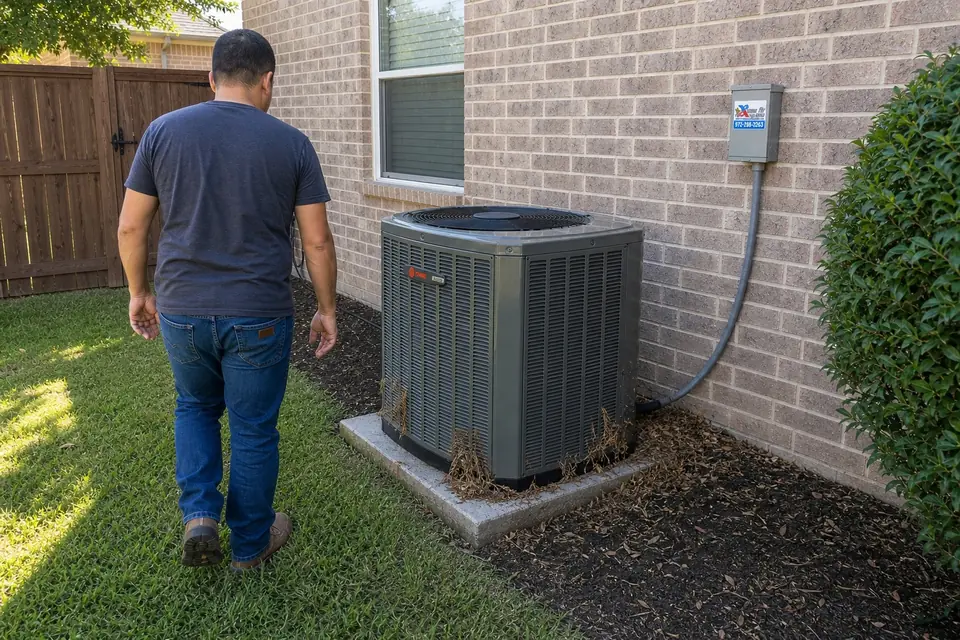
- Check both breakers. Most central AC systems have two, one for the indoor unit and one for the outdoor unit. If one is tripped, flip it fully off, then back on. Also look for the shutoff box mounted on the wall near your outdoor unit. Make sure it hasn’t been switched off by a yard crew or a curious kid.
- Give it a few minutes. Many systems have a built-in delay that protects the compressor after a restart. If you just reset something, wait a few minutes before you decide it’s not working.
- Look at the drain pan in the attic. If your indoor unit is in the attic, it likely has a small safety switch that shuts the AC off when the drain line backs up. That’s what keeps water out of your ceiling. If the pan under the unit is holding water, that switch may be why your system stopped.
- Let a frozen coil thaw. If you see ice on the copper lines, turn the cooling off and set the fan to run. This lets the ice melt. Running the AC while it’s iced up can strain the compressor.
- Clear around the outdoor unit. The outdoor unit needs to breathe. Grass clippings, leaves, and weeds packed against the sides can choke the airflow, and that’s hard on the unit in a North Texas summer. Clear about two feet of space around it. With the power off at the shutoff box, you can gently rinse the outside with a garden hose. Don’t use a pressure washer, because it can flatten the thin metal fins.
- Open your vents. Make sure the supply vents in each room are open and that furniture or rugs aren’t blocking the larger return vents. Closing too many vents doesn’t save money. It just makes the system work harder.
If one of these gets cold air flowing again, you’re done. Just keep an eye on it for a day or two. If a breaker trips once and holds, it may have been a one-time thing. If the outdoor unit was packed with clippings, clearing it may be all it needed.
A few things are best left alone, too. Don’t open the electrical panel on the outdoor unit. The capacitor inside can hold a strong charge even with the power off. Don’t try to add refrigerant yourself. And don’t keep flipping a breaker that won’t stay on. A breaker that keeps tripping is a warning, and resetting it over and over can turn a small electrical problem into a bigger one.
If none of these checks bring the cool air back, it’s time for a technician. That usually means one part has failed, and finding it is the next step.
Frequently Asked Questions
Common questions about Central air conditioning repair
What temperature should I set my AC at in Fort Worth summers?
Most homeowners find 76-78°F while home and a few degrees higher while away works well in Fort Worth’s heat. Setting it much lower rarely cools faster. It just makes the system run longer and work harder on a 100-degree afternoon, which adds wear to parts that are already under stress.
What is the 3 minute rule for AC?
The 3 minute rule means waiting about 3 minutes before restarting your AC after it shuts off. This gives the pressure inside the compressor time to equalize. Restarting too fast can strain the compressor and trip a breaker, which is part of why many systems have a built-in restart delay.
How long does it usually take to get a repair technician out in Fort Worth?
Many Fort Worth homeowners report waiting until the next available slot during peak summer heat, since AC calls surge the moment temperatures climb. Same-day service is common when you call early in the day, but a system that fails on the hottest afternoon of the year may mean a longer wait with high-demand companies.
Ready to Get Started?
Call (817) 677-1907 Today, Get Service Today.