


Home Rewiring in Carrollton: Do You Need a Full Rewire or a Repair?
A straight answer on whether your house needs rewiring or a smaller repair, and what a full project involves.
What’s Covered on This Page
- Signs Your Wiring Needs More Than a Quick Fix
- When You Don’t Need a Full Home Rewire
- What a Whole-Home Rewire Involves
- What Drives the Cost of Rewiring a Home
- Why Carrollton Homeowners Trust Who They Hire for This Job
- How long does rewiring a house take?
- Do electricians have to tear out my drywall to rewire my house?
- Does the cost of rewiring change much between a smaller and larger home?
Signs Your Wiring Needs More Than a Quick Fix
Most electrical trouble starts small. A switch stops working, or a breaker trips now and then. That’s normal, and it’s often a simple fix. The real question is whether you’re seeing one problem or a pattern. A pattern points to the wiring itself, not to one part.
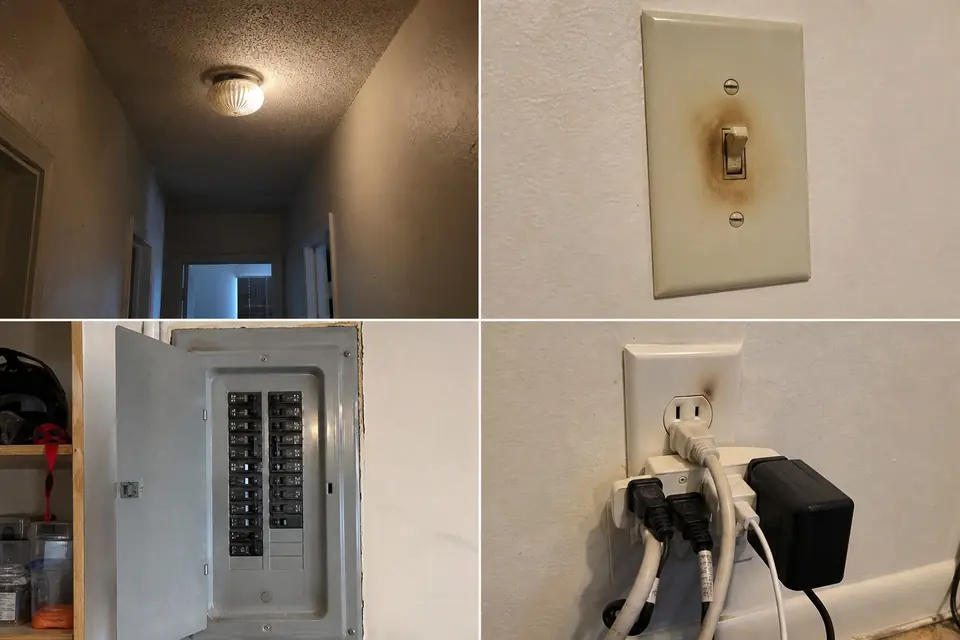
These signs suggest your home may need more than a repair:
- Two-prong outlets all through the house. They usually mean there’s no ground wire. A three-prong adapter makes the plug fit, but it doesn’t add the ground.
- Breakers that trip in several rooms. This is different from one circuit tripping when too many things are running on it.
- Lights that dim or flicker across the house when the AC, microwave, or a hair dryer kicks on.
- Outlets or switch plates that feel warm, look darkened, or give off a burning smell.
- Knob-and-tube wiring. Look for small white porcelain knobs in the attic, or old wire wrapped in cloth.
- Aluminum branch wiring. It’s dull silver instead of copper, and it was used in some homes built in the 1960s and 1970s.
- Wire insulation that looks cracked, crumbly, or brittle where you can see it in the attic or near the panel.
- Years of add-ons, like splices with no junction box, or extension cords doing the job of real circuits.
North Texas adds its own wear. In many Carrollton homes, wiring runs through the attic, and those attics get brutally hot every summer. Heat speeds up how fast old insulation dries out and cracks. Wire that’s held up fine for decades can get fragile after enough July afternoons up there.
Here’s how a pattern can add up. You’ve reset the same breaker three times this month. The bedroom lights flicker when the AC starts. Your outlets won’t take a three-prong plug. Any one of those might be a small fix. Put together, they usually mean the wiring has hit its limit, and fixing them one at a time just spreads out the cost.
Now the honest part. Plenty of problems don’t call for a rewire. One dead outlet, a loose switch, or one breaker that trips when the space heater and hair dryer share a circuit can usually be handled with electrical troubleshooting or a simple outlet and switch repair. If your wiring is copper, grounded, and in good shape, you don’t need new wiring. You need the one bad part fixed.
If you can’t tell which situation you’re in, that’s normal. A licensed electrician can look at your panel, a few outlets, and the wire in your attic and give you a straight answer: repair it, or replace the wiring.
When You Don’t Need a Full Home Rewire
A whole-home rewire is a big job. It’s the right call when the wiring itself is worn out or unsafe. But some problems that look like a rewire are really one weak spot in a system that’s otherwise fine. When that’s true, a smaller job fixes it for far less money and far less mess.
Here are the most common cases where a targeted fix makes more sense:
- Your outlets are two-prong, but the wire behind them is in good shape. You may not need new wire just to get safer outlets. A GFCI outlet shuts off power fast if current leaks where it shouldn’t. That protects people from shock even on a circuit with no ground. In some homes, an electrician can also add a ground wire to the circuits that need it most, like the ones feeding computers and TVs.
- One room or appliance keeps overloading a circuit. A home office, a garage workshop, or a new freezer can push an older circuit past its limit. A dedicated circuit gives that load its own line back to the panel. The rest of your wiring stays as it is.
- The panel is the problem, not the wire. If your breaker box is old, full, or too small for the AC, EV charger, or appliances you run today, an electrical panel replacement or upgrade may solve what feels like a whole-house problem. Good wiring can stay in place and connect to the new panel.
- Only part of the house has old wiring. Many homes have been added onto over the years. If the trouble sits in one older wing, an addition, or a single floor, a partial rewire of just those circuits may be all you need.
Aluminum branch wiring is a case to look at closely before you decide. The weak point is usually where the aluminum wire connects to outlets, switches, and splices. Depending on the home’s condition, the fix might be a full replacement, or it might be repairing those connections the right way. An electrician should look at the actual wire and connections in your home before anyone tells you which one you need.
There’s also a good case for waiting. If you’re planning a kitchen or bath remodel in the next year or so, and nothing is warm, sparking, or smelling hot right now, it often makes sense to rewire that area while the walls are already open. You skip cutting into finished drywall twice. If you’re seeing any of the heat or burning signs above, don’t wait for the remodel. Get it checked now.
Newer homes are a different story too. If your house was built in the last few decades with copper wire and grounded three-prong outlets, a full rewire is rarely the answer to a few flickers or trips. Those problems usually trace back to one device, one connection, or one overloaded circuit.
The bottom line is simple. A rewire should fix a wiring problem, not a parts problem. If a smaller job will make your home safe, that’s the job you should pay for. When you ask for an estimate, ask the electrician to explain why the smaller option won’t work before they recommend the bigger one. You should get a clear answer.
What a Whole-Home Rewire Involves
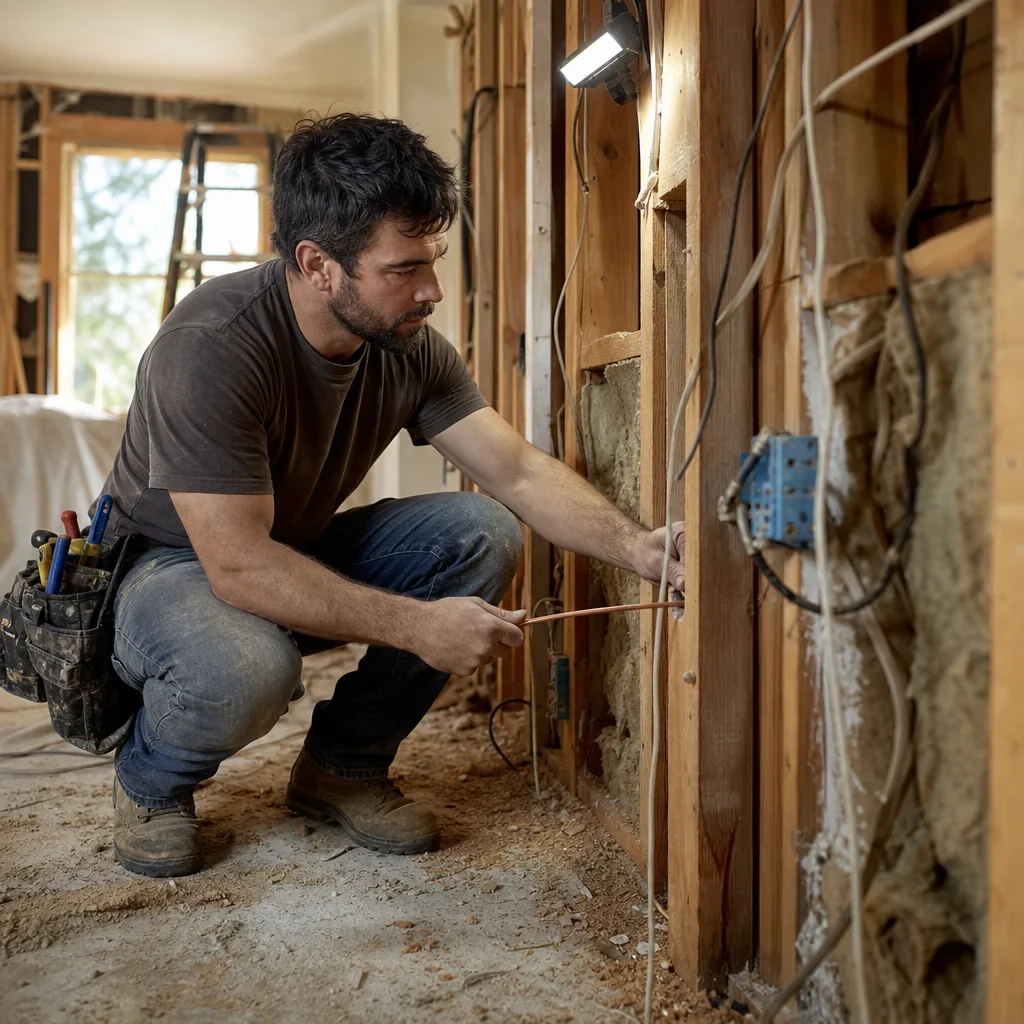
A whole-home rewire replaces the old wiring in your walls and ceilings with new wire, new circuits, new outlets and switches, and proper grounding. When it’s done, every circuit is tested before you count on it. Your house stays standing and your walls stay up. It’s a big job, but it’s not a gut job.
Most rewires follow the same basic path, whoever does the work:
- Planning the circuits. The electrician maps out what each room needs today, not what it needed decades ago. That means circuits sized for your kitchen, laundry, AC, and the things you plug in now. This is also when they check whether your panel can handle the new layout.
- Running new wire. New wire gets pulled through the attic and fished down inside the walls to each outlet, switch, and light. Electricians cut small, neat openings in the drywall where they can’t reach any other way, instead of tearing out whole walls.
- Replacing devices. Old outlets and switches come out. New ones go in, including grounded three-prong outlets and the protected outlets now expected in kitchens, baths, and other wet areas.
- Grounding the system. Every circuit gets a real ground path, so stray current has a safe place to go instead of through an appliance or a person.
- Connecting and testing. The new circuits get tied into the panel, labeled, powered up, and tested one by one.
Most homes around Carrollton sit on slab foundations, so there’s no crawlspace under the floor to run wire through. Almost everything comes down from the attic. That makes attic access a big part of how smoothly the job goes. A roomy attic with clear paths is easier to work in than a tight one packed with ductwork and insulation. Low-slope roofs, vaulted ceilings, and second stories can all make some runs harder to reach.
You can usually keep living in your home during a rewire. Power to parts of the house gets shut off while those circuits are being worked on, so expect some rooms to go dark for stretches. It helps to clear space along the walls and in closets that back up to outlets, and to make sure the attic hatch is easy to get to.
Here’s exactly what our home rewiring work includes, and what it doesn’t, so you’re not guessing:
- Included: wire and materials, professional installation, devices, grounding, and startup and testing.
- Not included: drywall finishing and paint, fixture upgrades, code corrections beyond the scope of the job, and permits unless your estimate says so.
That drywall line matters. The small openings get left in place for patching, and finishing and painting them is a separate step. Some homeowners hire a drywall pro. Others wait and patch while they’re repainting anyway. Knowing this up front helps you plan the whole project, not just the electrical part.
A rewire is also the kind of job that typically needs a city permit and an inspection. Before you sign anything, ask who pulls the permit, whether it’s in the price, and when the inspection happens. Any electrician you’re thinking of hiring should answer those questions clearly and put the answers in writing.
Have questions? We’re happy to help.
Call Today, Get Service Today. Xtreme Air Services — Carrollton is ready to help.
What Drives the Cost of Rewiring a Home
Most home rewiring jobs we quote fall between $8,000-$20,000. Our most common job is replacing outdated or unsafe wiring throughout the home with new circuits, devices, and grounding, then inspecting and testing it. That job runs $10,500-$15,000. Where your home lands depends on its size and how much work the job really takes.
Two houses with the same square footage can get very different quotes. These are the things that move the number:
- Home size and number of circuits. More rooms and more circuits mean more wire, more devices, and more hours. A kitchen packed with appliances needs more circuits than a spare bedroom.
- Wall, attic, and crawlspace access. Many Carrollton homes sit on a slab, so new wire comes down from the attic. A roomy attic keeps labor down. A tight attic crowded with ductwork, a vaulted ceiling, or a second story takes longer to reach.
- Condition of the existing wiring. Brittle insulation, knob-and-tube, or years of add-on splices can take extra time to track down and remove safely.
- Panel upgrades. If your panel can’t handle the new circuits, it may need to be replaced or upgraded as part of the job.
- Drywall repair. More openings mean more patching later. Finishing and paint aren’t part of our price, so plan for that on your side.
- Code upgrades. Bringing an older home up to today’s electrical code can add protected outlets and other work the old wiring never had.
- Permits. As covered above, ask whether the permit is in your quote. Ours includes it only if your estimate says so.
Here’s a simple way to picture it. A one-story ranch with an easy attic, copper wire in fair shape, and a panel that can handle the load sits near the lower end. A two-story home with old knob-and-tube, a cramped attic, and a panel that needs replacing sits near the higher end. Same service, very different amount of work.
A rewire is priced by your home’s size and scope. That’s why a real number starts with someone looking at your panel, your attic, and a few outlets. We charge a $26-$99 service-call fee for that visit. If you go ahead with the work through Xtreme Air Services, that fee gets credited toward the job.
When you compare quotes, look past the bottom line. Ask each electrician what’s included, what’s excluded, and whether the permit and drywall work are in the price. A lower number that leaves out half the job won’t stay lower for long. You should know what you’re paying for before any work starts. That’s why we give you upfront pricing with no surprises.
If the total feels like a lot to cover at once, you have options. We offer flexible financing on qualifying installations and larger jobs, on approved credit. That way you can make your home safe now and spread the cost out.
Call now for your estimate
Watch Our Video
See How We Handle Home rewiring in Carrollton
Xtreme Air Services — Carrollton
Why Carrollton Homeowners Trust Who They Hire for This Job
A rewire isn’t a quick visit. A crew will be in your attic, inside your walls, and in your panel, often while you and your family are still living there. The wire they run will be hidden behind drywall for decades. You won’t see the quality of the work after it’s closed up, so who you hire matters as much as what you pay.
Before you let anyone start, check these things. They apply to any electrician, including us:
- A Texas electrical license. Electricians in Texas are licensed through the Texas Department of Licensing and Regulation (TDLR). Ask for the license number and look it up yourself.
- Insurance. If someone gets hurt in your attic or something gets damaged, you don’t want that cost landing on you.
- Who’s coming into your home. Ask whether the people on site are employees who’ve been background-checked, or whoever was free that week.
- A written scope. You should get a written list of which circuits are being replaced, what’s in the price, and who handles the permit.
- Straight answers. A good electrician will tell you when a smaller fix will do. If someone pushes a full rewire without walking you through why, get a second opinion.
Here’s how we line up. Xtreme Air Services is a family-owned, licensed and insured contractor. Our technicians are background-checked and drug-tested, so you know who’s walking through your front door and up into your attic. You get upfront pricing approved before work starts, so the number doesn’t creep up halfway through the job.
We’re also local. Our Carrollton office is at 2340 E Trinity Mills Rd, Suite 300. That’s not a call center three states away. If you have a question in the middle of your project, you can talk to a real person who knows the job.
One more thing matters in Carrollton homes. Your attic is where the new wire runs, and it’s usually where your AC equipment and ductwork live too. We handle HVAC, plumbing, and electrical under one roof. If something in the attic needs a closer look while the electrical work is underway, you’re not juggling three different companies to sort it out.
Your neighbors have had their say, too. We hold a 4.8-star rating across more than 2,900 reviews on Google, Angi, and HomeAdvisor. Reviews don’t replace checking a license, but they tell you how a company treats people once the work starts.
And if the cost is what’s holding you back, flexible financing is available on qualifying larger jobs, on approved credit. Safer wiring shouldn’t have to wait until you can pay for it all at once.
Call 469-269-6099
Frequently Asked Questions
Common questions about Home rewiring
How long does rewiring a house take?
Most whole-home rewires take several days to about two weeks, depending on your home’s size and attic access. A smaller one-story home with an easy attic and copper wiring already in place goes faster. A larger two-story home with a cramped attic, old knob-and-tube wiring, or a panel that needs replacing takes longer. You can usually keep living in the house, but expect some rooms to lose power in stretches while those circuits are worked on.
Do electricians have to tear out my drywall to rewire my house?
No, most of the wire comes down through the attic, not through torn-out walls. Electricians fish new wire down inside the walls to each outlet, switch, and light fixture, cutting small, neat openings only where they can’t reach any other way. Since most Carrollton homes sit on slab foundations with no crawlspace, the attic carries nearly all the new wiring. Those small openings get left ready for patching, and finishing and painting them is a separate step, not included in the rewiring work itself.
Does the cost of rewiring change much between a smaller and larger home?
Yes, home size and the number of circuits are two of the biggest factors driving the price up or down. A bigger home with more rooms, more appliances, and more circuits needs more wire, more devices, and more labor hours than a smaller one. Attic access matters just as much: a roomy attic keeps labor down, while a tight attic crowded with ductwork or a vaulted ceiling adds time no matter the square footage.
Ready to Get Started?
Call (469) 269-6099 Today, Get Service Today.