


Tankless Water Heater Installation in Dallas: Is Your Home a Standard Job?
Whether your home is a standard tankless job or needs added gas, venting or electrical work – explained before you buy.
What’s Covered on This Page
- Standard Installation vs. Added-Scope Work
- Gas Line and Venting Requirements for Gas Tankless Units
- Electrical Capacity for Electric Tankless Units
- Sizing a Tankless Unit for Your Household
- When a Tank Replacement Makes More Sense Than Tankless
- Can one tankless water heater handle two showers running at once?
- Do I need a licensed plumber for tankless water heater installation?
- Why do some plumbers talk people out of tankless water heaters?
Standard Installation vs. Added-Scope Work
If you’ve been shopping around, you’ve probably seen tankless prices all over the map. Most of that spread comes down to one question: can the new unit hook up to what’s already in your home, or does your home need changes first?
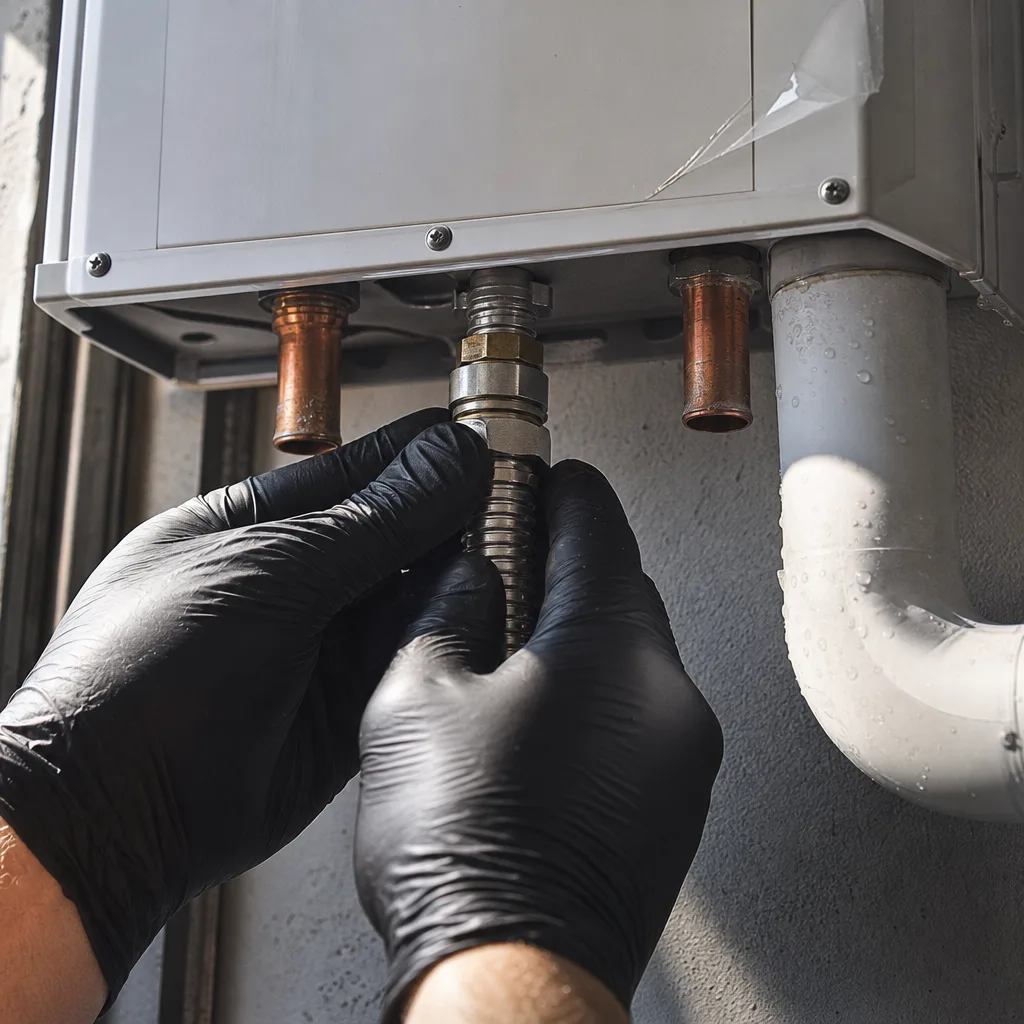
Our most common job is a standard like-for-like tankless installation. It uses your existing connections and doesn’t need major changes. That job typically runs $3,700 to $5,100. Our overall range for tankless installation is $3,000 to $6,500.
Here’s what a standard installation includes:
- The tankless unit and the materials to install it
- Professional installation and standard connections
- Startup and testing, so you know it’s making hot water before we leave
- Haul-away of your old water heater
Added scope is anything your home needs beyond those standard connections. Duct, electrical, and plumbing changes aren’t part of the standard price. Neither are code corrections or permits, unless your quote says they’re included.
Why would a home need extra work? A tankless unit heats water on demand, the moment you turn on a faucet. A tank heats water slowly and stores it. Heating water that fast takes a lot of energy at once, so the connections that worked fine for an old tank may not be enough for a tankless unit.
- Gas supply: a gas tankless unit can need more gas than your current line delivers. If the line is too small, it may need to be upsized.
- Venting: gas units need proper venting, and the old tank’s vent may not match what the new unit calls for. Venting is a big part of what shapes the price of a gas tankless job.
- Electrical: an electric tankless unit can need a dedicated circuit or more capacity than your panel has today.
- Location and access: a unit that’s hard to reach, or one that’s moving to a new spot, takes more labor and materials.
- Code upgrades and permits: older setups sometimes have to be brought up to current code as part of the swap.
The size and efficiency of the unit you pick, along with the brand and model, also move the price up or down. A bigger home with more bathrooms running hot water at the same time needs more capacity than a small one.
Because gas line installation and electrical panel upgrades are services we also offer, you don’t have to coordinate a second contractor if your home needs that work. One team handles the whole job.
What matters most is that you see the full scope before anything gets installed. Our technicians check your gas line, venting, electrical, and the install location, then give you upfront flat-rate pricing to approve before work starts. If your home is a straight swap, you’ll know it. If it needs more, you’ll know exactly what and why, with no meter running. Financing is available on qualifying installations, on approved credit, if the full scope lands higher than you planned.
Gas Line and Venting Requirements for Gas Tankless Units
If you have a gas tank water heater today, a gas tankless unit is a natural next step. But the two use gas very differently. Your tank burns a small flame for a long time and keeps water hot in storage. A tankless unit fires a much bigger burner the moment you open a hot tap, then shuts off when you’re done. That burst of demand is why your gas line and vent get a close look before anything is installed.
Your gas line has to carry enough fuel for every gas appliance that might run at the same time. Think about a winter evening when your furnace is running, someone’s cooking on a gas range, and two showers are going. If the line feeding your water heater was sized for a tank, it may come up short once a tankless unit asks for far more gas at once.
When the line is too small, you don’t usually get a dramatic failure. You get hot water that runs lukewarm or cuts in and out when other gas appliances are on. That’s why line size matters as much as the unit you pick. Here’s what goes into whether your line is big enough:
- How long the run is from your gas meter to the water heater. Longer runs lose more pressure.
- Which other gas appliances share that line, such as a furnace, range, or dryer.
- The current pipe size and how many bends and fittings it goes through.
- Whether your gas meter can supply the total load for the whole house.
In many Dallas homes, the water heater sits in a garage or utility closet, and the gas line may run up through the attic to reach it. Attic runs can be long and hard to reach, which matters if the line needs to be upsized. Gas line installation and gas leak detection are both services we offer, so any line work and testing stay part of the same job.
Venting is the other big piece. Most gas tanks use a metal flue that lets hot exhaust rise up and out on its own. Tankless units don’t work that way. They push exhaust out with a fan and need a vent made for that job. Higher-efficiency condensing units pull so much heat from the exhaust that it cools down and makes water. They vent through plastic pipe and need a small drain for that water. Non-condensing units run hotter and call for a special metal vent.
That means your old flue usually can’t just be reused. It also raises a question many homeowners don’t think about. If your furnace shares that same flue with your old tank, taking the water heater off it changes how the flue works for the furnace. The furnace side may need its own fix so exhaust still draws out the way it should.
Getting venting right is a safety issue, not just a box to check. A vent that’s the wrong type, too long, or poorly sealed can let exhaust, including carbon monoxide, back into your home. If you have gas appliances and no CO alarm near your bedrooms, it’s worth adding one whether or not you go tankless. We also offer carbon monoxide testing if you want your current setup checked.
The good news is that all of this can be seen up front. A look at your meter, your line, your flue, and where the unit will go tells you whether you’re looking at a straight swap or a home that needs gas or vent work first.
Electrical Capacity for Electric Tankless Units
If your home doesn’t have gas, or you’d rather skip gas venting altogether, an electric tankless unit can look like the simpler choice. You don’t need a flue, a gas line, or a vent through the wall. What it does need is a lot of electricity at once. That’s the part to check before you buy.
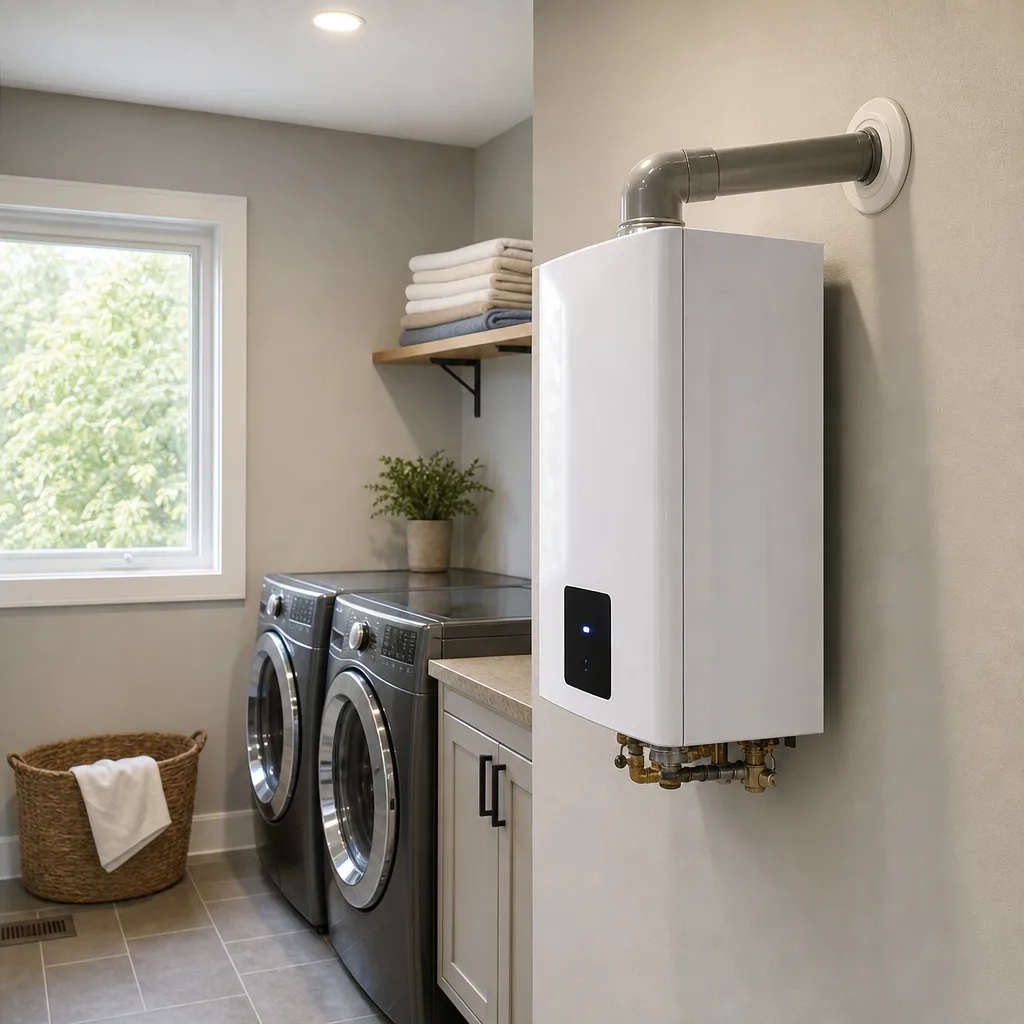
Here’s why. An electric tank heats water slowly over an hour or more, so it draws a modest amount of power. An electric tankless unit has to heat water in the few seconds it takes to flow through. To do that, a whole-home model usually needs several large breakers of its own. Together, those breakers can ask for as much power as the rest of your house uses combined.
So the real question isn’t whether the unit fits on the wall. It’s whether your electrical service can feed it without overloading. Our technicians look at four things:
- Your panel’s total capacity. This is the most power your home can draw at once, and it’s printed on the main breaker.
- Open space in the panel. A whole-home unit can need several double slots, and a full panel has nowhere to put them.
- Wire size and distance. The unit needs heavy wire run from the panel, and a long run to a garage or closet adds cost.
- What else runs at the same time. Your AC, electric dryer, range, and EV charger all share the same service.
That last point matters in Dallas. On a July afternoon your AC is working hard for hours. If someone starts a shower while the dryer and range are running, every one of those loads is pulling from the same panel. A setup that looks fine on paper can trip breakers when real life stacks up.
Winter matters too. When a hard freeze rolls through North Texas, the water coming into your home gets much colder. An electric tankless unit has to raise that cold water a lot more to reach shower temperature. If the unit is sized for summer water, you may get a cooler shower on the coldest mornings. Size it for winter, and make sure your electrical service can carry that bigger unit.
Many older ranch homes around Dallas were wired long before anyone planned for this kind of load. In those homes, a whole-home electric tankless unit may mean a panel upgrade. Sometimes it means a bigger electric service from the street, which also involves your utility, Oncor Electric Delivery. That can turn a water heater job into a much bigger electrical project.
Here’s the honest answer. If your panel is already near its limit and you don’t have gas, a whole-home electric tankless unit may not be worth the electrical work it takes. A good electric tank water heater could serve you better. Another option is a small point-of-use tankless unit under one sink, which needs far less power. We’ll tell you which way makes sense for your home, even if it’s the smaller job.
If an upgrade is the right call, electrical panel upgrades, subpanel installation, and dedicated circuit installation are all services we offer. The electrical work and the water heater install stay with one team, quoted together before anything starts.
Ready when you are – get in touch today.
Call Today, Get Service Today. Xtreme Air Services — Oak Lawn is ready to help.
Sizing a Tankless Unit for Your Household
With a tank, you size by gallons. A 40- or 50-gallon tank holds a set amount of hot water, and when it’s gone, it’s gone. A tankless unit never runs out, but it can only heat so much water at one time. So the real question is how much hot water your home uses in its busiest moment.
That busiest moment is what you size for. Picture a weekday morning. One person is in the shower, another is in the second bathroom, and the dishwasher is running. If the unit can’t keep up with all three, it doesn’t quit. It just sends out water that’s cooler than you set it for, and everyone notices.
Tankless units are rated in gallons per minute, or GPM. That’s how much hot water they can make every minute. Two things decide the GPM your home needs:
- Flow: add up the hot water fixtures that run at the same time. A shower is roughly 2 gallons per minute, a kitchen faucet a bit less, and a dishwasher or washing machine adds more on top.
- Temperature rise: how many degrees the unit has to heat the water coming into your home to reach the temperature you want at the tap. The colder the incoming water, the harder the unit works and the fewer gallons it can deliver.
Those two numbers work against each other. A unit that easily runs two showers in August may only handle one and a half in January, when the water coming in from the street is much colder. That’s the same winter effect covered in the electrical section, and it applies to gas units too. Size for your coldest mornings, not your warmest ones.
Before you talk to anyone about a unit, it helps to answer a few questions about how your family really uses water:
- How many showers might run at the same time on a busy morning?
- Do you run the dishwasher or washing machine while people are showering?
- Do you have a large soaking tub or a shower with more than one head?
- Is anyone moving in, or are kids getting older and taking longer showers?
Here’s the honest part. Bigger isn’t always better. A unit with far more capacity than your home ever uses costs more up front, and on a gas model it can also mean a bigger gas line and vent than you’d otherwise need. If you’re a couple in a two-bathroom home who rarely run two showers at once, a mid-size unit will likely serve you just fine.
On the other end, some larger homes simply need more hot water at once than one unit can make. In that case, the answer may be a high-capacity unit or two units working together. Either way, that choice feeds right back into the gas, venting, or electrical work your home needs, and into the price.
So when you get a quote, ask how the unit was sized. A good answer mentions how many fixtures your household runs at the same time and the coldest water the unit will see. If the answer is just the square footage of your house, ask a few more questions before you sign.
Watch Our Video
See How We Handle Tankless water heater installation in Dallas
Xtreme Air Services — Oak Lawn
When a Tank Replacement Makes More Sense Than Tankless
Tankless isn’t the right fit for every home. Sometimes a new tank water heater is the smarter buy, and you should hear that before you spend more than you need to. Here are the cases where we’d point you toward a tank.
- Your home needs a lot of added work. If your gas line, venting, or electrical panel would need major upgrades, as covered above, that added scope can wipe out the savings for years. A like-for-like tank swap uses what you already have.
- You won’t be in the house long. Tankless saves energy a little at a time, month after month. If you plan to sell in the next few years, you may never earn back the higher upfront cost.
- Your family uses little hot water. A single person or a couple in a small home won’t see much difference on the gas or power bill. The savings come from not keeping a big tank hot all day, and a small household doesn’t lose much that way to begin with.
- You’re out of hot water right now and money is tight. When an old tank fails without warning, a straight tank replacement is often the simpler, lower-cost way to get hot showers back. You can plan a tankless upgrade later, when you’re not under pressure.
- You want hot water during a power outage. A gas tankless unit needs electricity to run its fan and controls. When a storm knocks out power, it stops making hot water. Many standard gas tanks with a pilot light keep working without power, and that matters when a winter storm hits North Texas.
- You mostly run small trickles of hot water. A tankless unit needs a minimum flow before it turns on. If you like to rinse dishes at a low trickle, the unit may not fire, and the water stays cold.
Hard water is the other thing Dallas homeowners should weigh. Our water carries a lot of minerals. Inside a tankless unit, those minerals build up as scale on the parts that heat the water. Over time, that scale cuts down on how well the unit works. A tankless unit in a hard-water home needs a regular flush to clear the scale out. If you know you won’t keep up with that, a tank can be easier to live with. If you do go tankless, a water softener can help protect the unit, and water softener installation is a service we offer.
None of this means a tank is the better water heater. It means it may be the better fit for your house and your plans. A tank costs less to buy and install. It’s simpler to replace. It has fewer parts that need regular care. For a lot of families, those trade-offs come out ahead.
If one or two of these sound like you, it’s fair to ask for a price on both. Seeing a tank replacement and a tankless install side by side, each with its full scope spelled out, is the clearest way to tell which one pays off in your home.
Frequently Asked Questions
Common questions about Tankless water heater installation
Can one tankless water heater handle two showers running at once?
It depends on the unit’s size and how cold your incoming water is. A tankless unit is rated in gallons per minute, and two showers running together need around 4 GPM or more. A unit that easily covers two showers in August may fall short on a cold January morning, when the incoming water needs more heating. Sizing for your coldest water, not your warmest, is the only way to know for sure.
Do I need a licensed plumber for tankless water heater installation?
Yes, and for a gas unit you also need someone who can safely handle gas line and venting work, not just plumbing. Gas tankless units need a line sized for a much bigger burst of fuel than your old tank used, plus venting built for the exhaust type your new unit produces. Getting this wrong can let exhaust, including carbon monoxide, back into your home. Having one team confirm your gas line, venting, and install location together avoids gaps between separate contractors.
Why do some plumbers talk people out of tankless water heaters?
Usually because a home’s gas line, venting, or electrical setup isn’t ready for one, and that added work can erase the savings. A tankless unit demands a lot more gas or power at once than a tank ever did, so an older home may need line upgrades, new venting, or more electrical capacity first. That’s added scope, not a flaw in tankless units themselves. The honest move is checking your home’s gas, venting, and electrical before recommending either option, which is why some installers lean toward whichever job is simpler for your specific house.
Ready to Get Started?
Call (469) 269-6373 Today, Get Service Today.