


EV Charger Installation in Fort Worth: What Your Home Needs First
Level 2 home chargers wired on their own circuit, with your panel checked first so the charger runs at full speed.
What’s Covered on This Page
- Your Panel Decides What This Job Costs
- Fort Worth Requires a Permit for This Electrical Work
- Level 2 Installation: What Happens From Panel to Charger
- Level 1 vs. Level 2: Do You Even Need an Electrician
- Licensed Electrical Work You Can Verify
- Are there any rebates for installing an EV charger in Fort Worth?
- How long does an EV charger installation usually take?
- Can I install an EV charger myself to save money?
Your Panel Decides What This Job Costs
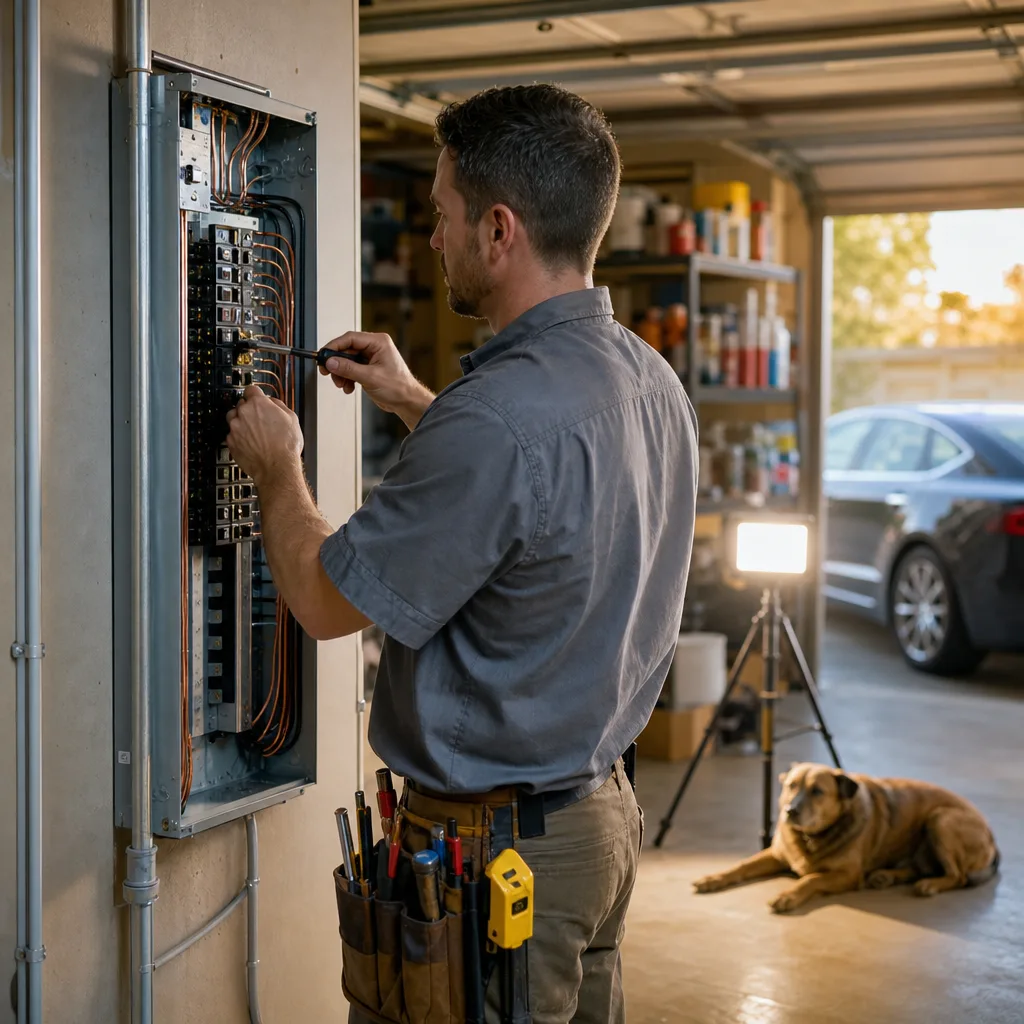
You’ve probably seen EV charger quotes online that are all over the map. That’s because the charger is only part of the job. The bigger question is what’s behind your panel door, and how much work it takes to get a new circuit from there to your car.
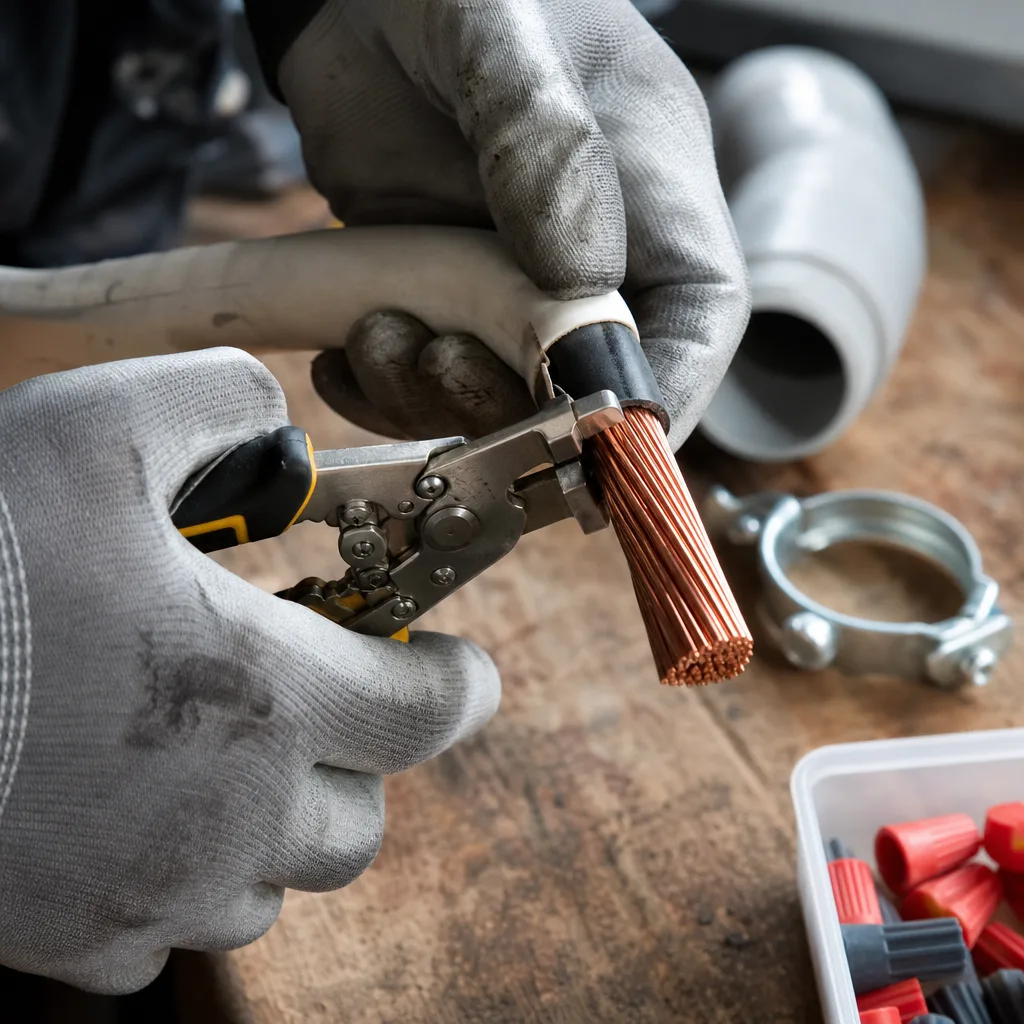
Our most common job is putting a Level 2 home charger on a dedicated circuit from your panel. We mount it, connect it, and test it. Most of these jobs finish the same day and fall in the $900-$1,700 range. Across all EV charger jobs, our typical range is $500-$2,500.
Here’s what moves your price up or down:
- Distance from the panel. A panel on the garage wall right next to your parking spot means a short run. A panel on the far side of the house means more wire and more labor.
- Panel capacity. A dedicated charger circuit needs room in your panel. If there’s space and enough capacity, the job stays simple. If not, an upgrade may be needed first.
- Charger amperage. A higher-amp charger can fill your battery faster, but it needs a bigger circuit. Sometimes a slightly lower setting fits your panel and still covers your daily driving.
- Wall and conduit routing. Running wire through a finished wall, across a ceiling, or outside in conduit takes more time than a straight run across open studs.
- Code upgrades. If something nearby isn’t up to current code, it may need to be fixed before the new circuit can go in.
- Permits. These can add to the total, depending on the job.
Here’s the honest part. Not every home needs a panel upgrade to charge an EV. If your panel has room, you may only need the dedicated circuit and nothing more. A good electrician should tell you that plainly instead of selling you work you don’t need. If your panel really is maxed out, our electrical panel replacement and upgrade service covers that, and it’s priced separately.
So you can compare quotes fairly, here’s what our install price includes: the dedicated circuit, professional installation, mounting, startup, and testing. It doesn’t include the charger itself if you don’t supply one, panel upgrades, trenching, code corrections, or permits, unless your quote says otherwise. When you put two quotes side by side, check whether each one covers the same things.
There’s a $26-$99 service-call fee to come out and look at your setup. That fee is credited toward the job if you go ahead with Xtreme Air Services. You get upfront flat-rate pricing before any work starts, so there’s no meter running while we’re in your garage.
If your job grows because of a panel upgrade or a longer run, flexible financing is available on qualifying installations and larger jobs, on approved credit. That way the extra electrical work doesn’t have to stand between you and charging at home.
Fort Worth Requires a Permit for This Electrical Work
Adding a new 240-volt circuit for a Level 2 charger isn’t a small swap like changing a light switch. It’s new wiring run from your panel, and in Fort Worth that kind of electrical work goes through the city’s permit and inspection process. The permit is how a second set of eyes confirms the job was done safely before you start charging your car every night.
Think about what that circuit does. It pulls a heavy load for hours at a time, often overnight while your family’s asleep. A wire that’s a size too small or a loose connection might work fine on day one and slowly heat up over months. An inspection is the check that catches that kind of mistake while it’s still easy to fix.
When an inspector looks at a charger install, they’re generally checking things like:
- The wire is sized correctly for the breaker and the charger’s amperage.
- The breaker matches the circuit and is labeled in your panel.
- The circuit is properly grounded.
- Wire running through walls, attics, or outside is protected the right way, like in conduit where it’s exposed.
- The charger or outlet is mounted securely and in a sensible spot for a garage or driveway.
There’s a practical side too. A permitted, inspected install leaves a paper trail. If you sell your home, a buyer’s inspector may ask about that big new circuit in the garage. If you ever have an insurance claim tied to your electrical system, unpermitted work can raise questions you don’t want to answer. A closed permit settles both.
Here’s when you probably don’t need one. If your EV came with a Level 1 cord and you’re plugging it into an existing, working 120-volt outlet, you’re not adding new wiring, so there’s nothing to permit. For a lot of folks who drive under 40 miles a day, that slow overnight charge is enough for a while. The permit question comes up when you add a new circuit for faster charging.
If your panel can’t handle the new load, the job can grow beyond a single circuit. A panel upgrade or service change is bigger electrical work, and it may also involve Oncor, the company that delivers power to most Fort Worth homes, if the service coming into your house has to change. That’s worth knowing up front so the timeline doesn’t catch you off guard.
In Texas, electrical work like this should be done by an electrician licensed through the Texas Department of Licensing and Regulation, or TDLR. That license, plus the city permit, is what protects you. As covered in the pricing section, permit costs aren’t part of the base install price unless your quote says so. Before you hire anyone, ask these questions:
- Are you a TDLR-licensed electrician or electrical contractor?
- Will this job be permitted with the City of Fort Worth, and who’s pulling the permit?
- Is the permit cost in my quote, or will it be added later?
- Will the work be inspected before I start using the charger?
If an installer tells you the permit doesn’t matter or offers a lower price to skip it, that’s your sign to keep looking. Saving a little now isn’t worth a circuit nobody checked running in your garage every night.
Level 2 Installation: What Happens From Panel to Charger
A Level 2 install is simple to describe. You get a new dedicated circuit from your panel to where you park, then the charger is mounted, connected, and tested. Most of these jobs finish the same day. What happens between those two points depends on your home, and it always starts with the panel.
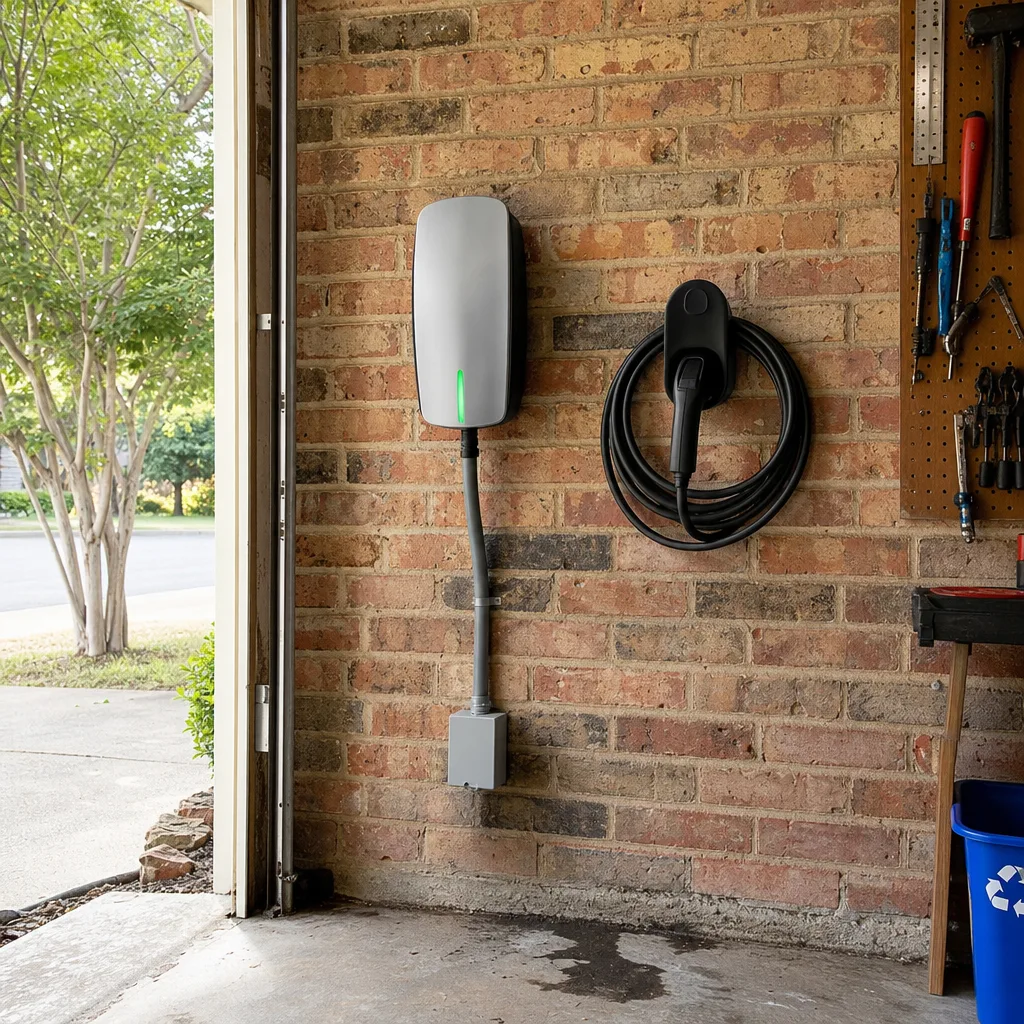
Before any wire gets pulled, settle a few decisions so install day goes smoothly:
- Where the charger goes. Measure where your charge port sits when you park. A charger on the wrong wall means a cord stretched across the garage floor every night.
- Hardwired or plug-in. A hardwired charger connects straight to the circuit. A plug-in charger uses a heavy-duty 240-volt outlet. Hardwiring is a cleaner setup with no outlet to wear out. A plug-in lets you take the charger with you if you move.
- How many amps. Your panel’s spare capacity sets the limit. If your panel is tight, a lower setting can still fill your battery overnight.
- Who supplies the charger. If you’re buying your own, have it on hand before the install. It isn’t part of the install price unless your quote says so.
On install day, the work follows the path from your panel to your car.
First, power to the panel is shut off so it’s safe to work inside it. A new double-pole breaker goes in. That’s the two-slot breaker a 240-volt circuit needs. It gets labeled so you’ll always know which switch controls the charger.
Next comes the wire run. This is where homes differ the most. If your panel sits on the garage wall and the studs are open, the run can be short and straight. If the panel is on an outside wall or across the house, the wire may go through the attic, along a ceiling, or outside in conduit. In a lot of Fort Worth homes built on slabs, there’s no crawl space under the floor, so wire usually goes overhead through the attic. In a Texas summer, that attic can get brutally hot. That’s one reason to schedule early in the day when you can.
Then the charger is mounted at a height and spot that keeps the cord off the floor and out of your car’s path. The circuit is connected at both ends.
Last is startup and testing, and this is the step that matters most to you. A finished install isn’t just a charger with a green light. You want to see your car start charging and pull power at the rate you expected. If your charger has a phone app, this is a good time to get it connected to your Wi-Fi while someone’s still there to help.
To get ready, clear a path to your panel and the charging spot, move anything stored along that wall, and plan to have your car home for testing. After that, the inspection covered above is the final check before you plug in every night.
Not sure what your EV charger installation project needs? Ask us.
Call Today, Get Service Today. Xtreme Air Services — Fort Worth is ready to help.
Level 1 vs. Level 2: Do You Even Need an Electrician
Not everyone who buys an EV needs an electrician right away. Your car probably came with a Level 1 cord. It plugs into a regular 120-volt wall outlet, the same kind you’d plug a lamp into. A Level 2 charger runs on 240 volts, like your clothes dryer, and it fills your battery much faster. The real question isn’t which one is better. It’s which one fits the way you drive.
Level 1 is slow. It adds only a few miles of range for every hour it’s plugged in. That sounds bad until you think about how long your car sits in the garage overnight. If you get home at 6 and leave at 7 the next morning, that’s 13 hours of slow, steady charging. For a lot of people, that’s plenty.
You can probably stick with Level 1 for now if:
- You drive a plug-in hybrid. The battery is small, and the gas engine covers longer trips.
- Your daily driving is short and your car sits home most nights.
- The EV is a second car that doesn’t rack up big miles.
- You have reliable charging at work and only need a top-off at home.
- You’re renting or plan to move soon and don’t want to put money into a home you’re leaving.
If that’s you, save your money. Use the cord you have, watch how your battery holds up for a few weeks, and decide later. As the permit section covered, plugging into an outlet you already have doesn’t involve any new wiring.
There’s one catch with Level 1. It pulls power for hours at a time, and plenty of garage outlets share a circuit with a freezer, a fridge, or the door opener. Read your owner’s manual. It’ll tell you what your carmaker allows for outlets and cords. If the breaker trips while the car’s charging, or the outlet looks scorched or feels warm, stop using it and have it checked. Our electrical troubleshooting team can look at that outlet without turning it into a charger sales pitch.
Level 2 starts to make sense when Level 1 can’t keep up. That usually looks like waking up to a battery that isn’t full, or planning your day around how much range you’ve got. It’s common if you:
- Commute long distances across the Metroplex most days.
- Have a full battery EV with a big battery that takes forever to fill on a wall outlet.
- Share the garage with two EVs that both need a charge overnight.
- Drive for work, like rideshare or deliveries, and need a quick turnaround between shifts.
- Need to recharge fast between a morning trip and an evening one.
Weather plays a part in Fort Worth too. On a hard winter freeze, your car may spend some of that slow trickle warming its own battery. Level 1 can fall behind on exactly the mornings you need a full charge. In the summer heat, your car may use energy to keep the battery cool while it’s parked in a hot garage.
One more thing. If your garage already has a 240-volt outlet from an old dryer or a welder, don’t assume it’s ready for a charger. It has to be sized and wired for hours of steady load, so have it checked before you plug in.
If you’re on the fence, you don’t have to decide on day one. Starting with Level 1 and upgrading once you know your habits is a perfectly good plan.
Watch Our Video
See How We Handle EV charger installation in Fort Worth
Xtreme Air Services — Fort Worth
Licensed Electrical Work You Can Verify
You’re about to let someone open your panel and run a circuit that will carry a heavy load in your garage every night. You shouldn’t have to take anyone’s word for it that they’re qualified. You should be able to check.
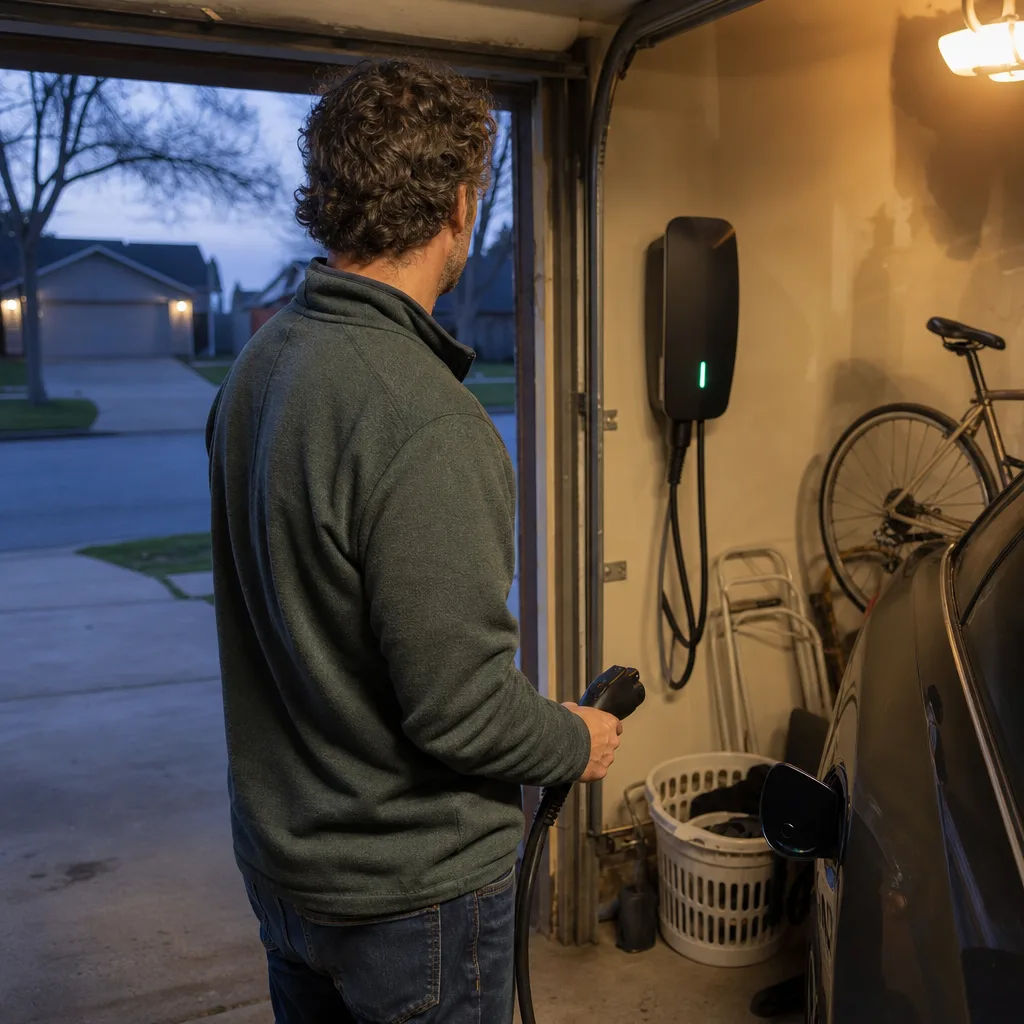
Xtreme Air Services is a licensed and insured HVAC, plumbing, and electrical contractor serving Fort Worth and the rest of the DFW Metroplex. We’re family-owned and operated. Our technicians are licensed, background-checked, and drug-tested before they ever step into your home. Your neighbors have given us a 4.8-star rating across more than 2,900 reviews on Google, Angi, and HomeAdvisor.
Don’t stop at what we say about ourselves. Here’s what to ask any electrician before you book, us included:
- Can I have your license number? A real contractor will give it to you on the spot, and you can look it up with TDLR yourself.
- Are you insured for electrical work in my home? Ask to see proof. If something goes wrong inside your walls, you don’t want that to become your problem.
- Who’s doing the work? Make sure the person in your garage is the licensed, vetted tech you were promised and not an unknown subcontractor.
- What does my written quote include? It should list the circuit, mounting, testing, and anything extra like a panel upgrade or permit, so nothing shows up later.
- Will you test the charger with my car before you leave? You want to see it pull power, not just light up.
That last question ties back to the whole point of this page. Your panel sets the price, so the right installer looks at it first and tells you plainly what your job needs. Sometimes that’s just a dedicated circuit. Sometimes it’s more. Either way, you should know before any work starts. That’s why you get upfront flat-rate pricing from us, approved by you before we pick up a tool, with no meter running.
It also helps to have one team that can handle whatever the panel check turns up. If your home needs an electrical panel upgrade, a subpanel in the garage, or whole-house surge protection to go with the charger, our electricians handle that too. You don’t have to bring in a second company and start the quote process over.
Timing matters when you’ve just brought home a new EV. Same-day service is available, and there’s no extra charge for nights or weekends, so you can book around your schedule without paying more for it. Every job is backed by our 100% satisfaction guarantee.
If you’d rather know what you’re dealing with than guess, start with your panel. One visit tells you whether you need a simple circuit or something bigger, and what it’ll cost.
Call 817-677-1907
Frequently Asked Questions
Common questions about EV charger installation
Are there any rebates for installing an EV charger in Fort Worth?
Rebate programs change often, so check with Oncor and your EV maker before you install. Some utilities and automakers offer credits for home charging equipment, but availability depends on your provider and the time of year. Ask your electrician to note your panel size and circuit details on the invoice, since some rebate programs ask for that paperwork.
How long does an EV charger installation usually take?
Most Level 2 charger installs finish in a single day, from opening the panel to testing the charger with your car. The timeline depends on how far your panel sits from your parking spot and whether the wire runs through open studs or has to go through the attic. A straightforward job with a nearby panel moves faster than one needing a longer run or extra code work.
Can I install an EV charger myself to save money?
You shouldn’t wire a 240-volt circuit yourself, even to save money. This is new wiring from your panel carrying a heavy load for hours overnight, and Fort Worth requires a permit and inspection for that kind of work. A licensed electrician protects you from a loose connection or undersized wire that could overheat months later, long after the job looks finished.
Ready to Get Started?
Call (817) 677-1907 Today, Get Service Today.