

If you’ve ever asked what does tonnage mean HVAC and gotten a confusing answer involving weight or equipment size, you’re not alone. Tonnage in HVAC has nothing to do with how heavy your air conditioner is. It measures cooling power. Specifically, it tells you how much heat your system can pull out of your home or building every hour. Understanding this single number can save you from buying the wrong system, overpaying on energy bills, and living with a house that never quite feels comfortable.
Table of Contents
- Key Takeaways
- What does tonnage mean in HVAC: the origin and the numbers
- How tonnage translates to actual system sizing
- Common misconceptions about HVAC tonnage
- Practical steps to find the right tonnage for your space
- My take on why tonnage understanding actually matters
- Get the right tonnage with expert HVAC help
- FAQ
Key Takeaways
| Point | Details |
|---|---|
| Tonnage measures cooling power | One ton equals 12,000 BTU/hr of heat removed, not the physical weight of the unit. |
| Sizing errors are common | Relying on square footage alone leads to oversized or undersized systems in up to 50% of installations. |
| Manual J is the gold standard | Professional load calculations factor in insulation, climate, and occupancy for accurate tonnage sizing. |
| Oversizing causes real problems | Units that are too large short cycle, fail to control humidity, and drive up energy costs. |
| Right-sizing pays off long term | Correctly sized systems last longer, run more efficiently, and keep indoor comfort consistent. |
What does tonnage mean in HVAC: the origin and the numbers
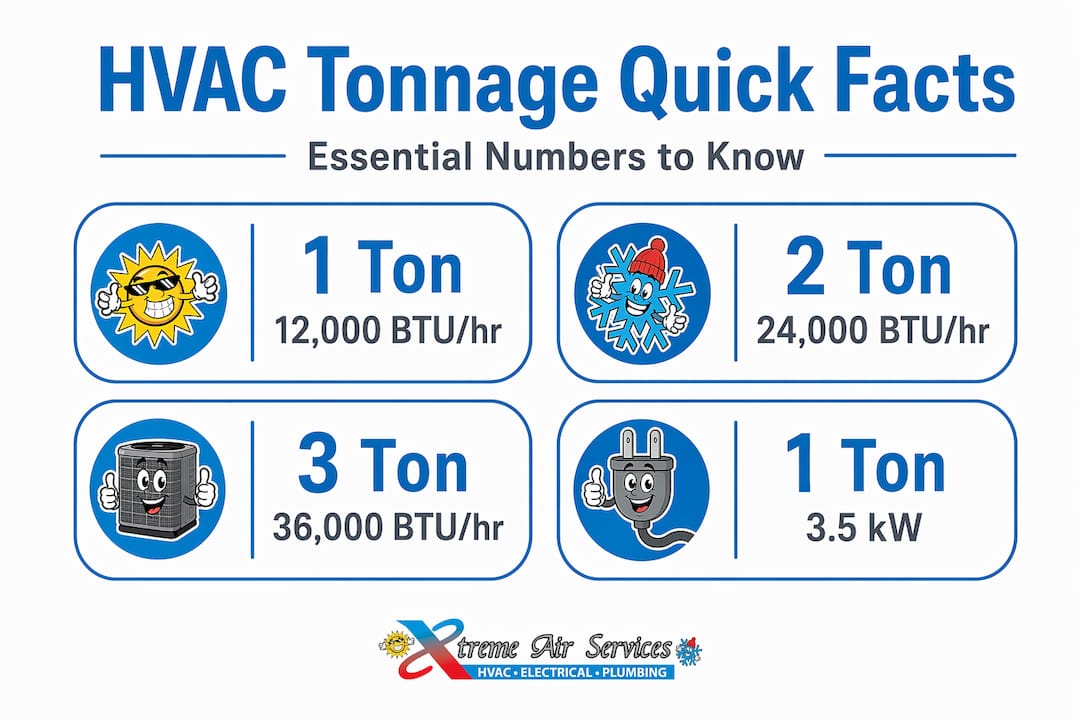
The word “ton” in HVAC comes from the ice industry, not a weight scale. Before mechanical cooling existed, the term originated from the energy required to melt one short ton of ice over 24 hours. When engineers standardized that number, they landed on 12,000 BTU per hour. That figure became the universal benchmark for measuring cooling capacity, and the name “ton” stuck.
So when you see a system labeled as a 3-ton unit, it means that system can remove 36,000 BTU/hr of heat from your space. It has nothing to do with how the unit looks, how big the cabinet is, or how much it weighs on a shipping pallet.
Here is a quick reference for the numbers that matter:
| Tonnage | BTU/hr | Kilowatts (kW) |
|---|---|---|
| 1.5 tons | 18,000 BTU/hr | 5.28 kW |
| 2 tons | 24,000 BTU/hr | 7.03 kW |
| 2.5 tons | 30,000 BTU/hr | 8.79 kW |
| 3 tons | 36,000 BTU/hr | 10.55 kW |
| 3.5 tons | 42,000 BTU/hr | 12.31 kW |
| 4 tons | 48,000 BTU/hr | 14.07 kW |
| 5 tons | 60,000 BTU/hr | 17.58 kW |
The conversion is straightforward: 1 ton equals 3.517 kW. Engineers working on larger commercial projects often work in kilowatts, while residential contractors in North America almost always refer to tons. Both describe the same thing: thermal power. The rate at which heat moves.
Pro Tip: When you look at any AC unit’s spec sheet, find the BTU/hr rating and divide by 12,000. That gives you the tonnage. A unit showing 24,000 BTU/hr is a 2-ton system, regardless of what the salesperson calls it.
Tonnage units remain dominant in North America because of historical precedent and their practical fit for residential and light commercial work. But understanding the BTU conversion gives you a real advantage when comparing quotes or reviewing equipment specs.
How tonnage translates to actual system sizing
Knowing the definition is one thing. Knowing how to apply it to your home or building is where the real value lives.

Residential central AC units commonly range from 1.5 to 5 tons, sized in half-ton steps. A small townhouse or condo might need a 1.5-ton unit. A large single-family home in a hot climate could require a 4 or 5-ton system. Larger commercial properties often use multiple systems to cover different zones, each sized independently based on that zone’s specific load.
The mistake most homeowners make is assuming square footage tells the whole story. It does not. The factors that actually determine your cooling load include:
- Ceiling height. Taller ceilings mean more air volume to cool.
- Insulation quality. Poorly insulated walls and attics dramatically increase the load.
- Window area and orientation. South and west-facing glass adds significant solar gain.
- Local climate. A home in Dallas carries a far heavier cooling load than the same home in Denver.
- Occupancy. Each person in a space generates roughly 250 BTU/hr of heat.
- Appliances and lighting. Kitchens, server rooms, and commercial kitchens add load that has nothing to do with square footage.
This is exactly why Manual J load calculation exists. It is the recognized industry method for sizing HVAC systems accurately, and it accounts for every one of those variables. Proper Manual J sizing can save you 20 to 40% on energy costs and prevents the sizing errors that appear in roughly half of all systems installed using rules of thumb alone.
Sensible vs. latent cooling capacity
Here is a piece of HVAC sizing knowledge most homeowners never hear. Your AC system does two distinct jobs: it removes heat (sensible cooling) and it removes humidity (latent cooling). Both are measured in BTU/hr, but they behave differently.
Sensible and latent capacities must both be balanced for true comfort. A unit that handles sensible load well but runs too briefly to dehumidify will leave you with a room that feels cold and clammy rather than genuinely comfortable. This is one of the most common complaints from homeowners with oversized systems, and it comes down to tonnage being wrong for the actual load.
Pro Tip: Ask your HVAC contractor for the sensible heat ratio (SHR) on any system they recommend. In humid climates like Texas, you want a lower SHR, meaning the unit handles more latent (humidity) load. A generic tonnage number alone does not capture this.
Common misconceptions about HVAC tonnage
Some of the costliest HVAC decisions come from misunderstanding what tonnage actually means. These are the misconceptions that show up most often.
Tonnage equals the physical weight of the unit. This one is so common it deserves repeating. Tonnage is a cooling rate, not a mass measurement. A 5-ton air conditioner does not weigh five tons. It removes heat at a rate of 60,000 BTU/hr. The confusion is understandable given the word, but the distinction matters every time you read a spec sheet or compare systems.
Square footage is enough to determine the right size. The old rule of 1 ton per 400 to 600 square feet is outdated and unreliable. Sizing by square footage alone risks 30 to 60% oversizing, with direct consequences for comfort and operating costs. Two homes with identical square footage but different insulation, window counts, and orientations can have cooling loads that differ by a full ton or more.
Bigger is always better. This thinking leads directly to oversized units, and the problems they cause are well documented:
- The system reaches the thermostat setpoint too fast and shuts off early. This is called short cycling.
- Short cycling means the unit never runs long enough to pull humidity out of the air.
- Oversized units produce cold, clammy indoor air and higher energy costs because they start and stop constantly instead of running in longer, more efficient cycles.
- Equipment that short cycles wears out faster, increasing maintenance and replacement costs.
Undersized units are just a comfort issue. An undersized system runs continuously trying to hit a setpoint it cannot reach. That constant operation strains the compressor, shortens the system’s lifespan, and still fails to keep the space cool on the hottest days of the year. It is not just a comfort problem. It is a reliability and cost problem.
Understanding the HVAC tonnage definition clearly helps you avoid all of these traps before you sign a contract or approve an installation.
Practical steps to find the right tonnage for your space
You do not need to be an engineer to apply this knowledge. Here is a practical sequence for determining the right tonnage and using that information wisely.
-
Get a Manual J calculation done. This is non-negotiable for any new system or replacement. Professional load calculations incorporate square footage, ceiling height, insulation values, window specs, local climate data, and more. Any reputable contractor should offer this as a standard part of the sizing process.
-
Convert BTUs to tons yourself. Once you have a load estimate in BTU/hr, divide by 12,000 to get the tonnage. If a contractor hands you a quote for a specific unit, pull the BTU rating from the spec sheet and verify the math matches the load calculation. It should.
-
Consider zoning for larger buildings. A 5,000-square-foot commercial space is not well served by one massive unit. Multiple smaller systems zoned by area give you better temperature control, redundancy if one unit fails, and often better efficiency overall. Each zone gets sized independently based on its actual load.
-
Ask contractors the right questions. Before accepting any recommendation, ask specifically: “Is this recommendation based on a Manual J calculation?” If the answer is no, or if the contractor says something like “we use 400 square feet per ton,” that is a red flag.
-
Use this comparison table as a starting reference (not a substitute for proper sizing, but a useful sanity check):
| System size | BTU/hr | Approximate home size | Best fit scenario |
|---|---|---|---|
| 1.5 tons | 18,000 | 600–900 sq ft | Small home, good insulation, mild climate |
| 2 tons | 24,000 | 900–1,200 sq ft | Moderate climate, average insulation |
| 2.5 tons | 30,000 | 1,200–1,500 sq ft | Average home, mixed insulation quality |
| 3 tons | 36,000 | 1,500–2,500 sq ft | Standard home, hot climate like Texas |
| 4 tons | 48,000 | 2,000–3,000 sq ft | Larger home, older construction, high solar gain |
| 5 tons | 60,000 | 2,500–4,000 sq ft | Large home or small commercial, hot/humid climate |
The ranges above assume a reasonably insulated structure in a warm climate. A well-insulated new build might size down. An older home with poor attic insulation and large west-facing windows might size up. That is exactly why right-sizing improves equipment lifespan, lowers energy costs, and enhances indoor comfort. The table gets you in the ballpark. The Manual J gets you to the right answer.
My take on why tonnage understanding actually matters
I’ve watched homeowners spend thousands of dollars on the wrong system because they trusted a quick square footage estimate from a contractor who skipped the real work. In my experience, this is one of the most common and most avoidable mistakes in HVAC.
What I’ve learned from seeing this play out repeatedly is that tonnage knowledge is not just trivia. It is leverage. When you understand what the number means, you can have a real conversation with your contractor instead of just nodding at whatever they recommend. You can ask why they chose a 3-ton unit over a 2.5-ton unit. You can ask to see the load calculation. Most homeowners never ask those questions, and most contractors never volunteer that information.
The uncomfortable truth I’ve observed is that oversizing is still incredibly common, partly because contractors sometimes install what they have in stock, and partly because many customers believe bigger means better. But an oversized unit is not a bonus. It is a problem you pay for every month in energy costs and every summer in clammy, uncomfortable air.
What actually works is pairing tonnage knowledge with the right professional. When you walk into that conversation knowing that 1 ton equals 12,000 BTU/hr, that sizing by square footage alone leads to errors, and that Manual J is the standard, you become a much harder customer to shortchange. That knowledge protects your investment and your comfort for the 15 to 20 years that system will be running in your home.
Facility managers dealing with commercial spaces have even more at stake. A wrong sizing decision across multiple zones can mean years of complaints, excessive energy spend, and premature equipment failure across the board. The investment in a proper load calculation pays back fast.
— Xtreme
Get the right tonnage with expert HVAC help
Understanding tonnage is the first step. Having a team that applies it correctly is what actually makes a difference in your home or building.

At Xtremeairservices, we size every system using proper load calculations, not guesswork or outdated square footage rules. Whether you are replacing a residential unit in a Dallas home or sizing a commercial system for a larger facility in Plano, Irving, or Sunnyvale, TX, our team works through the actual numbers before making a single recommendation. We handle everything from the initial assessment through installation and ongoing maintenance. If you want a system that performs the way it should from day one, our HVAC repair and maintenance team is ready to help. Reach out to Xtremeairservices today to schedule your evaluation.
FAQ
What does one ton mean in HVAC?
One ton in HVAC means the system can remove 12,000 BTU of heat per hour from your space. It has nothing to do with the physical weight of the equipment.
How do I calculate HVAC tonnage for my home?
The most accurate method is a Manual J load calculation performed by a professional, which accounts for insulation, climate, window area, and occupancy. As a rough check, divide the BTU/hr rating of any unit by 12,000 to get the tonnage.
What happens if my AC unit is the wrong tonnage?
An oversized unit short cycles, leaving humidity in the air and wasting energy. An undersized unit runs constantly without reaching the target temperature. Both lead to higher costs and faster equipment wear.
What size HVAC system do I need for a 2,000 sq ft home?
In a hot climate like Texas, a 2,000 square foot home typically needs a 3 to 3.5-ton system, but insulation quality, ceiling height, and window placement can change that. A load calculation gives you the precise answer.
Why is tonnage the standard measurement for AC systems in the US?
The tonnage unit became the standard in North America due to its historical roots in the ice industry and its practical fit for describing residential and light commercial cooling capacity. It remains the dominant measurement used by contractors and equipment manufacturers across the country.
Recommended
Need professional help? Explore our residential air conditioning and heating.