


So, what is demand controlled ventilation? Demand controlled ventilation (DCV) is a system that automatically adjusts the amount of fresh outdoor air supplied to a building based on real-time occupancy and air quality signals, primarily carbon dioxide (CO2) levels. Unlike traditional fixed-rate ventilation, which runs at the same speed whether a room holds 50 people or none, DCV reads the actual conditions inside and responds accordingly. The result is better indoor air quality and lower energy bills at the same time. Building certifications like LEED, WELL, and BREEAM now practically require DCV for new construction and major renovations in 2026.
What is demand controlled ventilation and how does it work in real time?
DCV works by using CO2 sensors as a proxy for how many people are in a space. People exhale CO2, so rising CO2 levels signal rising occupancy. The system reads those levels continuously and adjusts the outdoor air intake to match.
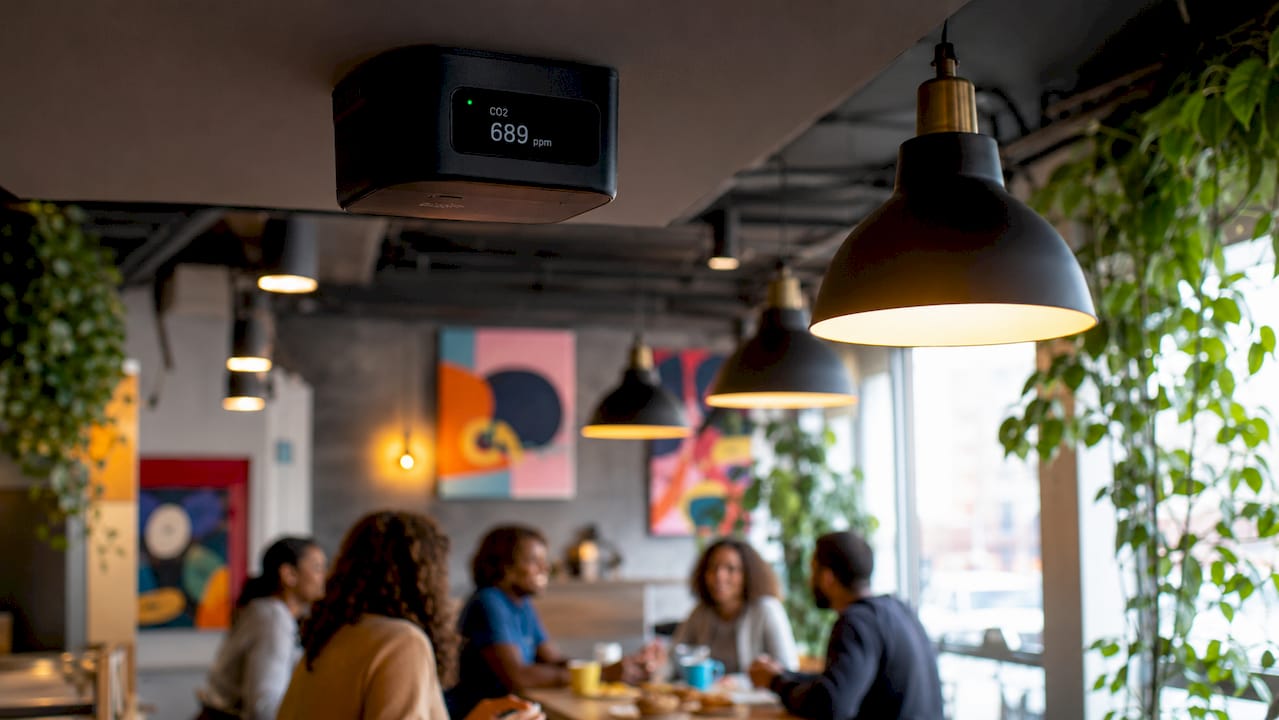
The control logic follows a clear threshold structure. CO2 modulation begins at roughly 600–700 ppm and targets a setpoint of around 800 ppm, keeping indoor air below 850 ppm averaged over eight hours. That 50 ppm buffer between the setpoint and the limit gives the system time to respond before air quality degrades. When CO2 drops back toward baseline, the system reduces airflow and saves energy.
CO2 sensors do not capture every indoor pollutant. Volatile organic compounds (VOCs) from furniture, cleaning products, and building materials do not raise CO2 levels. For that reason, ASHRAE Standard 62.1 requires every DCV system to maintain a minimum ventilation floor rate regardless of what the CO2 sensor reads. That floor rate covers pollutants that occupancy sensors simply cannot detect.
Humidity sensors add a second layer of control. Excess moisture causes mold growth even when CO2 is perfectly normal. A well-designed DCV system combines CO2 and humidity signals and responds to whichever reading demands more ventilation at any given moment. That logic protects both air quality and building structure.
Multi-zone buildings add one more layer of complexity. A conference room, a gym, and an empty storage area all produce different CO2 readings at the same time. The system must respond to the highest reading across all zones, not an average. Building Automation Systems (BAS) tie these zones together, giving facility managers a single dashboard to monitor and adjust the entire demand ventilation system.
- CO2 sensors detect occupant presence and trigger airflow increases
- Humidity sensors prevent mold by adding a moisture-based ventilation signal
- Minimum ventilation floor covers VOCs and other non-CO2 pollutants
- Zone-based control responds to the highest demand signal, not an average
- BAS integration centralizes monitoring and control across the whole building
Pro Tip: Place CO2 sensors at breathing height, roughly 3–5 feet off the floor, and away from doors, windows, and supply air diffusers. Poor placement is the single most common reason a DCV system underperforms from day one.
What are the benefits of demand ventilation compared to traditional systems?
The core benefit of demand controlled ventilation is simple: you stop paying to heat, cool, and move air that nobody needs. Fixed-rate ventilation systems run at full capacity on a schedule, not based on actual occupancy. A conference room that sits empty for six hours still gets fully ventilated under a traditional setup. DCV eliminates that waste.
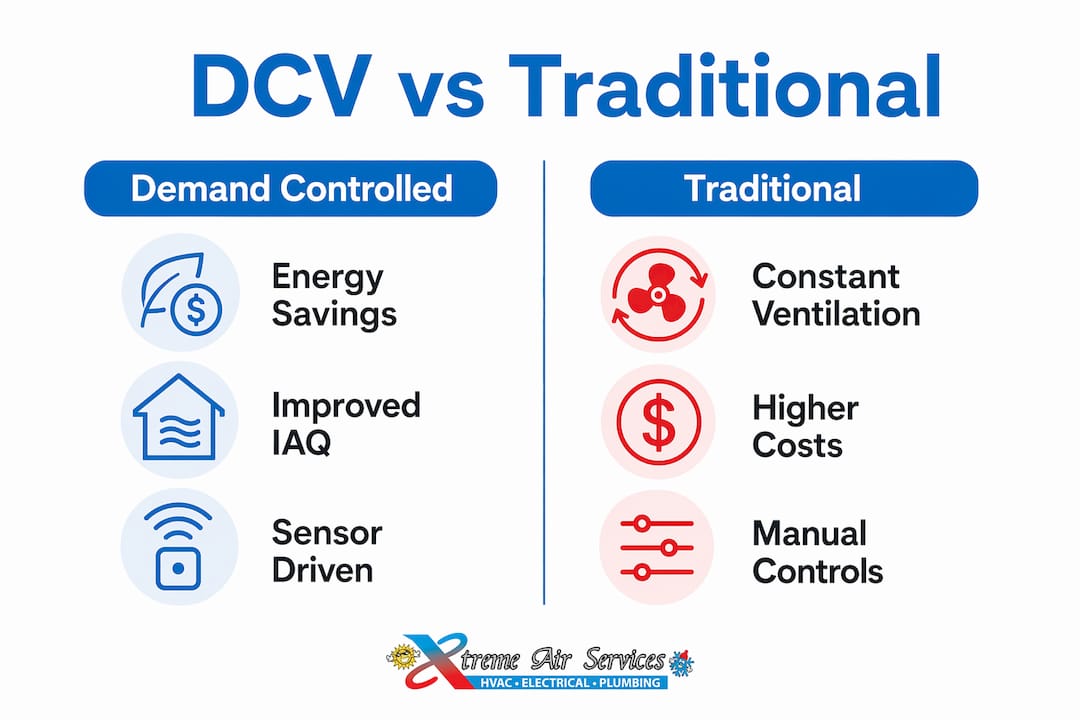
Energy savings show up across three cost categories. Heating and cooling costs drop because less outdoor air enters the building and requires conditioning. Fan energy drops because variable-speed fans run slower during low-occupancy periods. Buildings with variable occupancy achieve significant cost and energy savings with DCV compared to fixed ventilation rates. Schools, offices, and conference centers see the largest gains because their occupancy swings dramatically throughout the day.
The health and productivity benefits are equally real. Elevated CO2 levels above 1,000 ppm are associated with reduced cognitive performance, headaches, and fatigue. DCV keeps CO2 well below that threshold by design. Employees in well-ventilated offices report fewer sick days and higher concentration levels. For facility managers, that translates directly into tenant satisfaction and lease retention.
Green building certifications now treat DCV as a baseline expectation rather than a bonus feature. LEED, WELL, and BREEAM all award points for energy efficiency and IAQ improvements that DCV delivers. For any building owner pursuing certification in 2026, DCV is not optional. It is the standard.
- Reduced heating and cooling costs from conditioning less unnecessary outdoor air
- Lower fan energy consumption through variable-speed operation tied to real demand
- Improved occupant health by keeping CO2 below levels that impair cognition
- Green building certification credits under LEED, WELL, and BREEAM frameworks
- Long-term cost recovery that offsets the higher upfront installation investment
How does DCV compare to VAV systems?
Variable Air Volume (VAV) systems and DCV systems both adjust airflow, but they do it for different reasons. Understanding that distinction helps you choose the right approach for your building.
A VAV system modulates airflow to maintain temperature setpoints in different zones. It responds to thermostat signals, not air quality signals. If a zone is already at the right temperature, a VAV system may reduce airflow even if the room is packed with people. That can leave occupants in a stuffy, CO2-rich space while the temperature stays perfectly comfortable. You can read more about how VAV systems work before deciding which approach fits your building.
DCV responds directly to occupancy and air quality. It does not care about temperature. It cares about how many people are breathing in a space and whether the air is clean. That makes DCV more precise for indoor air quality control, but it also makes it more complex and more expensive to install.
| Feature | DCV | VAV |
|---|---|---|
| Primary control signal | CO2 and humidity sensors | Thermostat temperature signal |
| Occupancy responsiveness | Direct and real-time | Indirect, based on load |
| Indoor air quality focus | High | Moderate |
| Installation complexity | Higher | Lower |
| Best fit | Large buildings, IAQ certifications | Smaller projects, budget constraints |
| Certification suitability | LEED, WELL, BREEAM | General comfort compliance |
Experts note that DCV suits high-performance buildings targeting certifications, while VAV can suffice for smaller or budget-constrained projects. The two systems are not mutually exclusive. Many large commercial buildings run VAV for temperature control and layer DCV on top for air quality control. That combination gives you the best of both approaches.
For residential use, full DCV is rarely necessary in a single-family home with predictable occupancy patterns. The cost-to-benefit ratio shifts in favor of DCV once you have variable, high-density occupancy, such as a home with a large finished basement used for gatherings, a home office with multiple workers, or a rental property.
Pro Tip: If you manage a commercial facility and are deciding between VAV and DCV, ask your HVAC contractor to run an occupancy analysis first. Buildings with occupancy swings greater than 50% between peak and off-peak hours almost always recover the DCV investment within a few years through energy savings alone.
What should homeowners and facility managers know before installing DCV?
Installation success depends heavily on decisions made before a single sensor goes into the wall. The most common DCV failures trace back to sensor placement errors, not equipment defects.
CO2 sensors must be placed at breathing height in the occupied zone, away from supply air diffusers and exterior doors. A sensor near a diffuser reads diluted air and underestimates actual CO2 levels. A sensor near an exterior door reads outdoor air and triggers unnecessary ventilation. ASHRAE 62.1 specifies sensor accuracy and calibration requirements that installers must follow to keep the system compliant and effective.
Multi-zone systems require careful logic design. Averaging CO2 readings across zones is a common and costly mistake. If one zone reads 900 ppm and another reads 400 ppm, the average looks acceptable while one room is actually under-ventilated. The correct approach is to ramp airflow based on the highest reading in any active zone. That logic protects every occupant, not just the statistical average.
Humidity control deserves equal attention during design. A DCV controller should select the highest ventilation demand between its CO2 signal and its humidity signal at all times. Skipping humidity sensors to cut costs is a false economy. Mold remediation costs far more than a humidity sensor.
Ongoing maintenance keeps the system honest. CO2 sensors drift over time and require periodic calibration, typically once per year. A sensor that reads 50 ppm low will allow CO2 to climb 50 ppm higher than intended before triggering a response. For a building targeting 850 ppm as a ceiling, that drift matters. Facility managers should include sensor calibration in their preventive maintenance schedule alongside filter changes and coil cleaning.
- Sensor placement: breathing height, away from diffusers and exterior doors
- Calibration schedule: annual at minimum, more often in high-use spaces
- Zone logic: respond to the highest CO2 reading, never an average
- Humidity integration: always include humidity sensors alongside CO2 sensors
- Minimum ventilation floor: never disable it, even during low-occupancy periods
- BAS compatibility: confirm your existing building automation system can accept DCV sensor inputs before purchasing equipment
Pro Tip: Ask your installer for a commissioning report after installation. A proper commissioning test verifies that each sensor reads accurately, each zone responds correctly, and the minimum ventilation floor is active. Without that report, you have no baseline to compare against during future maintenance checks.
Key Takeaways
Demand controlled ventilation is the most direct way to improve indoor air quality and reduce ventilation energy costs at the same time, provided sensors are placed correctly and maintained on schedule.
| Point | Details |
|---|---|
| CO2 is the primary control signal | Systems modulate airflow starting at 600–700 ppm and target an 800 ppm setpoint. |
| Minimum ventilation floor is non-negotiable | A floor rate must stay active to cover VOCs and pollutants CO2 sensors cannot detect. |
| Humidity sensors prevent mold | Controllers select the higher demand between CO2 and humidity signals at all times. |
| DCV outperforms VAV for air quality | VAV controls temperature; DCV controls occupant air quality directly and in real time. |
| Sensor placement determines system performance | Incorrect placement causes under-ventilation or wasted energy regardless of equipment quality. |
Why DCV is the upgrade most buildings should have made five years ago
I have seen a lot of HVAC systems in homes and commercial buildings across the Dallas area. The pattern that stands out most is how many buildings still run ventilation on a fixed timer or a simple on/off schedule. The equipment works fine. The logic behind it does not.
Fixed ventilation made sense when controls were expensive and sensors were unreliable. Neither of those things is true anymore. CO2 sensors are affordable, accurate, and proven. The argument for running a building at full ventilation capacity during off-hours is gone.
What I find most interesting is the gap between what homeowners think ventilation does and what it actually does. Most people assume their HVAC system handles air quality automatically. It handles temperature automatically. Air quality requires a separate, deliberate strategy. DCV is that strategy.
The upfront cost is real. A full DCV installation in a commercial building costs more than a standard ventilation setup. But the energy savings on heating, cooling, and fan operation compound every year. Buildings with high occupancy variability, offices, schools, gyms, and conference centers, typically see the fastest payback. Residential installations in larger homes with dedicated entertainment spaces or home offices are catching up quickly.
The technology is also getting better. Multi-pollutant sensors that track VOCs, particulate matter, and CO2 simultaneously are moving from specialty applications into mainstream HVAC. When those sensors become standard, DCV will respond to a fuller picture of indoor air quality than CO2 alone can provide. The buildings that invest in DCV infrastructure now will be ready to upgrade sensors without replacing entire systems.
My honest recommendation: if you manage a facility with variable occupancy and you are not running some form of demand controlled airflow, you are spending money you do not need to spend. Start with a professional occupancy analysis. The numbers will make the decision for you.
— Xtreme
How Xtreme Air Services can support your DCV system
Xtreme Air Services installs, maintains, and troubleshoots HVAC systems for homes and commercial facilities across the Dallas area. A DCV system is only as good as the sensors and controls keeping it calibrated. Without regular maintenance, CO2 sensors drift, humidity readings go stale, and the system stops responding the way it was designed to.

Our HVAC maintenance plans include sensor calibration checks, system performance reviews, and airflow verification to keep your demand ventilation system running accurately year after year. If you want to improve your home air quality or need a professional assessment of your current ventilation setup, Xtreme Air Services is ready to help. Contact us to schedule a consultation and find out whether DCV is the right fit for your building.
FAQ
What is DCV in HVAC systems?
DCV stands for demand controlled ventilation. It is an HVAC control strategy that adjusts outdoor air intake based on real-time CO2 and humidity sensor readings rather than running at a fixed rate.
What CO2 level triggers a DCV system to increase airflow?
Most DCV systems begin modulating airflow at 600–700 ppm and target a setpoint of 800 ppm, keeping indoor CO2 below 850 ppm averaged over eight hours per ASHRAE guidelines.
Does DCV replace the need for a minimum ventilation rate?
No. DCV systems must maintain a minimum ventilation floor at all times to dilute VOCs and other pollutants that CO2 sensors cannot detect, as required by ASHRAE Standard 62.1.
Is demand controlled ventilation worth it for a home?
DCV delivers the strongest return in spaces with variable, high-density occupancy. Homes with large gathering areas, home offices with multiple occupants, or rental properties benefit most from demand controlled airflow.
How often do DCV sensors need calibration?
CO2 sensors require calibration at least once per year. High-use spaces may need more frequent checks to prevent sensor drift from allowing CO2 levels to exceed safe thresholds.
Recommended
- What Is A VAV HVAC System? A 2026 Guide
- Types Of Commercial HVAC Systems: 2026 Facility Guide
Need professional help? Explore our commercial HVAC services.