


What Are the Most Common A/C System Repair Problems? (What to Expect)
The five failures behind most repair calls – a system running without cooling, a humming outdoor unit, ice on the coil, cooling that fades over weeks – and what each one usually turns out to be.
What’s Covered on This Page
- The Most Common A/C Repair Calls We Handle
- AC Running But Not Cooling: What’s Usually Behind It
- A Humming Outdoor Unit Usually Points to the Capacitor
- Ice on the Coil Isn’t Always a Refrigerant Problem
- Cooling That Fades Over Weeks Often Means a Slow Leak
- Related Links
- Does having a common part fail mean my whole AC system is wearing out?
- How do you figure out which part failed before starting a repair?
- Is it possible for two problems to be happening at the same time?
- Are these common failures something I should try to fix myself?
- Does the age of my AC unit make these problems more likely?
The Most Common A/C Repair Calls We Handle
North Texas summers really test an AC system. We see patterns in what parts fail. Certain components break down more often in July heat. This doesn’t mean your entire system is in trouble. Often, one part just reached the end of its life at a bad time.
- Capacitor failure: the outdoor unit hums, but the fan won’t spin. Capacitors are very sensitive to heat. After weeks of triple-digit temperatures, they often fail first.
- Low refrigerant from a leak: your system runs, but the air isn’t as cold. Sometimes ice forms on the coil. We handle refrigerant recharge and leak repair, always checking for the source.
- Frozen evaporator coil: airflow drops. You might see ice on the indoor unit. This usually happens from a dirty filter, restricted airflow, or a refrigerant problem.
- Clogged drain line: water pools near the indoor unit. Your system might shut itself off. Attic-run drain lines here collect algae and dust, and a clog trips a safety switch.
- Blower motor or fan motor trouble: weak airflow from the vents. The system runs, but not much air moves. We repair and replace both indoor blower motors and outdoor fan motors.
- Electrical or sensor faults: your system won’t turn on. It might short-cycle or trip a breaker often. This covers AC electrical repair, sensor repair, and circuit board replacement.
A technician runs an AC not cooling diagnosis. This finds the actual problem instead of just guessing from the symptoms. Most calls involve one part, found and fixed on the same visit. Sometimes, a system has two issues at once-a refrigerant leak that’s also frozen a coil. That takes a little longer to sort out and repair right.
How a repair plays out depends on the extent of the failure. Part cost and availability also matter. The age and brand of the equipment, and whether multiple components failed, change things. Nights and weekends cost the same as a weekday call. You can see how these factors line up with real numbers on our air conditioning repair pricing page.
AC Running But Not Cooling: What’s Usually Behind It
If your system is running but the air from the vents feels warm or barely cool, the cause is almost always one of a few specific parts. It’s usually not the whole unit failing. This is one of the most common calls we get across the Sunnyvale and DFW area. It happens especially once the summer heat sets in and systems run for hours.
- Low refrigerant from a leak in the coil or line set. This shows up as weak cooling that slowly gets worse.
- A dirty condenser coil outside, coated in pollen, grass clippings, and dust. This stops the system from releasing heat properly.
- A frozen evaporator coil, often from restricted airflow or an underlying refrigerant problem.
- A failing capacitor. This small part takes a real beating in North Texas heat and is one of the more frequent failures we see.
- A blower motor that’s weak or not moving enough air across the coil.
- A dirty air filter choking off airflow before it reaches the coil.
A frozen coil is one case where we can’t always tell you the root cause right away. The ice has to thaw. Then a technician can see what’s leaking or blocked underneath it. So, that visit sometimes takes longer than a simple capacitor or coil cleaning call. We’d rather tell you that upfront than promise a quick fix we can’t deliver.
On a diagnostic visit, a licensed technician checks refrigerant levels, coil condition, electrical components, and airflow. This finds what’s behind the problem. We then walk you through it in plain language before any repair starts. You get a written, flat-rate quote before we touch anything. You know the total cost and what it covers ahead of time.
For a fuller picture of how a repair visit works from the first call to the finished job, our page on AC repair service has more information.
If you want the full picture on how these calls get diagnosed and priced, our A/C system repair page walks through the process from the first visit to the finished repair.
A Humming Outdoor Unit Usually Points to the Capacitor
If your outdoor unit is humming or buzzing, but the fan isn’t spinning, that’s almost always a capacitor problem. The capacitor is a small cylindrical part. It gives the compressor and fan motor the jolt they need to start up. Without a good jolt, the motor can’t get moving. So, it just hums and pulls power without doing any work.
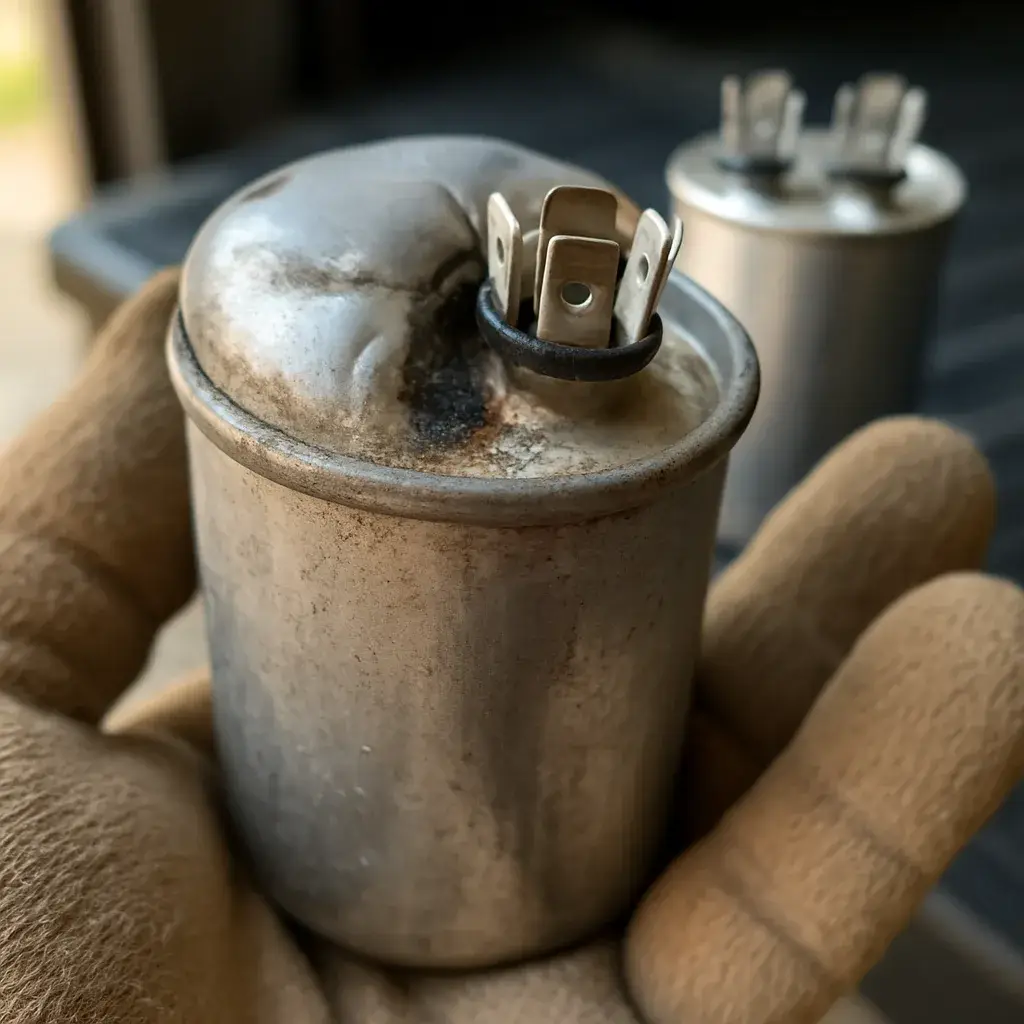
Capacitors wear out from heat and time. It’s nothing you did wrong. In North Texas, outdoor units run hard through long summer stretches. That heat cycling breaks down the internal components faster than in milder climates. A capacitor rated for a certain number of microfarads slowly drifts out of range. Once it’s too far off, the motor can’t start reliably. Some capacitors even show a bulge on top before they fail completely, though plenty give out with no visible warning.
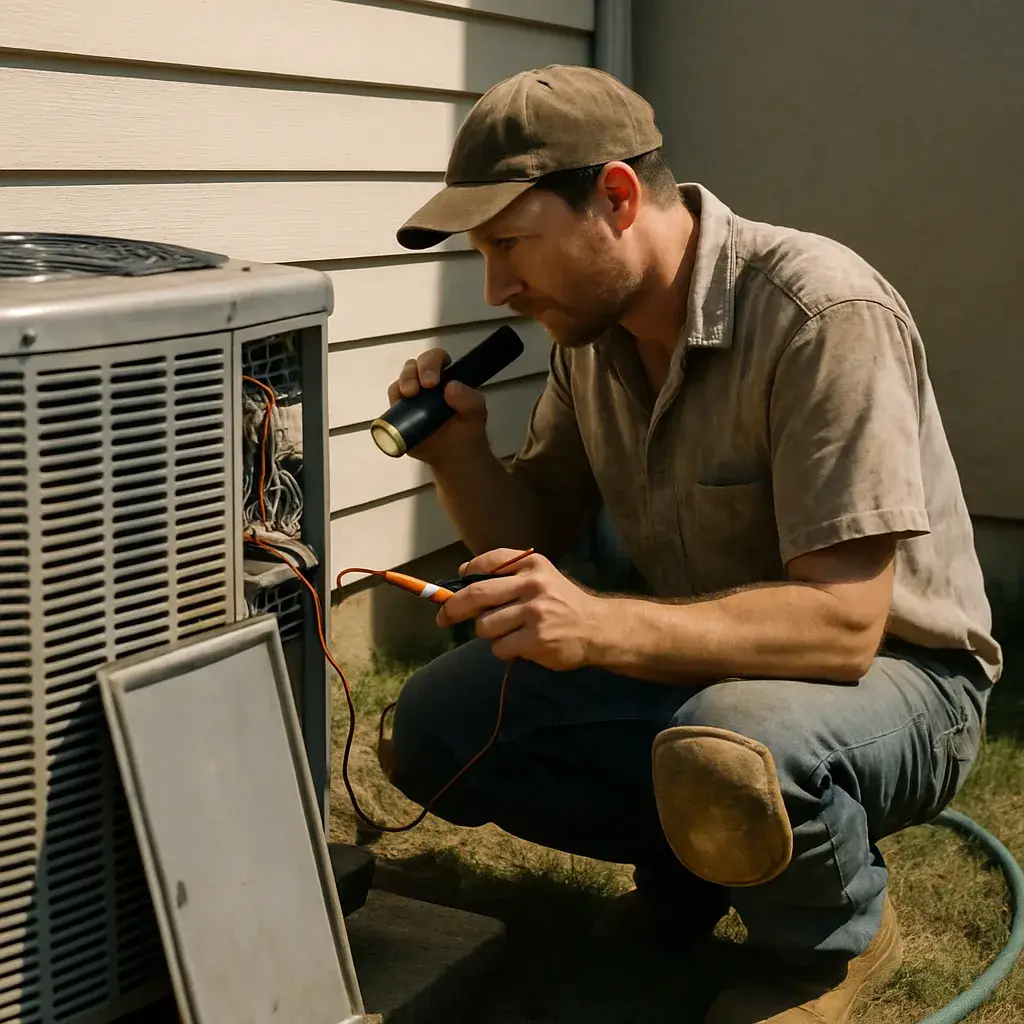
A humming sound doesn’t always mean the capacitor, though. Sometimes it’s the contactor sticking. Or a seized fan motor bearing. Or debris caught in the fan blade. That’s why a technician tests before replacing anything. We check the capacitor with a meter against its rated microfarad value. We check the contactor for pitting or arcing. And we confirm the fan motor spins freely by hand before deciding what needs to come out.
- Listen for a hum with no fan movement. Or a fan that spins slowly and struggles to reach speed.
- Check for a breaker that trips shortly after the unit tries to start.
- Look for a capacitor case that’s swollen, cracked, or leaking a waxy residue.
- Test the contactor points for pitting, which can cause a similar humming symptom.
This is a common single-part failure. Most calls like it get diagnosed and fixed the same visit once the part is confirmed. You can see typical price ranges for this kind of call on our A/C system repair pricing page before you book anything.
Not sure what your A/C system repair project needs? Ask us.
Call Today, Get Service Today. Xtreme Air Services is ready to help.
Ice on the Coil Isn’t Always a Refrigerant Problem
A coil covered in ice looks like one problem. But it almost always has two possible causes, leading to different repairs. Most homeowners assume low refrigerant right away. Airflow restriction across the coil causes it just as often, sometimes more.
Here’s how it works. Your evaporator coil needs a steady flow of warm air moving across it to stay above freezing. Cut that airflow down-maybe a clogged filter, a blocked return, or a failing blower motor-and the coil surface drops below freezing. Ice builds up fast. Low refrigerant does something similar. It drops the coil’s operating temperature. Both problems can produce the exact same ice.
We see this a lot in older Sunnyvale and DFW-area homes with attic-mounted systems. A dirty filter or a partially collapsed duct run restricts airflow long before anyone notices. On a newer variable-speed system, the blower can sometimes compensate for a while. This delays the visible ice, but it doesn’t prevent it.
This is why we don’t quote a fix over the phone based on ‘ice on the coil.’ A technician has to let the coil thaw. Then they check static pressure, filter condition, blower operation, and refrigerant charge. Only then can we say what’s causing it. Guessing wrong means paying for a refrigerant recharge when the real issue was a $15 filter, or the reverse.
Refrigerant doesn’t get used up, by the way. A system that’s low on refrigerant has a leak somewhere in the line set or coil. Topping it off without finding and repairing that leak just means the ice comes back later. We walk through what the diagnostic found before recommending a repair. If the fix involves refrigerant, we’ll point you to what typically drives that cost on our pricing page.
If you’re seeing ice form repeatedly within the same season, that’s a pattern worth having looked at. Don’t just thaw it out and wait again. It doesn’t mean anything catastrophic. It just means whatever caused it the first time is still there.
Cooling That Fades Over Weeks Often Means a Slow Leak
If your house has felt a little warmer than the thermostat setting for a few weeks now-not all at once-that pattern usually points to a slow refrigerant leak. It’s not a sudden breakdown.
Most people notice it gradually. The system runs longer to hit the same temperature. Upstairs rooms feel warmer. Or the outdoor unit seems to cycle on and off more than it should. Some homeowners spot ice forming on the copper line to the outdoor unit. Or they hear a faint hiss near the indoor coil. None of that means the system is failing completely. It means refrigerant is getting out somewhere it shouldn’t.
Refrigerant leaks happen because the copper lines and coils can develop small pinhole openings over time. Vibration, a joint that rubs against metal ductwork, or years of expansion and contraction in North Texas heat can wear a spot thin enough for refrigerant to seep out slowly. A system doesn’t use up refrigerant like a car uses gas. If the level is low, it’s low because it’s leaking, not because it needs a routine top-off.
On the visit, a technician checks pressures with gauges. They also use an electronic leak detector to find where refrigerant is escaping. This is better than guessing from symptoms alone. Once we find it, we recharge the refrigerant and repair the leak at that specific point. Then we test to confirm the system holds and cools as it should before we leave.
Here’s the part we won’t sugarcoat: if the leak is inside the evaporator coil itself rather than at a fitting or joint, repairing it gets more involved. Depending on the system’s age, replacing that coil or the whole unit sometimes makes more sense than repeatedly recharging a coil that keeps losing refrigerant. We’ll walk you through both options and what each one runs. General cost ranges and what typically drives them up are on our A/C repair pricing guide, if you want to see numbers before we’re even out at your house.
Older systems running older refrigerant types can cost more to recharge. That refrigerant is simply harder to source. It’s not a mark-up decision on our end. It’s a supply reality we’ll explain if it applies to your equipment.
Frequently Asked Questions
Common questions about A/C system repair
Does having a common part fail mean my whole AC system is wearing out?
No, a single part failing doesn’t mean the whole system is done. Most calls we handle involve one component, like a capacitor or blower motor, reaching the end of its life. We fix that part, test the system, and it runs normally again. A part wearing out after years of North Texas heat is normal, not a sign of a bigger breakdown. If several parts fail together or the unit is old, we’ll tell you plainly what we’re seeing.
How do you figure out which part failed before starting a repair?
We run a diagnostic that checks refrigerant levels, coil condition, electrical parts, and airflow before touching anything. This finds the actual failed part instead of guessing from symptoms alone. Once we know what’s wrong, we explain it in plain language and give you a written flat-rate quote. You know the cost and what’s included before work starts. Most single-part problems get diagnosed and repaired on the same visit.
Is it possible for two problems to be happening at the same time?
Yes, and it happens more than people expect. A refrigerant leak that also froze a coil is a combination we see. When that happens, the visit takes longer because the ice has to thaw before we can see what’s leaking or blocked underneath. We’d rather take the extra time to find the real cause than guess at it. Most calls are simpler, one-part fixes finished the same day.
Are these common failures something I should try to fix myself?
Some things are worth checking yourself first, like a dirty air filter or an outdoor unit covered in grass clippings and pollen. Those are simple homeowner fixes. Parts like capacitors, blower motors, and circuit boards involve live power or refrigerant, and need a licensed technician. If your system is still running weak or warm after you’ve checked the filter and cleared debris outside, that’s when it’s worth a call.
Does the age of my AC unit make these problems more likely?
Older units and units running through many North Texas summers do see more wear on parts like capacitors and blower motors. Heat cycling breaks components down faster over time. That said, age alone doesn’t tell us which part will fail next, and a well-maintained older system can still run reliably. We diagnose based on what’s happening in your system, not just its age.
Ready to Get Started?
Call 972-288-2263 Today, Get Service Today.