


AC Replacement or Repair: How We Help You Decide
When a repair is still the better option, when replacement wins, the real numbers behind that math, and what a $6,400 to $9,200 replacement price includes and leaves out.
What’s Covered on This Page
- The Short Answer on Repair vs. Replacement
- The Factors That Decide It
- When Repair Is the Better Option
- When Replacement Is the Better Option
- What’s Included in a Replacement Price and What Isn’t
- Related Links
- How do I know whether to repair or replace my AC?
- What’s the mistake homeowners make most often when weighing this decision?
- When would you tell me to replace instead of taking my repair money?
- How does the repair-vs-replace math work with real numbers?
- Does the service-call fee apply no matter which option I choose?
The Short Answer on Repair vs. Replacement
Here’s the plain version: a single failed part on a system that still has years left gets repaired, not replaced. But once a system starts needing repair after repair, or the repair itself is a big chunk of what a new system costs, replacement starts making more sense. We charge a $26 to $99 service-call fee for the visit. That fee gets credited toward the repair cost if you move forward with us.
- Age of the system: older units near the end of their expected life lean toward replacement.
- Cost of the repair compared to the cost of replacing: a repair that’s a fraction of replacement cost usually stays a repair.
- How often the unit has needed attention: a pattern of breakdowns changes the math.
- Efficiency: newer systems run on higher SEER2 ratings, which affects energy use going forward.
- Refrigerant type and part availability for older equipment.
We won’t push a full AC replacement on a system that just needs one part. If your compressor, capacitor, or coil is the problem and the rest of the system is sound, we’ll say so and fix that piece. Where it gets less black-and-white is a system in year 12 or 13 with a major component failing. That’s a real judgment call. We’ll walk you through what the repair costs against what a new system costs before you decide anything. You can see how we scope a full job on our AC replacement page, including what a cooling load calculation looks like for your home.
Whichever way it goes, the price we quote is flat-rate and in writing before any work starts. Replacement pricing covers the equipment, professional installation, standard connections, startup and testing, and haul-away of the old unit. It doesn’t cover duct, electrical, or plumbing modifications, code corrections, or permits unless we’ve already identified that need and stated it up front. Financing is available on qualifying installations for anyone who wants to spread the cost of a replacement out instead of paying it in one shot.
The Factors That Decide It
Age matters, but it doesn’t decide anything by itself. A 14-year-old system that’s been maintained can still make sense to repair if the fix is small. A 6-year-old system with a failed compressor might not. What moves the decision is a mix of things we look at together during a diagnostic visit, not a single rule of thumb.
- Cost of the repair against the cost of a new system, weighed as a real dollar comparison, not a guess
- Equipment size and efficiency rating (SEER2), since an undersized or aging unit may cost more to run every month than it looks like on paper
- Condition of the ductwork and electrical connections, because bad access or old wiring can change what a new install requires
- How many repairs the system has already needed and what parts are involved; a compressor or coil failure carries more weight than a capacitor
- Whether the equipment is still available and supported for parts, which affects how practical repeat repairs are
- Code requirements that may apply to a replacement but not a repair, since new installs sometimes trigger different standards
We’ll tell you flat out when a repair is the better call. If your system is a few years old, the failure is a common part like a capacitor or a blower motor, and the rest of the system checks out fine, replacing it usually isn’t worth your money. We’ve walked away from bigger tickets because the smaller fix was the right answer.
On the other side, we lean toward replacement when a major component fails on an older system. This also applies when repair costs start closing in on a meaningful share of a new system’s price. Or when the home would genuinely run better and cheaper on a properly sized, higher-efficiency unit. That’s a case-by-case call, not a formula, and it’s exactly what the diagnostic visit is for.
Every AC replacement quote we write is a flat-rate number in writing before any work starts. You’re deciding with a real price in hand instead of guessing. You can see how that pricing breaks down, and what typically drives it up or down, on our AC replacement pricing page.
When Repair Is the Better Option
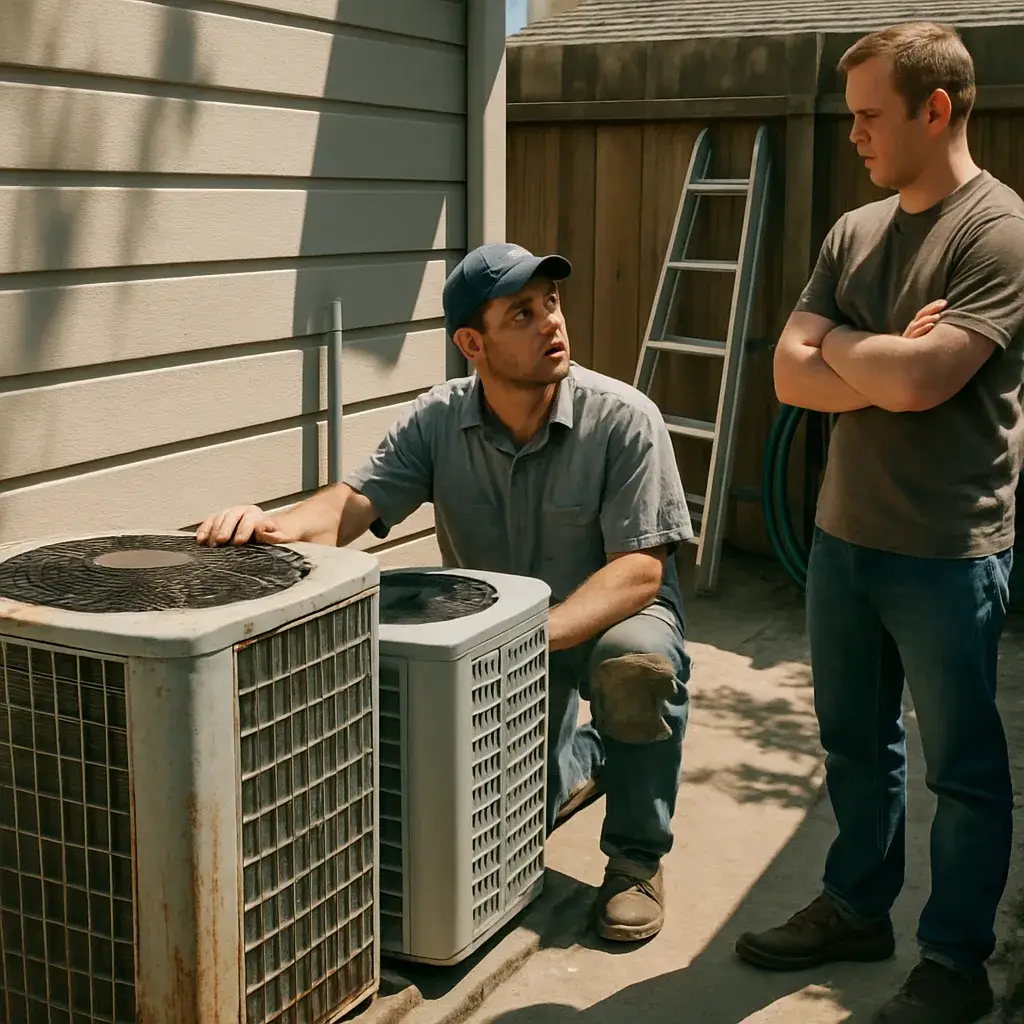
Repair is usually the right call when one part failed on a system that’s otherwise in decent shape. A bad capacitor, a worn blower motor, a refrigerant leak in an accessible line, or a failed condenser coil are all single-point problems. We can replace an AC capacitor, rebuild a blower motor, or recharge and repair a refrigerant leak in a single visit most of the time. And the system runs like it did before the part gave out.
Age and history matter as much as the part that broke. If your system is under 10 years old, has a reasonably clean maintenance record, and this is the first big issue it’s had, repair almost always makes more financial sense than tearing it out. A compressor replacement or coil swap on a younger unit can add years of service for a lot less than a full replacement.
- The failed part is isolated, like a capacitor, sensor, fan motor, or control board, not a symptom of the whole system breaking down at once.
- The unit is younger than 10 years and hasn’t had repeat major repairs.
- The repair cost is a small fraction of what a new system would run, not close to it.
- The refrigerant type is still supported and not headed for a phase-out that will make future repairs expensive or impossible.
- You’re planning to stay in the home and want a few more solid years out of the current system.
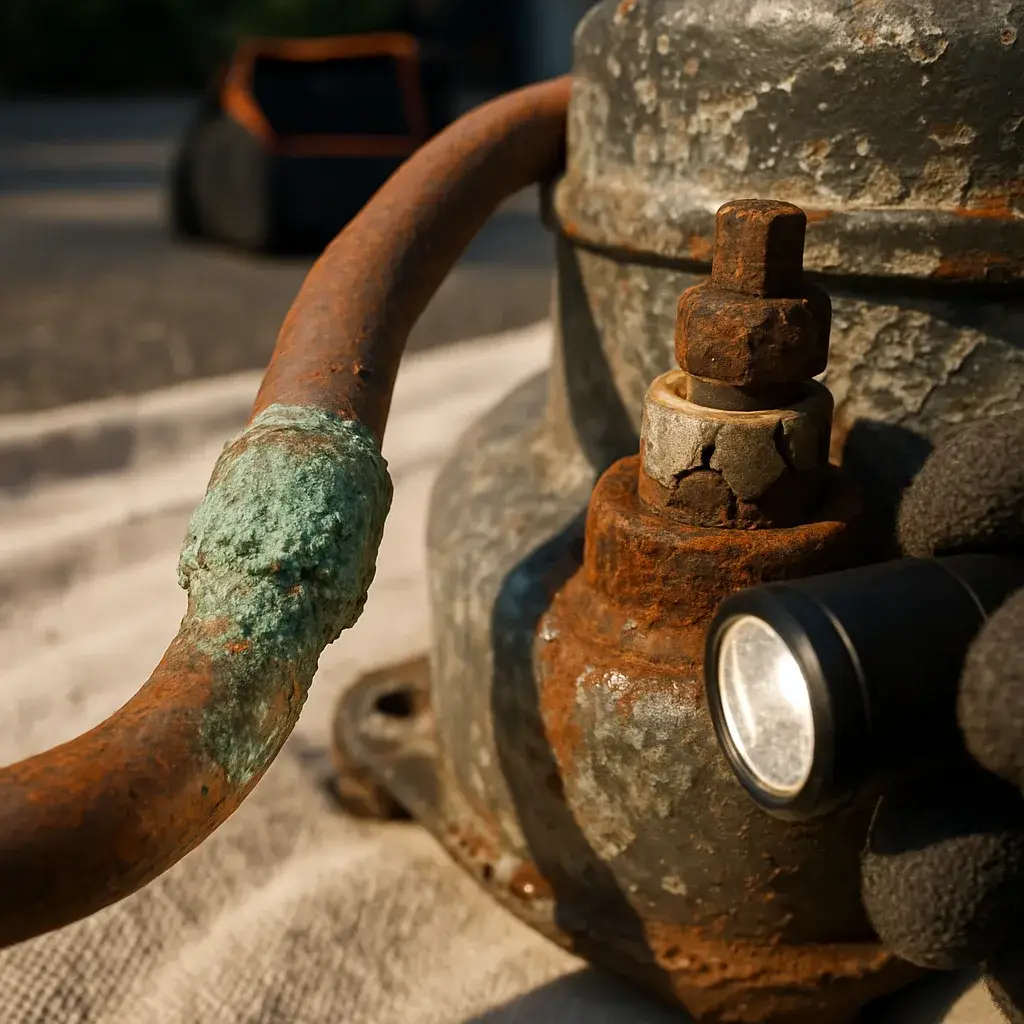
Here’s the part we won’t dress up: repair isn’t always the cheaper long-term move just because it’s the cheaper short-term move. If a system is already 12 or 15 years old and the compressor goes, we’ll tell you straight that a repair might buy you one more summer, not five. We’d rather say that up front than have you spend money on a fix that gets you back here in eight months.
When you call us out to look at a cooling problem, the diagnostic visit runs $26 to $99 as a service-call fee. That amount gets credited toward the repair cost if you decide to move forward with us. You get a written, flat-rate price before any work starts, whether the fix is a $200 capacitor or a bigger component job. There’s no meter running and no surprise on the invoice.
Any repair work we do carries our workmanship warranty on the labor, along with the manufacturer’s warranty on the part itself if it’s still in coverage. That’s the same backing we put behind a full system installation, just sized to the job.
Thinking about AC replacement? Let’s talk.
Call Today, Get Service Today. Xtreme Air Services is ready to help.
When Replacement Is the Better Option
Replacement usually makes more sense than repair once the system is old, the failures start stacking up, or the cost to keep fixing it starts closing in on the cost of a new unit. Most residential AC systems run 12 to 15 years before the compressor, coil, or refrigerant system starts wearing out for good. If your unit is in that range and it’s the second or third repair in a couple of years, replacement usually costs less over time than continuing to patch it.
- The system is past 12 to 15 years old and using an older refrigerant type
- You’ve had more than one major repair (compressor, coil, or electrical) in the past year or two
- The repair estimate runs close to half the cost of a new system
- Your energy bills have climbed as the unit’s efficiency dropped off
- You’re renovating or adding square footage and the current unit can’t handle the new load
A standard AC replacement in our service area, a like-for-like swap using your existing connections, typically runs $7,000 to $10,000. The full range for more involved jobs lands between $5,500 and $13,000. That covers the equipment, professional installation, standard connections, startup, testing, and haul-away of the old unit. It does not cover duct, electrical, or plumbing modifications, code corrections, or permits unless we flag those upfront in your written quote. Size, SEER2 efficiency rating, brand, and how easy the unit is to access all move the price. So does anything unusual, like custom fabrication or upgrading old ductwork to match a new system.
If your system is five years old and the fix is a bad capacitor or a clogged drain line, we’re not going to talk you into a replacement you don’t need yet. That call gets made after we’ve looked at the actual equipment, not off a rule of thumb. You can see more on what drives the price on our AC replacement pricing page.
When replacement is the right call, financing is available on qualifying installations, so the decision doesn’t have to hinge on paying the full amount at once.
What’s Included in a Replacement Price and What Isn’t
A standard AC replacement quote from us covers the equipment and materials, the professional installation, standard connections, startup and testing, and hauling away your old unit. That’s the base of every written price we hand you before work starts. What it does not cover, unless we’ve written it into the quote, is duct or electrical or plumbing modifications, code corrections, or permit fees. If your home needs any of that on top of a straight swap, we’ll spell it out as its own line item so you know exactly what you’re paying for and why.
A like-for-like replacement, same connections, no major changes, typically runs $7,000 to $10,000. Full AC replacement jobs across the DFW area can run $5,500 to $13,000 depending on the system and the house. The gap between those numbers almost always comes down to a short list of factors, not guesswork or padding.
- Equipment size and efficiency, tonnage and SEER2 rating, since a bigger or higher-efficiency Trane system costs more up front and less to run
- Brand and model, since features and equipment tiers vary in price
- Ease of access; an attic unit under a steep roof pitch takes longer to reach than a ground-level pad
- Condition of the existing ductwork, wiring, or plumbing tied into the system
- Code upgrades required by TDLR-licensed work, or by whichever side of the Dallas/Kaufman county line your property sits on
- Any custom sheet metal or fabrication a nonstandard setup requires
System size, SEER2 rating, and access are the three factors that move a price the most in either direction. A technician can’t give you a real number over the phone. But they can walk your attic or your side yard and tell you which of these applies to your house within the same visit.
If you’re starting with a diagnostic visit instead of jumping straight to replacement, our service-call fee runs $26 to $99. We credit that toward the repair cost if you move forward with us. We also offer financing on qualifying installations for homeowners who’d rather spread the cost out than pay it in one shot. You can see how these numbers stack up against repair costs on our AC replacement page before you decide which direction makes sense for your system.
Frequently Asked Questions
Common questions about AC replacement
How do I know whether to repair or replace my AC?
We look at a mix of things together, not one single rule. Age of the system, how much the repair costs against a new unit, how often it’s broken down, and whether parts are still available all factor in. A single failed part on a younger system usually means repair. A major failure on an older unit tips toward replacement. We walk through this with you during the diagnostic visit before you decide anything.
What’s the mistake homeowners make most often when weighing this decision?
Assuming repair is automatically the cheaper choice long-term. A repair that’s a small fraction of replacement cost usually is the better deal. But once repair costs start closing in on a meaningful share of what a new system runs, the math changes. Age, repeat repairs, and part availability all matter as much as the price of the fix in front of you right now.
When would you tell me to replace instead of taking my repair money?
We’d tell you to replace when a major component like a compressor or coil fails on an older system, or when repair costs start closing in on what a new system would run. We won’t push replacement on a system that just needs one part. If your capacitor or blower motor is the problem and the rest checks out fine, we’ll say so and fix that piece instead.
How does the repair-vs-replace math work with real numbers?
A full AC replacement typically runs $7,000 to $10,000, with a range of $5,500 to $13,000 depending on the system. We compare that number against your actual repair estimate, not a guess. If the repair is a small fraction of that range, it usually stays a repair. If it starts closing in on a big share of it, replacement often makes more sense.
Does the service-call fee apply no matter which option I choose?
The $26 to $99 service-call fee covers the diagnostic visit itself, and it gets credited toward the repair cost if you move forward with us on that repair. We quote replacement separately as a flat-rate number in writing before any work starts, so you’re comparing real costs, not estimates, once we’ve looked at the system.
Ready to Get Started?
Call 972-288-2263 Today, Get Service Today.