


What Are the Most Common Questions About A/C System Installation?
Getting the equipment size right, whether your existing ductwork can carry a new system, who pulls the permit, how long installation day actually takes, and what happens to the old unit.
What’s Covered on This Page
- Getting the Equipment Size Right
- Ductwork Compatibility With New Equipment
- Permits and Code Compliance
- Installation Timeline and Home Disruption
- What Happens to the Old Unit
- Related Links
- How do you decide what size AC system my house needs?
- Does my existing ductwork have to be replaced with a new system?
- What SEER rating do I actually need?
- Who pulls the permit for a new AC installation?
- Is financing available for a new system?
Getting the Equipment Size Right
People ask about sizing more than almost anything else when they’re shopping for a new system. A unit that’s too big will cool the air fast. But it shuts off before it pulls out the humidity. Your house feels cold and clammy at the same time.
A unit that’s too small runs almost nonstop on a 100-degree North Texas afternoon. It still can’t quite catch up. Either way, you feel it in the rooms. And you feel it on the electric bill.
Square footage alone doesn’t tell you what size unit a house needs. A 1970s slab home with a single-pane window wall and an attic full of ductwork gains and loses heat differently. It’s not like a newer subdivision home with better insulation and shaded windows. Ceiling height, the number of return vents, attic temperature swings, and which way the house faces – all these change the real cooling load. That’s why we run a cooling load calculation as part of the AC system consultation. We don’t just match whatever tonnage was there before.
Sometimes the load calculation confirms the old system’s size was right. And sometimes it doesn’t. We’ve walked into homes where the prior system was oversized by a full ton. We’ve also seen others where an addition or new windows changed the numbers enough that we recommended stepping up. We won’t tell you it’s always one or the other until we’ve run the numbers for your house.
- Home size, ceiling height, and layout
- Insulation levels and window type/orientation
- Ductwork condition and how much of it runs through the attic
- Local climate load for the Dallas-Fort Worth area
- Existing equipment size and whether it matched the house
This sizing step is part of every installation we quote. It’s alongside the walkthrough of your options in our full guide to A/C system installation. There’s no extra charge to get the number right instead of guessing.
Ductwork Compatibility With New Equipment
Many homeowners assume new equipment just connects to whatever ductwork is already there. Sometimes it does. Sometimes it doesn’t. That gap is one of the more common surprises we see in this line of work.
People notice a new system that seems too small or too big for the house. Maybe weak airflow in a back bedroom. Or a big jump in noise coming through the vents after install. None of that means the equipment is bad. It usually means the ductwork was sized for a different system, or for a different era of house.
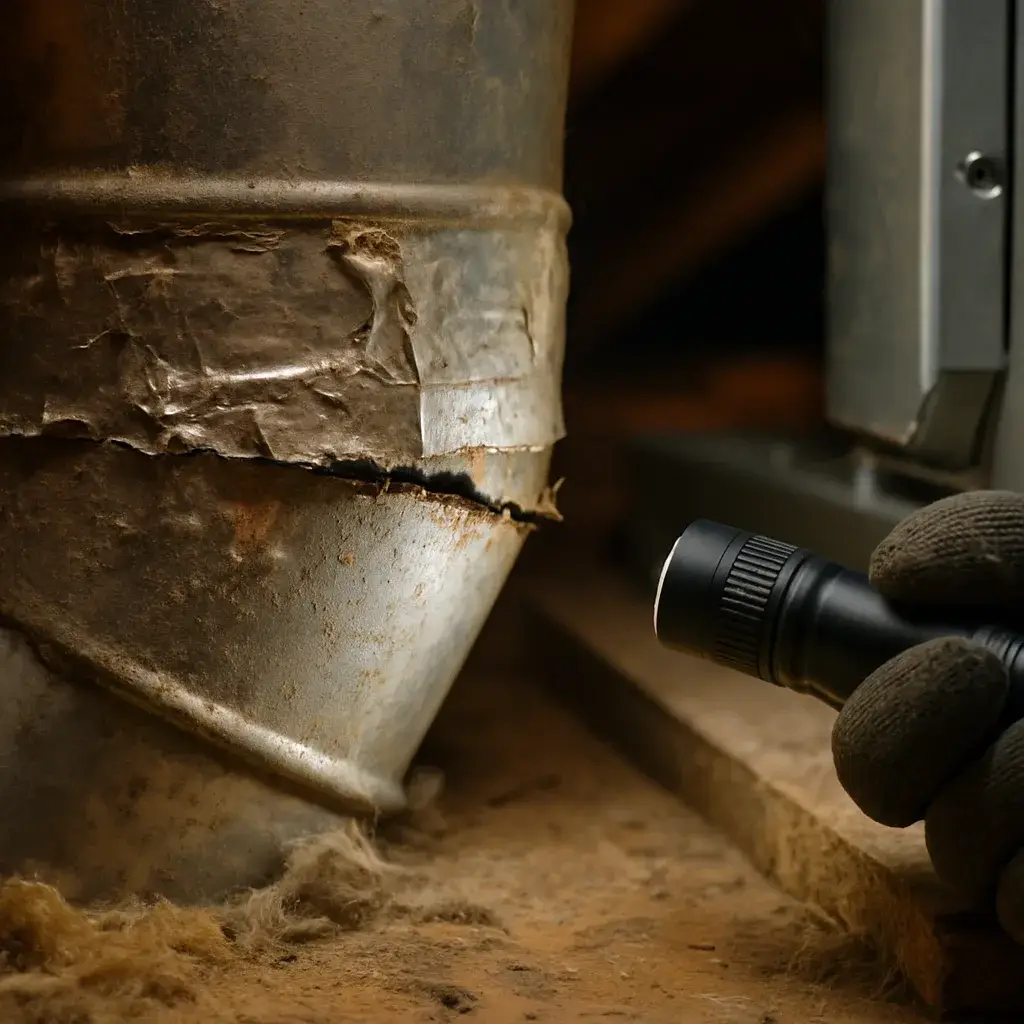
Many homes across Sunnyvale and the surrounding DFW towns were built in the last couple decades. They are slab-on-grade with ductwork run through the attic. That ductwork was designed around the tonnage and airflow of the original equipment. Newer high-efficiency systems, especially variable-speed units, often move air differently. If the trunk lines or returns are too small, the new system works harder to push air. You can hear it or feel it in weak rooms.
This is part of why a cooling load calculation matters before equipment gets picked. It accounts for insulation, window exposure, and how the existing duct layout will perform with the new system, not just the old one.
If the ductwork checks out, we install straight to the existing connections. The equipment does the work it’s supposed to do. If it doesn’t, that’s a real conversation before anything gets installed. It’s not an invoice line item after the fact. Standard installation covers equipment, materials, professional installation, startup, and testing on existing connections. Duct modifications, sealing, or code corrections are a separate scope. We’ll tell you plainly if your home needs one before we quote the job.
We also handle duct sealing and HVAC duct and vent repair as its own service. This is separate from equipment installation. It’s for homeowners who want the distribution side addressed on its own timeline.
You can read more about how we approach the equipment side on our A/C system installation page. The duct question, by the way, is really its own inspection.
A technician walking the attic and checking supply and return sizing before quoting equipment is the difference between a system that performs the way it should and one that technically runs but never quite feels right.
Permits and Code Compliance
Yes, a full A/C system installation typically needs a permit in North Texas. We pull it before the work starts, not after. Swapping in a new condenser, air handler, or full system usually counts as more than a simple repair. This is true in the eyes of local code officials. That means an inspection follows the install. It confirms the electrical, refrigerant, and equipment connections meet current code.
Where you sit matters more than people expect. Sunnyvale sits in Dallas County, right up against the Kaufman County line, and we work both sides of it. Which side your property falls on can change which office issues the permit and schedules the inspection. We’re a Texas Department of Licensing and Regulation licensed contractor. We handle that coordination as part of the job rather than leaving it for you to sort out with a permit office.
- We identify whether your address falls under Dallas County or Kaufman County jurisdiction before filing.
- We pull the mechanical and electrical permits a full system installation requires.
- We schedule the required inspection once the equipment is installed and running.
- We install to current code, not just to what the old system had when it went in decades ago.
This is one of the places where we’ll pump the brakes if a customer asks us to move faster by skipping a step. If the goal is to avoid the permit process entirely, or to install equipment without the inspection that’s supposed to follow, we’ll pass on that job. A system installed off the books doesn’t carry the same protection if something needs to be traced back to the work later. And it can complicate things at resale or with insurance.
Permit timing does add a step to the schedule. We’ll tell you that upfront. We won’t let it surprise you mid-job. Most residential installs still move through inspection without slowing the overall project down much. We’re the ones filing and tracking it, not you. Older homes on original ductwork or older electrical sometimes turn up a code item. It might need correcting alongside the new equipment. We’ll walk you through that if it comes up.
Have questions? We’re happy to help.
Call Today, Get Service Today. Xtreme Air Services is ready to help.
Installation Timeline and Home Disruption
Most A/C system installation jobs finish in a single day. A straightforward swap uses the same connections as the old unit. That typically means our technicians arrive in the morning. They test the running system with you before they leave that afternoon. Larger jobs, like a whole-house system change or one that needs duct or electrical work, get scheduled at a time that works for you. They aren’t squeezed into a single visit.
Before any of that happens, you get a same-day diagnostic visit. We inspect the system and walk the site. Then you get a written, flat-rate quote before anyone touches equipment. No guessing about scope once the crew shows up. That quote also tells you which day you’re looking at for the actual install.
On installation day, expect some noise and foot traffic. Your technicians will be in the attic or a closet for part of the day. They’ll run the indoor unit. They’ll also be outside at the condenser pad for the rest. We protect floors and work areas as we go. We clean up before we call the job done. If you’re at home, you’ll notice the air conditioning is off for a stretch. This happens while the old unit comes out and the new one goes in. It’s usually a few hours, not all day.
- Attic access that’s tight or hard to reach can add time to the removal and setup
- Existing ductwork that needs sizing changes or repair before the new unit connects properly
- Electrical work needed to bring wiring up to what the new equipment requires
- Permits and inspections required by your city or county before the job can be signed off
Every install we do is performed to code with the proper permits and inspections when they’re required. That can add a step to the timeline that a quicker, off-the-books job would skip. If your ductwork or wiring isn’t a match for the new equipment, we say so in the written quote before work starts. It’s not a surprise mid-install.
Once the work is done, we walk the system with you. We test it together. You see it running before we leave. For a fuller picture of how a job gets scoped and scheduled, our A/C system installation page walks through what to expect from the first call to the final walkthrough.
What Happens to the Old Unit
We haul the old unit away as part of the job. That’s built into a standard installation, not an add-on we mention after the fact. When our crew finishes setting your new system, the old condenser, coils, and any related equipment leave with us. You don’t need a truck, a dumpster, or a second call to a junk removal outfit.
On our A/C system installation jobs, haul-away of the old unit is written into what’s covered. It’s right alongside the equipment, the standard connections, and the startup and testing we do before we call the job finished.
Before anything gets carried out, the refrigerant in your old system has to come out first. That’s not optional. Any system holding refrigerant needs it recovered by a certified technician. This happens before the unit can be disconnected and moved. It’s a rule that applies across the industry, not something specific to how we run our trucks. Our techs handle that recovery as a normal step. Then they move on to disconnecting the lines and pulling the old equipment out of the closet, attic, or pad.
For homes with an older split system on a slab pad out back, that usually means disconnecting the outdoor condenser first. Then working through the indoor coil and any attic ductwork tie-ins. Summer attic temperatures in North Texas make that a job you want done efficiently. You don’t want a crew up there longer than they need to be.
Old equipment gets dismantled and disposed of properly. It’s not dumped somewhere convenient. That covers standard AC systems dismantlement work. This is true whether the old unit is a window-style setup, a central system, or a ductless mini-split being swapped for something newer. What it doesn’t cover is hauling away unrelated junk from the same closet or attic space. If duct or electrical modifications turn up once the old unit is out, that’s separate work. It gets priced separately, which is worth knowing going in.
If you want to see how removal fits into the full installation cost breakdown, our A/C system installation page walks through what’s included and what typically runs extra.
Frequently Asked Questions
Common questions about A/C system installation
How do you decide what size AC system my house needs?
The size comes from a cooling load calculation on your actual house, not from square footage and not from whatever was there before. Insulation, window count and orientation, ductwork, and how much sun the house takes all change the answer, so two homes of the same size can need different tonnage. We run that calculation during the consultation, before anyone writes a quote. Sizing off the old unit is how people end up with a system that short-cycles or never quite keeps up.
Does my existing ductwork have to be replaced with a new system?
Usually not, but it does have to be checked before the quote rather than discovered mid-install. New equipment moves air differently than a system from fifteen years ago, and undersized or leaking ducts will hold back a unit that is otherwise sized correctly. We look at duct condition, sizing and static pressure as part of the consultation. If sections need repair or resizing, that goes in the written quote up front, not as a change order on installation day.
What SEER rating do I actually need?
SEER2 measures cooling efficiency, and a higher number costs more up front while drawing less power to run. What is worth paying for depends on how long you plan to stay in the house and how hard the system works, which in North Texas is most of the year. Federal minimums are already higher in the southern states than up north, so the entry-level option here is not an inefficient system. We show you the price gap between tiers and what it saves per season instead of steering you toward the highest number on the shelf.
Who pulls the permit for a new AC installation?
We do. A system replacement here requires a permit and an inspection, and pulling it is our responsibility rather than something handed back to the homeowner. The permit is what puts an inspector on the finished work, and it is also what protects you later when you sell the house and the work has to show as done to code. If a contractor offers to skip the permit to save you money, that is a job we would turn down ourselves.
Is financing available for a new system?
Yes, and most people use it for a job this size. We go through the financing options once you have seen the written quote, so you are comparing real numbers rather than a monthly payment in the abstract. It makes more sense on a full installation than on a small repair, where paying at completion is usually simpler. Ask during the consultation and we will lay out what is available.
Ready to Get Started?
Call 972-288-2263 Today, Get Service Today.