


What Are the Most Common Boiler Repair Problems?
No heat traced back to ignition components, pressure loss that points to a leak rather than a bad gauge, kettling from heat-exchanger buildup, and frozen condensate lines.
What’s Covered on This Page
- The Most Common Boiler Repair Problems We’re Called to Diagnose
- No Heat or No Hot Water Usually Traces Back to Ignition Components
- Low or Repeated Loss Usually Points to a Leak, Not a Bad Gauge
- Banging or Kettling Noises Point to Buildup Inside the Heat Exchanger
- Frozen Condensate Lines Cause Seasonal Shutdowns in Condensing Boilers
- Related Links
The Most Common Boiler Repair Problems We’re Called to Diagnose
When a boiler stops working, it usually shows itself in one of a few ways. Your house won’t heat evenly, or the pilot light won’t stay lit. Or maybe you hear a knocking or gurgling sound coming from the unit. None of this means something rare is happening. These are the calls we get most, across older homes and newer builds alike in Sunnyvale and the towns around it.
- No heat or the boiler won’t fire at all. This is often an ignition failure, a tripped safety switch, or a pilot that’s gone out. We check the ignition system and controls first, as that’s where the failure usually sits.
- Losing pressure or a visible leak. Boilers hold water under pressure, and a worn valve, a loose fitting, or a small corrosion spot can let it drop over time. We pressure-test to find exactly where it’s coming from.
- Banging, gurgling, or kettling sounds. This is almost always sediment or limescale building up on the heat exchanger, especially in older units that haven’t had regular servicing.
- Short cycling, where the boiler turns on and off in short bursts instead of running a normal cycle. That points to airflow, water flow, or a control problem, rather than a simple part failure.
- Thermostat or control board that won’t respond. Sometimes it’s the thermostat itself, sometimes it’s the board inside the unit. We test both before replacing anything.
Boilers also involve combustion, so we treat carbon monoxide safety as part of the diagnostic, not an add-on. Boiler safety inspections are part of what we offer. If something during a repair visit raises a safety concern, we say so plainly before we finish the job.
Not every one of these problems ends in a repair. If the heat exchanger itself has cracked or the unit is old enough that parts are getting hard to source, we’ll tell you that’s a replacement conversation instead of pushing a repair that won’t hold. Our boiler repair technicians walk you through both options with the actual cost laid out on our boiler repair pricing guide before you decide anything.
Once a boiler is running right again, boiler maintenance and cleaning on a regular schedule cuts down on the sediment and wear that cause a lot of these calls in the first place. That’s the one follow-up we’ll mention here, and it’s worth asking about regardless of who installed your system originally.
No Heat or No Hot Water Usually Traces Back to Ignition Components
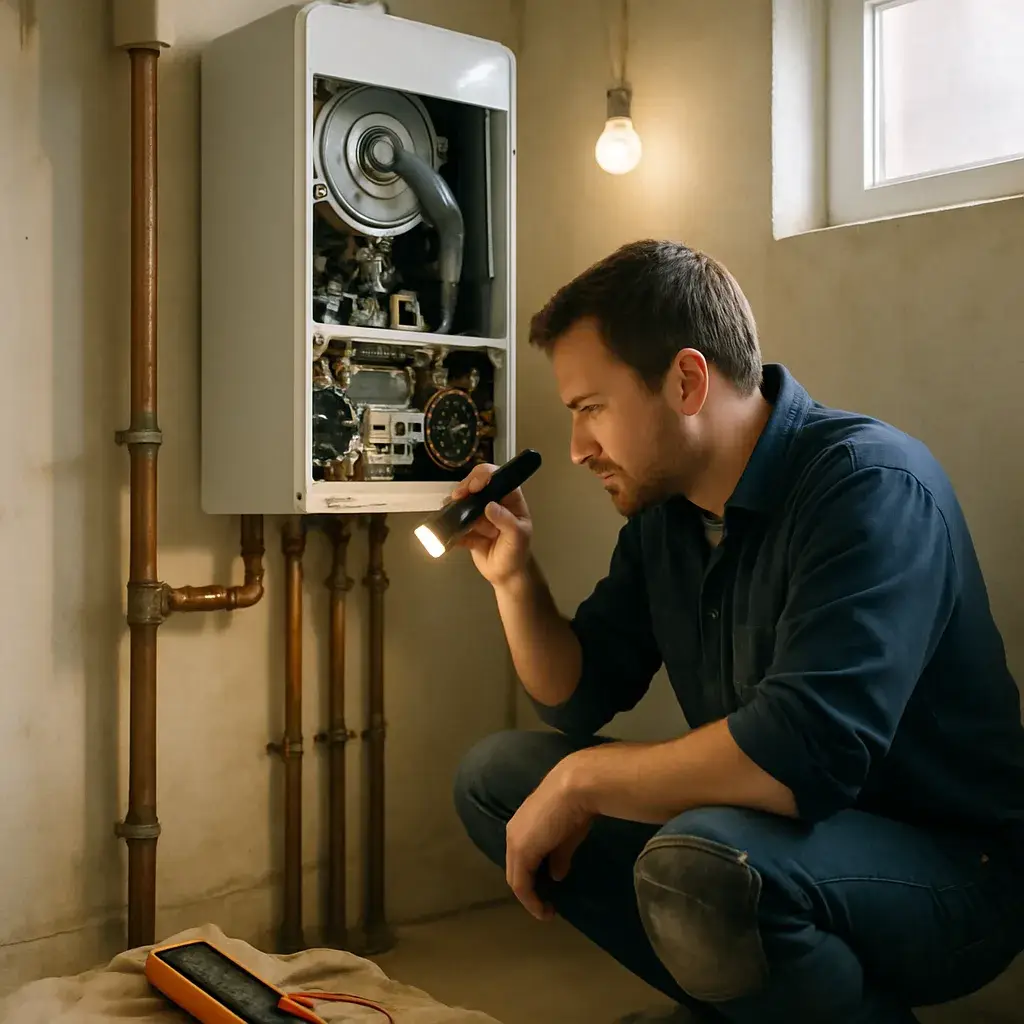
When a boiler quits making heat or hot water, the ignition system is where we look first. That’s the group of parts that lights the burner: the igniter itself, the pilot assembly on older units, the flame sensor that confirms the flame caught, and the control board that runs the whole sequence. If any one of these fails, the boiler can still power on and run its pumps, but the burner never lights and the water never gets hot.
A hot surface igniter wears out like a light bulb. It heats up thousands of times over a heating season. Eventually the element cracks or stops glowing hot enough to catch the gas. On older boilers with a standing pilot, the pilot can blow out from a draft. Or the thermocouple that senses the flame can weaken with age and shut the gas valve down as a safety measure. A dirty or misaligned flame sensor reads a flame as absent even when it’s burning. So the board cuts fuel to protect the system. None of these are unusual failures. They’re wear items on a mechanical system that fires on and off constantly.
- Igniter won’t glow or glows weakly, so the burner never lights
- Pilot light won’t stay lit or won’t light at all
- Flame sensor reads a false no-flame signal and shuts the burner down
- Control board fails to send the ignition sequence or send it correctly
- Gas valve doesn’t open on command, often tied to a board or wiring fault
During a diagnostic visit, our technician checks the ignition sequence step by step: power to the board, signal to the igniter or pilot, and the flame sensor’s response once the burner catches. That’s how we find the actual failed part instead of swapping components and hoping. It’s the kind of troubleshooting we cover under our Boiler Repair service, where a licensed technician walks through the same root-cause process on every call.
Ignition failures on commercial boilers sometimes point to a bigger issue. For example, a failing control board that’s also driving other faults. Repeated ignition lockouts on an older unit can be a sign the boiler is nearing the end of its service life, rather than needing one more part. We’ll tell you when that’s what we’re seeing instead of just swapping the failed component and sending you on your way.
Once we identify the failed part, most ignition repairs finish in the same visit. We explain what failed, why, and what it takes to fix it before we touch anything, in plain terms, not jargon.
Low or Repeated Loss Usually Points to a Leak, Not a Bad Gauge
If your boiler’s pressure gauge keeps drifting down and you find yourself topping it off again and again, that’s almost always a leak somewhere in the system. It’s not a faulty gauge. A healthy sealed system holds pressure for weeks or months at a time. When it won’t hold, water is leaving the loop somewhere, even if you never see a puddle.
Most of the time the water isn’t dripping onto your floor. It’s escaping through a pinhole in a pipe joint, a weeping valve, or a failing expansion vessel. It’s evaporating or seeping into a wall cavity before you’d ever notice it. On older systems in North Texas homes and on commercial mechanical rooms we service, we also see slow leaks at pump seals and at the relief valve itself. This can pass a little water every cycle without ever looking like an obvious failure.
A slow leak can take more than one visit to pin down. Sometimes the loss is small enough that it doesn’t show up during a single inspection. We have to test the system, watch it over a short period, or isolate sections of pipe one at a time to find where it’s losing water. We’d rather tell you that upfront than promise a five-minute answer we can’t back up.
What we do: we check the expansion vessel’s charge. We inspect visible pipework and joints for staining or corrosion. We test the relief valve. And we pressure-test the closed loop to isolate the leak point. Once we find it, we can tell you plainly whether it’s a fitting, a valve, or a component that needs replacing. Then we walk you through the repair before any work starts.
You can see typical cost ranges and what’s included on our boiler repair pricing page. The fix for a leaking valve looks different from repairing a pinhole in copper pipe.
Need help with Boiler repair?
Call Today, Get Service Today. Xtreme Air Services is ready to help.
Banging or Kettling Noises Point to Buildup Inside the Heat Exchanger
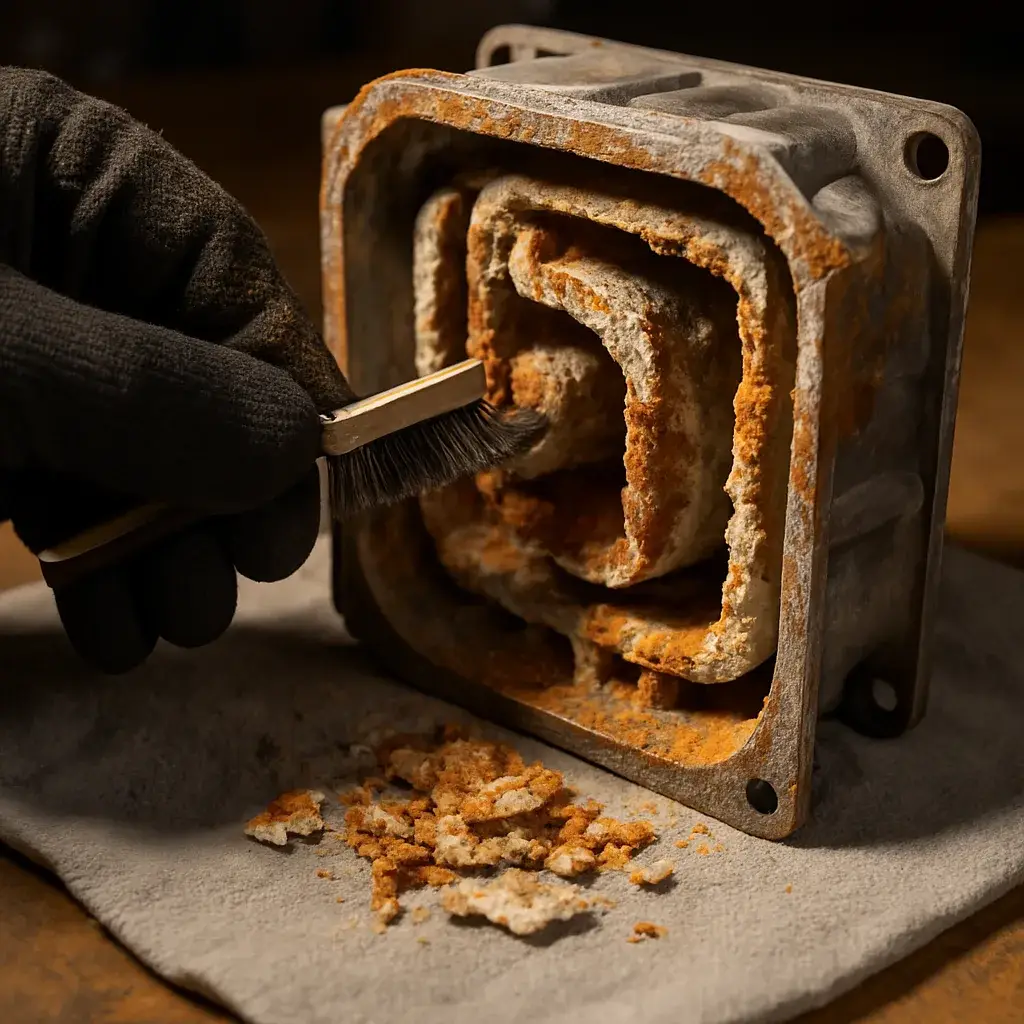
A banging, popping, or kettling sound from a boiler almost always points to scale or sediment buildup inside the heat exchanger. Water sitting against hot metal leaves mineral deposits behind, and North Texas water runs hard. Over time that layer of scale traps small pockets of water against the hottest part of the exchanger. Those pockets flash to steam and collapse fast. That’s the knocking or rumbling sound you hear, sometimes described as a kettle coming to a boil.
This is one of the more common calls we get on older commercial boilers and units that haven’t had regular servicing. It’s not usually a sign the unit is about to fail outright. But it does mean the heat exchanger is working harder than it should to move heat through that scale layer. Left alone long enough, the extra stress can shorten the life of the exchanger itself.
- How long the noise has been happening and whether it’s gotten louder or more frequent
- Water hardness and treatment history on the system, if any
- Age of the boiler and whether the heat exchanger has been descaled before
- Whether the noise happens at startup, during steady operation, or both
- Any related symptoms, like uneven heat output or the unit cycling more than it used to
On a service call for this, one of our licensed technicians inspects the exchanger and the water side of the system to confirm scale is the cause before recommending anything. Sometimes a full descale and cleaning resolves it. Sometimes the buildup and corrosion have gone far enough that cleaning won’t undo the damage. Replacing the affected component makes more sense than repeated cleanings. We’ll tell you which situation you’re in, and why, before any work starts. That’s part of the written flat-rate quote we walk through with you first.
We handle this under our Boiler repair work across Sunnyvale and the greater Dallas-Fort Worth area, on both commercial and industrial systems. If you’d rather see how these visits are priced before you book one, our boiler repair page breaks down what’s typically included.
Frozen Condensate Lines Cause Seasonal Shutdowns in Condensing Boilers
A condensing boiler cools its exhaust gas enough that water vapor turns to liquid. That condensate has to drain outside through a small PVC line. When that line freezes, the boiler senses the blockage and shuts itself down. You’ll usually see a fault code on the display and no heat, even though the unit looks fine otherwise.
This shows up most on sudden cold snaps, the kind North Texas gets a few times a winter when temperatures drop fast after a warm stretch. Condensate lines routed through an attic or along an uninsulated exterior wall are the ones we see freeze. A lot of homes east of Dallas built from the 1970s through the 1990s have attic-run mechanical lines. That space can swing cold fast once the heat’s off overnight.
On a diagnostic visit, a technician traces the condensate line from the boiler to the outside termination and finds where the ice has formed. Sometimes it’s a short stretch that thaws with heat and clears on its own once the line is insulated. Other times the line was pitched wrong when it was installed. Water sits in a low spot instead of draining, which makes it freeze faster next time. We’ll show you exactly where the problem is before we touch anything, and you get a written quote before work starts.
A frozen line by itself usually isn’t an expensive fix. But if the run through the attic was never insulated or pitched right, a permanent fix might mean rerouting or insulating that section. This is rather than just clearing it each time it happens. That’s a bigger conversation than a single repair call, and we’ll tell you plainly if that’s what we’re looking at.
If your unit is due for its annual check, our boiler maintenance visits include a look at the condensate line and its insulation before cold weather sets in. That’s part of what a proper boiler servicing covers.
You can look over the full range of what a repair call includes on our Boiler repair page.
Ready to Get Started?
Call 972-288-2263 Today, Get Service Today.