


Emergency HVAC Service: How Do We Decide Between Repair and Replace?
The age, part cost and failure-count math behind the call, when a single failed part is worth repairing at $200 to $525, when a system past 15 years points to replacement, and how we decide on site.
What’s Covered on This Page
- The Short Answer: Repair Usually Makes Sense for a Single Failed Part, Replacement Makes Sense as a System Ages Past 15 Years
- The Factors That Decide Repair vs. Replace
- When We’d Recommend a Repair
- When We’d Recommend Replacement
- How We Help You Decide During an Emergency Call
- Related Links
- What matters most when you’re deciding between a repair and a replacement on my system?
- What’s the biggest mistake homeowners make when comparing repair and replacement costs?
- When would you tell me to replace my system instead of taking my repair money?
- How do the repair costs compare to what I’d pay if I chose replacement instead?
- Does a repair on an older system come with any kind of guarantee it won’t need more work soon?
The Short Answer: Repair Usually Makes Sense for a Single Failed Part, Replacement Makes Sense as a System Ages Past 15 Years
Here’s the plain version. If your AC or heater is working fine except for one broken part (like a capacitor, a blower motor, or an igniter), we repair it. Most of these calls involve finding the one thing that quit. We replace it, then test the system before leaving. That’s a $200 to $525 job in most cases. It’s usually done the same visit.
Replacement starts making more sense once the system is past 15 years old. This is especially true if a bigger part, like the compressor or heat exchanger, failed. At that age, the rest of the unit is close behind the part that just quit. Putting a few hundred dollars into an old system can buy you a few more months – not a few more years.
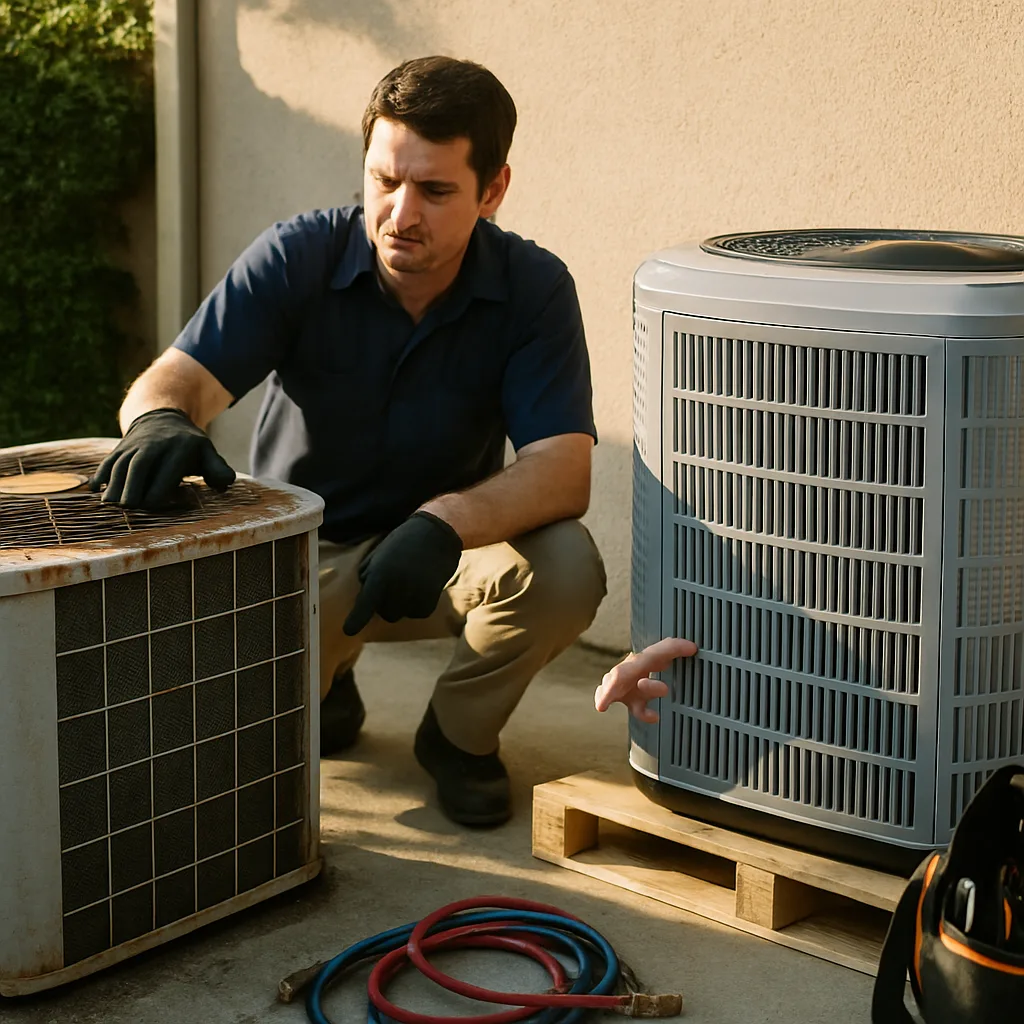
A few things push the decision one way or the other on any call. We walk through each of these with you before recommending anything. We use our Emergency HVAC service page as a reference for what a visit covers.
- How much of the system is affected. One part failing is different than three parts failing close together.
- Whether the part is still made or easy to source for the brand and age of your unit.
- How old the equipment is and how it’s held up so far.
- Timing of the call. We charge no extra for nights or weekends, so an after-hours breakdown doesn’t change the math on repair versus replace.
There’s a gray zone around year 10 to 15. A capacitor or contactor failing on a 12-year-old unit is still a repair, plain and simple. A compressor failing on that same 12-year-old unit is where we’d talk through the numbers with you instead of just fixing it. A compressor repair can run close to what a chunk of a new system costs. Our $26 to $99 service call fee gets credited toward the repair if you move forward with us. That way, getting the numbers doesn’t cost you extra.
The Factors That Decide Repair vs. Replace
Most emergency calls come down to one failed part. Most of those get fixed the same day for somewhere between $200 and $525. The bigger range we quote ($200 to $900) covers everything from a simple capacitor swap to a job where more than one part gave out at once. What pushes a call from the low end to the high end, or from a repair into replacement territory, is a short list of specific things. It’s not a gut feeling.
- How much of the system failed. A single failed part is a repair. A failed part that damaged a second component (like a bad capacitor that took out a motor with it) changes the math.
- Part cost and availability. Some parts sit on our truck. Others have to be sourced. Older or less common equipment can mean a longer wait and a higher part cost.
- The age and brand of the equipment. A ten-year-old system with one bad part is usually worth fixing. A much older system that keeps needing parts is a different conversation.
- Whether it’s one failure or a pattern. If we find a single root cause, that’s a repair. If we find several worn components pointing to a system nearing the end of its life, we say so.
- Timing has nothing to do with it. We don’t charge extra for nights or weekends. An after-hours call doesn’t tip the scale toward one option or the other on price alone.
On an older system, a repair can be the right call this time and still not be a permanent one. We’ll fix what’s broken. We tell you plainly if we think it’s likely to need more work down the road. We don’t guess at a timeline we can’t back up.
A diagnostic visit is what settles it. A technician finds the root cause and explains it in plain terms. Then, you get a flat-rate price in writing before any work starts. You decide with real numbers instead of a guess over the phone. You can see how that visit fits into the rest of the process on our emergency HVAC service page.
The service call fee runs $26 to $99. It gets credited toward the repair if you move forward with us. That fee, plus the flat-rate quote before we touch anything, keeps this decision in your hands.
Timing matters here too. Summers around Sunnyvale routinely sit above 100 degrees for weeks at a stretch, and attic temperatures in older homes climb well past that, so an aging system tends to fail at the point it is working hardest. When a system past 15 years gives out mid-heatwave, that context is part of what we weigh with you.
When We’d Recommend a Repair
We recommend a repair when one part failed. The rest of the system is sound. Fixing that part gets you back to normal without inviting the next breakdown in a month. Most calls we run for our Emergency HVAC service fall into this category. A capacitor gives out, a blower motor seizes, a sensor drifts – the fix is a same-day, single-visit job.
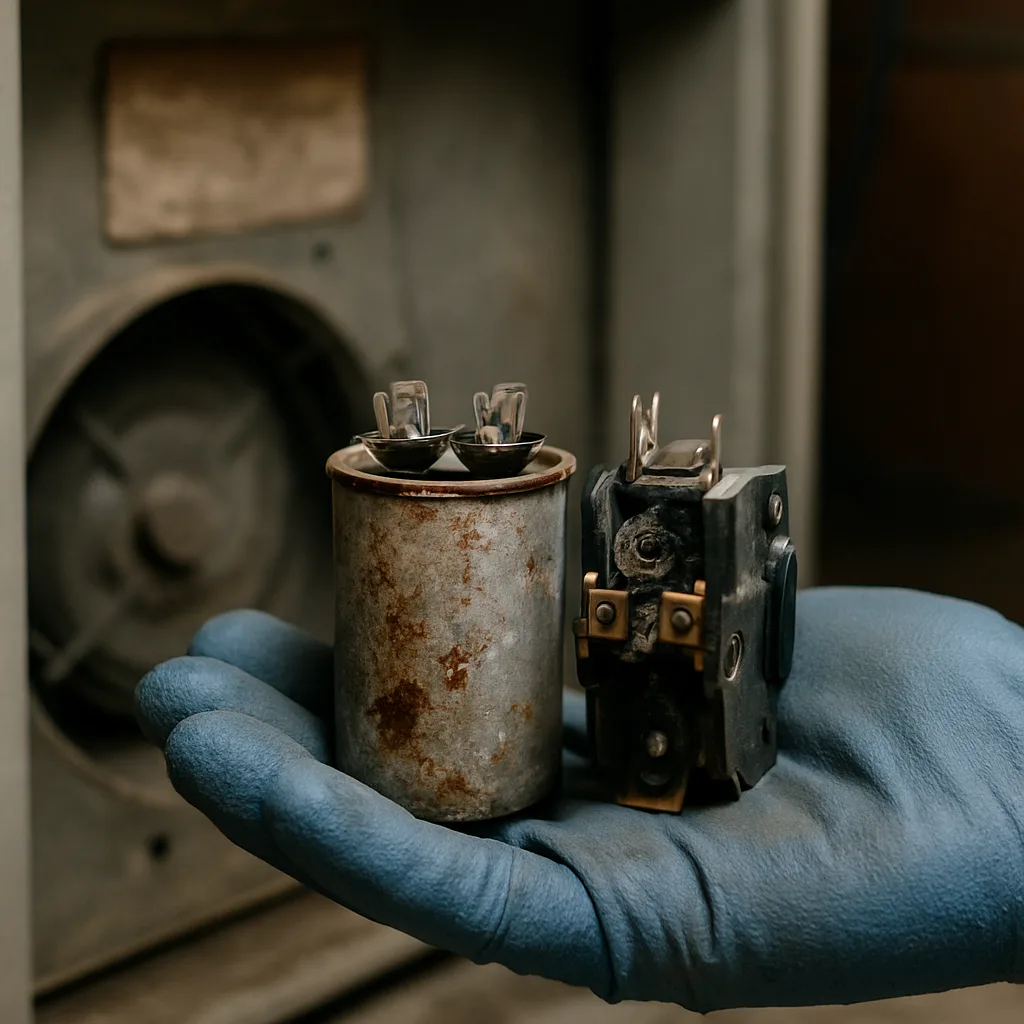
The typical repair on a call like this runs $200 to $525, sometimes higher depending on the part and the brand. A service call fee of $26 to $99 applies upfront. If you move forward with the repair, that fee gets credited toward the job. You’re not paying twice to find out what’s wrong.
A few things push a job toward repair instead of replacement:
- One part failed, not several components at once
- The equipment is still within a normal service life for its brand and use
- The replacement part is available and reasonably priced against the age of the system
- The unit has a track record of running well otherwise
Here’s the part people overthink: a repair only makes sense if the number pencils out against what a new system would cost you over the next several years. If a 14-year-old unit needs a $500 fix today, and a compressor failure is a realistic next step, we’ll say so plainly during the diagnostic. We don’t want you to spend the money twice.
Our technicians find the actual failed part first. Then they put the price in writing before any work starts. No hourly meter, no guessing what you’ll owe when the invoice shows up. That written, flat-rate quote covers diagnosis, labor, the standard part, testing, and cleanup. It does not cover a second failed component discovered mid-repair. It also does not cover a major part replacement, or code upgrades and permits. Those get quoted separately if they come up.
Nights and weekends cost the same as a weekday call. So, timing your repair around a holiday or a Sunday afternoon won’t change the number we quote you.
Have questions? We’re happy to help.
Call Today, Get Service Today. Xtreme Air Services is ready to help.
When We’d Recommend Replacement
We lean toward replacement when the repair cost starts closing in on what a new system would run. We also lean that way when a unit keeps failing in different spots. A single part failure on a working system almost always gets repaired. It’s the pattern around that failure that changes the math.
Age matters here. Most residential AC and furnace equipment in North Texas homes is built to run 12 to 15 years. The Texas heat doesn’t do it any favors. Once a system is past that window, and the failed part is a major component (not something small), the repair often isn’t the better use of your money. This is true even at our standard $200 to $525 range for common jobs.
The other factor is whether more than one thing has gone wrong at once. Our pricing already accounts for a single common failure, diagnosed and fixed on the first visit. When a technician finds a second or third failed component during that same call, that’s usually the moment we bring up replacement. We don’t stack repair costs on an older unit.
- Equipment age, especially systems past 12 to 15 years old
- Repair cost relative to what replacement would run
- Whether the failure involves a major component versus a smaller part
- Whether multiple components have failed on the same visit
- Efficiency gains available with newer high-efficiency HVAC systems
Sometimes the cheaper recommendation is the right one. If your five-year-old system trips on a bad capacitor, we’re fixing the capacitor. We don’t upsell a working unit just because a replacement job is worth more to us. If you do land on replacement, our AC replacement and financing options are there to help spread out the cost. We’ll walk you through the numbers before anything gets ordered.
How We Help You Decide During an Emergency Call
When a technician gets to your home on an emergency call, the first job is finding the actual cause, not guessing. Once we know what failed, we lay out your options in plain terms. What a repair costs, what a replacement would run – and which one makes more sense for your specific system.
For most emergency calls, the fix is a single failed part (like a capacitor, contactor, or blower motor). A common repair like this runs $200 to $525. The full range for emergency HVAC service is $200 to $900, depending on what broke. That price covers diagnosis, labor, the standard replacement part, testing, and cleanup. It does not cover additional parts that fail later, major components, code upgrades, or permits. Those get quoted separately if they come up.
A few things move the number up or down.
- Whether one part failed or several failed at once
- Whether the part is common and on the truck or has to be ordered
- The age and brand of your equipment
- Timing, though nights and weekends cost the same as any weekday call
Age and repeat failures are the real deciding factors. If your system is under 10 years old and one part failed, repairing it almost always makes financial sense. If it’s older and this is the second or third repair in a short stretch, we’ll tell you that plainly. Sometimes putting another few hundred dollars into an aging system just delays a replacement that’s coming anyway. We’d rather say that upfront than let you spend money twice.
Before anything gets fixed, you get a written, flat-rate quote showing both the repair option and the replacement option side by side. Financing is available if replacement is the better call. The $26 to $99 service call fee gets credited toward the repair if you move forward with us. Nothing starts until you approve what’s in writing. You can read more about how we handle a call from start to finish on our emergency HVAC service page.
Frequently Asked Questions
Common questions about Emergency HVAC service
What matters most when you’re deciding between a repair and a replacement on my system?
We look at how much of the system failed, whether the part is easy to source, and how old the equipment is. One failed part on a system under 15 years old is almost always a repair. A pattern of worn parts, or a major component failing on an older unit, points toward replacement. We walk through these factors with you during the diagnostic visit before recommending anything, and you get a flat-rate price in writing before we start.
What’s the biggest mistake homeowners make when comparing repair and replacement costs?
The common mistake is comparing today’s repair bill to a new system’s price without looking ahead. A repair only makes sense if the cost holds up against what you’d likely spend over the next few years. If a 14-year-old unit needs a repair today and a bigger part failure looks likely soon, we say so during the diagnostic instead of letting you spend the money twice.
When would you tell me to replace my system instead of taking my repair money?
We’d tell you to replace once the system passes 15 years old, especially if a major part like the compressor or heat exchanger fails. At that point, a repair can buy a few more months rather than a few more years. We’ll still fix a single part if that’s what you choose, but we say plainly when we think more work is likely coming.
How do the repair costs compare to what I’d pay if I chose replacement instead?
Most single-part repairs run $200 to $525 and get done the same visit. Jobs with more than one failed part can run up to $900. Our service call fee is $26 to $99, and it’s credited toward the repair if you move forward. Financing isn’t typical for a repair this size, but it’s available if the numbers point you toward a full replacement instead.
Does a repair on an older system come with any kind of guarantee it won’t need more work soon?
No, we don’t promise that, and we wouldn’t want to guess at a timeline we can’t back up. What we do is fix the part that failed and tell you plainly if the rest of the system looks like it’s nearing the end of its service life. That way you’re deciding with real information, not a guarantee we can’t stand behind.
Ready to Get Started?
Call 972-288-2263 Today, Get Service Today.