


What Problems Come Up Most Often With Emergency / Same-Day AC Repair?
The repeat offenders behind most emergency calls – capacitor failure, a refrigerant leak, a frozen evaporator coil, and electrical faults – with what to expect from each repair.
What’s Covered on This Page
- The AC Problems We Get Called Out For Most
- Capacitor Failure: What to Expect
- Refrigerant Leaks: What to Expect
- A Frozen Evaporator Coil: What to Expect
- Electrical Component Failures: What to Expect
- Related Links
- How do you decide whether to repair a part or recommend replacing something bigger?
- Does every emergency AC call get fixed in one visit?
- Do you charge extra for AC repairs at night or on weekends?
- Who shows up to do the repair?
- Do you work on all AC brands, or just one?
- What’s covered by your guarantee if the repair doesn’t hold?
The AC Problems We Get Called Out For Most
The one we hear most is warm air coming from your vents. Or maybe your system isn’t cooling at all. Sometimes it’s a failed capacitor, which takes a beating in Texas summers. Sometimes it’s low refrigerant from a slow leak. Other times the compressor itself has just given out. Our AC not cooling diagnosis starts by checking the electrical components first.
Weak or uneven airflow is next. This usually points to a blower motor working too hard or a dirty condenser coil outside. It could also be ductwork losing air somewhere in your attic. We handle blower motor repair and condenser coil cleaning as part of the same visit when that’s what’s going on.
A frozen evaporator coil is common enough that we treat it as its own category. You might see ice on the lines outside. Or barely any air movement inside. This is almost always tied to airflow restriction or a refrigerant issue. Frozen coil repair means thawing the system properly first, then finding what caused the freeze. We don’t just clear the ice and hope it doesn’t come back.
Strange noises like clicking or humming usually trace back to a bad capacitor or a failing fan motor. Sometimes it’s a circuit board issue. We won’t replace a capacitor and call it done if the compressor’s already showing signs of strain. Swapping the cheap part when the expensive one is the real problem just gets you a second service call. We’d rather tell you that upfront.
- System runs but blows warm air
- Weak airflow from some or all vents
- Ice on the coil or refrigerant lines
- Clicking, humming, or a unit that won’t start
- Short cycling or constantly running
- Thermostat not responding to the system
Thermostat trouble is its own bucket. Sometimes the thermostat itself has failed. Other times, it’s a wiring or sensor issue further down the line. We check AC sensor repair and electrical connections before assuming the thermostat is at fault. Replacing it doesn’t help if the real issue is downstream.
These are the calls that make up most of our Emergency / same-day AC repair work across Sunnyvale and the surrounding DFW area. This is true whether the house is a 1980s slab-on-grade or a newer subdivision build. We walk through actual pricing ranges on our AC repair cost guide. Most of these repairs get diagnosed and fixed the same day. The flat-rate price is approved before we touch anything.
Capacitor Failure: What to Expect
A failed capacitor is one of the most common reasons an air conditioner stops cooling in a North Texas summer. You’ll usually notice the outdoor unit humming or clicking. But the fan won’t spin. Or the whole system feels like it’s trying to start and giving up. Sometimes the air handler runs inside but nothing happens outside. So the house just keeps getting warmer.
- Outdoor unit hums or clicks but the fan doesn’t turn
- System short cycles, turning on and shutting off within seconds
- Warm air blows from the vents even though the thermostat is calling for cooling
- A faint burning smell near the outdoor unit’s electrical compartment
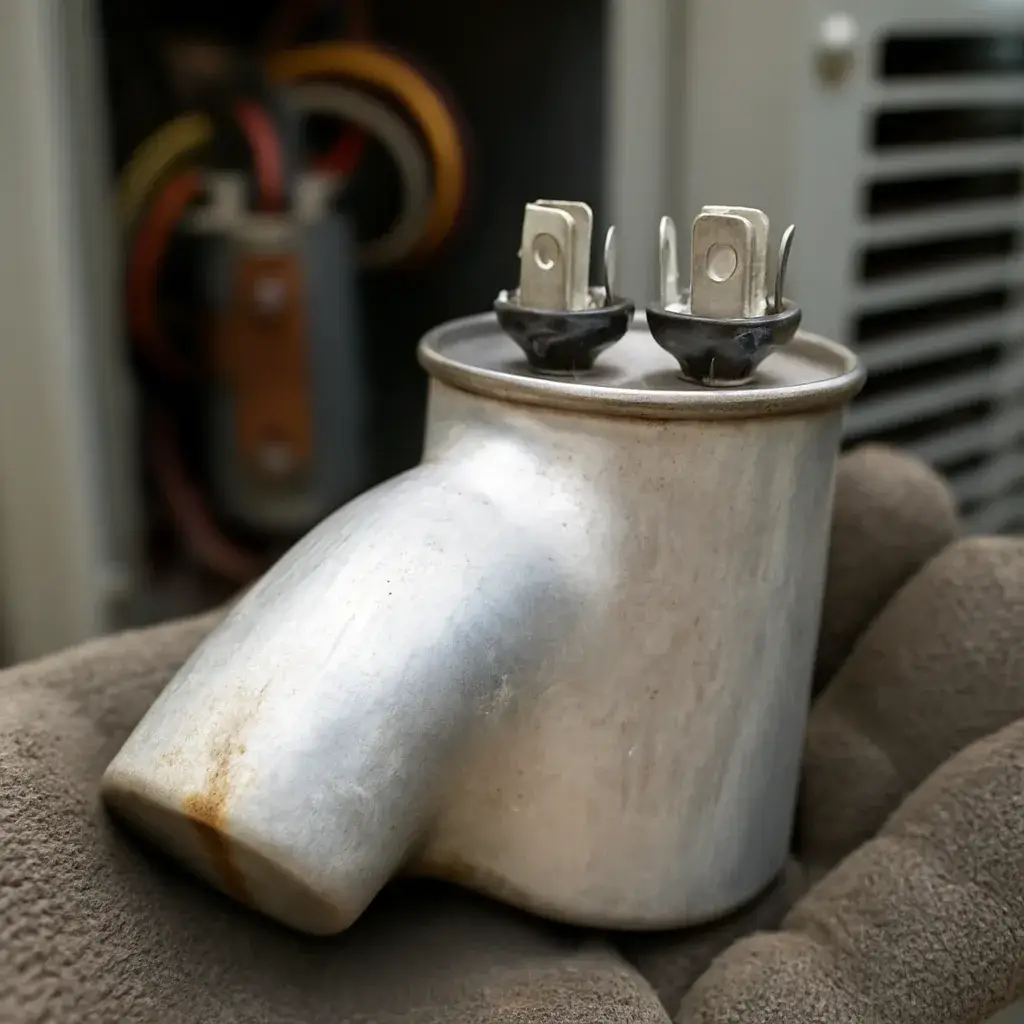
Capacitors take a beating in Texas summers. They store the electrical charge that starts the compressor and fan spinning. Repeated 100-degree days, a condenser cabinet sitting in direct sun, and long run times combine. This wears them down faster than in milder climates. Most last several years. Heat and age are a real, predictable combination out here. This isn’t a sign anything was installed wrong, just part of living in DFW.
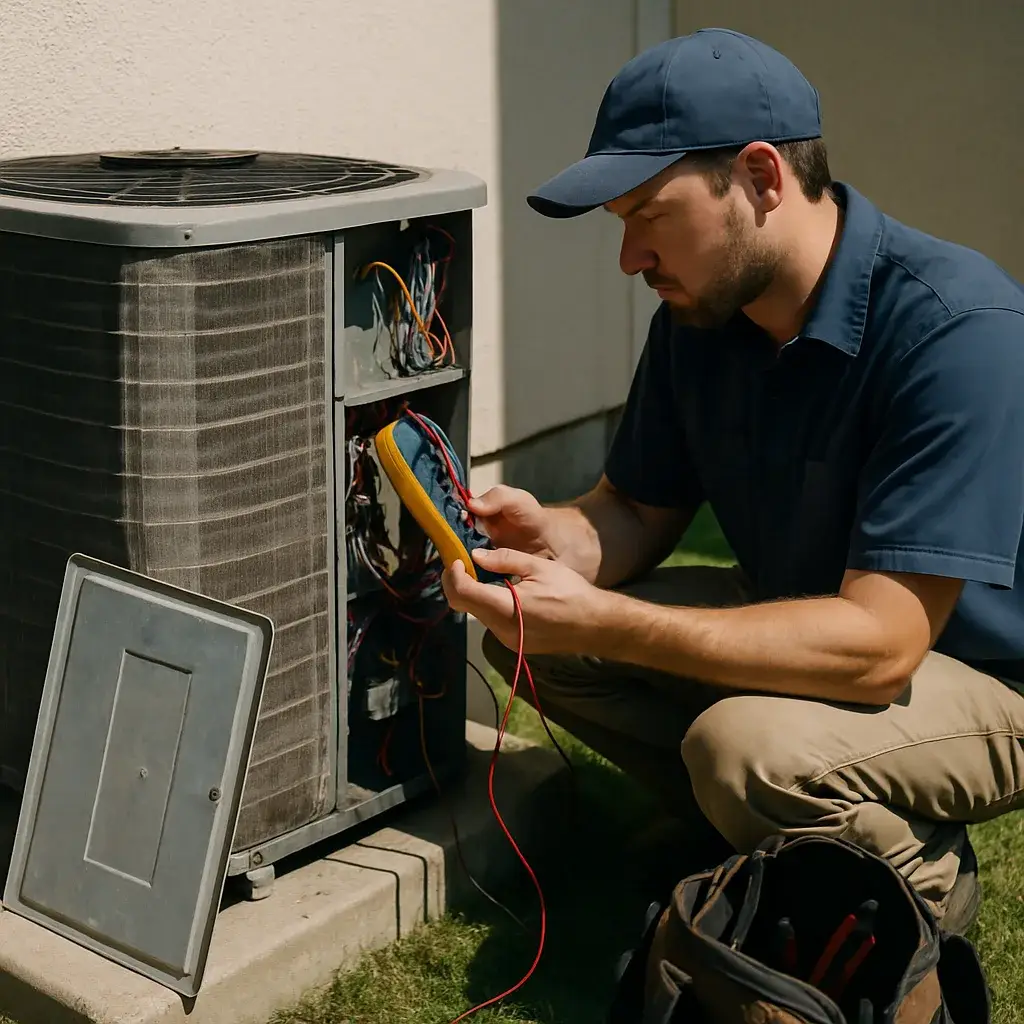
Not every no-cool call turns out to be the capacitor. It’s one of several common culprits. We won’t assume it’s the fix before we look. A technician tests the capacitor’s actual output against its rated range with a meter. We also check the contactor and wiring around it. Then we confirm the unit draws power correctly once the new part is in. If the capacitor tests fine, we keep looking. We won’t replace a part that wasn’t the problem.
If a capacitor replacement is the fix, you get a flat-rate price in writing before we touch anything. That’s part of the same process we follow on every repair call. For homeowners who want to see how that pricing works before calling, our main service page walks through what’s typically involved.
Most capacitor swaps finish in the same visit. It’s a small, contained part, and technicians carry common sizes on the truck. Once it’s replaced, we run the system through a full cycle with you there. We confirm the fan and compressor are both working the way they should before we leave.
Refrigerant Leaks: What to Expect
When your AC runs constantly but never quite cools the house, a refrigerant leak is often the reason. You might see ice on the copper line outside or hear a hissing sound near the outdoor unit. Sometimes, people just notice their power bill going up because the system works harder for less cooling.
Refrigerant doesn’t just disappear. If your system is low, it means there’s a leak somewhere. This could be a worn fitting, a rubbed line, or a coil corroded from age. Or maybe a factory connection never sealed right. We see this a lot in North Texas: attic-installed systems take a beating from the summer heat and vibrations. That can loosen fittings or wear lines thin over the years.
When you call us for weak cooling, our technician will run a full diagnostic. We find where the refrigerant is escaping. We don’t just top it off and leave. Topping off without fixing the leak means you’ll have the same problem in a few months. We want to find the actual source on the first visit, so you’re done right the first time.
Not every leak is a quick fix, by the way. A pinhole in an accessible line is easier than a leak inside an aging evaporator coil. (Those are often buried deep in the air handler.) The age of your coil, the type of refrigerant, and how the system was installed all impact the repair. We’ll show you what we found. Then we’ll go over your options before any work starts.
Once we locate the leak, the repair is only part of the job. The system also needs to be recharged to the manufacturer’s spec. Then we test it under load. This confirms it’s holding and cooling correctly, not just running quiet for an hour. Costs vary based on what’s leaking. Our pricing page has typical ranges and what drives them.
Refrigerant recharge and leak repair is one of the jobs our licensed and insured technicians handle on Emergency / same-day AC repair calls. It goes along with the broader diagnostic and repair work that comes with a system that’s stopped cooling.
Need help with Emergency / same-day AC repair?
Call Today, Get Service Today. Xtreme Air Services is ready to help.
A Frozen Evaporator Coil: What to Expect
A frozen evaporator coil is a common reason North Texas homeowners call us for same-day AC repair during the summer. You’ll often notice warm air coming from the vents, even if the thermostat says your system is running. Or you might see ice on the copper line outside, near your condenser, or inside the air handler. Sometimes, it looks like water pooling around the indoor unit once the ice starts to melt (we see that a lot in Sunnyvale).
- Warm or weak airflow from the vents while your system is on
- Visible ice on the copper refrigerant line or the coil itself
- Water dripping or pooling around the indoor unit
- The outdoor unit cycles, but your house isn’t getting cool
A coil freezes because something is blocking the normal flow of air or refrigerant. A dirty air filter can do it. So can closed supply vents or a weak blower motor. These things starve the coil of the warm return air it needs to stay above freezing. Low refrigerant from a leak has the same effect, by the way. Once ice starts to form, it tends to build up. The problem usually worsens the longer your system keeps running.
Turning the system off to melt the ice won’t fix anything. It just buys you some time. The real cause, whether it’s an airflow problem or a refrigerant issue, is still there once the coil thaws. Running your system when it’s actively frozen can also put a lot of strain on the compressor-that’s the most expensive part of your unit to replace.
When you call us for a frozen coil, our diagnostic visit helps us figure out what’s causing it in your system. We don’t guess. That might mean an evaporator coil repair, a blower motor repair, or a refrigerant leak repair. It could even be something as simple as an air filter replacement. Whatever we find, you’ll get a flat-rate quote in writing before we start any work. You’ll know exactly what you’re approving and why.
You can see how our process runs from your first call to the finished repair. A frozen coil can come from different causes, so the cost varies a little. Our pricing guide walks through what’s typical for each situation.
Electrical Component Failures: What to Expect
Electrical parts fail more often than mechanical ones during a Texas summer. You’ll usually notice it as a system that hums, clicks, or just goes silent. You flip the thermostat down and nothing happens. Or the outdoor unit tries to start and stops. That’s almost always a sign of an electrical component, not the whole system. (It’s a common misunderstanding.)
The capacitor is the part we see fail the most. It stores the charge that gets the compressor and fan spinning. Heat wears it down over years, especially on an outdoor condenser baking on a slab all afternoon. When it goes, the unit tries to start, hums, and can’t get moving. AC capacitor replacement is a fast, contained fix in most cases.
Circuit boards fail less often. But they’re a common reason a whole system can go dead with no warning lights and no obvious sound at all. A board controls the sequence, the fan, the compressor, and the safety switches. A bad relay or a moisture-damaged board can knock the whole thing offline. AC circuit board replacement takes longer to diagnose. We have to rule out simpler causes first before we call it.
Sensors are the quiet troublemakers. A bad sensor can make a system short-cycle, run warm, or shut off early even though the rest of the unit is fine. AC sensor repair is usually a smaller job on its own. But it can look identical to a bigger problem from the thermostat. That’s why we test before we guess.
Fan motor electrical faults show up as a motor that spins slow, hums without turning, or trips a breaker. Sometimes it’s the motor winding. Sometimes it’s a wiring connection that’s loosened from years of vibration and heat cycling. We won’t replace a motor before checking the wiring and connections feeding it. Swapping a good motor doesn’t fix a bad connection.
Electrical failures on an older system sometimes travel in pairs. A capacitor that failed under strain can take a motor with it if it sat bad too long. We won’t promise a single-part fix until we’ve opened the panel and looked. We’ll tell you plainly if we find more than one thing wrong before we touch anything.
Every diagnostic visit for AC electrical repair includes a written, flat-rate quote before we do any work. You know what you’re approving and why. For a look at how these repairs are typically priced, our AC repair pricing guide breaks down the ranges by component.
Frequently Asked Questions
Common questions about Emergency / same-day AC repair
How do you decide whether to repair a part or recommend replacing something bigger?
We start by testing the part that’s failing, like a capacitor, against its rated output. If a technician sees signs the compressor is also failing, we won’t just swap the cheap part and call it done. We’d rather tell you upfront that a bigger issue is in play than have you pay for a repair that doesn’t hold. That’s how we handle every diagnostic call, not just the easy ones.
Does every emergency AC call get fixed in one visit?
Most calls we get, including capacitor swaps and thermostat issues, get diagnosed and repaired the same day. Some jobs take longer, like a refrigerant leak in a coil that needs to be located precisely before any repair happens. We won’t top off refrigerant and leave without finding the source, since that just brings the same problem back. If a repair needs a special-order part, we’ll tell you before we start.
Do you charge extra for AC repairs at night or on weekends?
No, we don’t add an extra charge for AC repair calls at night or on weekends. An evening or Sunday call isn’t priced differently than a weekday afternoon visit. We give you a flat-rate price in writing before any work starts, no matter when the call comes in. For a full breakdown of repair costs, our pricing guide covers that in detail.
Who shows up to do the repair?
Every technician we send is licensed, registered, and insured, and each one goes through a background check and drug testing before working for us. We also have NATE-certified technicians on staff, which means they’ve been tested on real HVAC knowledge, not just trained in-house. That matters most on an emergency call, when you’re letting someone into your home to work on a system you rely on every day.
Do you work on all AC brands, or just one?
We’re a Trane Comfort Specialist Dealer, but that doesn’t mean Trane is the only brand we touch. We also service and repair Daikin, Lennox, RunTru, and Goodman systems, so you’re not stuck calling around if your unit isn’t a Trane. The brand affects which parts we carry on the truck, but not whether we can diagnose and fix the problem.
What’s covered by your guarantee if the repair doesn’t hold?
We back our repairs with a 100% satisfaction guarantee, so the goal is a fix that holds, not just a part that’s swapped in and hoped for. That guarantee applies alongside our flat-rate pricing, meaning the price we quote before starting is the price you pay. If something about the repair isn’t right, that guarantee is what we stand behind. It’s part of how we handle every call, not an add-on.
Ready to Get Started?
Call 972-288-2263 Today, Get Service Today.