


What to Expect With Generator Fuel Line Connection: Common Questions and Issues
The fuel line questions and problems Sunnyvale, TX homeowners run into most, answered plainly.
What’s Covered on This Page
Sizing the Fuel Line to Match Your Generator’s Demand
This comes up almost every time we quote a whole-home standby installation: will the existing gas line even handle it? Fair question. A portable generator barely sips fuel compared to a 20kW standby unit running your AC, water heater, and kitchen all at once, and the pipe feeding your furnace was never sized with that kind of draw in mind.
Usually the first sign of trouble is a generator that runs fine for a minute, then bogs down or shuts off the moment a real load hits, like the AC compressor kicking on. That’s not a defect in the generator. It’s a pipe sizing problem, and it happens because most homes were plumbed for a furnace and a water heater, not a standby unit meant to carry the whole house.
Three things drive the sizing: fuel type, run length, and the size of the generator itself. Natural gas needs a wider pipe than propane to deliver the same energy, since propane packs more heat value per cubic foot. An 80-foot run from the meter to a generator pad out back needs different sizing than a 15-foot run. And a 22kW unit pulls a lot more fuel volume than a 10kW unit, so a pipe that works fine for one size can come up short on another.
We work all of this out before we ever cut into a line. As part of generator sizing and consultation, we calculate the generator’s BTU demand, measure the actual run and routing, and confirm what pipe size that combination calls for. Then we run and connect the fuel line, sized and tested, before the generator goes live. If your existing gas service or meter can’t support the extra load, we’ll say so directly rather than connect a line that won’t hold up.
We don’t guess on this. Testing after the connection confirms the line delivers gas at the rate the generator’s spec sheet requires, not just that gas is present. That step is part of every fuel line connection we do, whether it’s a short run for a smaller unit or a longer route for a full whole-home system.
Cost depends heavily on those same factors: fuel type, length, pipe size, plus whether code upgrades or permits enter the picture. We keep the specifics on our generator installation pricing page rather than guessing here, since every property’s routing is different.
- Fuel type changes required pipe diameter: natural gas needs more volume than propane for the same output
- Longer runs and more elbows increase drop, which can require a larger pipe
- Generator size (kW) sets the BTU demand the line has to support
- Testing after connection confirms the line performs, not just that it’s connected
Natural Gas vs. Propane: Why the Setup Isn’t the Same
Natural gas and propane don’t run through the same size pipe at the same pressure, so the fuel line connection isn’t a copy-paste job between the two. Natural gas typically runs at lower pressure through your existing meter, so we’re often sizing the line off what that meter can already deliver alongside your furnace, water heater, and range. Propane runs off a tank instead, and the line has to be sized and routed for the tank’s pressure and its distance from the generator pad.
Line length changes the math too. A generator 15 feet from the meter is a different job than one 60 feet away on the far side of the house, and that distance affects pipe diameter regardless of fuel type. Longer runs on natural gas sometimes need a larger pipe just to keep pressure steady once the generator kicks on under load. We’ve seen homeowners assume the generator manufacturer’s stock recommendation covers their setup, and it doesn’t always account for everything else already pulling from that same meter.
Propane brings its own wrinkle. If you’re on a smaller residential tank, we check that the tank and regulator can feed the generator plus whatever else in your home runs on propane. That’s a conversation we have before running any pipe, not after. Access matters on both fuel types too, since a line that has to cross under a porch, through a flower bed, or around a slab foundation takes more time and different fittings than a straight shot across open yard.
Every job gets tested once the connections are made, on either fuel type, before we call it finished. That’s part of doing the connection right the first time. If your property has code upgrades pending, like an older meter setup that needs updating, that’s a separate conversation from the generator line itself, and we’ll flag it plainly rather than bundle it in quietly.
For a full breakdown of what drives cost between fuel types, line lengths, and access conditions, our Generator Fuel Line Connection page lays out what’s included and what typically runs extra, like meter upgrades or permit fees.
We’ll ask about your fuel source before we ever quote a line length, because guessing at that detail is how a job ends up undersized. If you’re not sure whether your home runs on natural gas or propane, that’s a perfectly good question to bring to the call.
Checking Whether Your Existing Gas Meter Can Handle the Added Load
A lot of homeowners ask us this before they even ask about the generator itself: will my gas meter handle it? Most residential meters are sized for a furnace, a water heater, and maybe a range or dryer. A standby generator adds a large new draw on top of all that, measured in BTUs per hour, and it demands full output the moment the power goes out. If the meter was sized tight to begin with, a generator can push it past what the utility rated it for.
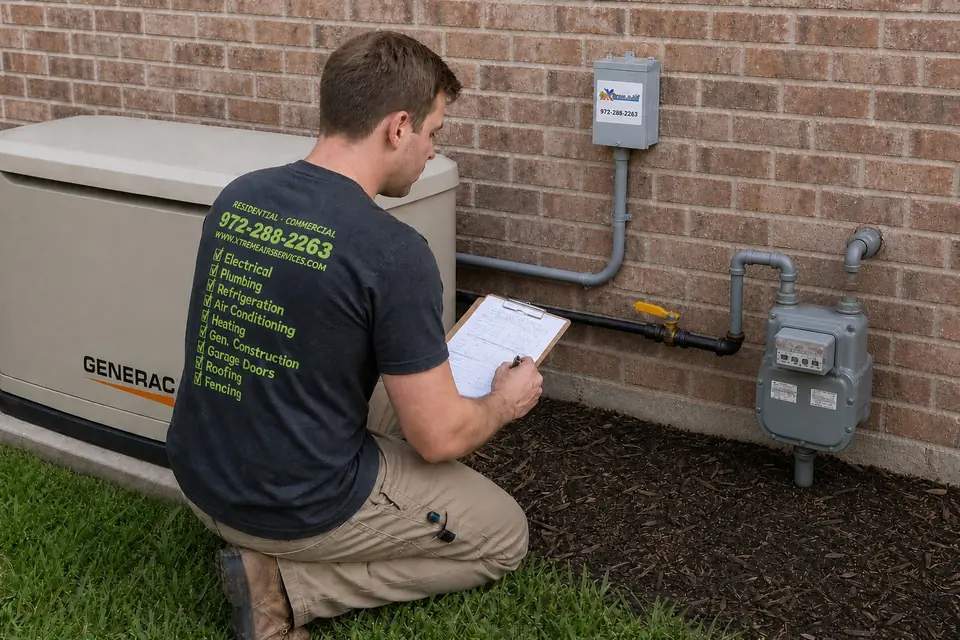
Usually this shows up first as a line item on a quote rather than a problem in the house. Nothing about your current gas service feels off day to day. The issue only surfaces once a generator’s fuel demand gets added to everything else already running off that meter. Older homes in established DFW neighborhoods with smaller original meters tend to run into this more often than newer construction, where builders typically planned for higher loads.
Here’s why it happens: gas utilities size meters based on the connected load at the time of install, and a generator simply wasn’t part of that picture back then. When we size a generator, part of that consultation is calculating total BTU demand across your whole home and comparing it against what your existing meter is rated to deliver.
- Total connected gas load from existing appliances (furnace, water heater, range, dryer, fireplace)
- The generator’s fuel consumption rating at full electrical output
- Whether the home runs on natural gas or propane, since sizing rules differ
- Distance and pipe size between the meter and the planned generator location
Here’s the part we won’t dress up. If your meter can’t handle the added load, that’s a conversation with your gas utility about a meter or regulator upgrade, and that work falls outside what we install and connect. We handle the fuel line itself: running and connecting it, sizing it correctly, and testing every connection before we sign off. Meter and regulator upgrades are a separate step, and we say so upfront rather than let it surface as a surprise mid-project.
This is part of what we cover during backup power assessment and generator sizing consultation, alongside our generator fuel line connection work, so you know before anything gets installed whether your meter needs attention first.
Thinking about Generator fuel line connection? Let’s talk.
Call Today, Get Service Today. Xtreme Air Services is ready to help.
Testing Every New Connection
Every new fuel line connection gets tested before we call the job done. That’s part of how a natural gas or propane line to a generator gets connected correctly, and it’s built into our generator fuel line connection work.
People sometimes ask if a visual check of the fittings is enough. It isn’t. A joint can look tight and still leak under actual operating pressure. Thread sealant that looks fine going on can weep once the line is charged, especially at a coupling that got a little more torque than the last one. You only catch that by testing, not by looking.
In North Texas, fuel lines run outdoors or through unconditioned space more often than not, and the swing between a hot Sunnyvale afternoon and a cold snap in January can move a pipe just enough to stress a joint that wasn’t seated all the way. A test done once at install, at whatever the ambient temperature happens to be, is a snapshot. We’d rather catch a marginal joint on day one than have it show up as a slow leak months later.
If a section fails, we don’t just retighten the loudest joint and call it fixed. We isolate and recheck each connection along the run until the whole line holds at the pressure it needs to hold. That can add time to a visit, but we’d rather take that time than sign off on a line we’re not confident in, since we back our installs with a workmanship warranty, and that only means something if the work underneath it is solid.
This also matters for code. Any generator fuel line connection we run is installed to code, with permits and inspections pulled when the job calls for them. A test is usually part of what an inspector wants to see documented, so it’s not a step we’d skip even if nobody asked us to.
If you’re comparing quotes for a whole-home standby generator install, it’s worth asking every contractor whether testing is included in the fuel line work or billed separately later. You can see how we scope that on our generator installation page, and what’s included with the connection itself.
Permits and Code Requirements for This Work
Running a fuel line to a standby generator usually touches your gas or propane system, and that means local code and permit rules often apply. Most cities in the Dallas-Fort Worth area require a permit and inspection for new gas piping, including the line that feeds a generator, because it involves pressurized fuel and a connection near your home or business. Whether a specific job needs a permit depends on the fuel type, the line size, and what the local building department requires for that address.
We perform every fuel line connection to code, with the proper permits and inspections pulled when they’re required. That’s how the job gets done at Xtreme Air Services. If a customer wants the line run without pulling a permit that’s required, that’s a job we’ll pass on, and it’s one of the situations where we’ll tell a customer no rather than take the work.
In practice, that looks pretty straightforward. A licensed technician sizes the line for your fuel type, natural gas or propane, and routes it to meet code for clearance and protection. Once the line is connected, we test it before the generator is fired up, confirming the connection holds and doesn’t leak. If your jurisdiction requires an inspection, that gets scheduled as part of the job rather than skipped.
- Fuel type and line size often decide whether a permit is required and how the inspection is scheduled.
- Testing the connection happens as part of the install, not as an optional extra.
- Permits, code corrections, meter or regulator upgrades, and tank supply are not automatically included in the base job cost unless stated up front.
That last point matters because a lot of homeowners assume permit cost is baked into every quote. It isn’t automatic here, and we’d rather say that plainly than have it show up as a surprise later. If a permit is needed for your specific line, we address it as part of the written quote before any work starts.
This is also a case where ‘depends’ is the real answer. A short propane line to a portable hookup and a long natural gas run to a whole-home standby unit can land in very different permit categories depending on your city. That gets determined during the visit, not guessed at over the phone.
See our full generator fuel line connection service in Sunnyvale for what the complete job involves.
Ready to Get Started?
Call 972-288-2263 Today, Get Service Today.