


Generator Load Testing: Should You Repair or Replace What Fails?
How we decide whether to repair or replace a generator that fails its load test in Sunnyvale.
What’s Covered on This Page
- What Decides Whether We Repair or Replace
- When We’d Recommend Repairing Your Generator
- When We’d Recommend Replacing Your Generator
- What a Generator Load Test Costs and What It Covers
- How We Help You Decide Between Repair and Replace
- Is it safe to run a load test on an older generator?
- Do you make more money by recommending replacement over repair?
- Does the load test fee count toward a replacement, or only a repair?
- Do you offer financing if I end up needing a full replacement?
- What if the load test shows nothing needs immediate work?
What Decides Whether We Repair or Replace
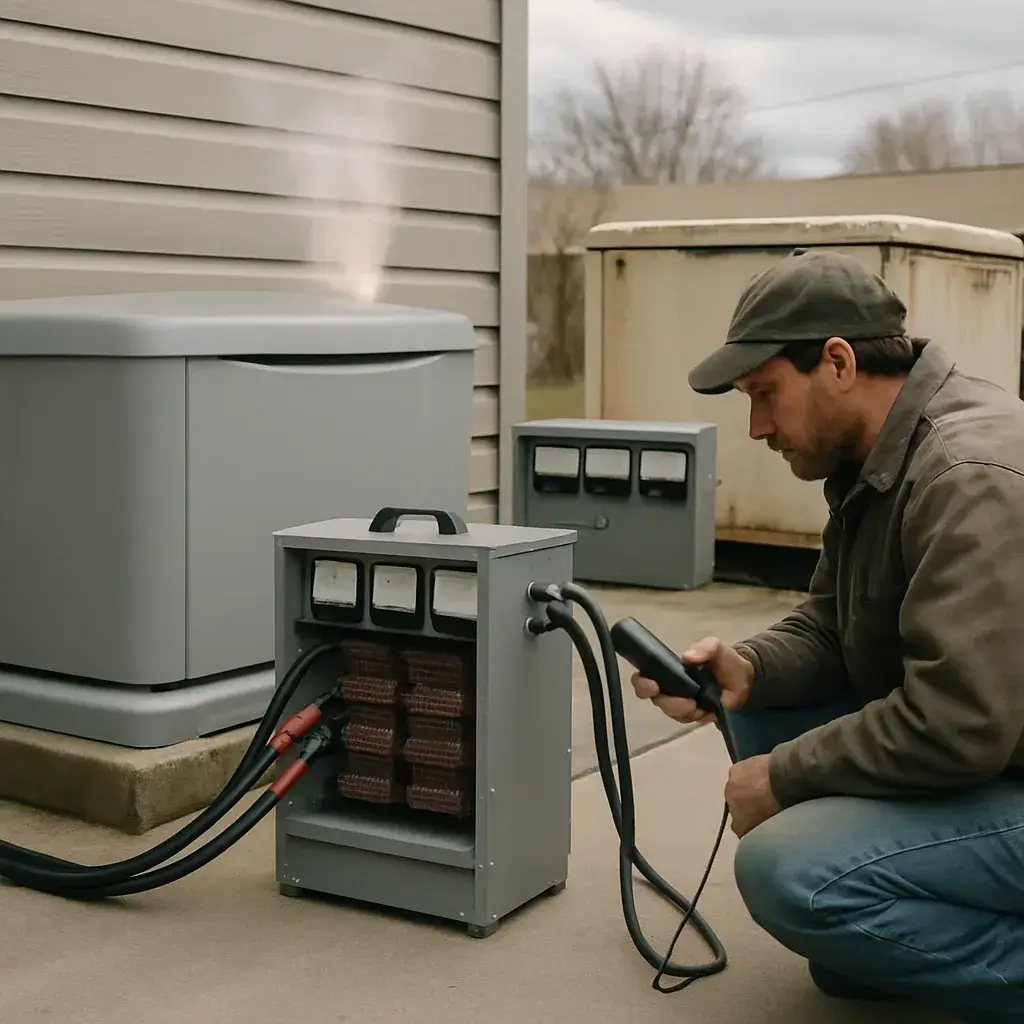
A load test does not make that call by itself. It shows whether your generator can carry your home’s real demand under real conditions, and that points us toward one of a few outcomes. We hook up a load bank, run the generator against a demand close to what your panel pulls, and watch how it holds voltage, frequency, and temperature over time. That is what shapes the next step.
If the unit carries the load and only needs an adjustment, cleaning, or a part, that’s a repair. Weak batteries, a dirty air filter, a fuel delivery issue, or a transfer switch that’s slow to engage are all things we’ve found during a load test that do not call for a new generator. They call for a fix. If the generator starts and idles fine but sags or stalls once real load hits it, that’s a different story. An engine that’s tired, a genuinely undersized unit for your home’s actual draw, or a control board that’s failing under stress usually points toward replacement, especially if the unit is already old and the cost of repeated repair work starts stacking up. We run into this regularly on Sunnyvale properties.
Age and history matter here too. A five-year-old standby generator that fails a load test because of one weak component is a different conversation than a fifteen-year-old unit that’s been limping through storm season on borrowed time. We’ll tell you plainly which situation you’re in. The load test findings only help if we’re direct about what they mean for your generator, not a generic script. Most Sunnyvale homes we visit land in that range.
Sizing is the other piece people do not expect. We’ve run load tests on generators that start up, sound fine, and pass every visual check, but still cannot carry the home once the AC compressor and a couple of big appliances kick on at once. That’s a mismatch between what was installed years ago and what the home needs today, especially after an addition, a new HVAC system, or added appliances. In that case, no repair fixes it. The fix is a properly sized replacement or, in some cases, a look at your transfer switch and backup power setup as a whole. (This is the part people overthink.) This comes up often enough in Sunnyvale that we plan for it.
We put every finding in writing, with a clear summary and our recommended next step, so you’re not left guessing at what a stalled needle or a flickering light on the panel meant. If a repair gets the job done, we’ll say so. If the numbers point to replacement, we’ll walk through why, not just hand you a number. Either way, the fee for the load test itself applies to the repair cost if you move forward with us, so the diagnostic work is not money spent twice. Sunnyvale homeowners ask us about this constantly.
When We’d Recommend Repairing Your Generator
If your generator fails a load test but the problem traces back to one part, a repair is usually the right call. We see this most with weak batteries, a bad transfer switch, a dirty air filter choking the engine, or a control board that’s throwing a code while the rest of the unit is sound. A load test shows how the generator behaves under real demand, not just whether it starts and idles. A generator can turn on and sound fine sitting in the yard, then stumble the moment it’s asked to carry your AC, your fridge, and your well pump at the same time. The same applies across our Sunnyvale service area.
We’d lean toward repair when the generator is younger, when the failure is isolated to a single component, and when the unit has been maintained on a regular schedule. A five-year-old standby generator that fails a load test because of a tired battery or a fouled injector is a different situation than a fifteen-year-old unit that’s been neglected. Age alone does not decide it, but it’s part of the picture along with how the unit has been running and what parts are showing wear. (That part stays simple for a reason.) We have seen it play out that way on plenty of Sunnyvale jobs.
Here’s where it gets specific to price. Our load test itself runs $150 to $300, depending on the generator’s size, whether load bank equipment is needed, and the property setup. That fee gets credited toward the repair if you move forward with us. So you’re not paying twice, once to find the problem and again to fix it. What that test includes is the on-site load run and a written summary of what we found and what we’d recommend next. It does not include the repair itself. Whatever we identify, whether that’s a new battery, a transfer switch replacement, or a control board swap, gets quoted separately as its own line item, and you approve it before we touch anything. It is one of the more common questions we field in Sunnyvale.
This is also where we’ll tell you plainly when repair is not the better move. If the load test turns up multiple failing systems at once, or if the engine itself is showing the kind of wear that suggests the next failure is right around the corner, we’ll say so instead of working through part after part. We’ve walked customers through generators where fixing today’s problem would’ve just set up next year’s service call. That’s one reason we run the test and hand you a written summary rather than just a verbal opinion, so you’ve got something to compare against if you want a second read on it. And yes, we see that pattern. Our Sunnyvale crews handle this as a matter of routine.
For most homeowners across the Dallas-Fort Worth area, a generator that fails one component of a load test and has been on a regular maintenance schedule is a repair candidate first. Replacement usually comes into the conversation when the failures stack up, not when there’s just one part to address. That is true whether you are in Sunnyvale proper or just outside it.
When We’d Recommend Replacing Your Generator
A load test tells us one thing plainly: can the generator carry your home’s actual demand, or does it struggle once real appliances kick on. Most of the time, a generator that fails part of that test just needs a repair, a new part, an adjustment. But sometimes the test points somewhere else, and that’s when we’ll talk replacement instead of another fix. Sunnyvale properties are no different in this respect.
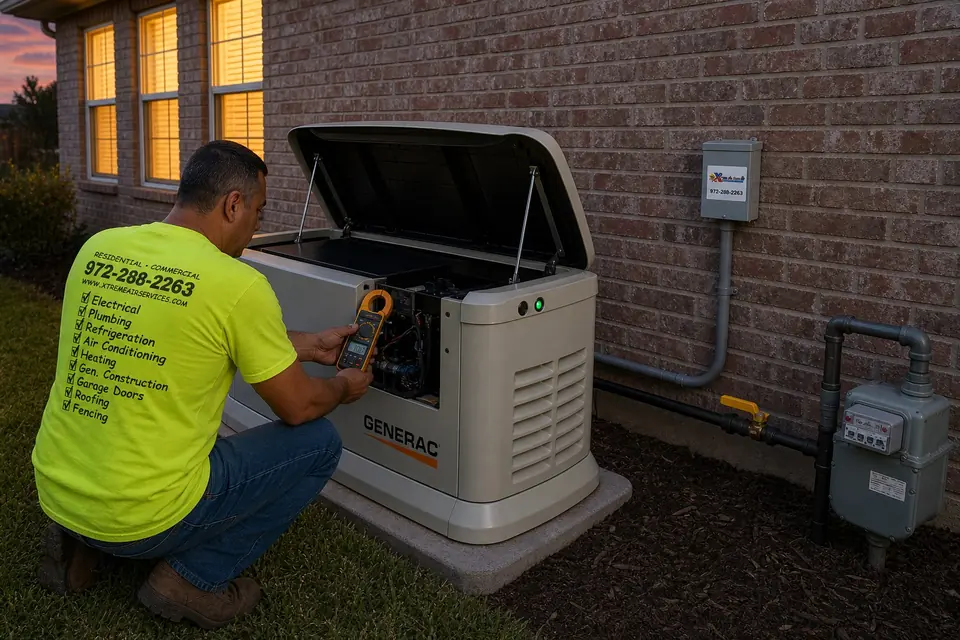
The clearest sign is a unit that cannot hold voltage or frequency steady once we put a real load on it, even after the obvious repair items are ruled out. If the generator is older and the core components, the engine, the alternator, are showing wear across the board rather than one isolated failure, patching one piece often just buys a few months before the next part gives out. We’ll say that plainly if we see it. We’d rather tell you a unit is nearing the end of its useful service than sell you a repair we do not expect to hold. We factor that in on every Sunnyvale visit.
Sizing matters too. Backup power needs change. Sometimes homeowners add a workshop, a second AC system, or an addition after the original generator was sized. A load test can show a generator that was fine for the house it was installed on, but is not sized right for the house today. That’s a sizing conversation, not a repair one, and we handle generator sizing and consultation as part of figuring out what a replacement should cover. (By the way, that comes up more than you might think.) Homeowners across Sunnyvale run into the same thing.
Cost also plays into it. Our load test runs $150 to $300, and our service call fee ($26 to $99) applies toward any repair work if you move forward with us. That works fine for a straightforward repair. But once repair costs start stacking, a major engine failure here, a control board there, on a generator that’s already ten-plus years old, the math starts favoring a new unit with a full manufacturer’s equipment warranty behind it, rather than continuing to chase failures on one that’s aging out. Financing is not part of the load test itself, but it is available for larger repairs and replacement installs, which matters if a whole-home standby unit is the right call. This is standard practice for our Sunnyvale technicians.
We’ll also say this: if you bring us a generator you bought somewhere else and just want it installed, that’s not typically a job we take on. Our workmanship warranty backs equipment we source and can stand behind, so replacement conversations usually start with what we’re installing, not labor-only work on equipment from another source. It holds for Sunnyvale and the nearby Dallas County communities.
None of this replaces the actual test results in front of us. The written findings and recommendation summary we hand you after every generator load testing visit lays out what we saw and why we’re recommending repair, replacement, or nothing at all. That paperwork is yours to keep, compare, or think over before you decide anything. We keep that in mind on Sunnyvale service calls.
Watch Our Video
See How We Handle Generator Load Testing in Sunnyvale
Xtreme Air Services — Serving Sunnyvale and surrounding areas
Have questions? We’re happy to help.
Call Today, Get Service Today. Xtreme Air Services is ready to help.
What a Generator Load Test Costs and What It Covers
A generator load test with Xtreme Air Services runs $150 to $300 for the test itself, and it sits inside a broader $150 to $500 range depending on what your generator needs. There’s also a service-call fee of $26 to $99, and that gets credited toward the repair if you move forward with us. So if the test turns up a bad transfer switch or a weak battery, you’re not paying the visit fee twice. That has been our experience throughout Sunnyvale.
Here’s what that price buys. We hook up a load bank and run your generator under real electrical demand, not just an idle test where the engine turns over and sounds fine. A generator can start up, run smooth, and still not carry your home’s air conditioner, well pump, and refrigerator all at once. Load testing is the only way to know for sure. Once we’re done, you get a written summary of what we found and what we’d recommend next, in plain language. Sunnyvale customers see this play out the same way.
What’s included is the on-site test and that written report. What’s not included is any repair work the test uncovers. If we find a failing capacitor, worn contacts, or a transfer switch that’s not switching clean, that’s a separate job with its own price, and we’ll quote it in writing before touching anything. We do not fold hypothetical repairs into the test price, because half the generators we test pass clean and need nothing at all. The Sunnyvale homes we service follow this pattern.
What moves the price around inside that range? Generator size is the biggest factor. A small portable unit takes less time and less equipment than a whole-home standby generator sized for a large property. Load bank requirements matter too. Some tests need a bigger load bank to properly simulate your home’s peak demand, and bigger equipment costs more to bring out. Property size plays in as well, since a commercial generator serving a business often takes longer to test properly than a residential unit in a Sunnyvale backyard. (That part is usually plain once we see the setup.)
Financing is not typically part of a load test. It’s a smaller job, and most homeowners pay it directly. Where financing does come in is if the test leads to a bigger repair or a full generator replacement.
We will not quote you a number without seeing the generator first. Size and setup change the equipment we need, and giving a flat price over the phone for every generator in North Texas would mean guessing. What we can tell you is the range above and the fact that the service-call fee always applies toward the repair, so calling to ask never costs you more than you expect. We take the same approach on every Sunnyvale project.
How We Help You Decide Between Repair and Replace
A generator load test does not tell you to repair or replace anything by itself. It tells you how your generator behaves under real demand, the kind it would face if the power went out tonight and your whole house pulled from it at once. We run the unit under load, watch how it holds voltage and frequency, and check whether it can carry what your home or business needs. Then we hand you a written summary of what we found and what we’d recommend next, so the decision is yours to make with real numbers in front of you. That is how we scope it for Sunnyvale customers.
The test itself runs $150 to $300 for a typical single-family home, with the full range landing between $150 and $500 depending on your generator’s size, whether load bank equipment is needed, and how big the property is. We charge a $26 to $99 service-call fee for the visit, and if the test shows a repair is needed and you move forward with us, that fee applies toward the repair. The test includes the on-site load run and the written findings. It does not include any repair work itself, that gets quoted separately, in writing, before we touch anything. Sunnyvale sits squarely in our everyday service area.
Here’s where the repair-versus-replace question gets answered: what the load test uncovers. If your generator carries the load fine but shows a weak transfer switch connection, a fuel delivery hiccup, or a component that’s underperforming, that’s usually a repair. We’ve tested generators that passed everything except one voltage regulation issue, and a single part fixed it. On the other hand, if the unit cannot hold a stable load at all, or the engine is straining to carry even a partial house load, that points toward a bigger conversation about whether the generator was sized right in the first place, or whether it’s reached the end of what it can reliably do.
Age and sizing matter more than most people expect. A generator that was sized for a smaller home years ago, or one that’s been asked to carry more than it was built for after an addition or new appliances, can fail a load test even when every part is technically working. In that case, no repair fixes the mismatch. That’s a sizing conversation, and we’ll tell you straight if that’s what we’re looking at rather than selling you a repair that won’t hold up the next time the power goes out.
Financing is not typically part of this smaller test, but it is available if the results point toward a larger repair or a full generator replacement. Every recommendation we make gets written down, not just spoken, so you can think it over or get a second opinion. Any work you approve after the test is backed by our workmanship warranty on the labor, plus the manufacturer’s warranty on any parts involved, on top of our 100% satisfaction guarantee on the visit.
See our full generator load testing service in Sunnyvale for what the complete job involves.
Frequently Asked Questions
Common questions about Generator Load Testing in Sunnyvale
Is it safe to run a load test on an older generator?
Yes. We size the load bank test to your generator’s actual output, so the process is built around what the unit can safely handle. The point of the test is to see how the generator performs under close-to-real demand, not to push it past what it’s rated for. If we see signs during the test that concern us, we stop and tell you plainly what we found rather than pushing further.
Do you make more money by recommending replacement over repair?
No, our load test fee is the same whether the result points to a repair or a replacement. We hand you a written summary of what the generator did under load and what we’d recommend next, based on that data, not on which option costs more. If a repair solves the problem, we say so. If the numbers point elsewhere, we walk through why.
Does the load test fee count toward a replacement, or only a repair?
The load test fee is credited toward a repair if you move forward with us on the repair itself. It does not roll into a replacement, since a new generator is its own separate project with its own quote. We’ll be clear about which situation applies once we’ve reviewed the test results with you.
Do you offer financing if I end up needing a full replacement?
Financing isn’t typically available for the load test itself, since it’s a smaller diagnostic job. It is available for larger repairs and full generator replacements. If your load test results point toward replacement, we can talk through financing at that stage of the conversation.
What if the load test shows nothing needs immediate work?
Then we tell you that plainly. A load test is meant to show whether your generator carries your home’s real demand, and sometimes it holds voltage, frequency, and temperature steady the whole time. In that case, there’s no repair or replacement to recommend, and we won’t invent one just to have something to sell you.
Ready to Get Started?
Call 972-288-2263 Today, Get Service Today.