


Heating System Repair vs. Replacement: How We Help You Decide
The age, part-availability and failure-count math behind the call, the single-part fixes we repair, the cracked heat exchanger and $5,000 Rule cases we won’t, and how we decide on site.
What’s Covered on This Page
- What Factors Decide Repair vs. Replace
- When We’d Recommend a Repair
- When We’d Recommend Replacement
- How We Help You Decide
- Related Links
- How do I know whether to repair or replace my heating system?
- What’s the factor homeowners get wrong most when weighing repair versus replacement?
- When would you recommend replacement instead of taking repair work from me?
- Does the diagnostic fee count toward anything if the unit needs replacing instead of repairing?
- Is financing available if a repair turns into a bigger job than expected?
What Factors Decide Repair vs. Replace
Age matters more than most people expect. A five-year-old furnace with a bad ignitor is an easy call. That’s a straightforward part swap. A seventeen-year-old furnace with a cracked heat exchanger or a failed control board is a different conversation. You are putting real money into a system near its expected life’s end.
Part cost and availability change the math too. Some furnace parts sit on the truck. Others, especially on older or less common equipment, take longer to source and cost more. When a part is expensive or hard to get, and the unit is old, repair starts losing its appeal fast.
- Age of the furnace or heat pump and how many years it likely has left
- Whether one part failed or several components are going at once
- Cost and availability of the specific replacement part
- How the repair cost compares to the cost of a new system
- Efficiency, an older low-AFUE unit can cost more to run every winter than a newer one costs to own
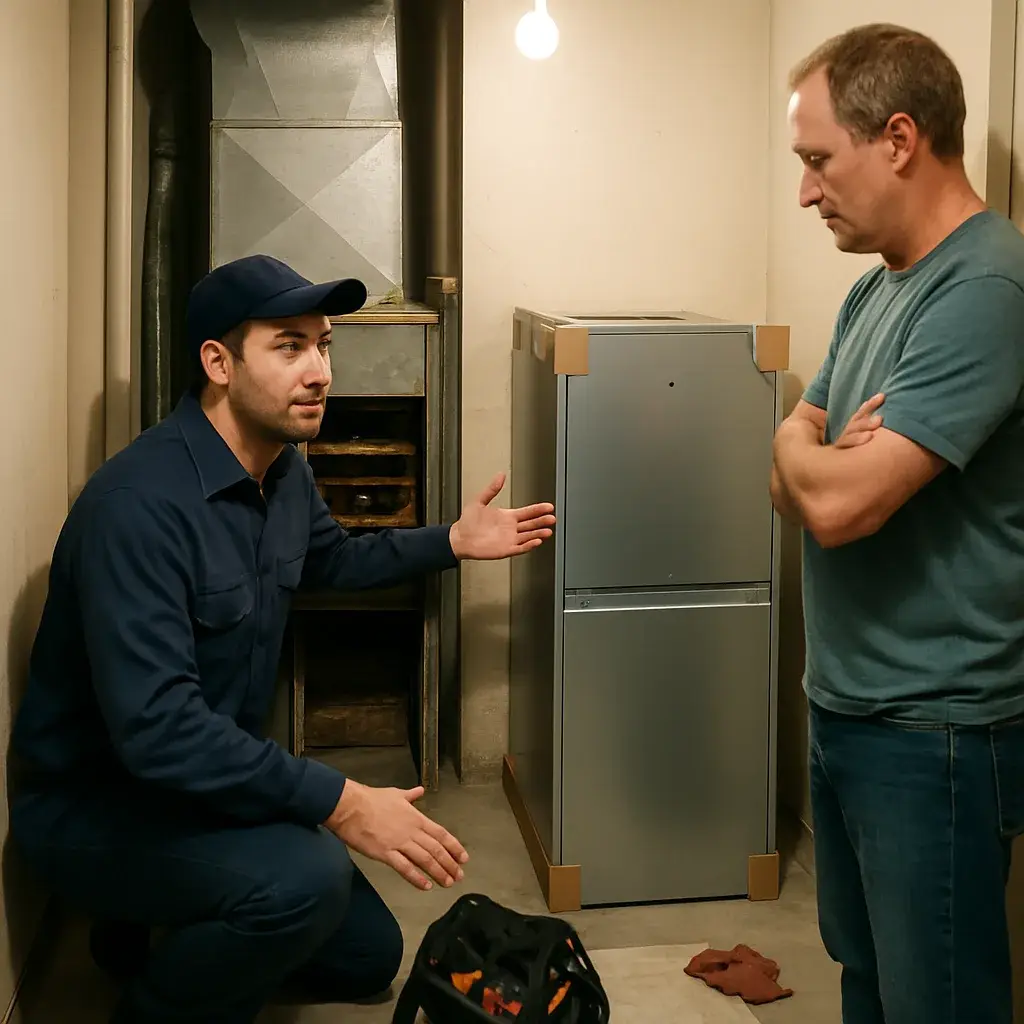
If your system needs a $150 part and it’s five years old, replacing it makes no sense. We will say so. But if a technician finds a second and third failed component during the same visit on a unit already past fifteen years, we will tell you that plainly. We do not nickel-and-dime you through repair after repair. That’s a real judgment call, not a formula. It’s one reason a same-day diagnostic visit matters more than a phone guess.
Time of the call does not move the price. We charge the same for a Saturday night repair as a Tuesday afternoon one. Every repair quote includes diagnosis, labor, and the standard replacement part. We perform testing and cleanup before we leave. If the visit turns into a bigger job, financing is available for larger repairs and replacements. That is not typically needed for a single-part fix. You can read more about what’s covered on our heating system repair page.
When We’d Recommend a Repair
Most heating calls we run across Sunnyvale end with a repair, not a replacement pitch. If your furnace or heat pump has a single failed component, that’s usually a same-visit fix. The most common culprits we see are a cracked ignitor, a dirty or failing flame sensor, a blown capacitor, or a seized blower motor. Each of these has a clear diagnostic signature, a widely available replacement part, and a predictable labor time. That combination makes repair the responsible recommendation.
- Ignitor failures: system tries to start, clicks, but never lights – usually a $150-$250 fix
- Flame sensor issues: furnace lights then shuts off within seconds – typically $150-$300
- Capacitor failure: blower or outdoor fan hums but won’t spin – generally $175-$350
- Blower motor problems: weak airflow, loud grinding, or no air movement at all – usually $250-$400
Repairs in this category generally run $150 to $400 total. That figure already includes diagnosis, labor, the standard replacement part, post-repair testing, and cleanup before we leave. There’s no separate line-item guessing game. If you’ve already paid our $26-$99 diagnostic fee, that amount is credited directly toward the repair cost when we do the work. You are not paying twice to get your heat back on.
Age alone does not rule out a repair. We regularly fix 15 to 18 year old furnaces in Sunnyvale’s older neighborhoods. This happens when the failure is isolated to one part and that part is still in production or available from a local supply house same-day. The math only shifts toward replacement when multiple components are failing at once, the heat exchanger is compromised, or the unit is on borrowed time with a history of repeat service calls.
A few things sit outside the base repair price. These get quoted separately if they come up. This includes any additional parts discovered to have failed once we’re inside the unit. It also covers major components like a heat exchanger or control board, code-driven upgrades required by current Sunnyvale building standards, or permit costs on larger jobs. We will always walk you through those before doing the work, not after.
When We’d Recommend Replacement
Most heating system problems in Sunnyvale homes are fixable. Repair is almost always our first recommendation. But there are a handful of situations where pushing for a repair would be doing you a disservice. Being upfront about these scenarios is part of doing the job right. This happens even when it means a bigger conversation than a homeowner was expecting.
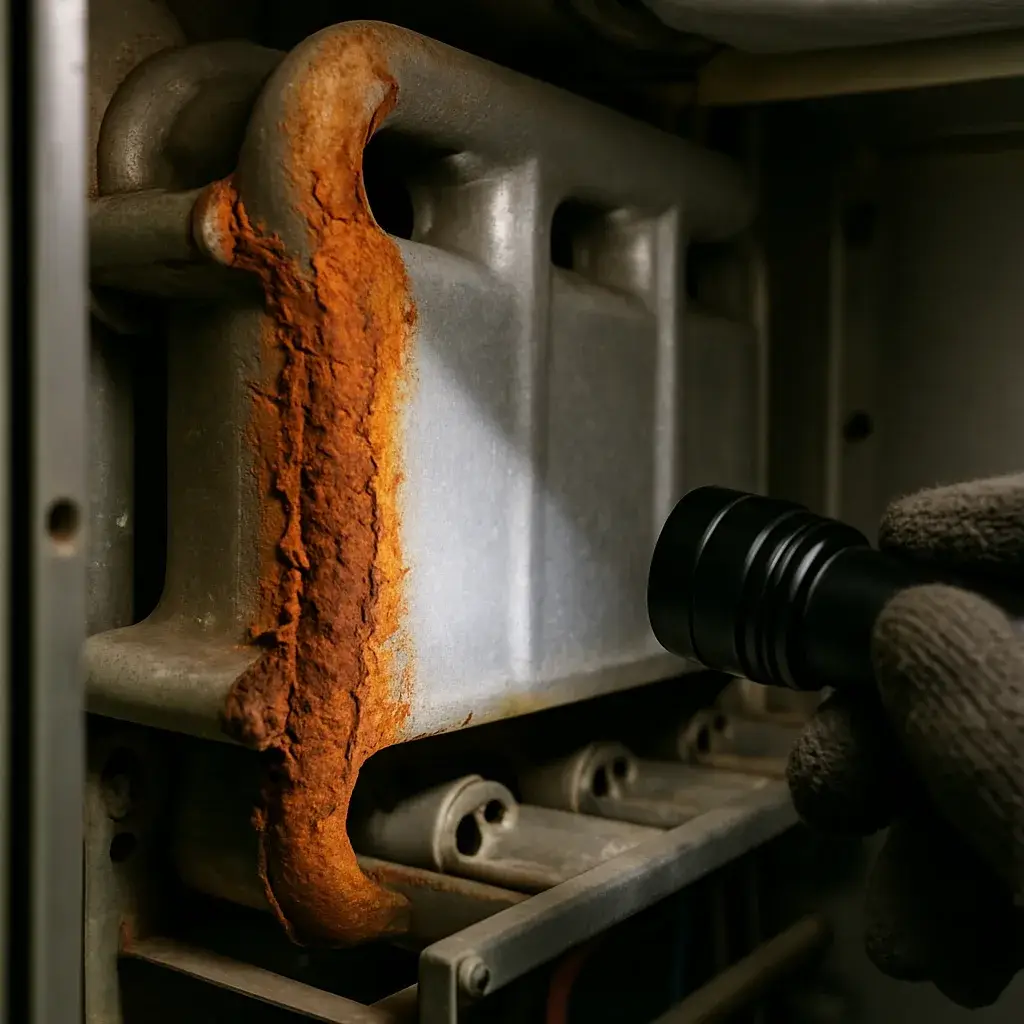
A cracked heat exchanger is the clearest example. This component separates the combustion process from the air circulating through your home. Once it cracks, there’s a real risk of carbon monoxide leaking into your living space. Because of that safety risk, this is one of the few conditions where repair generally isn’t the recommended path. We will say so plainly. We do not try to patch around it.
- Multiple major components failing around the same time on an older furnace or heat pump, which changes the math far more than the unit’s age alone
- OEM parts no longer manufactured for a discontinued or aging model, leaving no reliable path to a proper repair
- Repeated breakdowns that suggest the system is nearing the end of its practical service life, even if each individual fix seems minor
- Repair costs that, added up, cross a reasonable threshold relative to the cost of a new, more efficient system
That last point is where we apply what’s often called the $5,000 Rule. Multiply the age of the unit by the cost of the repair. If that number exceeds roughly $5,000, replacement usually makes more financial sense. It’s a useful guideline, not an automatic verdict. A 6-year-old furnace with a $700 repair is a different conversation than a 16-year-old unit facing the same bill. The dollar figure looks identical on paper. We walk through that math with you on-site. The decision is based on your specific system, not a generic rule.
Sunnyvale’s housing stock includes plenty of homes with original heating equipment from decades past. It is common for one of these older systems to need a blower motor, control board, and heat exchanger inspection all within the same visit. When that happens, we lay out both paths clearly. This includes expected lifespan, efficiency gains, and total cost. You are deciding with full information rather than guessing.
For larger repairs and full replacements, financing options are available to help spread out the cost. Smaller, single-part repairs typically do not require it. Those bills tend to be manageable on their own.
Ready when you are – get in touch today.
Call Today, Get Service Today. Xtreme Air Services is ready to help.
How We Help You Decide
We look at three things before we tell you repair or replace: how much of the system has failed, what the part costs and whether it’s on the truck, and how old the furnace is. A furnace with one failed part and years of life left gets repaired. A furnace with a second or third part going, or one that’s already past its expected life, gets an honest conversation about replacement instead.
Most heating repairs on our heating system repair calls run between $150 and $700. The common visit lands between $150 and $400. A typical call means we find the failed part, fix or replace it, and test the system before we leave. Most of these jobs get fixed on the first visit.
- How much of the system is affected, not just the one symptom you noticed
- Whether the part is common or something we have to source
- The age and brand of your furnace
- Whether more than one component has failed at once
- Nights and weekends cost the same as a weekday call, no overtime charge
The diagnosis, labor, and the standard replacement part are part of that price. This also includes testing and cleanup after. What’s not included is a second failed part we find once we’re inside the unit. This also applies to a major component like a heat exchanger, or any code upgrade or permit work. If we find something bigger once we’re in there, we quote it separately before we touch it.
Here’s the part most companies skip. If your furnace is old and this isn’t the first part to go, we will say so instead of quietly repairing it and letting you find out later. Stacking repairs on an aging system usually costs more over a year or two than one replacement would. We would rather tell you that up front than have you call us again in six months for the next part.
Every visit starts with a $26 to $99 service call fee. It is credited toward the repair if you move forward with the work. Financing is not typically needed for a job this size. But it is available if the diagnosis points toward a bigger repair or a full system replacement.
Frequently Asked Questions
Common questions about Heating system repair
How do I know whether to repair or replace my heating system?
We look at four things: how old the unit is, how many parts have failed, whether the replacement part is cheap or hard to find, and how the repair cost compares to a new system. A newer furnace with one failed part is almost always a repair. An older unit with several problems at once, or a part that’s hard to source, tips toward replacement. We walk through these factors with you before recommending either path, based on what we find during the visit, not a guess over the phone.
What’s the factor homeowners get wrong most when weighing repair versus replacement?
Most homeowners focus only on the price of the repair in front of them. They don’t factor in whether it’s the second or third failed part in a short time, or whether the unit already shows multiple issues. One $200 fix looks affordable on its own. Three of those within a year, on an aging unit, often costs more than replacing it would have upfront. We look at the pattern, not just the invoice in front of us.
When would you recommend replacement instead of taking repair work from me?
We’ll tell you to replace instead of repair when the numbers or the safety picture say so, even though a repair still pays for the visit. That includes a cracked heat exchanger, multiple major components failing on an older unit, or a repair cost that adds up close to what a new system costs. We’d rather tell you that plainly at the time of diagnosis than have you pay for a repair on a system that’s on its way out.
Does the diagnostic fee count toward anything if the unit needs replacing instead of repairing?
The $26 to $99 diagnostic fee only credits toward the repair cost, not toward a full system replacement. If our technician finds the unit needs replacing instead of a repair, that visit fee stays separate from any replacement quote. It still covers the trip out and the time spent finding the actual problem, which is useful information either way. We’ll walk you through the numbers before any work begins so you know what applies where.
Is financing available if a repair turns into a bigger job than expected?
Financing isn’t typically needed for a single-part repair, since most run $150 to $700 total. If the visit uncovers a bigger problem, like a system that needs replacing, financing is available for larger repairs and full replacements. We’ll let you know at the time of diagnosis if your situation qualifies for that option, based on what the technician finds inside the unit.
Ready to Get Started?
Call 972-288-2263 Today, Get Service Today.