


Chiller Installation in Allen: Why It Takes One Team for Refrigeration, Piping, and Electrical
Chiller installation handled by one mechanical team for the refrigeration, piping and electrical – not a residential AC swap.
What’s Covered on This Page
- Chiller Installation Is a Mechanical Contractor Job, Not a Residential AC Swap
- Signs an Allen Building Needs a New Chiller
- Repair or Replace: When Chiller Installation Is Not the Right Call
- What Happens During a Chiller Installation
- What Drives Chiller Installation Cost
- What are the most common problems that show up after a chiller installation?
- How long does a chiller installation take from start to finish?
- Can my building run without cooling during a chiller changeover?
Chiller Installation Is a Mechanical Contractor Job, Not a Residential AC Swap
If your building runs on a chiller, you already know what’s riding on it. Chiller installation affects your tenants, your equipment, and whether your doors stay open through a North Texas summer. The most important thing to know before you hire anyone is this: a chiller is a connected system, not a single box. You’ll get the best result when one accountable team owns every connection, start to finish.
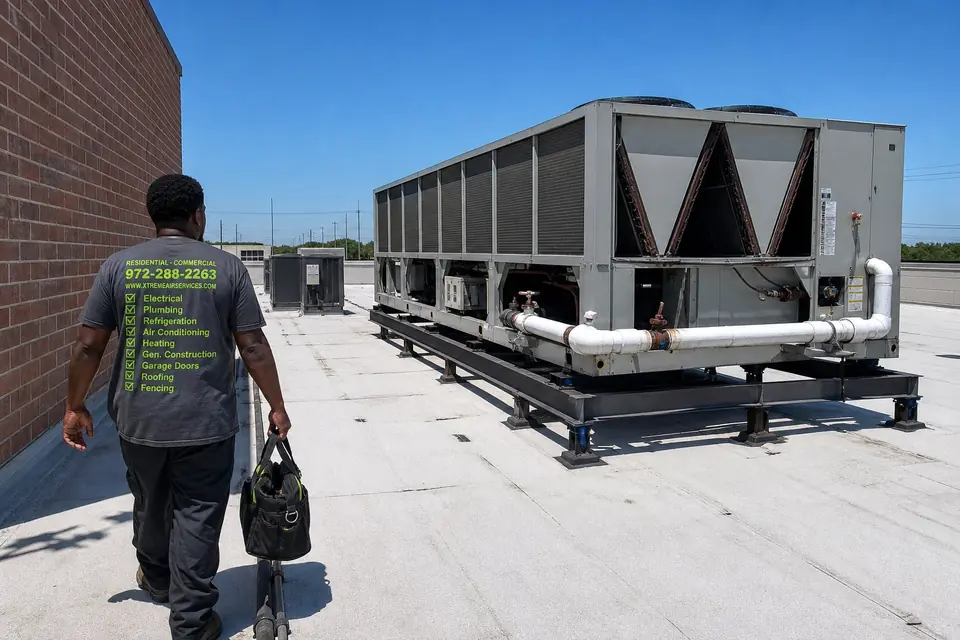
Here’s the difference in plain English. A home AC cools air and pushes it through ducts. A chiller cools water. That chilled water then travels through pipes to air handlers or fan coils all over your building, and they use it to cool the air. So when a chiller goes in, the job reaches well past the unit itself.
- Refrigeration work. The chiller has to be charged, checked for leaks, and started up by technicians trained to handle refrigerant safely.
- Piping and pumps. Chilled water lines, valves, and pumps have to be sized and connected so water moves at the right flow. A water-cooled chiller also ties into a cooling tower.
- Electrical. Commercial chillers usually run on three-phase power and need the right breakers, disconnects, and wiring to start without trouble.
- Controls. The chiller has to talk to your building automation so it ramps up and down with your real cooling load.
- Rigging and placement. A chiller can weigh several tons, so getting it onto a pad or roof safely is a planned job of its own.
When those pieces get split between three or four contractors, gaps show up. The electrician waits on the HVAC crew, and the plumber isn’t sure who owns the pump. When something doesn’t work at startup, everyone points at someone else. Meanwhile your building sits warm.
That’s why we handle it as one job. Xtreme Air Services is a licensed and insured HVAC, plumbing, and electrical contractor under HVAC License #TACLA29023C, with one team covering HVAC, plumbing, electrical, and refrigeration. Chiller installation, cooling tower installation, piping, pump work, and building automation are all part of what our commercial side does. You get one point of contact, out of our Allen office on W McDermott Dr, who answers for the whole system.
Now the honest part. Many buildings don’t need a chiller at all. If you run a house, a small office, a single storefront, or a restaurant with a few rooftop units, a chiller is probably the wrong tool. Most of those spaces are better served by split systems, ductless mini-splits, rooftop units, or a VRF system. Those usually cost less to put in and are simpler to maintain. If someone is pushing a chiller for a space that size, ask them to explain why.
Chillers make sense for larger buildings with steady, heavy cooling loads. Think multi-story offices, schools, medical buildings, data rooms, and process cooling. If that’s you, the question isn’t whether to bring in a pro. It’s whether the team you hire can own every part of the system that keeps your building running.
Signs an Allen Building Needs a New Chiller
Most chillers don’t quit all at once. They slip, a little more each summer, until one hot afternoon the building can’t keep up. If you know what to watch for, you can plan a replacement on your schedule instead of scrambling in the middle of an Allen heat wave.
Here’s a common picture. It’s mid-August. The building feels fine in the morning. By 3 p.m., tenants on the top floor start calling about warm offices, and the server room is running hotter than you’d like. The chiller is running flat out and still losing ground. That’s often the first sign it can’t carry your load anymore.
These are the signs worth taking seriously:
- It can’t hold temperature on the hottest days. If the chilled water coming off the unit creeps warmer every afternoon, the chiller may have lost capacity it won’t get back.
- Repairs keep stacking up. One service call a year is normal. A compressor this summer, a motor last summer, and a control board the year before add up to a pattern.
- It uses an older refrigerant. Some older chillers run on refrigerants that are being phased out. Each recharge gets harder to find and more costly to pay for.
- Your energy bills climb while your building stays the same. When the space and the hours haven’t changed but the bills keep going up, the machine is working harder to do the same job.
- Your building changed and the chiller didn’t. Added floors, new tenants, a bigger data room, or process equipment can push your cooling needs past what the unit was sized for.
- You see leaks, rust, or corrosion. Refrigerant leaks, water around the unit, or corroded tubes and frames often point to wear that’s deeper than one part.
- It trips, short cycles, or gets louder. A chiller that shuts itself off, struggles to start, or rattles and vibrates more than it used to is telling you something.
- It won’t work with your building controls. Older units often can’t talk to modern building automation. That means you can’t ramp cooling up and down with real demand, so you pay to cool empty space.
North Texas summers make all of this worse. Long stretches of high heat mean your chiller runs hard for months at a time, not weeks. A unit that barely made it through last summer is going into this one with more wear and no extra room to spare.
Now the honest part. One of these signs on its own doesn’t mean you need a new chiller. If the unit is otherwise in good shape and one part failed, a repair is often the smarter money. A bad sensor, a worn pump, or a control problem can make a healthy chiller act like a dying one. Replacement starts to make sense when you see several of these signs together, or when one big repair would cost a large share of what a new unit costs.
The way to know for sure is to have someone look at the whole system. That means the chiller, plus the pumps, piping, electrical, and controls around it. Sometimes the problem everyone blames on the chiller turns out to be somewhere else in the loop.
Repair or Replace: When Chiller Installation Is Not the Right Call
A new chiller is a big check to write. Before you write it, make sure the chiller is really the problem. Plenty of units that look worn out are just being dragged down by the system around them.
These fixes can bring a struggling chiller back without replacing it:
- Cleaning condenser and evaporator tubes. North Texas water is hard. Over time, scale builds up inside the tubes and on the cooling tower and acts like a blanket. The chiller works harder and cools less. A good tube cleaning can make a real difference.
- Fixing the cooling tower. A tower with clogged fill, a weak fan, or poor water treatment sends warm water back to the chiller. The chiller gets blamed for a tower problem.
- Repairing or rebuilding pumps. A worn pump or a clogged strainer cuts water flow. Low flow can make the chiller trip or lose capacity, even when the machine itself is fine.
- Balancing the system. If water isn’t moving evenly to every air handler, some floors run hot while others run cold. That’s a balancing problem, not a chiller problem.
- Finding and fixing refrigerant leaks. A slow leak on an otherwise healthy chiller is usually worth tracking down and repairing.
- Tuning the controls. Bad setpoints, a failed sensor, or controls that fight each other can make a good chiller run poorly.
There’s also a middle path between a repair and a new unit, which is a retrofit. Upgrading controls so an older chiller can talk to your building automation, or adding variable-speed drives to your pumps, can cut energy use and buy you years. If the compressor and shell are sound, that can be the better use of your money.
Sometimes the right answer is to wait. Say you’re planning a renovation, adding a floor, or expecting a big tenant change in the next year or two. Then it often makes sense to keep the current chiller running and replace it once you know your real cooling load. If you buy now, you might size it for a building you won’t have in two years.
Timing matters too. If your chiller made it through summer but you know it’s near the end, don’t rush the job in August. Plan the replacement for our cooler months, when your building can get by on less cooling and nobody’s sweating through the changeover.
If the tubes are clean, the loop checks out, and the chiller still can’t keep up, that’s a real answer. At that point, replacement isn’t a sales pitch. It’s the fix.
Ready when you are – get in touch today.
Call Today, Get Service Today. Xtreme Air Services — Allen is ready to help.
What Happens During a Chiller Installation
A chiller installation isn’t one day of heavy lifting. It’s a planned project with a clear order to it. Once you know the steps, you can plan around them, keep your tenants in the loop, and know what a finished job should look like.
Here’s how the work usually goes, start to finish.
- Size the new chiller to your real load. A good installer doesn’t just match the old unit’s tonnage. Your building may have changed since that chiller went in. The new one should fit how your building runs today, not how it ran 20 years ago.
- Check what’s staying. The pipes, pumps, valves, wiring, and controls that will hook up to the new chiller get looked over first. If something is worn out or too small, you want to hear about it now, not at startup.
- Plan the shutdown. You and your installer agree on when cooling goes off and for how long. If parts of your building can’t go without cooling, like a server room or a medical space, that plan should come before anyone picks up a wrench.
- Handle permits. Find out early who pulls them and whether they’re included in your quote. That way inspections don’t hold up the job.
- Take out the old unit. The refrigerant has to be safely recovered, not vented into the air. Then the old chiller is disconnected, rigged out, and hauled away.
- Set and connect the new chiller. The unit goes on its pad or roof spot. Then the crew ties in the chilled water lines, condenser water lines if you have a cooling tower, power, and controls.
- Flush and fill the loop. Debris and old scale in the piping can foul a brand-new chiller fast. The loop should be flushed, filled, and checked for leaks before the machine runs.
- Start it up and test it. This is where the job proves itself. Water flow, supply and return temperatures, refrigerant pressures, and safety shutoffs all get checked against the specs. The chiller should also respond the right way to your building controls.
That last step is the one to pay the most attention to. A chiller can turn on and blow cold water and still not be set up right. Ask to see the startup readings. Ask what the flow and temperature numbers should be and what they came in at. A team that did the job right won’t mind showing you.
Before you sign, know what your quote covers. On a standard like-for-like chiller installation using existing connections, Xtreme Air Services includes equipment and materials, professional installation, standard connections, startup and testing, and haul-away of the old unit. Duct, electrical, and plumbing modifications, code corrections, and permits aren’t included unless your quote says so. If your piping needs to be resized or your electrical service needs an upgrade, that’s separate work. You should see it written out before the job starts, not added halfway through.
When the crew leaves, you should have a chiller that’s running, a set of startup readings, and a clear answer to one question: who do you call if something’s off? With one team handling the refrigeration, piping, electrical, and controls, that answer is simple.
Watch Our Video
See How We Handle Chiller installation in Allen
Xtreme Air Services — Allen
What Drives Chiller Installation Cost
A chiller installation price depends on your building, not a price list. Two buildings in Allen can need chillers that look alike from the curb and still land far apart on cost. That’s because the price follows the whole system the chiller connects to, not just the box.

Here are the real numbers. Our chiller installations typically run $15,000 to $150,000. Most jobs are a standard like-for-like replacement that uses your existing connections with no major changes. That job usually falls between $42,000 and $96,000, including equipment, materials, professional installation, startup, and testing.
Where your project lands in that range comes down to a handful of things:
- Size and capacity. A chiller is sized in tons of cooling. A bigger building with heavier loads needs more tons, and more tons cost more. That’s why sizing to your real load matters. Oversizing means paying for capacity you’ll never use.
- Efficiency. A higher-efficiency chiller costs more up front but uses less power to do the same work. A North Texas chiller runs hard for months each summer, so those savings add up over the life of the unit.
- Brand and model. Features, controls, and build quality vary from one model to the next, and so does the price.
- Ease of access. A chiller set on a ground-level pad near a wide gate is one job. A chiller that has to be craned onto a roof, or squeezed into a tight mechanical room, takes more planning, equipment, and labor.
- Condition of what’s staying. If your pipes, pumps, wiring, or electrical service are worn out or undersized, they may need work before the new chiller can run right.
- Code upgrades and permits. Older installations sometimes don’t meet today’s requirements. Bringing them up to code adds to the job.
- Custom fabrication. Piping, supports, or connections that have to be built to fit your space cost more than standard parts.
The last four items are where surprise costs come from on a lot of jobs. They fall outside a standard like-for-like quote, as covered above. The fix is simple. Get them found and priced before work starts, not halfway through the install.
That’s how we price it. You get upfront, flat-rate pricing that you approve before any work begins, so there’s no meter running and no surprises. If we come out to look at your system, the service-call fee is $26 to $99, and it’s credited toward the job if you go ahead with Xtreme Air Services. For a project this size, flexible financing is available on qualifying installations and larger jobs, on approved credit.
When you’re comparing quotes, ask each contractor the same questions. What tonnage did you size this for, and how did you get that number? What’s included, and what’s listed as extra? Who handles the electrical, piping, and controls? Who pulls the permits? If one quote is far lower than the others, the answer to that last question usually explains why.
Call 469-299-8996
Frequently Asked Questions
Common questions about Chiller installation
What are the most common problems that show up after a chiller installation?
The most common problems trace back to the piping, pumps, or controls around the chiller, not the unit itself. Low water flow from a weak pump, scale buildup in the tubes from hard North Texas water, and controls that don’t talk to your building automation are frequent culprits. A loop that isn’t flushed before startup can also carry debris into a brand-new chiller and cause trouble right away. That’s why startup testing should check water flow, temperatures, and refrigerant pressures together, not just whether the unit turns on.
How long does a chiller installation take from start to finish?
Most chiller installations run through several planned stages: sizing, checking existing piping and electrical, a scheduled shutdown, removing the old unit, setting the new one, flushing the loop, and startup testing. The length depends on your building’s access, whether your pumps and wiring need work, and how much of your cooling has to stay online during the swap. Planning the shutdown around a server room or medical space, for example, can add time but protects what matters most in your building.
Can my building run without cooling during a chiller changeover?
It depends on what’s in your building, and that should be worked out before anyone starts the job. Spaces like server rooms or medical areas often can’t go without cooling for long, so a shutdown plan has to account for that ahead of time. Scheduling the replacement during cooler months also gives your building more room to handle a gap in cooling without strain.
Ready to Get Started?
Call (469) 299-8996 Today, Get Service Today.