


Cooling Tower Installation in Allen: What Facilities Buyers Need to Know
Cooling tower installs for commercial chilled-water plants, with the permit and mechanical code requirements explained.
What’s Covered on This Page
- Repair or Full Cooling Tower Installation: How to Tell the Difference
- What a Standard Cooling Tower Installation Includes
- Why Commercial and Light-Industrial Properties in Allen Need Proper Sizing
- Why a Manufacturer’s Install Guide Is Not a Substitute for a Licensed Mechanical Contractor
- Questions to Ask Before You Approve a Cooling Tower Installation Estimate
- How long does a cooling tower installation take from start to finish?
- Can my cooling tower be repaired instead of replaced?
- Do I need a permit for a cooling tower installation?
- What size cooling tower do I need?
Repair or Full Cooling Tower Installation: How to Tell the Difference
A cooling tower is really two things. One is the box: the frame, the casing, and the cold-water basin at the bottom. The other is everything working inside it, like the fan, motor, belts or gearbox, spray nozzles, fill, and float valve. When something inside the box fails, you can usually fix it. When the box itself fails, you’re looking at a new tower.
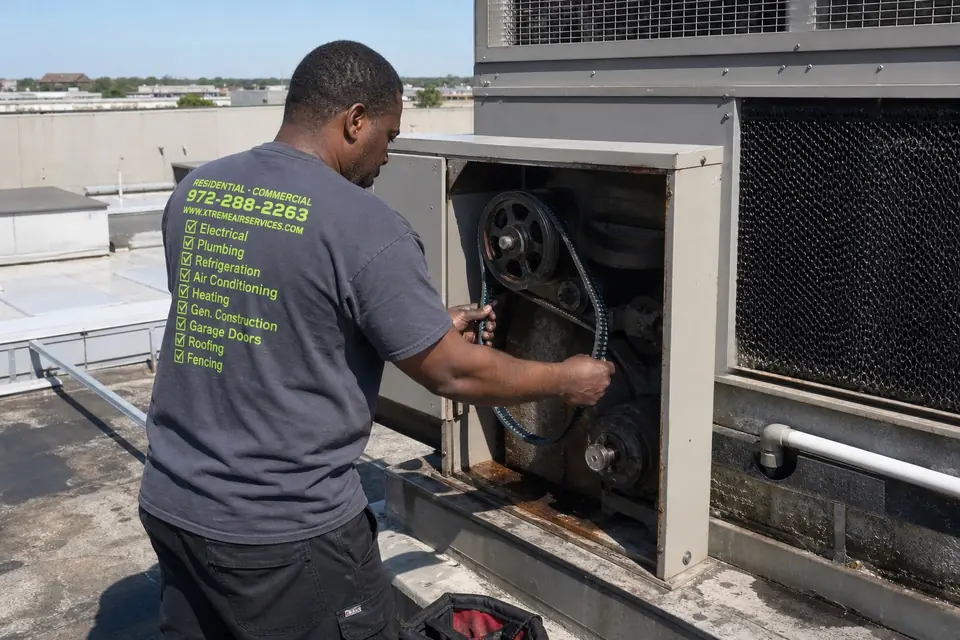
These problems usually point to a repair:
- A fan that squeals, shakes, or won’t turn. This often means a worn bearing, belt, motor, or gearbox.
- Water spraying unevenly across the fill. Clogged or broken nozzles are a common cause.
- The basin overflowing or running low. This often traces back to a stuck float valve or makeup water valve.
- Fill that’s packed with scale but still in one piece. It can often be cleaned or swapped out without touching the structure.
- Water escaping out the top as mist. Worn drift eliminators can be replaced on their own.
These problems usually point to a full installation:
- Rust that has eaten through the basin or casing, not just surface spots, and leaks you can’t stop.
- A frame or support structure that’s sagging, cracked, or rotted.
- Fill that’s collapsing in sections while the structure around it is also failing.
- Your building has grown. You added space, equipment, or tenants, and the tower runs flat out and still can’t hold the temperature.
- You’re paying for repairs over and over, and each fix just leads to the next part failing.
The sizing point catches a lot of owners off guard. A tower in perfect shape can still be the wrong tower. If it was sized for a smaller load, no repair will make it big enough. It will run hard every afternoon from June through September, wear out faster, and leave your chiller working harder than it should.
Water matters here too. North Texas has hard water. As the tower evaporates water to shed heat, the minerals stay behind and build up as scale on the fill, nozzles, and basin. Scale on its own is a maintenance problem. But years of heavy scale combined with corrosion underneath is often how a fixable tower turns into one that needs replacing.
Here’s a simple test. Add up what you’ve spent on the tower over the last couple of years, plus what the next repair will cost. Then think about what one hot afternoon with no cooling would cost your business, whether that’s tenants calling, a server room heating up, or a production line slowing down. If the repairs keep coming and the structure is part of the problem, putting money into a new tower usually protects you better than patching the old one.
If you can’t tell which side of the line you’re on, that’s normal. Get an honest look at both the box and the parts inside it before anyone quotes you a new tower.
What a Standard Cooling Tower Installation Includes
Our most common cooling tower job is a standard like-for-like replacement. The new tower goes where the old one stood and ties into your existing connections with no major changes. That job typically runs $28,000 to $64,000. It covers the equipment and materials, professional installation, startup, and testing.
Across all the cooling tower work we price, the typical range is $10,000 to $100,000. That’s a wide spread because towers come in very different sizes. A small unit serving one building isn’t the same job as a large tower feeding a central plant.
Here’s what a standard installation includes:
- The new tower and the materials needed to set it in place.
- Professional installation of the tower.
- Standard connections to the systems already in place. On a cooling tower, that generally means the condenser water lines to and from your chiller, the makeup water line, the drain, and power to the fan motor.
- Startup and testing, so you know the tower runs before the job is called done.
- Haul-away of the old unit. You aren’t left with a rusted tower sitting on your roof or pad.
Here’s what isn’t included unless your quote says it is:
- Changes to piping, plumbing, electrical, or ductwork beyond the standard connections.
- Code corrections, meaning fixes to older work that doesn’t meet current code.
- Permits.
That second list is where budgets usually get surprised, so it’s worth asking about early. Say your building added a wing a few years back and the old tower was always too small. The new one will be bigger, and bigger usually means larger pipe, a heavier electrical feed, or a stronger base. None of that falls under like-for-like. It’s not a trick. It’s simply a different job, and you should see it spelled out on your quote before any work starts.
These are the things that push the price up or down:
- Size and capacity. Tonnage is how much heat the tower can get rid of. More tonnage means a bigger, costlier tower.
- Efficiency, brand, and model.
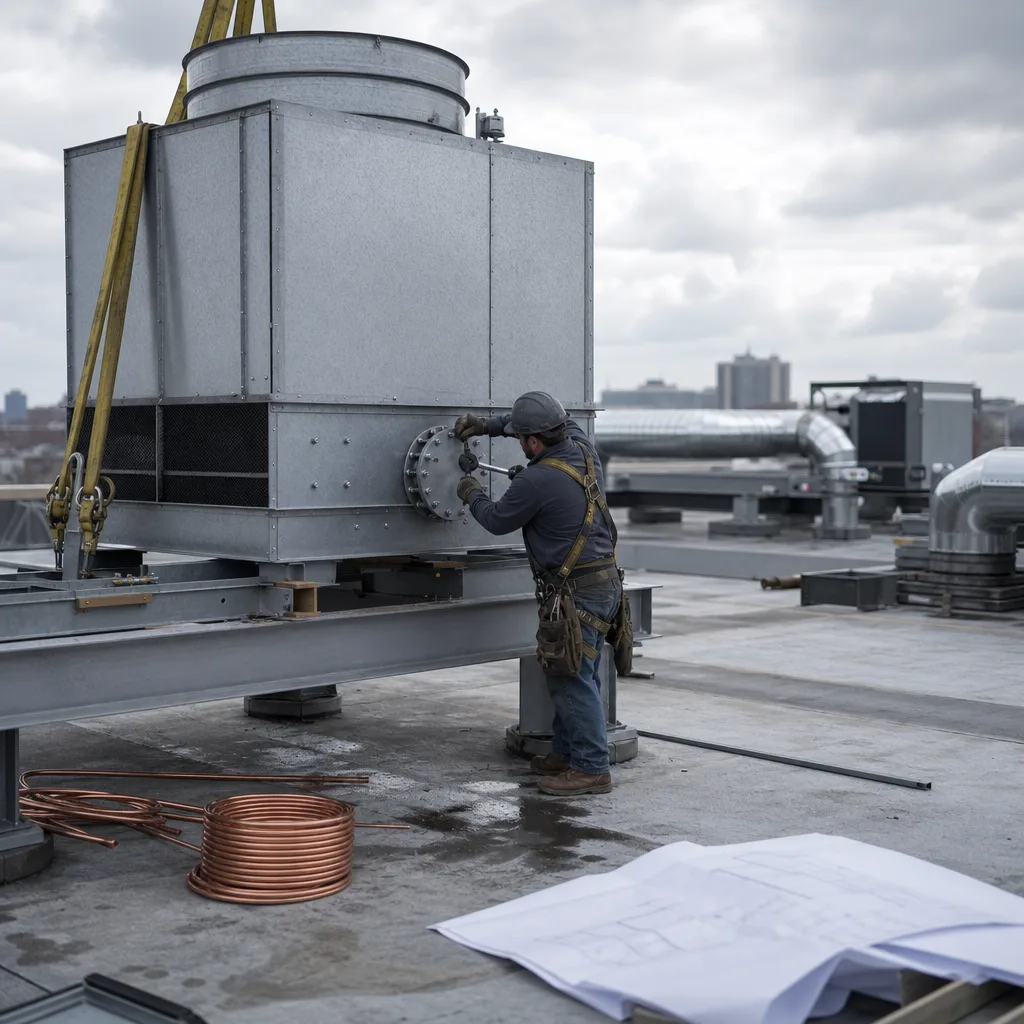
- Ease of access. A tower on a rooftop that needs a crane costs more to swap than one sitting on a ground-level pad.
- The condition of your existing piping, wiring, and plumbing.
- Code upgrades and permits.
- Any custom fabrication, like a new support frame or adapter pieces to fit an odd footprint.
There’s a $26 to $99 service-call fee for the visit. If you go ahead with Xtreme Air Services, that fee is credited toward the job. Since a new tower is a big spend for most businesses, flexible financing is available on qualifying installations and larger jobs, on approved credit.
The point of laying it all out this way is simple. When you can see what’s in the price and what’s outside it, you can compare quotes fairly. You also won’t find out about a permit or a piping change after the old tower is already gone.
Why Commercial and Light-Industrial Properties in Allen Need Proper Sizing
The most expensive cooling tower mistake isn’t the price tag. It’s buying the wrong size. A new tower copied from the old one’s nameplate can bring back the same problems you just paid to get rid of. Your tower should be sized to the heat your building makes today, the way North Texas summers feel, and the growth you already know is coming.
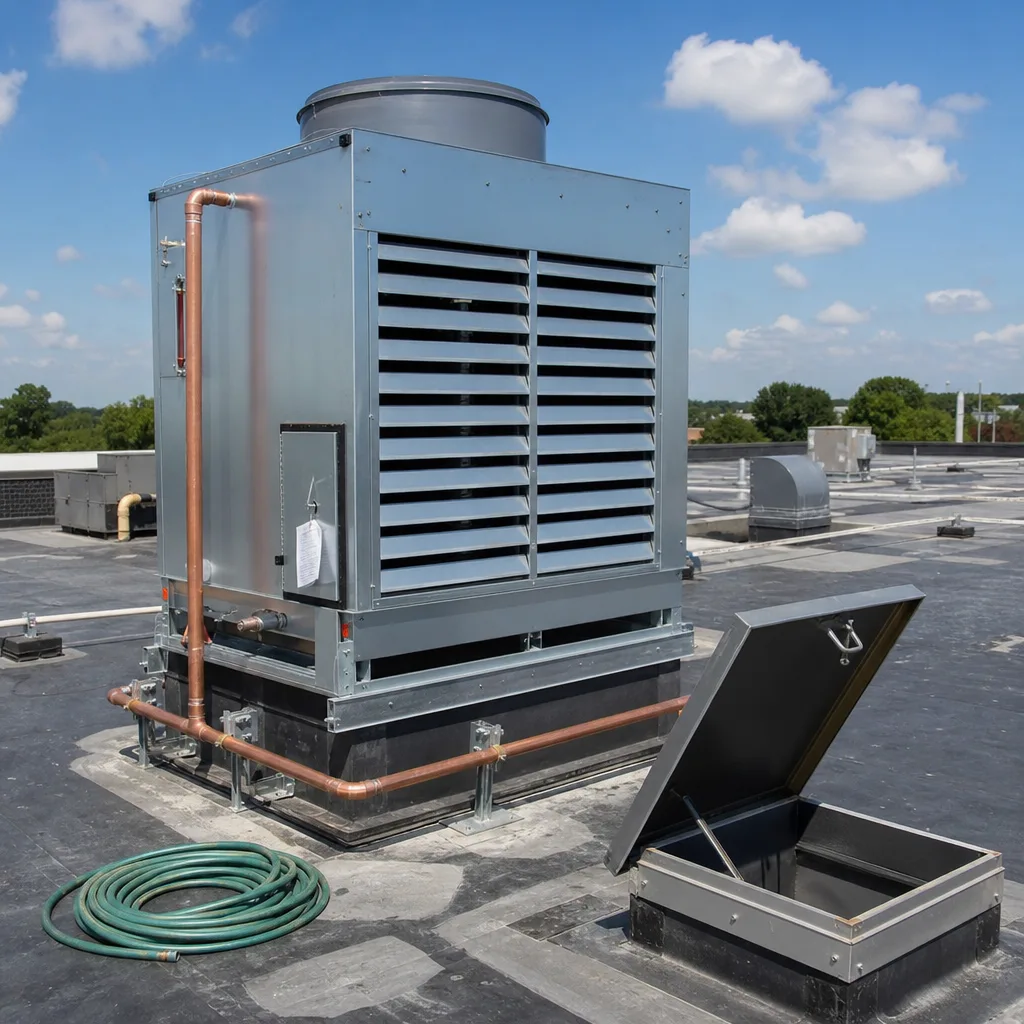
Allen has a lot of office, retail, medical, and flex space that has changed hands and changed uses over the years. An office floor becomes a server room. A warehouse bay picks up light manufacturing. A tenant build-out adds equipment that runs all day. Every one of those changes adds heat your cooling system has to get rid of. The tower installed when the building opened may have been sized for a very different building.
Proper sizing looks at a few things together:
- Heat load. This is how much heat your chiller sends to the tower on your busiest day, including the extra heat from the chiller’s own compressor.
- Water flow. This is how many gallons per minute move through the tower. The tower and the chiller need to agree on this number.
- Wet-bulb temperature. This is one reading that combines heat and humidity. A tower cools water by letting some of it evaporate, and evaporation slows down when the air is already muggy.
- Growth. Planned expansions, new tenants, or added equipment should be counted now, not after the tower is on the roof.
That wet-bulb point matters a lot here. A North Texas afternoon in July or August can be hot and sticky at the same time. That’s exactly when your building needs the most cooling and when a tower has the hardest time delivering it. A tower that looks fine on paper in mild weather can fall short on the days you can’t afford it.
When a tower is too small, the water heading back to your chiller stays too warm. The chiller has to work harder, use more power, and may shut itself off on high pressure to protect itself. That’s when tenants start calling and server rooms start heating up.
Bigger isn’t automatically safer, though. A tower that’s much too large costs more up front, weighs more on your roof or pad, and may need heavier piping and electrical work. If too little water spreads across too much fill, you can get dry spots where hard-water scale builds up faster.
So before you sign off on any new tower, ask to see how the size was chosen. A good answer is based on a cooling load calculation for your building, the chiller it’s paired with, and summer conditions in North Texas. A weak answer is “it’s the same size as the old one.” If the old one was struggling, the same size will struggle too.
Getting the size right also tells you early whether you’re looking at a true like-for-like swap or a bigger job with new piping, power, or support work. Knowing that before the old tower comes down keeps your budget and your schedule honest.
Have questions? We’re happy to help.
Call Today, Get Service Today. Xtreme Air Services — Allen is ready to help.
Why a Manufacturer’s Install Guide Is Not a Substitute for a Licensed Mechanical Contractor
The manual that ships with a new cooling tower is a good document. It tells the crew how to lift the tower, set it level, bolt it down, put the fan together, and run it for the first time. But it’s written for the tower alone. It assumes everything around the tower is already right, and on most jobs, everything around the tower is where the real work is.
Think about what the guide takes for granted:
- The roof or pad can hold it. An empty tower is one weight. A running tower with a full basin is a lot heavier. The guide gives you the numbers, but it can’t tell you whether your roof steel or slab is built for them.
- Your condenser water piping fits. The tower has to deliver the right flow to your chiller and get it back without air pockets, leaks, or starving the pump. That depends on your building, not the box.
- The electrical feed is right. The fan motor needs the right size wire, a proper disconnect, and controls that talk to your chiller and pumps.
- The makeup water line is protected. A tower is open to the air, so the line that refills it needs backflow protection to keep tower water out of your building’s drinking water.
- Permits are handled. The guide doesn’t know the City of Allen’s permit and inspection requirements. Someone has to pull the right permits and be there when the inspector shows up.
None of that is in the manual because it can’t be. Every building is different. A tower going onto a flex building off a busy commercial corridor faces different structural, piping, and power questions than one replacing an old unit on a ground-level pad behind a medical office.
This is also why a cooling tower job crosses trades. One install can involve mechanical work, plumbing, and electrical all at once. When three different outfits each handle one piece, problems tend to fall in the gaps between them. The pipe fitter says it’s an electrical issue. The electrician says the controls aren’t his. Meanwhile your building is warming up on a 100-degree afternoon.
Xtreme Air Services is a licensed and insured HVAC, plumbing, and electrical contractor, so those pieces sit under one roof and one point of accountability. Our HVAC license is #TACLA29023C, issued through the Texas Department of Licensing and Regulation, and you can look it up yourself. That’s worth doing with anyone you’re thinking about hiring for work this size.
Before you sign with anyone, ask a few plain questions. Who checks whether the roof or pad can carry the operating weight? Who handles the condenser water piping, the electrical feed, and the backflow protection on the makeup water line? Who pulls the permits and meets the inspector? And who do you call if something isn’t right after startup? If the answer is different people for each one, or nobody, you’ve found the gap the manual leaves open.
A good install isn’t just a new tower sitting where the old one was. It’s a tower that’s tied in, powered, protected, permitted, and proven to run before anyone calls it done.
Call 469-299-8996
Watch Our Video
See How We Handle Cooling tower installation in Allen
Xtreme Air Services — Allen
Questions to Ask Before You Approve a Cooling Tower Installation Estimate
A cooling tower estimate is a promise on paper. Before you sign it, make sure it says what you think it says. You already know to check what’s included and how the size was picked. These questions cover the rest. They’re the gaps that usually turn into phone calls you didn’t want to make.
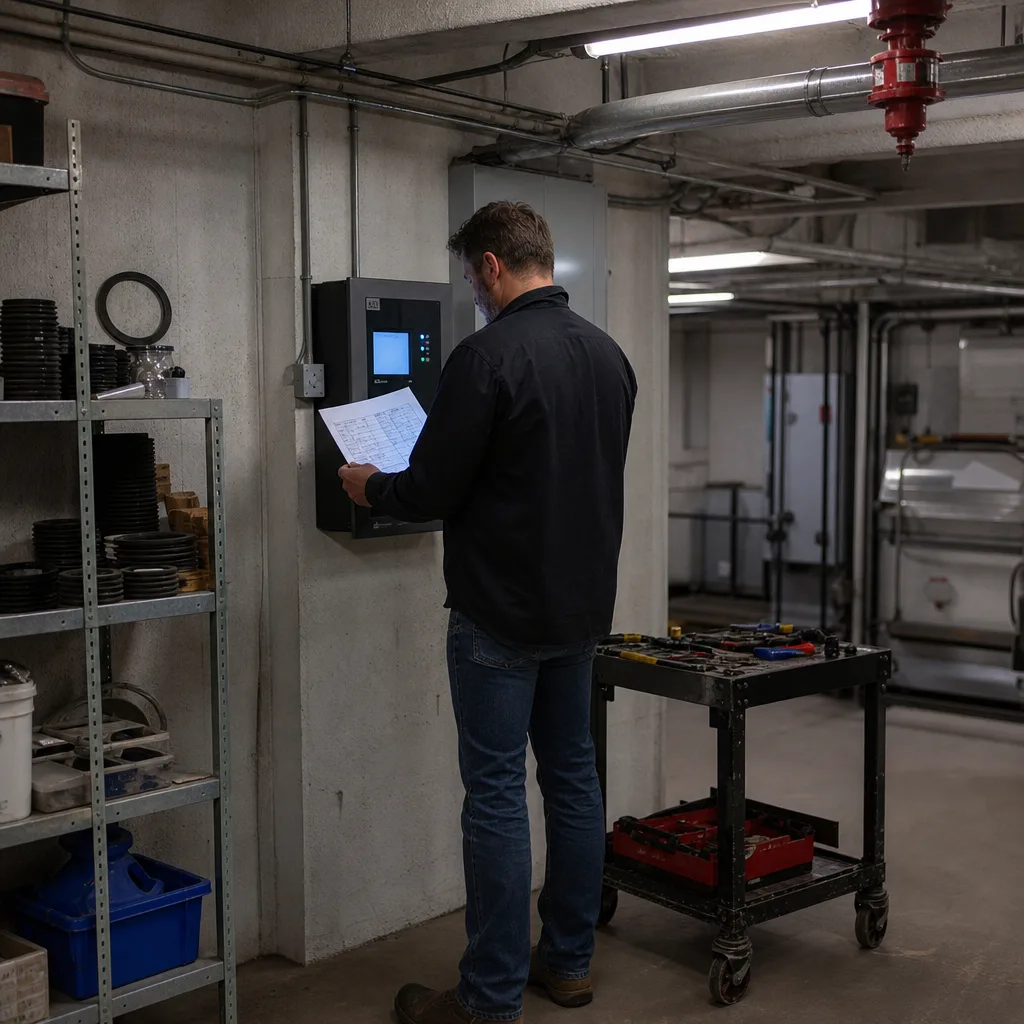
- Is this a set price, or an estimate that can grow? Ask whether the number is the price you’ll pay or a starting guess. At Xtreme Air Services, you get upfront flat-rate pricing that you approve before work starts, so there’s no meter running.
- What happens if you find a problem once the old tower is out? Rusted support steel or a corroded pipe can hide under an old tower. Ask how that kind of surprise gets priced, and make sure nothing extra gets done until you’ve seen it and said yes.
- How long will my building be without cooling? Ask for a plain timeline: when the old tower comes down, when the new one is set, and when it’s running again. If you can plan the swap for spring or fall instead of the middle of a North Texas summer, ask whether that changes the schedule.
- Is the crane or rigging in the price? A rooftop tower usually needs a lift, and that can mean blocking part of your parking lot or a drive for a day. Ask who sets that up, and whether your tenants or customers need a heads-up.
- What exactly does startup and testing prove? “We turned it on” isn’t enough. Ask what you’ll be shown. That should include water flowing at the right rate, the temperature of the water going in and coming out, a fan running smoothly without shaking, and no leaks at the basin or connections.
- Who sets up water treatment on day one? Hard water starts building scale on new fill right away. Ask who handles chemical treatment and the bleed-off setting that flushes out minerals, so your new tower doesn’t pick up the same scale that wore out the old one.
- Is the model and capacity written on the quote? You want the tower’s tonnage and flow rate on paper, not just “new cooling tower.” That’s the only way to compare two quotes fairly.
Here’s how this plays out. Two quotes land on your desk, and one is several thousand dollars lower. Then you notice it doesn’t mention rigging, doesn’t list the tower’s capacity, and says nothing about what happens if the support frame is rotted. The lower number may not be the lower bill. The quote that answers these questions up front is usually the one you can budget around.
A good contractor won’t mind any of these questions. If someone gets vague or rushes you to sign, take that seriously. Your building’s cooling is too important to leave to guesswork, and you should feel in control of this decision from the first visit to the final test.
Call 469-299-8996
Frequently Asked Questions
Common questions about Cooling tower installation
How long does a cooling tower installation take from start to finish?
It depends on your building’s setup, but you should always get a plain timeline before work starts. Ask when the old tower comes down, when the new one goes up, and when it’s running again. If a rooftop crane lift is needed, that can add time and may require blocking part of a parking lot or drive for a day.
Can my cooling tower be repaired instead of replaced?
Often yes, if the problem is in a moving part like the fan, motor, pump, valve, or fill. Repairs make sense when the frame, casing, and basin are still solid. Replacement becomes the smarter choice once rust eats through the basin or the tower can no longer keep up with your building’s cooling load.
Do I need a permit for a cooling tower installation?
Yes, permits are typically required for this kind of mechanical work. A licensed contractor handling your installation should pull the correct permits and be present when the inspector comes, so you don’t have to track down that process yourself.
What size cooling tower do I need?
The right size depends on your building’s heat load, water flow, and summer wet-bulb conditions, not just matching the old unit. A good contractor runs a cooling load calculation based on your chiller and expected growth, since copying an old tower’s nameplate can bring back the same performance problems you’re trying to fix.
Ready to Get Started?
Call (469) 299-8996 Today, Get Service Today.