


Generator Repair in Allen: Know What’s Wrong Before You Call
Standby and portable generators diagnosed and repaired, starting with the four failures we see most.
What’s Covered on This Page
- Four Fault Categories Explain Most Generator Breakdowns
- Signs a Generator Needs a Repair Call Now
- When a Generator Does Not Need Professional Repair
- What Happens During a Generator Repair Visit
- Generator Repair Costs and What Changes the Price
- Is it worth repairing a generator or should I just replace it?
- What is the most common problem with home generators?
- How often should I run my generator to keep it from failing?
Four Fault Categories Explain Most Generator Breakdowns
A generator that fails during an outage can feel like a total loss. Usually it isn’t. Most breakdowns come down to one of four things, and what your generator is doing right now often points to which one.
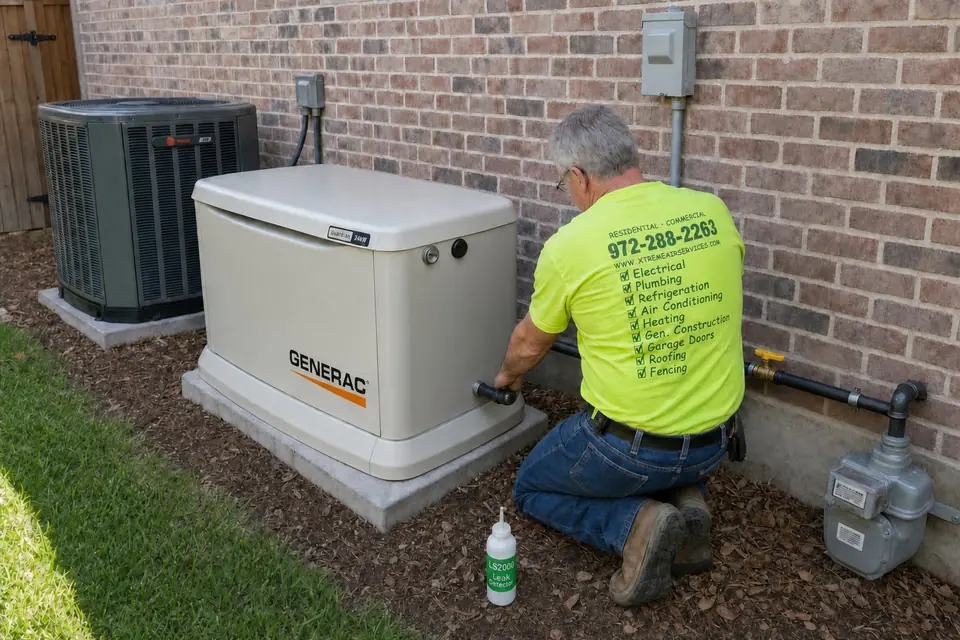
Battery. A standby generator starts off a battery, much like your car. North Texas summer heat wears batteries down, and a hard winter freeze can leave them too weak to crank. You might hear clicking, notice a slow crank, see a low-battery warning on the controller, or find that the generator skipped its weekly exercise run.
Fuel. Standby units run on natural gas or propane. Portable units usually burn gasoline. If the engine cranks but won’t catch, starts and then dies, or surges once your home’s load kicks on, fuel is a likely suspect. Common causes include a gas valve left closed after other work, a regulator problem, a low propane tank, or a clogged filter. With portables, it’s often old gas that’s been sitting since the last storm.
Controls. The controller is the generator’s brain. The transfer switch is the part that senses the grid has dropped and moves your home over to generator power. When either one has trouble, you may see an error code on the display, or the generator may sit idle when the power goes out. Sometimes the generator runs fine but your house stays dark. Causes range from a loose wire or a tripped sensor to a failed circuit board. Spring storms with heavy lightning can be hard on these electronics.
Starting. These are the parts that turn the engine over and light it: the starter motor, spark plugs, and ignition parts. A grinding sound, no crank even with a good battery, or rough running and misfires all point here. A low-oil safety shutdown can also stop a start. That shutdown protects the engine, but it still needs someone to find out why the oil is low.
- Clicking or slow cranking usually points to the battery.
- Cranks but won’t stay running usually points to fuel.
- Error codes, or the generator runs but the house stays dark, usually point to the controls or transfer switch.
- Grinding, no crank with a good battery, or misfires usually point to the starting parts.
Sorting the problem into these groups is how our team works a generator repair. We diagnose the fault, replace the failed part, and then confirm the generator starts and carries your home’s load before we call it done. Because one failed part is so often the whole story, most calls are fixed on the first visit.
Not every problem fits neatly into one group. If the trouble turns out to be a major component, or the unit is past the point of a sensible repair, we’ll tell you plainly. That kind of work is quoted separately before anything happens, so you can decide with the full picture in front of you.
Signs a Generator Needs a Repair Call Now
The worst time to learn your generator has a problem is the middle of an outage. Most of the time, it warns you first. If you notice any of the signs below, get it looked at now, while the power’s still on and a repair is a calm visit instead of a scramble.
- It skipped or failed its exercise run. Most standby units start themselves on a schedule, often weekly, just to stay ready. If yours didn’t run, or ran and shut down early, something stopped it. That same problem will stop it during a real outage.
- There’s an error code or warning light on the controller. A code is the generator telling you exactly where it hurts. It won’t clear up on its own, and some codes keep the unit from starting at all until someone fixes the cause.
- It struggled during the last outage. The lights flickered, the engine surged when your AC kicked on, or it shut down after a while. A generator that limped through one outage may not finish the next one.
- The generator ran, but your house stayed dark. That points to the transfer switch not handing your home over to generator power. You’ve got backup power you can’t use.
- You see fluid under or around the unit. Oil or fuel where it doesn’t belong means a leak, and a leak only gets worse.
- It sounds or smells different. New knocking, grinding, or rattling, or a burning or hot electrical smell, is worth taking seriously. Don’t wait on these.
Timing matters here in North Texas. Spring storm season can bring outages on short notice, summer heat puts extra load on your system, and a hard winter freeze can knock out power right when you need heat. If you can see a storm coming in the forecast and your generator has shown any of these signs, that’s the week to call, not the night the power drops.
Waiting can also turn a small fix into a bigger one. A weak battery that keeps getting asked to crank, or an engine that keeps running low on oil, can wear out other parts along the way. Catching one failed part early is usually the simplest and least expensive repair you’ll get.
If those check out and the problem’s still there, it’s time for a technician. A problem doesn’t have to wait for business hours, either. We don’t charge extra for nights or weekends, so you can call when you notice the problem instead of putting it off to save money.
When a Generator Does Not Need Professional Repair
Not every generator worry needs a technician. Plenty of times, the unit is doing exactly what it was built to do, or a switch just got bumped. You already know about the fuel checks above. Here are a few more things that look like a problem but usually aren’t.
- The controller is set to Off or Manual. A standby generator only starts on its own when it’s in Auto mode. If someone changed the setting while mowing, cleaning around the unit, or after other work, it’ll sit quietly during an outage. Check the display or switch against your owner’s manual and set it back to Auto.
- The generator’s own breaker is off. Most units have a main breaker right on the generator. If it’s tripped or switched off, the engine can run fine while no power reaches your home. On a portable, a tripped outlet breaker or GFCI outlet on the unit does the same thing.
- Some rooms stay dark on purpose. A lot of systems back up only certain circuits, like the fridge, a few lights, and the furnace fan, instead of the whole house. If the same circuits are dark every outage, that’s usually the design, not a failure.
- It keeps running after the power comes back. Standby units often run for a few minutes after the grid returns so the engine can cool down before shutting off. That’s normal.
- It runs by itself on a quiet weekday. That’s the exercise run that keeps the engine and battery ready. The noise is expected, as long as it starts and stops on schedule without warnings.
If one of those explains what you’re seeing, you’re done. No repair needed.
There’s also a difference between a broken generator and one that’s simply due for upkeep. Oil, filters, spark plugs, and a battery check wear out on a normal schedule, the same way your car needs an oil change. If your generator runs fine but it’s been a long time since anyone looked at it, what you need is generator maintenance, not a repair. That visit costs less and is built to keep small wear from turning into a failed part.
The same goes for coverage. Say your generator powers the kitchen and a few lights, but you wish it could run your central AC through an August outage. Nothing is broken. That’s a question about sizing and how your home is wired to the generator, and it’s a conversation about what you want your backup to do.
Then there’s the other end. If your unit is old, has failed more than once, and the fix keeps growing, putting more money into it may not make sense. You deserve to hear that straight before you spend anything.
Where you should stop guessing is safety. If you smell gas, see fuel pooling, notice scorched wires, or smell something burning, leave it alone. Don’t try to reset or restart it to see what happens. Those aren’t settings problems, and they need someone trained to handle fuel and high-voltage equipment.
Not sure what your Generator repair project needs? Ask us.
Call Today, Get Service Today. Xtreme Air Services — Allen is ready to help.
What Happens During a Generator Repair Visit
A generator repair visit has one goal: find the one failed part, fix it, and prove your generator works before we leave. You’ll know the price before any work starts, and in most cases you won’t need a second visit.
You can make the visit go faster with a little prep. Write down any error code on the controller. Note when the generator last ran, whether it skipped an exercise run, and what it did during the last outage. If you already tried the fuel or setting checks above, tell us what you found. Clear a path to the unit so the technician can get to it and to your transfer switch easily.
Here’s what the visit covers:
- Diagnosis. We track down the fault, whether it’s the battery, fuel, controls, or starting parts.
- Your price, approved first. You get upfront flat-rate pricing before we touch anything, so there’s no meter running.
- The repair. We replace the failed part. Most calls are fixed on the first visit.
- The proof. We check that the generator starts and carries your home’s load, not just that the engine turns over.
Most generator repairs cost $200-$525. The full typical range is $200-$900. There’s a $26-$99 service-call fee, and it’s credited toward the repair if you go ahead with us. So you aren’t paying twice just to find out what’s wrong.
- Included: diagnosis, labor, the standard replacement part, and testing.
- Not included unless quoted separately: major components, full unit replacement, code upgrades, or permits.
Where your repair lands in that range depends on a few things. The cause of the failure matters most. The brand and size of your generator matter too, along with how easy the part is to get and how hard the unit is to reach. Calling at night or on a weekend isn’t one of those things, since there’s no extra charge for nights or weekends.
Sometimes the fix turns out to be bigger than one part, like a major component or a unit that’s done for good. Then we stop and give you a separate quote. Nothing happens until you say yes. Financing usually isn’t offered for a smaller repair, but it is available on larger repairs and replacements. That gives you options if the bigger fix is the right call.
Our team works out of our office at 1333 W McDermott Dr in Allen. Every technician who comes to your home is licensed, insured, background-checked, and drug-tested. Same-day service is available, so you don’t have to spend another storm wondering whether your backup will start.
Call 469-299-8996
Watch Our Video
See How We Handle Generator repair in Allen
Xtreme Air Services — Allen
Generator Repair Costs and What Changes the Price
You’ve already seen our price ranges. The real question is where your repair falls in them. That comes down to a handful of things you can usually guess at before anyone shows up, so here’s how each one works.
What failed matters most. A battery is a simple part, it’s easy to find, and it swaps out fast. A failed controller board or a transfer switch part takes more time to track down and costs more to replace. That’s why the four fault groups from earlier matter for your wallet too. A generator that clicks and won’t crank is often a smaller repair than one that’s throwing error codes and leaving your house dark.
The brand and size of your generator come next. A larger unit built to run a whole home has bigger, pricier parts than a smaller unit that only backs up a few circuits. Parts for some brands are easy to get locally. Others have to be ordered. When a part has to ship, the price can go up, and the repair may need a second trip once the part arrives.
Access counts too. A generator on an open pad with clear space around it is quick to work on. One squeezed into a narrow side yard, boxed in by a fence, or grown over by shrubs takes longer. If you can trim back plants or move stored items before the visit, you’re helping your own bill.
Timing is one thing that won’t raise your price with us. A generator usually acts up during a storm, and storms don’t keep business hours. Since there’s no extra charge for nights or weekends, you don’t have to wait until Monday to save money.
Some work sits outside a standard repair. If the fix turns into electrical work that needs a permit, or brings older wiring up to current code, that gets its own quote first. Same for a major component or a full replacement. Nothing gets added to your bill without your say-so.
Whoever you call, these questions will tell you a lot about the quote in front of you:
- Is the price flat and approved before work starts, or is it billed by the hour?
- Does the service-call fee count toward the repair if I go ahead?
- Does the price include the part, the labor, and the testing, or are those billed separately?
- Will you test the generator under my home’s load, or just check that the engine starts?
- Do you charge more for nights, weekends, or holidays?
- Is the technician licensed and insured?
A clear answer to each one means you know what you’re paying for. Vague answers usually mean the final bill is where you find out.
Call now
Frequently Asked Questions
Common questions about Generator repair
Is it worth repairing a generator or should I just replace it?
Most of the time, repair is worth it, since one failed part like a battery or controller is usually the whole problem. A generator becomes a poor repair candidate when it has failed more than once and the fixes keep adding up. We’ll always tell you plainly if your unit has reached that point before you spend a dollar on it.
What is the most common problem with home generators?
Battery failure is one of the most common culprits, especially after North Texas summer heat or a hard winter freeze wears it down. You’ll often notice clicking, a slow crank, or a low-battery warning on the controller before it fully fails. Fuel issues, like a closed gas valve or old gasoline in a portable unit, are the other frequent cause.
How often should I run my generator to keep it from failing?
Most standby generators are built to run a short self-test on their own, often weekly, to stay ready for an outage. If yours skips that scheduled run or shuts down early, that’s a clear sign something needs attention now, before a real storm hits. Catching a skipped run early is usually a simpler fix than waiting until the power goes out.
Ready to Get Started?
Call (469) 299-8996 Today, Get Service Today.