


AC Replacement in Carrollton: Know Before You Replace
An honest read on whether it's time to replace, what a standard replacement includes, and the permit step explained.
What’s Covered on This Page
- Signs Your AC Needs Replacement, Not Another Repair
- When Repair Still Makes More Sense Than Replacement
- What’s Included in an AC Replacement Quote
- Why Carrollton AC Replacement Requires a Permit
- Choosing the Right Size System for Your Carrollton Home
- What is the $5,000 rule people talk about for AC replacement?
- How long does an AC replacement take once I schedule it?
- Can I stay in my house while the AC replacement happens?
Signs Your AC Needs Replacement, Not Another Repair
Not every breakdown means you need a new system. A lot of AC problems are simple fixes. But some signs tell you you’re putting money into a system near the end of its life. Here’s what to watch for.
- Your system is more than a decade or so old. Age alone isn’t a reason to replace. An older unit paired with any of the other signs on this list usually is.
- A big part failed. When the compressor or condenser coil goes out on an older unit, the repair can cost a large share of what a new system would. That’s often the tipping point.
- You keep calling for repairs. If the same system has been fixed more than once in the last couple of summers, the next breakdown is usually close behind.
- Refrigerant leaks keep coming back. A recharge without a lasting leak fix just buys time. Many older systems also run on a refrigerant that’s been phased out, which makes topping them off expensive.
- Your bills keep climbing. If you’re paying more each summer to cool the same house, your system is working harder to do the same job.
- It can’t keep up on hot afternoons. The AC runs nonstop, the house still feels warm, and the air feels sticky. That means the system isn’t removing heat or humidity the way it should.
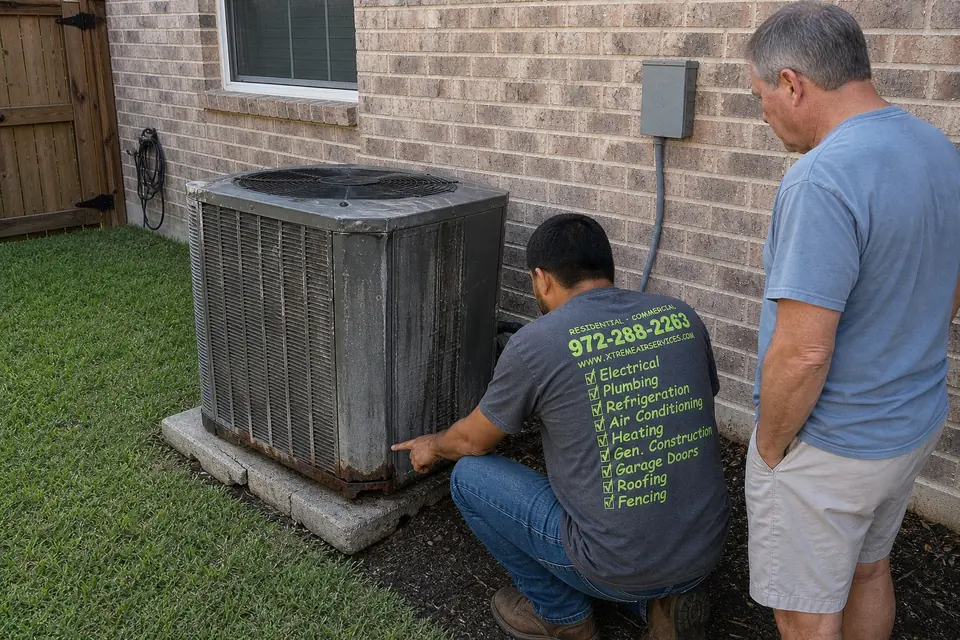
- You see rust, corrosion, or water damage. Corroded coils and rusted cabinets on the outdoor unit or attic air handler are signs of wear a repair won’t reverse.
North Texas summers make these signs show up faster. Long stretches of triple-digit heat mean your AC runs hard for months. In many Carrollton homes, the indoor unit sits in an attic that gets far hotter than the outside air. That heat wears down parts, wiring, and coils over time. A system that limps through May often gives out in July, right when you need it most.
Now for the honest part. If your system is fairly young and a capacitor, fan motor, or thermostat fails, fix it. Those are common, affordable repairs. Replacing a whole system over one of them doesn’t make sense. The same goes for a frozen coil caused by a dirty filter or a clogged drain line. Those are maintenance issues, not signs of a dying system.
A simple way to think about it: if the repair would get you several more good summers, repair it. If you’re paying to keep an old system limping along for one more season, it’s time to look at replacement.
You don’t have to make that call alone. We’ll give you upfront flat-rate pricing on the repair before any work starts. That way you can weigh it against replacement and choose what’s right for your home and your budget. No pressure, just the facts you need to decide.
When Repair Still Makes More Sense Than Replacement
A big repair bill doesn’t always mean it’s time for a new system. Here are the cases where keeping your current AC is the smarter call, even if it’s getting older.
You need cool air now, and you’d rather replace later. Say your AC quits in the middle of a July heat wave. A repair that gets your house cool this week can be the right move, even on a system you plan to retire. You get through the summer comfortably. Then you can shop for a new system in the fall or spring, when you aren’t sweating through the decision. A rushed choice made in a hot house isn’t always the best one.
You’re moving soon. If you plan to sell in the next year or so, a new system mostly benefits the next owner. A solid repair that keeps the house cool and the AC working through showings and inspection may be all you need.
The problem isn’t really the AC. Sometimes the unit is fine, and the trouble is somewhere else in the house:
- Leaky or crushed ducts. Many Carrollton homes run their ductwork through the attic. A torn or disconnected duct can dump cool air into the attic instead of your rooms. That calls for duct repair or sealing, not a new AC.
- One hot room. A back bedroom or upstairs room that never cools often points to airflow, ductwork, or zoning issues. A new outdoor unit won’t fix those.
- Thermostat in a bad spot. A thermostat in direct sun or near a hot kitchen can make the whole system run wrong.
The leak is found and fixed for good. The repeat recharges covered above are a warning sign. A single leak at an easy-to-reach fitting or valve is a different story. If a technician can find it, fix it, and the system holds its charge, a mid-age AC can keep going strong.
Your budget needs breathing room. If replacement would stretch you too thin right now, a sensible repair can buy you time to plan. That’s a fair choice. Just ask for an honest read on how much life the system has left, so you know roughly how long you’re buying.
Before you call anyone, check a few simple things yourself. A clogged air filter can choke airflow and make a healthy system seem weak. Swap it if it’s dirty. Make sure the thermostat is set to cool and the temperature is below the room temperature. Then check that the breaker for the AC hasn’t tripped. If one of these was the problem, you’ve just saved yourself a service call.
If you do have us out, our service-call fee is $26-$99, and it’s credited toward the repair if you proceed with Xtreme Air Services. Our job is to tell you what’s wrong and what makes sense for your home. Sometimes that answer is a repair.
What’s Included in an AC Replacement Quote
A good AC replacement quote should tell you exactly what you’re paying for before anyone picks up a tool. With us, you get upfront flat-rate pricing that you approve before work starts. There’s no meter running.
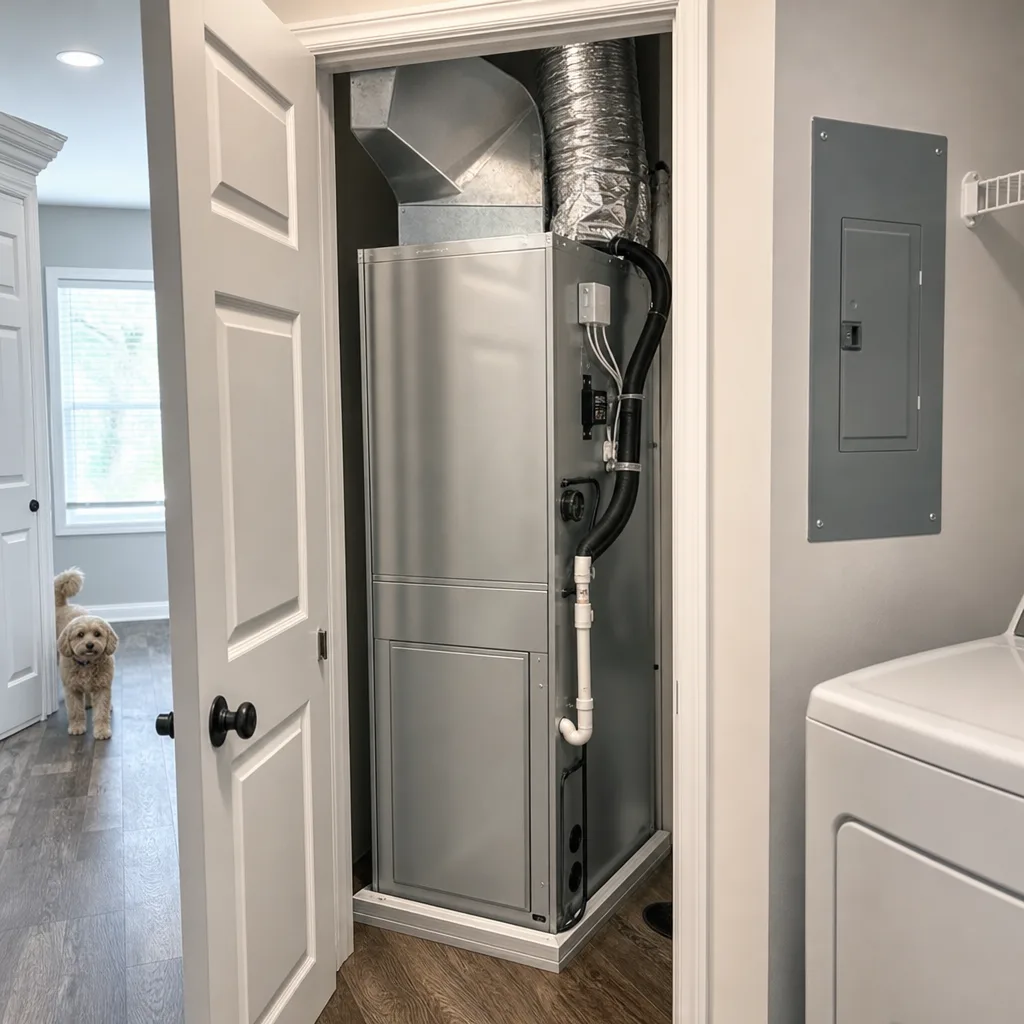
Here’s what our AC replacement price includes:
- The new equipment and materials
- Professional installation
- Standard connections to your existing setup
- Startup and testing, so you know the system is running right before we leave
- Haul-away of your old unit
Here’s what isn’t included unless your quote says so:
- Changes to your ductwork, electrical, or plumbing
- Code corrections
- Permits
We spell those out because they’re where surprise costs hide. If your home needs one of them, it should show up as its own line on the quote, not as a shock on the final bill.
Our typical price range for AC replacement is $5,000-$12,000. Our most common job is a standard like-for-like replacement that uses your existing connections with no major changes. That job runs $6,400-$9,200, and it covers the equipment, materials, professional installation, startup, and testing.
So why does one house land near the low end and another near the top? A few things drive the price:
- System size. This is measured in tons, which is how much heat the system can pull out of your house. A bigger home usually needs more tons.
- Efficiency. SEER2 is the efficiency rating on a new AC. A higher number means the system uses less power to cool the same space. Higher SEER2 systems cost more up front but can lower your summer bills.
- Brand and model. Different lines come with different features, like variable-speed systems that run longer at lower power for steadier temps and better humidity control.
- Ease of access. An indoor unit in a tight, hot attic takes more work to swap than one in a roomy closet or garage.
- The condition of what’s already there. Worn ductwork, old wiring, or plumbing that needs updating can add to the job.
- Code upgrades, permits, and any custom fabrication your setup requires.
Of all of these, system size, SEER2, and access move the price the most.
Sizing deserves its own question. A system that’s too big cools fast but shuts off before it pulls the moisture out, so the house feels cold and clammy. A system that’s too small runs nonstop through a Carrollton July and still can’t keep up. That’s why we offer cooling load calculations, which look at your home itself instead of just copying the size of the old unit.
As a Trane Comfort Specialist, we can walk you through Trane options at different efficiency levels and price points. If the total is more than you want to pay at once, flexible financing is available on qualifying installations and larger jobs, on approved credit.
Thinking about AC replacement? Let’s talk.
Call Today, Get Service Today. Xtreme Air Services — Carrollton is ready to help.
Why Carrollton AC Replacement Requires a Permit
Swapping out a central AC system generally needs a permit from the City of Carrollton, plus an inspection once the job is done. It’s not red tape for its own sake. A permit means someone who doesn’t work for your contractor checks that the new system was put in safely and to code.
That outside check protects you in ways you won’t see from the thermostat. Here’s what it covers:
- Electrical safety. A new outdoor unit needs the right size breaker, the right size wire, and a shutoff near the unit. If the wiring is too small for the new system, it can run hot inside your walls.
- Attic work. In many Carrollton homes, the indoor unit sits in the attic, right above your ceilings. An inspection looks at the condensate drain and overflow protection, so a clogged line doesn’t end up as a water stain over your living room. It also checks whether the unit can be reached safely for service.
- Gas appliances. If your system includes a gas furnace, the venting matters for your family’s safety. Proper venting carries exhaust out of the house instead of into it.
- Selling your home later. A buyer’s inspector may ask about HVAC work. Unpermitted work can slow down a sale or leave you paying for fixes at the worst possible time.
Carrollton’s older homes add one more wrinkle. Houses built decades ago went up under the rules of their day. When a new system goes in, current code applies to the new work. That’s when gaps tend to show up, like a missing outdoor shutoff, wiring that’s too small for today’s equipment, or no backup drain pan under an attic unit. Those fixes are the code corrections mentioned in the quote section. A permitted job brings them out into the open before the inspector signs off, not years later.
Who does the work matters too. In Texas, HVAC contractors are licensed through the Texas Department of Licensing and Regulation (TDLR). Our HVAC license number is TACLA29023C. You can look up any contractor’s license on TDLR’s website before you hire them.
Here’s the straight truth. If a contractor tells you a permit isn’t needed for a full system replacement, or offers a lower price to skip it, treat that as a red flag. The savings are small. If the work isn’t right, the risk lands on you and your home, not on them.
Not every AC job calls for a permit, though. Everyday repairs like replacing a capacitor, a fan motor, or a thermostat usually don’t. The permit question comes up when the whole system, or a major part of it, is being replaced.
Before you sign any replacement quote, ask three simple questions:
- Who’s pulling the permit, you or me?
- Is the permit cost on this quote, or will it be added later?
- When will the city inspection happen, and will someone be there for it?
A good contractor will answer all three without hesitating. If you get vague answers, keep asking until you get clear ones.
Watch Our Video
See How We Handle AC replacement in Carrollton
Xtreme Air Services — Carrollton
Choosing the Right Size System for Your Carrollton Home
The right size AC is the one that fits your house as it is today, not the one that fit it 15 years ago. You find that size by measuring how much heat your home takes on during a hot Carrollton afternoon. The size of the old unit and a quick look at your square footage don’t tell you that.

You’ve already seen what goes wrong when the size is off. A unit that’s too big leaves the house cold and clammy, and one that’s too small runs all day and still falls behind. The real question is how to get it right.
A lot of people assume the new system should match the old one. That feels safe, but it often isn’t. Here’s why:
- Your house may have changed. New windows, added attic insulation, a room addition, or a garage turned into living space all change how much cooling you need.
- The first installer may have guessed. Plenty of systems went in sized by a quick rule of thumb, and some of them were never right to begin with.
- A bigger unit got added “just to be safe.” Going up a size feels like insurance. It usually leads to short runs and sticky air.
A cooling load calculation looks at the things that really decide how hot your house gets. That includes your square footage and ceiling height, how much insulation is in the attic and walls, and how many windows you have and which way they face. It also counts how leaky the house is and how many people live there. A big wall of west-facing glass that takes the full afternoon sun needs more cooling than the same room on the north side.
Carrollton homes add a few details of their own. Many have ductwork and an indoor unit up in an attic that bakes all summer, so ducts lose some cooling before the air reaches your rooms. An older ranch home with tired insulation and single-pane windows can need a very different system than a newer two-story home of the same size. Two houses on the same street can land on different sizes.
Getting the size right also means looking past the outdoor unit:
- The indoor coil has to match the outdoor unit. A mismatched pair won’t cool or run as efficiently as it should.
- Your ducts have to handle the airflow. Putting a larger system on ducts that are too small can cause noise, weak airflow at the vents, and extra strain on the blower.
- Humidity matters as much as temperature. If your home tends to feel muggy, a variable-speed system can run longer at a lower speed and pull more moisture out of the air.
Before you approve any replacement, ask how the size was chosen. If the answer is “it’s what you had” or “about one ton per so many square feet,” ask for a load calculation instead. It’s a fair request, and it’s the best way to know your new system will keep your home comfortable for years.
Frequently Asked Questions
Common questions about AC replacement
What is the $5,000 rule people talk about for AC replacement?
It’s a rule of thumb that says if the repair cost multiplied by the age of your system is more than $5,000, replacement is the smarter move. For example, a $700 repair on a 10-year-old unit gives you 7,000, which points toward a new system. It’s a quick gut check, not a hard rule, since the condition of your ductwork and how often you’ve called for repairs matter too.
How long does an AC replacement take once I schedule it?
Most standard AC replacements are finished in a single day, from removing the old unit to testing the new one. Jobs take longer when your home needs duct repairs, electrical upgrades, or code corrections uncovered during the install. Attic access in Carrollton homes can also add time, since indoor units up there are harder to reach than ones in a closet or garage.
Can I stay in my house while the AC replacement happens?
Yes, you can stay home during a standard AC replacement. The outdoor unit swap happens outside, and the indoor work is usually limited to a closet, garage, or attic access point. The house will be without cooling for part of the day, so plan around the Texas heat if the job falls during a hot stretch.
Ready to Get Started?
Call (469) 269-6099 Today, Get Service Today.