


Refrigerant Recharge / Leak Repair in Irving: Fix the Leak, Not Just the Symptom
The leak found and repaired before any refrigerant goes in – because a recharge alone won't keep your home cool.
What’s Covered on This Page
- Warm Air and Rising Bills Usually Mean a Refrigerant Leak, Not Normal Wear
- Recharging Without Finding the Leak Is a Temporary Fix
- What Happens During a Recharge and Leak Repair Visit
- Why Only a Certified Technician Should Handle Refrigerant
- What Drives the Cost of a Refrigerant Recharge or Leak Repair
- Is it worth it to fix a leaky AC instead of just letting it run low?
- Can I just keep adding refrigerant every summer instead of fixing the leak?
- Why does my AC need a specific amount of refrigerant instead of just filling it up?
Warm Air and Rising Bills Usually Mean a Refrigerant Leak, Not Normal Wear
Refrigerant is what carries heat out of your home. It travels through closed copper lines between the coil inside your house and the unit outside, over and over. It isn’t used up, and normal aging doesn’t make it disappear. So if someone tells you your system “just needs a little topped off every summer,” what they’re really saying is that it leaks every summer.
That’s why refrigerant recharge / leak repair has to go together. If you add refrigerant without finding where it went, you pay for refrigerant that slowly leaks out again. In the meantime, your system works harder than it should.
Here’s what a low charge usually looks like from where you’re standing:
- Air from the vents feels cool but not cold, and it gets worse in the late afternoon heat.
- The system runs and runs, rarely shuts off, and the house never quite reaches your thermostat setting.
- Frost or ice builds up on the larger copper line at the outdoor unit or on the indoor coil.
- You find water around the indoor unit or an overflowing drain pan after that ice melts.
- You hear a hissing or bubbling sound near the indoor coil or the refrigerant lines.
- Your electric bill keeps climbing even though your habits haven’t changed.
The ice surprises a lot of people. How can a system that isn’t cooling be covered in frost? When the charge is low, pressure inside the indoor coil drops and the coil gets colder than it’s built to run. Moisture in your air freezes right onto it. That ice blocks airflow, so you get even less cooling. A frozen coil is often a symptom of a leak, not the real problem.
The higher bill comes from the same cause. A system that’s short on refrigerant can’t move as much heat each hour, so it runs longer to do the same job. In a North Texas summer, when your AC may already run most of the day, those extra hours add up fast. The compressor, which is the heart of the outdoor unit, also works under extra strain the whole time.
Not every warm-air problem is refrigerant. A clogged air filter, a dirty outdoor coil, a failed capacitor, or a thermostat problem can feel almost the same from inside the house. That’s why a good technician confirms the charge with gauges and temperature readings before adding anything. If a company offers to add refrigerant without checking where it went, it’s fair to ask why.
The good news is that a leak is usually something you can fix. Finding it early, before the coil freezes again or the compressor takes more strain, keeps a repair from turning into a bigger one.
Recharging Without Finding the Leak Is a Temporary Fix
Adding refrigerant without fixing the leak gets you cold air for a while. How long depends on the size of the hole. A slow leak might hold through one summer. A bigger one can send you back to warm air in a few days. Either way, the leak is still there, and you’ll pay for the same refrigerant again.
Each time the charge runs low, your system goes through the same rough patch. The coil can ice up, run times stretch out, and the compressor works under strain. In Irving’s long summers, that strain can go on for weeks before you notice the house isn’t keeping up. A worn-out compressor is a much bigger repair than a leak, and that’s the real cost of putting off the fix. If your compressor has already failed, AC compressor replacement is a separate job with its own page.
Most leaks show up in a handful of common spots:
- The indoor evaporator coil, where tiny pinholes can form in the thin copper or aluminum tubing over time
- Service valves and valve cores on the outdoor unit, the small ports a technician hooks gauges to
- Flare fittings and joints, especially on ductless mini-splits
- Copper lines that rub against a wall, a bracket, or the unit cabinet until the metal wears through
- Lines that get stressed when an outdoor unit’s pad settles or shifts on North Texas clay soil
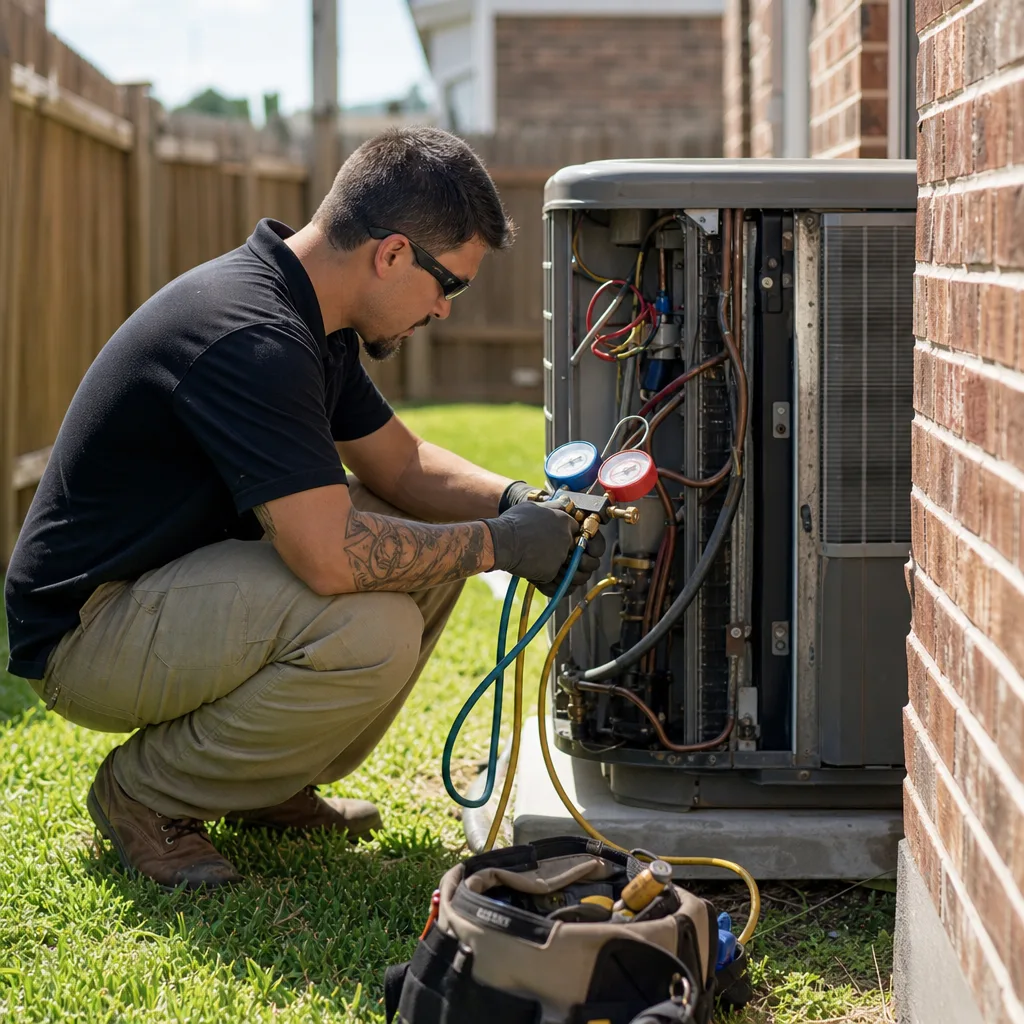
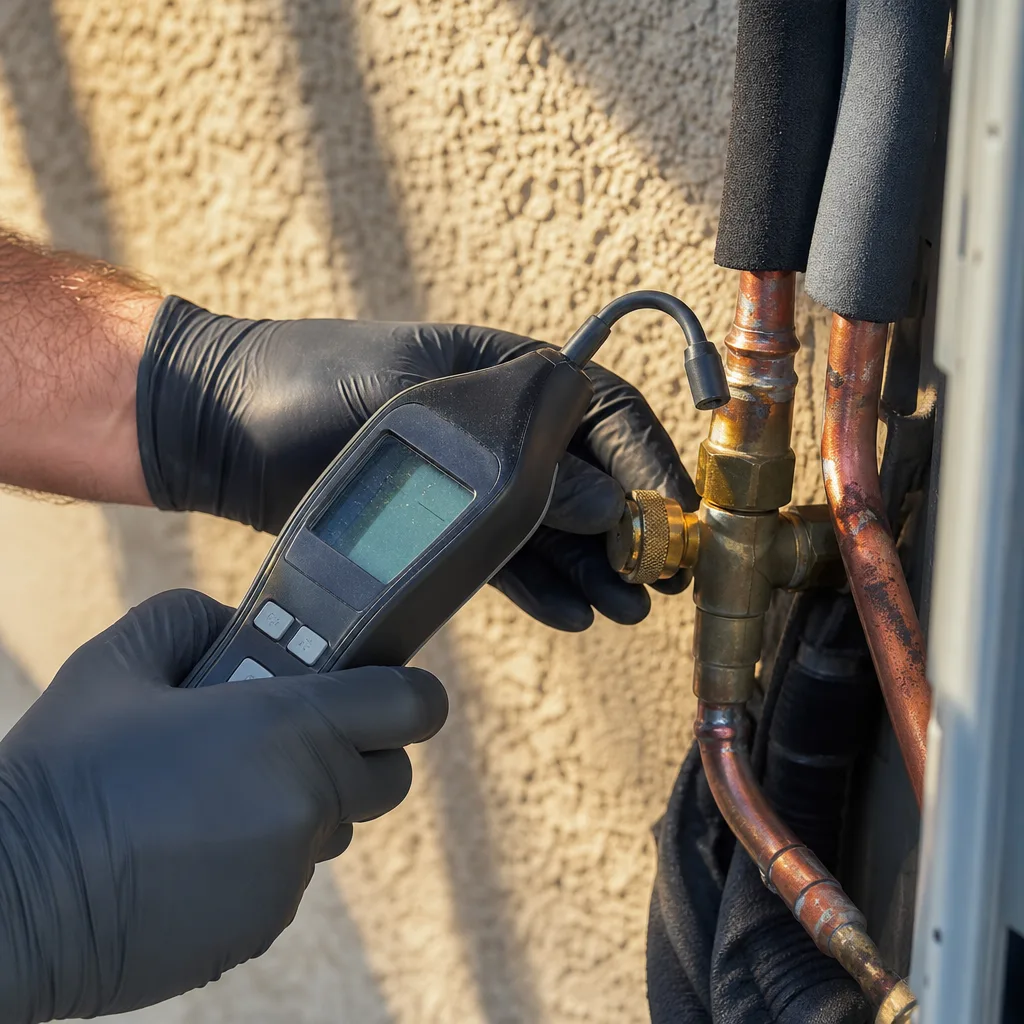
Finding the leak takes more than a glance. Technicians use electronic leak detectors, bubble solution on fittings, UV dye, or a pressure test with nitrogen to track it down. Once it’s found, the fix might be as simple as a new valve core or as big as brazing a joint or replacing a coil.
The recharge after the repair matters too. A proper job pulls the system into a deep vacuum to clear out air and moisture. Then the right amount of refrigerant is added by weight, based on what the manufacturer calls for. The technician checks pressures and temperatures afterward to make sure the system is running the way it’s built to run. Too little or too much refrigerant both hurt cooling and wear on the system.
Refrigerant itself isn’t getting easier to buy. R-410A, used in most systems installed over the last couple of decades, is being phased down, and newer equipment is moving to A2L refrigerants. Older systems that use R-22 rely on a refrigerant that’s no longer made. So every pound that leaks out of your home is a pound that costs more to replace than it used to.
Whoever works on your AC, it’s fair to ask three things before you pay:
- Where was the leak, and can you show me?
- How was it repaired?
- How much refrigerant went in, and how did you measure it?
A technician who found and fixed the problem can answer all three in plain words.
What Happens During a Recharge and Leak Repair Visit
A refrigerant visit follows a simple path. We find the part that failed, repair or replace it, and make sure your system runs the way it should before we leave. Most calls turn out to be one common failure that gets fixed on the first visit.
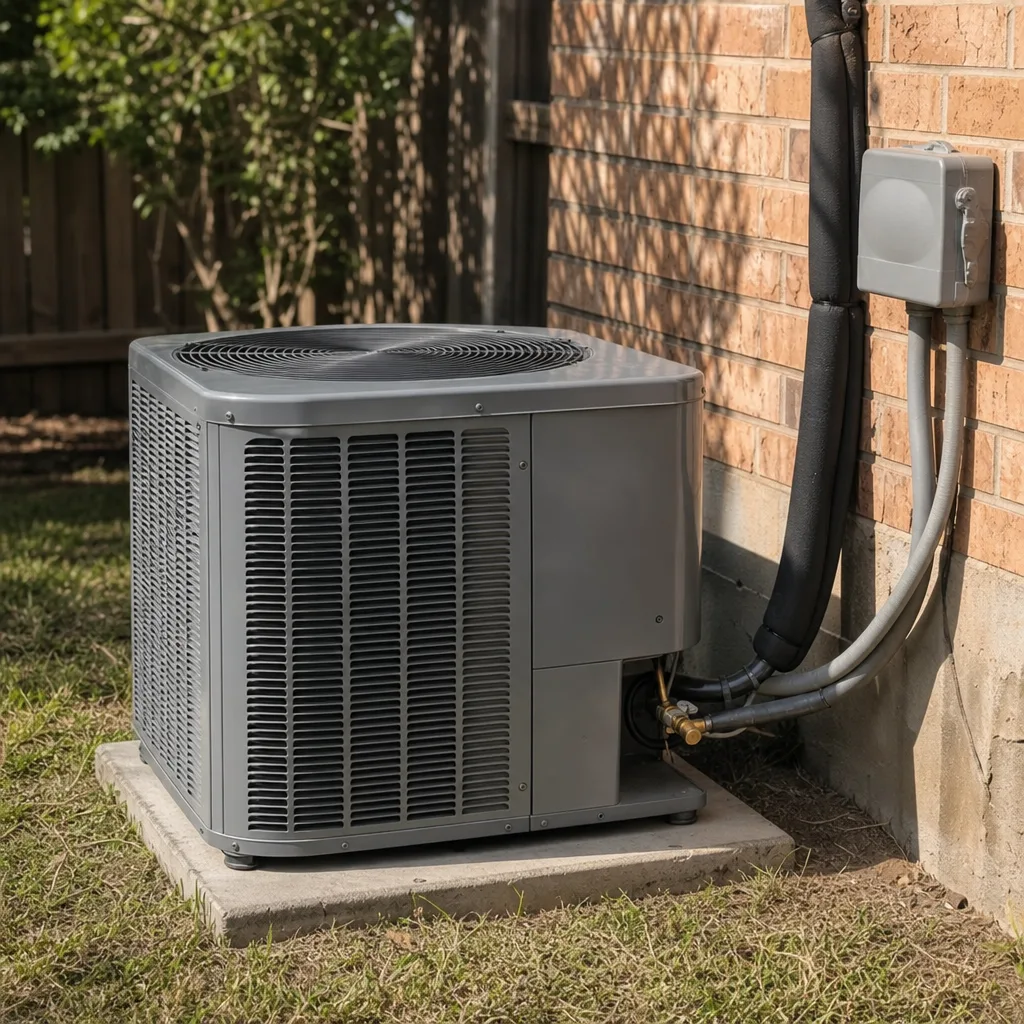
You don’t need to do much to get ready. A few small things help your technician get to the answer faster:
- Clear a path to the outdoor unit and to the indoor unit, whether it’s in a closet, the garage, or up in the attic.
- Think back to when the cooling started to slip and whether it got worse in the afternoon heat.
- Mention any ice you spotted on the lines, water around the indoor unit, or a hissing sound.
- Let us know if anyone has added refrigerant before and roughly when. A system that’s been topped off before is a strong hint the leak never got fixed.
Your technician starts by confirming the problem really is refrigerant and not one of the look-alikes, like a failed capacitor or a dirty coil. Then they track down the leak. Once they know what failed and what it takes to fix it, you get the price before any work starts. That’s upfront flat-rate pricing, so there’s no meter running while you wait. You decide whether to go ahead.
Here’s how the numbers work for this job at Xtreme Air Services:
- Service-call fee: $26-$99. It’s credited toward the repair if you go ahead with us.
- Most common refrigerant recharge and leak repair: $250-$800.
- Typical range across all refrigerant jobs: $250-$1,500.
- Included: diagnosis, labor, the standard replacement part, testing, and cleanup.
- Not included unless quoted separately: additional failed parts, major components, code upgrades, or permits.
Several things move the price up or down. These include how big the failure is, what the part costs and whether it’s easy to get, how old your equipment is and what brand it is, and whether more than one part has failed. The type of refrigerant matters too, whether your system runs on R-410A or one of the newer A2L refrigerants, because the leak repair and the new charge are priced together. Timing doesn’t change the price, though. There’s no extra charge for nights or weekends, so a July evening breakdown costs the same as a Tuesday morning one.
Financing usually isn’t needed for a job this size. If the visit shows a bigger problem, like a coil or compressor that needs replacing, financing is available on those larger repairs and replacements.
After the repair, your system gets recharged and tested the way the earlier sections describe. Your technician can show you where the leak was and what they did about it. The person in your home is a licensed, background-checked technician from a Trane Comfort Specialist contractor that serves Irving. You’re never left guessing what you paid for.
Call 469-200-2166
Ready when you are – get in touch today.
Call Today, Get Service Today. Xtreme Air Services — Irving is ready to help.
Why Only a Certified Technician Should Handle Refrigerant
Refrigerant isn’t a do-it-yourself job, and that’s not a sales line. Federal rules require anyone who opens a home AC system and handles its refrigerant to hold an EPA certification. It’s also against the law to let refrigerant vent into the air on purpose. Those rules exist because the work is risky for you and for the system.
Here’s what makes it risky:
- The lines run under high pressure. A loose hose or a cracked fitting can spray liquid refrigerant that’s cold enough to burn skin and eyes.
- Many newer systems use A2L refrigerants, which can catch fire under the wrong conditions. They need tools and handling built for that.
- In a lot of Irving homes, the indoor coil sits up in the attic. Working on pressurized lines in summer attic heat, balanced on joists, is a bad place to learn.
You’ve probably seen AC recharge kits on a store shelf. Most are made for cars, not home systems. The ones sold for home units often contain a leak sealant. Sealant can plug a tiny pinhole for a while. It can also gum up the small metering parts inside your system, and it can make a later repair harder. And a can won’t tell you where the leak is, which is the whole problem we covered earlier.
There’s also no way to charge a system correctly by guessing. Adding the right amount takes gauges, a scale, and temperature readings. Without them, you can easily overcharge the system. That’s just as hard on your compressor as running low.
That doesn’t mean you can’t do anything. Before you call anyone, it’s worth trying these:
- Put in a fresh air filter if yours looks dirty.
- Make sure your thermostat is set to cool and the setting is below room temperature.
- Check that the breaker for the outdoor unit hasn’t tripped.
- Look at the outdoor unit for leaves, grass, or cottonwood fuzz packed against the fins.
If one of those fixes it, great. You just saved yourself a service call. If you still see ice on the lines or the air still isn’t cold, leave the refrigerant side alone. If the coil has iced over, turning the system off and letting it thaw is safer than running it harder.
When you do call someone, you have every right to check who’s coming. Ask whether the technician is EPA certified to handle refrigerant. Ask for the company’s Texas HVAC license number. A qualified contractor will give you both without hesitating.
Xtreme Air Services is a licensed and insured HVAC contractor under Texas HVAC License #TACLA29023C, and the technician who comes to your home is background-checked. We’re happy to answer those questions on the phone before anyone shows up.
Call 469-200-2166
Watch Our Video
See How We Handle Refrigerant recharge / leak repair in Irving
Xtreme Air Services — Irving
What Drives the Cost of a Refrigerant Recharge or Leak Repair
The price ranges listed above are wide on purpose. Two homes can both have a refrigerant leak and need very different repairs. Where your job lands mostly depends on what failed and where it is. Here’s how each piece moves the number, so a quote makes sense when you hear it.
- Where the leak is. A leaking valve core or a loose flare fitting on the outdoor unit is small, easy to reach, and quick to fix. A pinhole in the indoor coil is a bigger job. If that coil sits in a hot Irving attic, the work takes longer. A coil that has to be replaced counts as a major part and gets its own quote.
- How much refrigerant got out. Refrigerant goes back in by weight. A system that’s nearly empty needs a lot more than one that’s only a little low.
- Which refrigerant your system uses. R-410A and the newer A2L refrigerants are priced differently. Older R-22 systems use a refrigerant that’s no longer made, so recharging them costs more.
- How old your equipment is and what brand it is. Parts for older or less common units can be harder to find and cost more. Sometimes they also take longer to get.
- Whether something else failed too. Running low on refrigerant puts strain on the whole system. Sometimes a capacitor or fan motor gives out along the way. Each extra failed part is priced on its own.
Sometimes the honest answer is that another repair isn’t the best use of your money. Replacement may be worth a look if your system is older, runs on R-22, or has had a coil leak fixed before. That doesn’t mean you have to replace it. It means you should see both choices side by side before you decide.
A good technician will lay out the repair price next to what replacement would involve. Then you can choose based on real numbers, not pressure. If a replacement makes more sense, AC replacement has its own page with the details.
Some companies quote a leak repair and then add a separate per-pound charge for refrigerant once the job is done. That’s how a fair-sounding price turns into a surprise bill. With upfront flat-rate pricing, you know the total before the work starts. Whoever you call, ask these questions before you say yes:
- Does this price cover both the leak repair and the recharge?
- Which part are you replacing, and is it included?
- If you find another failed part, will you stop and ask me before going further?
Clear answers to those three questions tell you the quote is complete. If the answers are vague, you’ll likely see more charges later.
Call now
Frequently Asked Questions
Common questions about Refrigerant recharge / leak repair
Is it worth it to fix a leaky AC instead of just letting it run low?
Yes, fixing the leak is almost always worth it. A system low on refrigerant runs longer to cool your home, which strains the compressor and raises your electric bill every month the leak goes unfixed. Letting it slide usually leads to a bigger repair, like a worn-out compressor, instead of a smaller one now.
Can I just keep adding refrigerant every summer instead of fixing the leak?
You can, but it costs you more over time and puts your system at risk. Needing a top-off every summer means the leak never got fixed, so you’re paying for refrigerant that slowly escapes again. Each low-charge period also stresses the compressor, which is the most expensive part to replace.
Why does my AC need a specific amount of refrigerant instead of just filling it up?
Your system is built to run on an exact amount of refrigerant, measured by weight, not by topping it off until it feels cold. Too little refrigerant makes the coil ice over and the system run longer. Too much puts the same kind of strain on the compressor. That’s why a proper recharge uses gauges and a scale instead of guesswork.
Ready to Get Started?
Call (469) 200-2166 Today, Get Service Today.