


Reverse Osmosis System Installation in Irving
Find out if reverse osmosis fits your water problem before you buy – then a licensed installation.
What’s Covered on This Page
- What’s Included in a Standard Under-Sink RO Installation
- Reverse Osmosis vs. Water Softening: Which One You Need
- Signs You Could Benefit from an RO System
- When an Under-Sink RO Install Isn’t the Right Fit
- What Happens During Installation
- How long do I need to run water after changing the RO filters?
- Will a reverse osmosis system fix the taste of Irving tap water?
- Can I install a reverse osmosis system myself?
What’s Included in a Standard Under-Sink RO Installation
When you book an RO install, you want to know what you’re getting and what the final number will look like. Here’s what comes with a standard under-sink job.
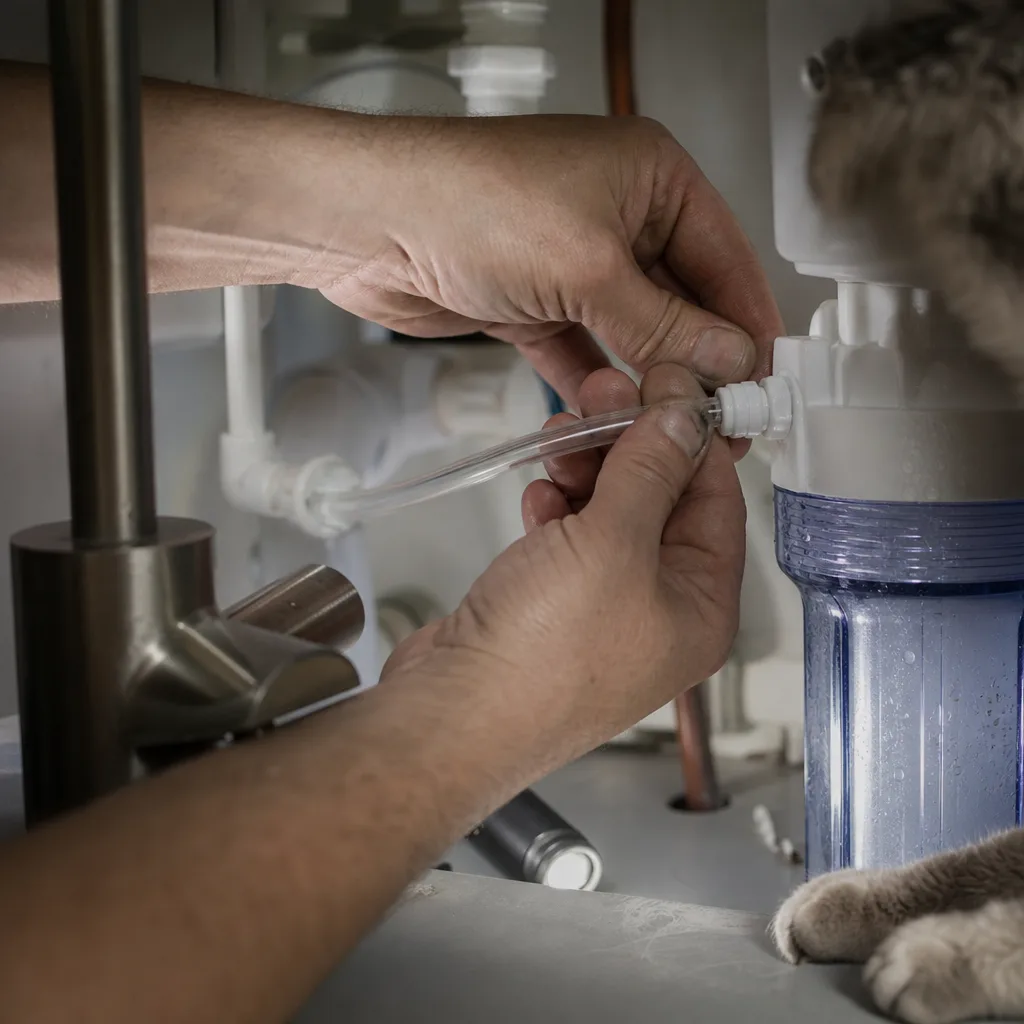
- The RO system and materials. This is the filter unit that sits under your sink. It includes the membrane, which is the part that does the real filtering.
- Professional installation. A licensed and insured technician sets up the system in your cabinet. You don’t have to figure it out from a manual.
- The faucet. RO water comes out of its own small faucet at the sink, so you can tell your filtered water apart from regular tap water.
- Connections. This means the cold-water supply that feeds the system and the drain connection. The drain line carries away the water the membrane rejects.
- Startup and testing. The system gets turned on and checked for proper output before the job is called done.
That last step matters more than people think. A new RO system that drips under the cabinet, or barely puts out water, isn’t really finished. Testing is how you know your system works the day it goes in, not a week later when you find a damp cabinet floor.
Some homes need more than a standard job. These items aren’t part of the standard price:
- A dedicated line, if the run is extensive
- Cabinet modifications
- Code corrections
- Permits, unless stated
You might not need any of these. They come up when the setup under your sink isn’t ready for the system. For example, there may be no good spot to tie into the drain, the cabinet may have no room for the unit, or the existing plumbing may have problems that should be fixed first. If your home needs any of this, we’ll explain why and give you the price before we touch anything. No meter running, no surprises.
On price, our typical range for RO work is $300-$1,200. The most common job is a standard under-sink system with faucet, membrane, and drain connection, tested for proper output, and it runs $475-$850. Where your job lands depends on the number of system stages and the capacity, the faucet and tank type, the condition of your existing plumbing, how easy it is to reach the drain and supply lines, and whether you add remineralization. Remineralization puts some minerals back into the water after filtering, and some people like how it tastes.
There’s a $26-$99 service-call fee. It’s credited toward the job if you go ahead with Xtreme Air Services. Financing usually isn’t offered for a smaller job like this one. It’s available on larger repairs and replacements.
Reverse Osmosis vs. Water Softening: Which One You Need
These two systems get mixed up all the time, and it’s easy to see why. Both treat your water, and both go in under or around your plumbing. But they fix different problems. If you buy the wrong one, you’ll still have the thing that bugged you in the first place.
Here’s the short version. A water softener protects your house. A reverse osmosis system improves the water you drink.
A water softener treats every drop that comes into your home. It pulls out the hardness minerals, mostly calcium and magnesium, before the water reaches your pipes, water heater, and fixtures. Hard water is a common North Texas problem. It’s what leaves white crust on faucets, cloudy spots on shower glass, and scale that builds up inside your water heater over time.
An RO system works at one spot, usually your kitchen sink. It pushes water through a very fine membrane that catches a wide range of dissolved stuff, not just hardness. That’s what gives you clean-tasting water for drinking, coffee, ice, and cooking. It doesn’t do anything for the rest of your house.
So start with what you’re noticing:
- Spots on dishes and glass, crusty faucet heads, or a water heater that’s losing ground to scale: you need a softener. An RO system won’t fix any of that.
- Tap water that tastes or smells off, or you’re tired of hauling cases of bottled water home: you need RO.
- Both of the above: you’ll likely want both, and they work well together.
Let’s be straight about the first case. If your only complaint is scale and spots, don’t let anyone sell you an RO system for it. You’d spend money and still be scrubbing the shower door every week. Our team handles water softener installation too, so we’ve got no reason to steer you toward the wrong fix.
There’s another case where RO alone makes sense. Maybe you’re renting, or you don’t want to change your whole plumbing setup. If what you really want is better drinking water at the kitchen sink, an under-sink RO system gets you there without touching the rest of the house.
When you have both, the softener does a favor for the RO system. Hardness minerals are rough on an RO membrane. Softened water going into it means less scale buildup on that membrane. And if you’ve ever wondered about the small amount of sodium a softener adds, RO takes most of it back out of your drinking water at the tap.
If you want filtered water at every tap instead of just one, whole-home water filtration is a separate option, and it has its own page. For most families who just want great drinking water in the kitchen, an under-sink RO system is the right size for the job.
Signs You Could Benefit from an RO System
Most people don’t wake up wanting a reverse osmosis system. They notice small things about their water that wear on them over time. If a few of these sound like your kitchen, an under-sink RO system is probably worth a closer look.
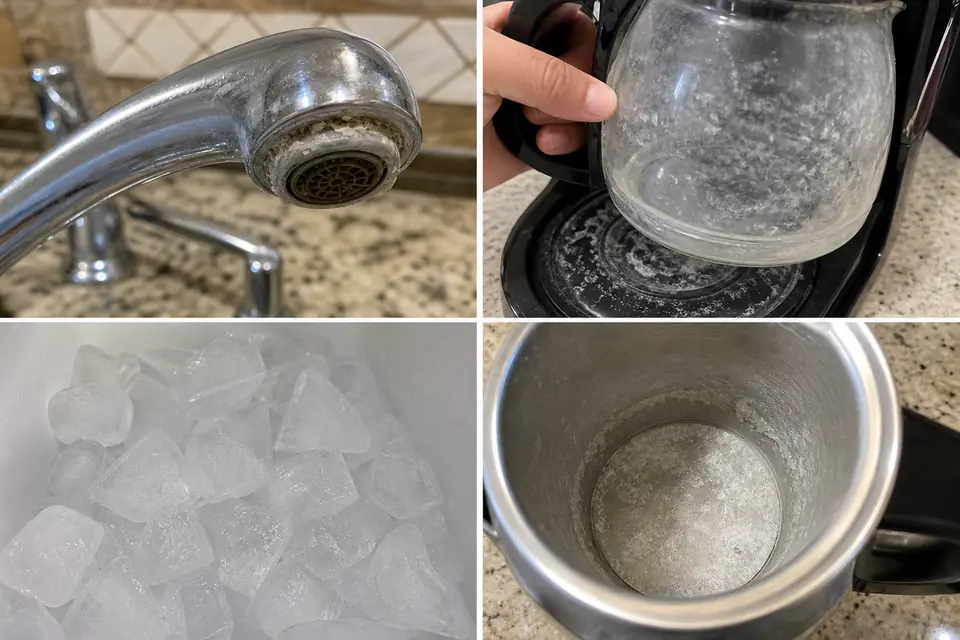
- You buy bottled water every week. If you’re hauling cases in from the store, or your recycling bin fills up with plastic, you’re already paying for filtered water. You’re just paying for it one bottle at a time.
- Your tap water tastes like a swimming pool. City water is treated with disinfectant to keep it safe. That’s a good thing, but some people can taste it and don’t like it.
- Your coffee or tea tastes flat or bitter. Water makes up almost all of your cup. When the water tastes off, so does everything you brew with it.
- Your ice cubes look cloudy or taste stale. Ice picks up whatever is in the water that made it. If your fridge has an ice maker, RO water can feed it too, depending on your setup.
- You’re always swapping pitcher or faucet filters. Those small filters help, but they fill up fast. If you’re tired of the refill routine, RO does more filtering with less fuss.
- You cook with a lot of water. Pasta, rice, soups, and beans all soak up the taste of your tap water.
Here’s a quick picture. You fill a glass at the sink, take a sip, and pour the rest out. Then you reach for a bottle from the fridge instead. If that’s a habit in your house, that’s the clearest sign there is. You don’t trust your tap water enough to drink it, and RO is built to fix exactly that.
Some water problems look like they need RO, but they don’t. An RO system won’t help with these, and it’s better you hear that now:
- A rotten-egg smell that only shows up in your hot water. That usually points to your water heater, not your water supply.
- Brown or rusty water from one tap, or after the water’s been shut off. That’s often old pipes or stirred-up sediment, and it should be looked at directly.
- Low water pressure all over the house. RO filters drinking water at one spot. It can’t fix pressure, and a pressure problem should be sorted out first.
- A sudden change in color, smell, or taste you’ve never noticed before. Don’t cover that up with a filter. Find out what changed.
There’s one more honest answer. If you like how your tap water tastes and you drink it happily, you may not need RO at all. Keep doing what you’re doing.
If you’re stuck in the middle and can’t tell whether your water is just a little off or there’s a real problem, start with the water testing we mentioned above. A test tells you what’s in your water, so you’re not guessing. Then you can decide on RO based on facts, not a sales pitch.
If what you want is clean, good-tasting water for drinking and cooking, and you’re tired of buying it by the case, an under-sink RO system is usually the right fit.
Need help with Reverse osmosis system installation?
Call Today, Get Service Today. Xtreme Air Services — Irving is ready to help.
When an Under-Sink RO Install Isn’t the Right Fit
An under-sink RO system is a great fit for a lot of kitchens. It isn’t a fit for every one. Here are the cases where we’d tell a neighbor to hold off or pick something else.
You won’t keep up with filter changes. An RO system has pre-filters and a membrane that wear out over time. If they don’t get changed, the water slows to a trickle and the filtering gets worse. That can leave you with water that’s no better than your tap. If you know you won’t think about it again after install day, a simple pitcher may serve you better. That’s honest, even if it’s less exciting.
Sending some water down the drain bothers you. RO works by flushing away the stuff the membrane catches. That means part of the water that goes in leaves through the drain line instead of reaching your glass. For most families it’s a small amount, since you’re only filtering drinking and cooking water. But if any wasted water is a dealbreaker for you, RO probably isn’t your system.
You rent and don’t have the okay. An RO install ties into your cold-water supply and your drain, and it may need a hole for the faucet. Get your landlord’s permission first. If you can’t, a countertop or pitcher filter you can take with you is the safer move.
Your cabinet or counter makes it a bigger job than you planned. Some sink cabinets are packed with a garbage disposal, pipes, and storage, with no room left for a tank. Some stone counters have no spare hole for the RO faucet. A refrigerator ice maker might sit far from the sink. None of these stop an install, but they can add work that falls outside a standard job, like cabinet changes or a long dedicated line. If that extra cost doesn’t make sense for you, it’s fine to wait until a kitchen remodel.
You’re on a private well with an unknown water quality. RO is built to polish water that’s already safe, like city water. Well water can carry bacteria, iron, or sediment that should be handled first. Test it before you add anything. Depending on what turns up, well water treatment, iron filtration, or UV water purification may need to come before an RO system, or replace it.
You want treated water everywhere, not just at one sink. If your goal is better water in the shower, the laundry, and every faucet, an under-sink system will leave you disappointed. That’s a whole-home job.
None of these mean RO is a bad product. It means it’s a tool for one job: great drinking and cooking water at one tap. If that’s not the job you need done, you shouldn’t pay for it, and we’d rather you hear that from us now than find out later with a system you don’t use.
Watch Our Video
See How We Handle Reverse osmosis system installation in Irving
Xtreme Air Services — Irving
What Happens During Installation
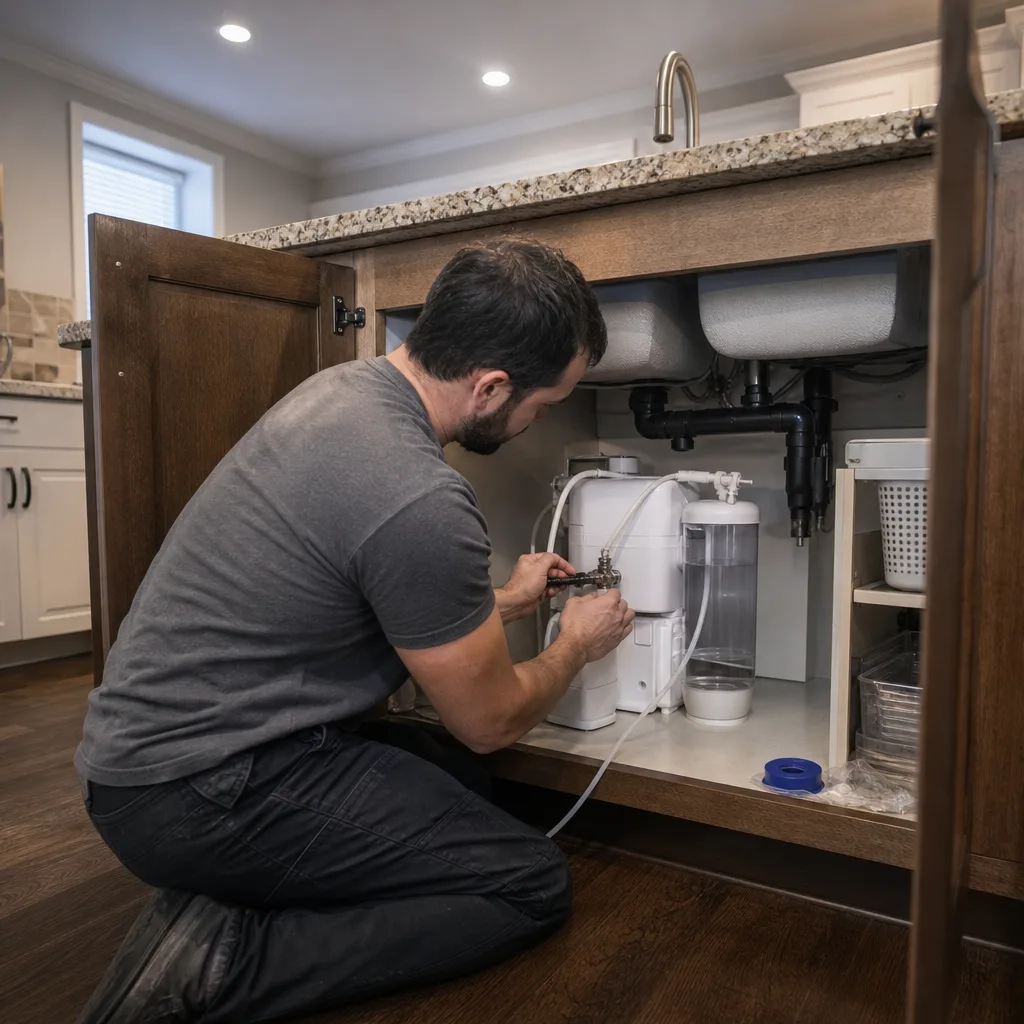
An under-sink RO install is a lot less of a project than most people expect. Nobody’s tearing up your kitchen. The work happens inside the sink cabinet and at one spot on the counter. Most jobs finish the same day, so you can usually pour your first glass of filtered water that evening.

Here’s what a typical under-sink install involves, start to finish.
- Checking the space. The cabinet gets a look first to see where the filter unit and storage tank will fit, where the cold-water line is, and where the drain can be tapped. This is the point where anything outside a standard job shows up, before any work starts.
- Shutting off the cold water. The cold supply under the sink is turned off so the system can be tied in without a mess.
- Tapping the cold-water line. A small valve or adapter goes on the cold line to feed the RO system. Your regular faucet still works the same way it always has.
- Mounting the filter unit. The filter housings get secured to the cabinet wall, up off the floor, so they’re easy to reach when it’s time to change filters.
- Setting the RO faucet. The faucet goes in an open hole in the sink or counter. If you have an unused sprayer or soap dispenser hole, that often works. If not, a new hole may be needed.
- Connecting the drain. A small fitting attaches to your sink’s drain pipe so the water the membrane rejects has somewhere to go.
- Placing the tank and running the tubing. The tank sits in the cabinet, and small tubes connect everything: supply, filters, membrane, tank, faucet, and drain. If you’re adding an ice maker connection, that line gets run too.
- Startup and testing. The water goes back on and the system fills. New filters usually need a flush, so the first tank or so often gets drained before you drink from it. Then every connection is checked for drips, and the faucet is checked for proper output.
That last step is the one that counts. A loose fitting under a sink can drip slowly for weeks before you notice a soft spot in the cabinet floor. Checking every joint with the water on, and making sure the faucet delivers, is how you know the job was done right the first time.
There are a few easy things you can do before install day to make it go smoother:
- Clear out the sink cabinet. Cleaning supplies, trash bags, and anything else stored under there should come out so the technician has room to work.
- Decide where you want the RO faucet. Most people put it near the back corner of the sink, close to where they fill glasses and pots.
- Know if you want the fridge connected. If you’d like RO water for your ice maker or fridge dispenser, say so when you call, since it means running a longer line.
- Plan to keep the kitchen sink free for a few hours. You won’t be able to use it while the water’s off and the system is going in.
That’s really it. You won’t need to take a day off for a remodel or live with a torn-up kitchen. You get a small faucet, a quiet system in your cabinet, and no more lugging cases of bottled water in from the car.
Call now
Frequently Asked Questions
Common questions about Reverse osmosis system installation
How long do I need to run water after changing the RO filters?
Flush the system for a few minutes before drinking from it after a filter change. New filters release a bit of carbon dust and air into the line, so the first tank of water should be drained rather than used. After that flush, the water runs clean and the system is back to normal.
Will a reverse osmosis system fix the taste of Irving tap water?
Yes, for most homes an under-sink RO system clears up chlorine taste and smell from city tap water. If your water tastes flat, like a swimming pool, or your ice cubes taste stale, RO filtering at the kitchen sink usually solves it. It won’t fix hardness spots on dishes or low pressure, since those come from different problems.
Can I install a reverse osmosis system myself?
You can, but most people call a licensed technician because the system ties into both your cold-water supply and your drain line. A professional install includes checking the cabinet space, tapping the right lines, and testing every connection for drips before the job is done. That testing step matters, since a loose fitting can leak quietly under the cabinet for weeks before anyone notices.
Ready to Get Started?
Call (469) 200-2166 Today, Get Service Today.