


Commercial HVAC Installation in Dallas: What a Real Quote Should Cover
New commercial systems scoped and sized for your building, with what's included and what costs extra laid out first.
What’s Covered on This Page
- Repair or Full Replacement: How to Tell Which One You Need
- What a Commercial Installation Quote Should Include
- Why Correct Sizing Matters More in Dallas Summers
- The Dallas Mechanical Permit Step
- What Happens During a Commercial Installation
- What is the $5,000 rule for commercial HVAC systems?
- How long does a commercial AC installation take once the old unit comes down?
- Does my building need a bigger electrical panel for a new commercial HVAC unit?
Repair or Full Replacement: How to Tell Which One You Need
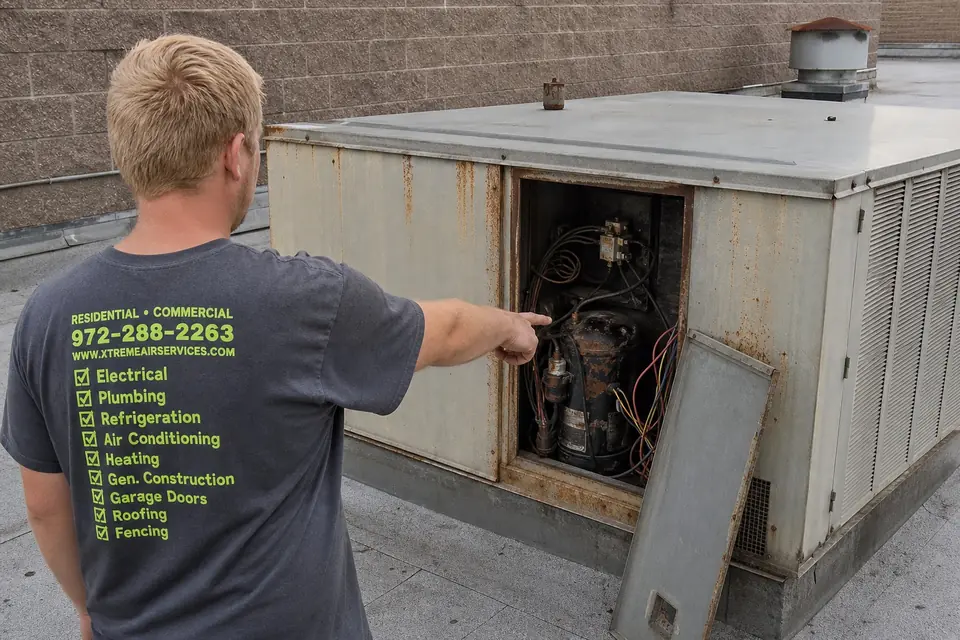
Not every struggling commercial unit needs to come off the roof. A lot of breakdowns come down to one worn part, like a capacitor, a fan motor, a contactor, or a refrigerant leak. Fix that part and the system can keep running for years. If that’s your situation, a new installation isn’t the right move, and we won’t tell you it is.
Repair is usually the right call when:
- The system was cooling fine until one specific failure, and nothing else is worn out.
- It hasn’t needed a string of service calls over the last year or two.
- The equipment is still sized right for your space, and you haven’t added people, kitchen equipment, servers, or square footage since it went in.
- The repair cost is small next to what new equipment would cost.
Replacement starts to make sense when the signs point the other way:
- You’re calling for service again and again, and each fix just buys a few weeks.
- The unit runs nonstop through a Dallas July and still can’t hold the thermostat setting, so tenants, staff, or customers notice.
- Your energy bills keep climbing while your usage hasn’t changed.
- The system uses an older refrigerant or parts that are getting hard to find. That makes every repair slower and more expensive.
- Your building’s use has changed, and the old equipment was never sized for what you do in there now.
Here’s a simple way to picture it. Say you run a restaurant and your rooftop unit’s compressor fails in August. If that unit has been reliable and fits your kitchen’s heat load, replacing the compressor might be the right fix. If the same unit has already had a fan motor, a coil, and two refrigerant leaks repaired in two summers, putting a compressor in it means paying for a big repair on equipment that’s already wearing out. That money often works harder as part of a new system.
Cost is part of the decision, so here are real numbers. Our most common commercial job is a standard like-for-like replacement using existing connections with no major modifications. It covers equipment, materials, professional installation, startup, and testing, and it typically runs $28,000-$64,000. Across all commercial installations, our typical range is $10,000-$100,000, depending on tonnage and scope. That’s why a repair quote should always be weighed against what replacement would cost for your building, not against a guess.
If you’re not sure which side you’re on, start with a diagnosis. Our service-call fee is $26-$99, and it’s credited toward the repair if you go ahead with Xtreme Air Services. You get a clear look at what failed and what it’ll take to fix it. You’ll also know whether the rest of the system is worth keeping, before you spend anything bigger.
What a Commercial Installation Quote Should Include
A good quote tells you exactly what you’re paying for, what you’re not, and why the number is what it is. If a bid is one line that says ‘install new rooftop unit’ and a total, you can’t compare it to anything. You also can’t tell what might get added once the crane shows up.
Here’s what should be written down before you approve anything:
- The equipment itself. That means the size in tons, the efficiency rating, and the brand and model. SEER2 measures cooling efficiency, and AFUE measures how much of your gas turns into heat. Higher numbers usually cost more up front and less every month after that.
- What’s included. With us, that’s equipment and materials, professional installation, standard connections, startup and testing, and hauling away the old unit.
- What’s excluded. Duct, electrical, and plumbing changes, code corrections, and permits aren’t part of a standard install unless the quote says they are. A fair quote names these so they don’t surprise you later.
- How the price was built. You should be able to see what pushed your number up or down.
That last point matters most when you’re comparing two bids that are far apart. Our pricing depends on equipment size and efficiency, brand and model, how easy the equipment is to reach, the condition of your existing ductwork, wiring, and plumbing, any code upgrades, permits, and any custom fabrication. A unit on a flat roof with clear access is a different job than one that needs a crane over a busy parking lot. The same goes for a curb adapter built because the new unit doesn’t match the old footprint.
Sizing deserves its own question. Ask how the contractor decided on the tonnage. If the answer is ‘same as the old one,’ think about whether your building still works the way it did when that unit went in. Added kitchen equipment, a server closet, or more people in the space all change how much cooling you need. A cooling load calculation looks at your actual space and how you use it, so you aren’t paying for too much unit or stuck with too little.
A few more questions are worth asking any contractor before you sign:
- Who pulls the permit, and is the permit cost in this number or separate?
- What happens to the price if you find problems with the ductwork or wiring once the old unit is out?
- How long will my building be without cooling, and can the work be scheduled around business hours?
- Is the contractor licensed and insured for this work? Ask for the license number.
We give upfront flat-rate pricing that you approve before work starts, so there’s no meter running while the crew is on your roof. Our HVAC license number is TACLA29023C, and you’re welcome to look it up. If a bigger install doesn’t fit this quarter’s budget, flexible financing is available on qualifying installations and larger jobs, on approved credit.
Why Correct Sizing Matters More in Dallas Summers
In Dallas, your commercial system isn’t tested on a nice spring morning. It’s tested at 4 p.m. in August, when the roof is baking, the sun has been on the building all day, and your space is full of people. Size decides whether the system holds up in that hour or falls behind. That’s why a new unit should be sized for how your building works today, not copied from the old unit’s label.
If the unit is too small, it runs nonstop and never catches up. The space slowly gets warmer through the afternoon. Your staff and customers feel it right when you’re busiest. The compressor never gets a break, so it wears out sooner, and your power bill climbs while the space still feels warm.
If the unit is too big, it seems like the safe choice, but it isn’t. An oversized unit cools the air fast and shuts off before it has time to pull moisture out. The thermostat says you’ve hit the set temperature, but the room feels damp and sticky. That’s a real problem during Dallas’s muggy stretches. All that starting and stopping is called short cycling. It’s hard on the compressor and electrical parts. You also paid more up front for capacity you can’t use.
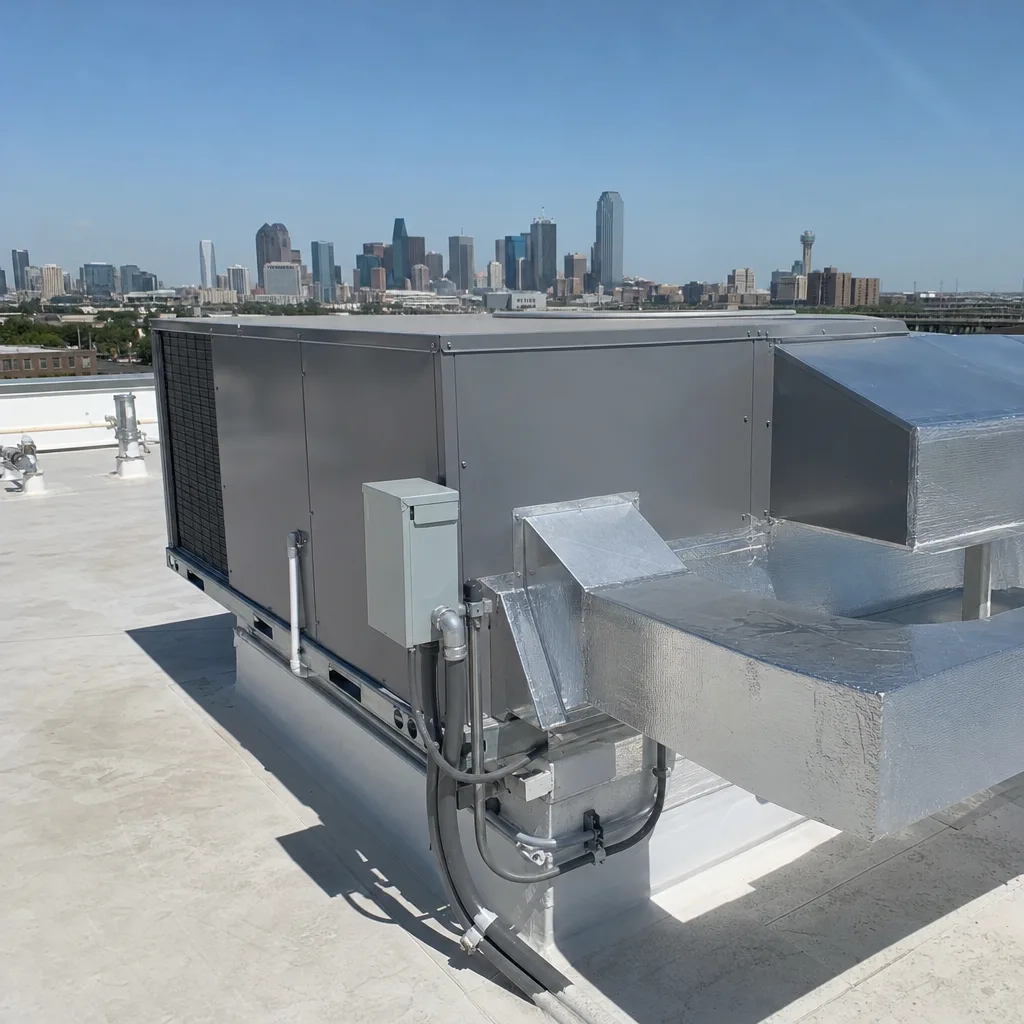
Most commercial units around Dallas sit on flat roofs in full sun, so they’re pulling in air that’s even hotter than the street. Ducts that run through hot ceiling spaces also lose some cooling before the air reaches your vents. A good sizing job accounts for both.
Here’s how it plays out. Say your strip-center suite used to be a quiet insurance office, and now it’s a busy salon with dryers running all day and a full waiting area. The old unit was the right size for the office. Put the same size back in, and you’ll be fighting the heat every summer afternoon.
Your current system may already be telling you its size is off. Watch for these signs:
- The space feels fine in the morning but drifts warm by late afternoon.
- The unit turns on and off every few minutes on hot days.
- The room hits the set temperature but still feels clammy.
- Rooms near windows or the back of the space never feel as cool as the rest of the building.
Efficiency only pays off when the size is right. A high-efficiency unit that’s the wrong size won’t save you what its rating promises, because it’s either overworking or short cycling. Variable-speed and multi-stage equipment can help. It runs at a lower speed on milder days and steps up when the heat peaks. Those longer, steadier run times do a better job of pulling humidity out of the air.
We offer cooling load calculations, so your new equipment is matched to your building as it runs today. As a Trane Comfort Specialist, we can walk you through which equipment sizes and options fit that number, in plain English, before you commit to anything.
Need help with Commercial HVAC installation?
Call Today, Get Service Today. Xtreme Air Services — North Dallas is ready to help.
The Dallas Mechanical Permit Step
Swapping a commercial unit in Dallas isn’t just a crane lift and a few connections. It’s permitted work, and an inspector looks it over after it’s in. That step protects you more than it slows you down, so it’s worth knowing how it fits into your project before anyone climbs onto your roof.
Here’s why it matters to you as the owner or tenant. An inspection is a second set of eyes on the parts of the job you can’t easily check yourself. That includes the electrical hookup and disconnect, the gas connection on a unit with gas heat, the condensate drain, and how the unit sits on its curb. If something’s off, you find out while the crew is still on the job, not when a breaker trips on the first 100-degree afternoon.
It also matters down the road. Landlords, buyers, lenders, and insurance adjusters can ask for permit records on major equipment. A unit that went in with a closed permit is one less question when you renew a lease, refinance, or sell the building.
Check where your property sits. A Dallas mailing address doesn’t always mean the City of Dallas handles the permit. Some properties with Dallas addresses are inside a neighboring city’s limits, and each city runs its own permit office with its own steps. Getting this right at the start keeps the job from stalling later.
Some installs need more than a mechanical permit. These situations can add a review or a second permit:
- The new unit is heavier than the old one, or it sits in a different spot on the roof.
- The new equipment needs a bigger circuit or a new disconnect, which turns part of the job into electrical work.
- Gas lines have to be moved or resized for a new heating section.
- The ductwork connection changes because the new unit doesn’t match the old footprint.
If your install needs electrical changes, our team also handles commercial electrical work, so you aren’t coordinating a second company around the same roof.
Now for cost. Permits aren’t part of our standard installation price unless your quote says they are. Your quote will spell out whether the permit is in the number or listed on its own, so you aren’t surprised by a separate line item after the unit is running. Code corrections work the same way. If the old setup doesn’t meet today’s rules, fixing it is separate from a standard like-for-like swap, and it should be named before you approve anything.
Plan your timing with the permit in mind. The permit and the final inspection add steps to the calendar, and you can’t always control how fast a city office moves. If your system is limping along in April, starting the replacement before the summer heat hits gives the paperwork room to clear. Then you aren’t stuck waiting on a permit while your space bakes in July.
If a contractor offers to skip the permit to save time or money, treat that as a warning sign. A quick install that leaves no record can cost you far more later, when someone finally asks for the paperwork and you don’t have it.
Watch Our Video
See How We Handle Commercial HVAC installation in Dallas
Xtreme Air Services — North Dallas
What Happens During a Commercial Installation
Most of the stress around a commercial install comes from not knowing what the day will look like. Will your space be hot all afternoon? Will there be a crane in your parking lot? Who needs to be there? Here’s how a typical rooftop replacement goes, so you can plan your business around it instead of the other way around.
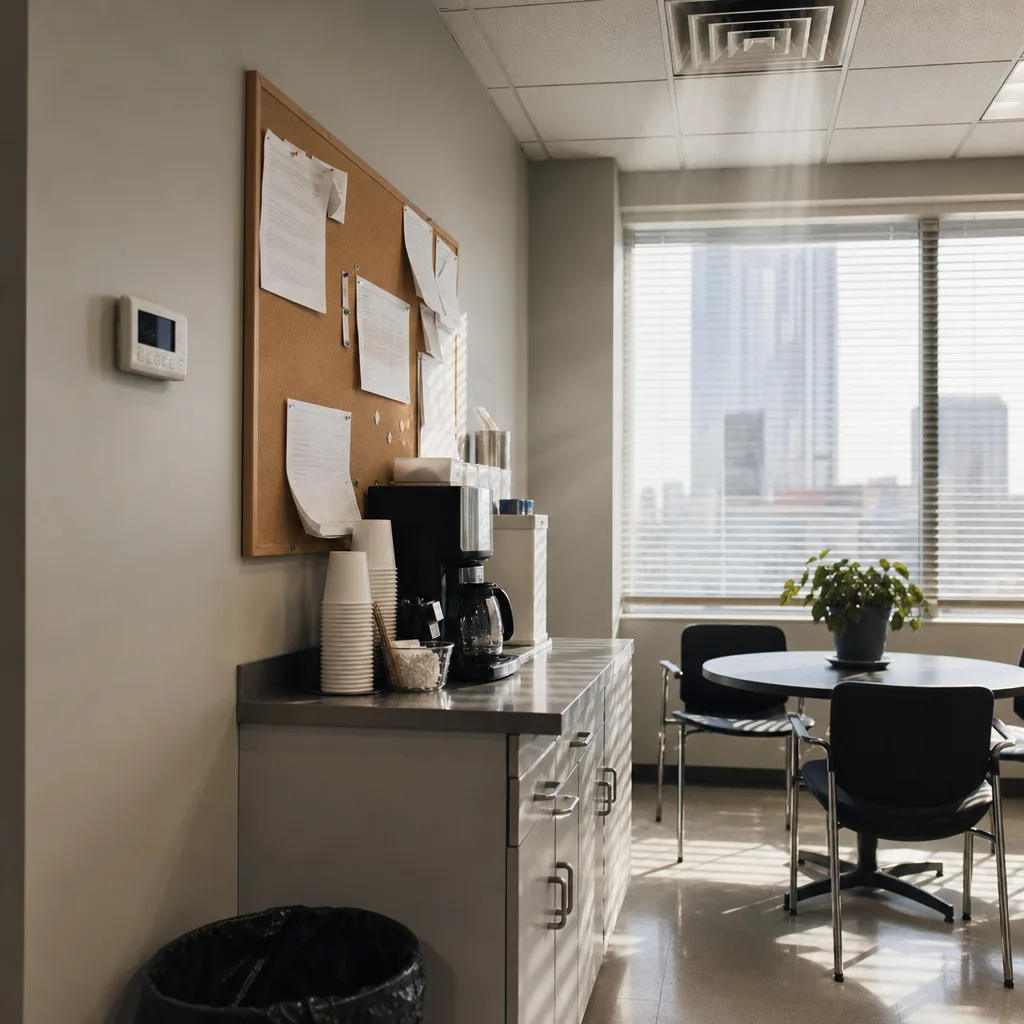
Before install day, the details get locked in. That means confirming the new unit fits your existing curb, or planning an adapter if it doesn’t. It also means checking that the electrical and gas supply match the new equipment and working out how the unit gets onto the roof. Lifting the unit is usually the biggest piece of planning, because it controls the schedule and how much of your lot gets blocked off.
On a straightforward like-for-like swap, the work itself usually follows this order:
- Shut down safely. Power and gas to the old unit are turned off and locked out, so nobody gets hurt.
- Recover the refrigerant. The old unit’s refrigerant is pulled out with recovery equipment instead of being vented into the air.
- Disconnect and lift out. Electrical, gas, condensate drain, and duct connections come off, and the old unit is lifted off the roof.
- Check the curb. With the old unit gone, the curb and roof opening can be looked over before anything new sits on them.
- Set the new unit. It’s lifted into place, leveled, and sealed to the curb so rain stays out and conditioned air stays in.
- Make the connections. Power, gas, the condensate drain, ductwork, and your thermostat or controls get hooked up to the new equipment.
- Start it up and test it. The system is run and checked for proper airflow, supply air temperature, refrigerant charge, and electrical draw, and the heat section gets tested too.
- Haul away the old unit. With us, removing the old equipment is part of the standard installation.
Startup and testing is the step you can’t see from the parking lot, and it matters most. A unit can be sized right and set perfectly and still underperform if the charge or airflow is off. Testing is how you know the system will hold up on that 4 p.m. August afternoon, not just on install day. After that, the permit inspection we covered earlier closes out the job.
A simple like-for-like rooftop swap is often finished in a day. Crane access, a curb adapter, or extra electrical or duct changes can stretch that out. Weather plays a part too. North Texas spring storms and high wind can push a crane lift back a day, so it helps to leave some room in your calendar instead of booking an install the morning before a big event.
You can make the day go smoother with a little prep:
- Tell staff, tenants, or neighbors in your center that cooling will be off for part of the day.
- Keep the parking area near the building clear if a crane is coming.
- Make sure someone can unlock the roof hatch, electrical room, and thermostat.
- Move anything you don’t want disturbed from directly under the roof work area.
- If you can, schedule early in the day during hot months, so the space isn’t sitting without cooling through the worst of the afternoon heat.
When you know what’s coming, you can keep your doors open, your people comfortable, and your day mostly on track.
Frequently Asked Questions
Common questions about Commercial HVAC installation
What is the $5,000 rule for commercial HVAC systems?
The $5,000 rule is a simple way to compare repair cost against replacement cost. If the repair bill, multiplied by the age of your unit in years, is more than $5,000, replacement usually makes more financial sense than another repair. It’s a rough guide, not a hard law, so it should be weighed alongside how often the unit has needed service and whether it still fits your building’s current cooling load.
How long does a commercial AC installation take once the old unit comes down?
A straightforward like-for-like rooftop swap is often finished in a single day. Crane access, a curb adapter, or extra electrical or ductwork changes can stretch the job longer, and North Texas spring storms or high wind can push a crane lift back a day. It helps to leave room in your schedule rather than booking an install right before a big event or peak business day.
Does my building need a bigger electrical panel for a new commercial HVAC unit?
It depends on the size and type of the new equipment, not just the old unit’s panel. If the new system needs a bigger circuit or a new disconnect, that turns part of the job into electrical work, which can trigger an additional permit review. Our team handles commercial electrical work directly, so you aren’t left coordinating a second company around the same roof access.
Ready to Get Started?
Call (469) 213-3107 Today, Get Service Today.