


Electrical Panel Replacement / Upgrade in Dallas
Panel upgrades for homes that have outgrown their power, done by licensed electricians with the permit pulled.
What’s Covered on This Page
- Know the Warning Signs That Point to a Panel Upgrade
- Repair or Full Replacement: How to Tell the Difference
- What Happens During a Panel Upgrade Visit
- Licensing, Permits, and Inspection in Dallas
- What Drives the Cost of a Panel Upgrade
- Can I get a federal tax credit for upgrading my electrical panel?
- What is the 80% rule for electrical panels?
- Does a panel upgrade qualify for any rebates through Oncor?
Know the Warning Signs That Point to a Panel Upgrade
Your panel almost never fails all at once. It gives you hints first. The trick is knowing which hints matter and which ones are just your house telling you it’s busy.
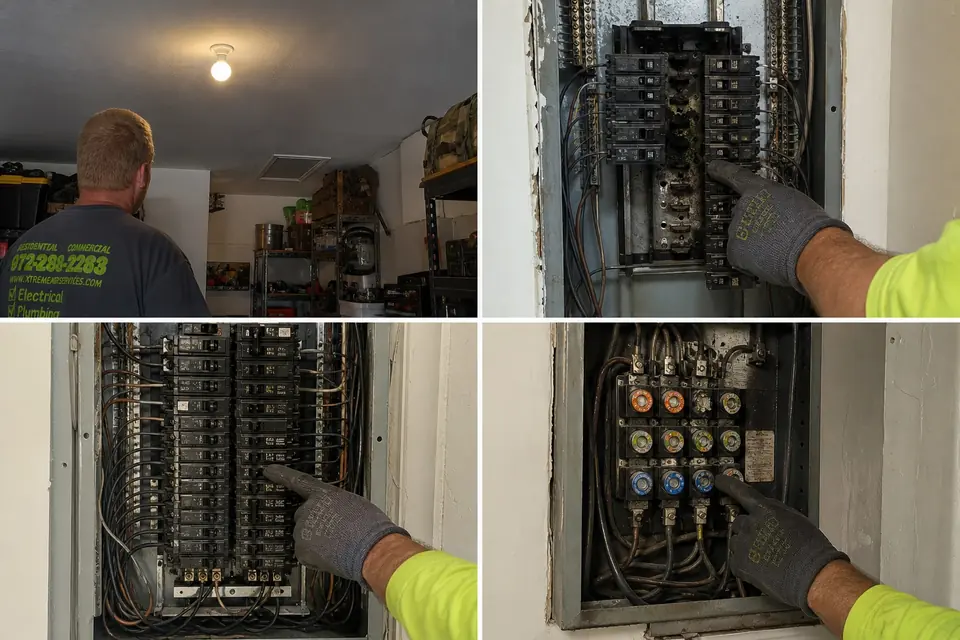
Here’s what usually points to a panel that’s worn out or too small for how you live now:
- Breakers that trip over and over, even when you aren’t running much. One trip is a warning. The same breaker tripping every week is a pattern.
- Lights that dim or flicker when your AC, dryer, or oven kicks on. In a Dallas summer, your AC runs hard for months, and a panel that’s straining shows it right when the compressor starts.
- A panel cover that feels warm, a buzzing or crackling sound, or a hot plastic or burning smell near the panel.
- Rust, corrosion, scorch marks, or melted spots on the panel or the breakers.
- Fuses instead of breakers. If you’re still swapping fuses, your system was built for a home with far fewer appliances than yours has today.
- No open spaces left. If an electrician has to squeeze in extra breakers or there’s simply nowhere to add a circuit, you’ve outgrown the panel.
Your plans can be a sign too. If you’re adding an EV charger, a hot tub, a bigger AC system, a kitchen remodel, or a standby generator, your current panel may not have the capacity to carry it. A lot of older Dallas homes were wired back when one window unit and a TV were the big loads. Asking that same panel to run central air, a second fridge, and a car charger is where trouble starts. That’s the most common reason folks move up to 200 amps.
Now for the honest part. Not every tripped breaker means you need a new panel. If a breaker trips once because you ran the hair dryer and space heater on the same bathroom circuit, that breaker did its job. Spread the load out and see if it happens again. A single dead outlet or one flickering fixture is often a wiring or fixture issue, not the panel. That’s a simple troubleshooting call, and you shouldn’t be sold a panel you don’t need.
Where you shouldn’t wait is anything involving heat. A warm panel, a burning smell, scorch marks, or a breaker that won’t stay reset are call-today signs. Don’t open the panel or try to fix it yourself. Leave the cover on, keep things clear around it, and get a licensed electrician to look at it.
If you’ve checked off two or more items on that list, or you’re planning a big new appliance, it’s time to have your panel looked at before it makes the decision for you.
Repair or Full Replacement: How to Tell the Difference
A panel problem doesn’t always mean a new panel. Sometimes one part has failed and the rest of the box is in good shape. Other times the whole panel is worn out or too small, and patching it only buys a few months. The difference comes down to three things: how far the damage goes, how much power your home needs, and whether the panel can still be fixed the right way.
A repair usually makes sense when:
- The trouble is limited to one spot, like a single worn-out breaker or one loose connection, and the rest of the panel looks clean.
- There’s no rust, water damage, or heat damage spreading across the panel.
- Your panel has enough capacity for what you run today and what you plan to add soon.
- The correct replacement breakers are still made for your panel, so nothing has to be forced in or swapped for a part that doesn’t match.
If that sounds like your panel, a repair is the smart call. Swapping one bad breaker in an otherwise healthy panel is a normal fix. Nobody should talk you into a whole new system for it.
A full replacement makes more sense when:
- Damage shows up in more than one place, like corrosion on the bus bars (the metal strips the breakers clip onto) or scorching around several breakers.
- Your home has outgrown the panel’s amperage. No repair adds capacity. If you’re short on power, the only real fix is a bigger panel.
- You’re still on fuses, or the right parts for your panel are hard to find or no longer made.
- You keep calling for repairs on the same panel. When the fixes start stacking up, that money is better spent on a panel that’ll keep up with your home.
Here’s a common situation in Dallas. Your AC runs hard from May into October, and you want to add an EV charger. Your panel isn’t damaged. It’s just full, and it was never sized for both loads at once. A repair won’t help here, because nothing is broken. The question is capacity, and that’s what an upgrade solves.
There’s also a middle option. If your main panel is healthy and your home has enough amperage, but you’ve simply run out of spaces for new breakers, a subpanel can add room without replacing the whole panel. A subpanel is a smaller second panel fed from your main one. It’s a good fit for a garage, a workshop, or an addition. It doesn’t work if your home needs more total power, because it still draws from the same main panel.
Whatever you’re told, ask why. A good electrician should be able to point to the exact part that failed, or show you the math on your home’s power needs. If the answer is “it’s just old” with nothing to back it up, ask more questions. If the answer is a scorched bus bar or a panel with no capacity left for the AC you already run, you’ll see it for yourself. With our team, you’ll get that answer in plain English and see the upfront flat-rate price before any work starts, whether it’s a single breaker or a full upgrade.
What Happens During a Panel Upgrade Visit
Once you’ve decided an upgrade makes sense, the work itself is pretty straightforward. Most of the planning happens before anyone touches a wire. The day of the swap is about doing it safely and doing it right. After that, you need proof that it all works. Here’s how it breaks down so you know what you’re signing up for.
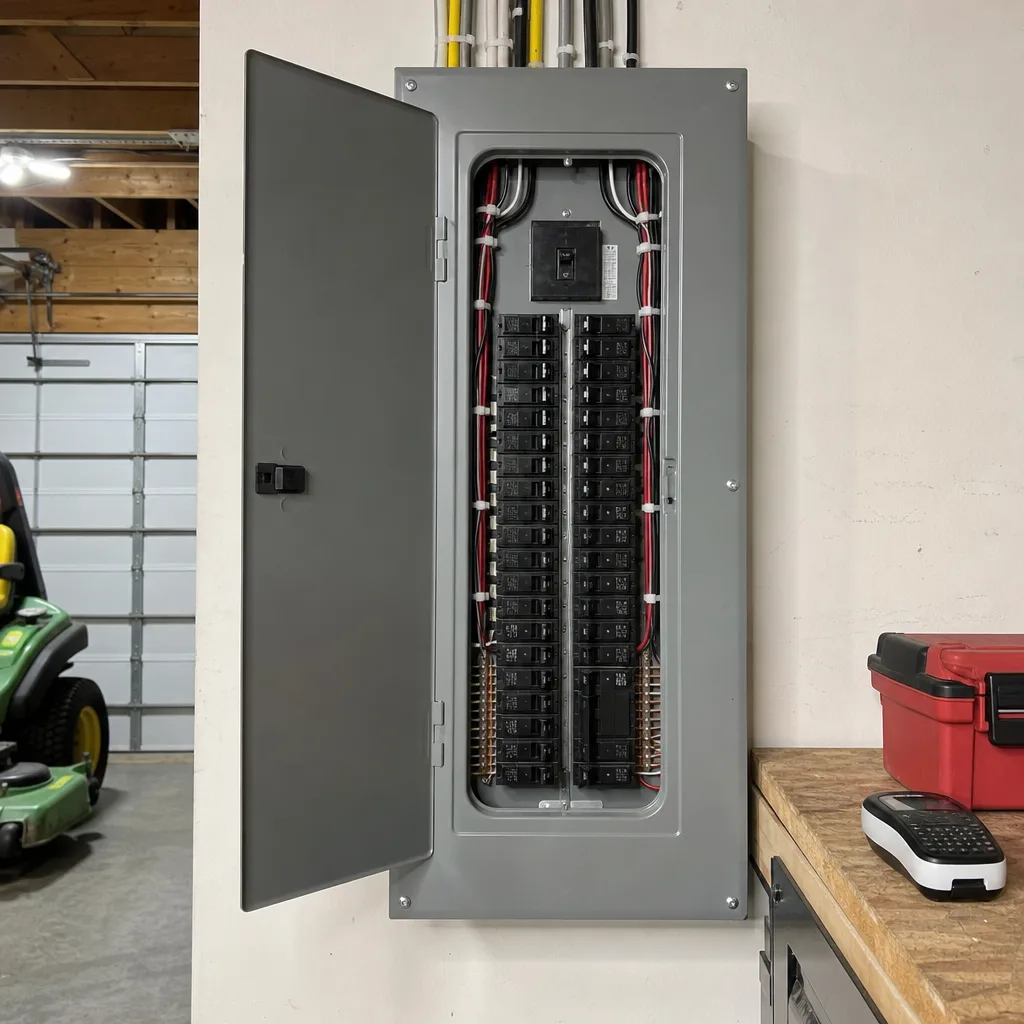
Before the work day, your panel gets a close look. That means its size, its condition, and what you run now. It also means what you’re planning to add, like an EV charger or a bigger AC system. That’s how the new panel gets sized. For a lot of homes, that’s a move up to 200 amps. You’ll see the upfront flat-rate price for the job before anything starts.
This is also when you’ll learn what sits outside the panel itself. Some of that work belongs to Oncor, the utility that delivers power in Dallas. That includes anything on the service entrance or the meter, which is where power comes into your home. Permits, rewiring, and code corrections are separate unless your quote says otherwise. Ask about all of these up front. You don’t want to find out on install day that the meter base needs work first.
On install day, power to your home has to be shut off while the old panel comes out. That’s the part you’ll feel most. Here’s how the swap goes:
- The old panel and breakers come out, and the new panel goes in.
- Your circuits get connected to new breakers sized for the job.
- Grounding is brought up to standard. That’s the safety path that sends stray electricity into the earth instead of through your home or you.
- The system gets started up and tested before your power is fully back on.
When it’s done, the old panel is hauled away, so it doesn’t end up sitting in your garage. In most cases, your area’s inspector will check the work after the permit is pulled. That second set of eyes is a good thing. It means someone outside the job has confirmed the work meets code.
A little planning on your end makes the day easier:
- Clear a path to the panel and about three feet of space in front of it. Move shelves, boxes, and anything stored against that wall.
- Plan for the power to be off. That includes the fridge, Wi-Fi, garage door, and any work-from-home setup.
- If anyone in your home uses powered medical equipment, say so when you schedule, so the timing can be planned around it.
- In a Dallas summer, the power being off means the AC is off too. Ask for an early start if you can. Have a cooler place lined up for kids, older family members, and pets.
The goal is simple. When the work is finished, you should have a panel sized for how your home runs. It should have new breakers, proper grounding, and a tested system. You should know exactly what was done and what you paid for.
Have questions? We’re happy to help.
Call Today, Get Service Today. Xtreme Air Services — North Dallas is ready to help.
Licensing, Permits, and Inspection in Dallas
A panel upgrade isn’t a weekend project, and it isn’t a job for a handyman. In Texas, electrical work is licensed by the Texas Department of Licensing and Regulation, called TDLR. The person working on your panel should hold a valid license, and the company should be a licensed electrical contractor. That’s your first layer of protection. It means the work is done by someone who’s been trained, tested, and held to a state standard.
Checking is easy. Ask for the license number before you sign anything, then look it up on the TDLR website. It takes about two minutes. A real contractor won’t mind. If someone gets vague or changes the subject, that tells you what you need to know.
The permit is the second layer. Replacing a panel changes how power enters and moves through your home, so cities treat it as permitted work. If your home is inside Dallas city limits, the permit goes through the City of Dallas. If your address is in a neighboring city, like Garland, Mesquite, or Richardson, that city handles it, even if your mail says Dallas. It’s worth confirming, because the rules and timing can be a little different from one city to the next.
Here’s why the permit matters to you, not just to city hall:
- It triggers an outside inspection. Someone who isn’t getting paid for the job checks that it was done to code.
- It protects you when you sell. Unpermitted electrical work can come up during a buyer’s home inspection and slow down or sour a sale.
- It gives you a paper trail. If you ever have an electrical claim, records showing the panel was permitted and passed inspection are good to have.
- It keeps the contractor honest. Work that has to pass inspection tends to be done more carefully.
So what does the inspector look at? In plain terms, they’re checking that the panel and breakers are the right size for the wiring, that grounding is in place and connected the right way, that circuits are labeled, and that there’s safe working space in front of the panel. They aren’t judging how neat the job looks. They’re checking whether it’s safe.
Before you hire anyone, ask three simple questions. Who’s pulling the permit? Is the permit fee in my quote or separate? Who meets the inspector? Clear answers mean you know exactly what you’re paying for and who’s responsible for each step.
Our team is licensed and insured, and our technicians are background-checked. That matters when someone is working inside the box that powers your whole home. Ask us those same three questions, and you’ll get straight answers in your quote before any work starts.
Watch Our Video
See How We Handle Electrical panel replacement / upgrade in Dallas
Xtreme Air Services — North Dallas
What Drives the Cost of a Panel Upgrade
Here’s the number you came for. With our team, a panel replacement or upgrade typically runs $1,500-$4,500. Our most common job is replacing an aging or undersized panel, usually with a 200-amp upgrade. That includes new breakers and proper grounding, and the system is inspected and tested. That job typically falls between $2,100-$3,300.
Why such a wide spread? No two panels sit in the same spot, in the same shape, feeding the same home. These are the things that move your price up or down:
- Panel amperage. A bigger panel costs more than a smaller one. That’s why sizing it to your real needs matters. Too small and you’ll outgrow it. Too big and you’re paying for power you won’t use.
- Brand. Panels and breakers vary in price by manufacturer.
- Meter and service condition. If the meter base or the wires coming into your home are worn, that can add work or change the timeline.
- Grounding upgrades. Many older Dallas homes were grounded to the standards of their day, and those systems often need to be brought up to current standards.
- Circuit count. More circuits mean more breakers and more connections to make.
- Ease of access. A panel on an open garage wall is quicker to swap than one wedged into a tight closet or behind built-in cabinets.
- Utility coordination. If Oncor needs to disconnect and reconnect service, the scheduling and the steps add to the job.
- Code upgrades and permits. Some homes need changes beyond the panel itself before the work can pass inspection.
Your price covers the panel and materials, professional installation, breakers, grounding, startup and testing, and haul-away of the old panel. As covered above, utility work on the service entrance or meter, rewiring, code corrections, and permits aren’t included unless your quote says so. Read that part of any quote closely. Two quotes can look far apart only because one leaves out the permit and the other doesn’t.
There’s also a service-call fee of $26-$99 for the visit. If you go ahead with the work, that fee is credited toward the job. Either way, you’ll see the upfront flat-rate price before any work starts. There’s no meter running, and you won’t get a surprise bill when we’re done.
If the total is more than you planned for, ask about financing. Flexible financing is available on qualifying installations and larger jobs, on approved credit. That can make it easier to fix the panel now instead of living with a box that keeps tripping while you save up.
Whatever price you’re given, it should match what was found at your panel. You should be able to point to each line and know why it’s there. If a line is vague, ask about it. A fair quote holds up to questions.
Call now
Frequently Asked Questions
Common questions about Electrical panel replacement / upgrade
Can I get a federal tax credit for upgrading my electrical panel?
You may qualify for a federal tax credit if the panel upgrade is done alongside certain energy-efficient improvements, like a heat pump or solar system. The panel itself has to support that new equipment to count. Check current IRS guidelines or ask your tax preparer, since credit rules and amounts change from year to year. We can tell you whether your planned upgrade fits the kind of work these credits usually cover.
What is the 80% rule for electrical panels?
The 80% rule means a panel should not be loaded past 80% of its rated capacity on a continuous basis. A 200-amp panel, for example, is meant to carry up to 160 amps of continuous load, not the full 200. This rule is part of why panels get undersized over time. As you add an AC, an EV charger, or other big loads, you can creep past that safe limit even if no single breaker has tripped yet. It’s one more reason a load check matters before you add anything new to an older panel.
Does a panel upgrade qualify for any rebates through Oncor?
Oncor offers various efficiency rebate programs, but these typically apply to specific equipment like HVAC systems or smart thermostats rather than the panel upgrade itself. A panel upgrade can still make you eligible for other rebates by letting you install qualifying equipment, like a higher-efficiency AC unit or an EV charger, that your old panel couldn’t support. Check Oncor’s current program list before you plan the work, since rebate offerings change year to year.
Ready to Get Started?
Call (469) 213-3107 Today, Get Service Today.