


EV Charger Installation in Plano: What the Job Involves and Costs
Level 2 home chargers wired on their own circuit, with your panel checked first so the charger runs at full speed.
What’s Covered on This Page
- What a Home EV Charger Installation Includes
- What Drives Your Installation Cost Up or Down
- Checking If Your Panel Can Handle a Level 2 Charger
- Level 1 vs. Level 2 Charging: Do You Need an Electrician at All
- Permits and Code Requirements for EV Charger Wiring
- How long does a home EV charger installation take?
- Can I install my own EV charger to save money?
- What happens if my electrician finds a problem with my panel during the EV charger quote?
What a Home EV Charger Installation Includes
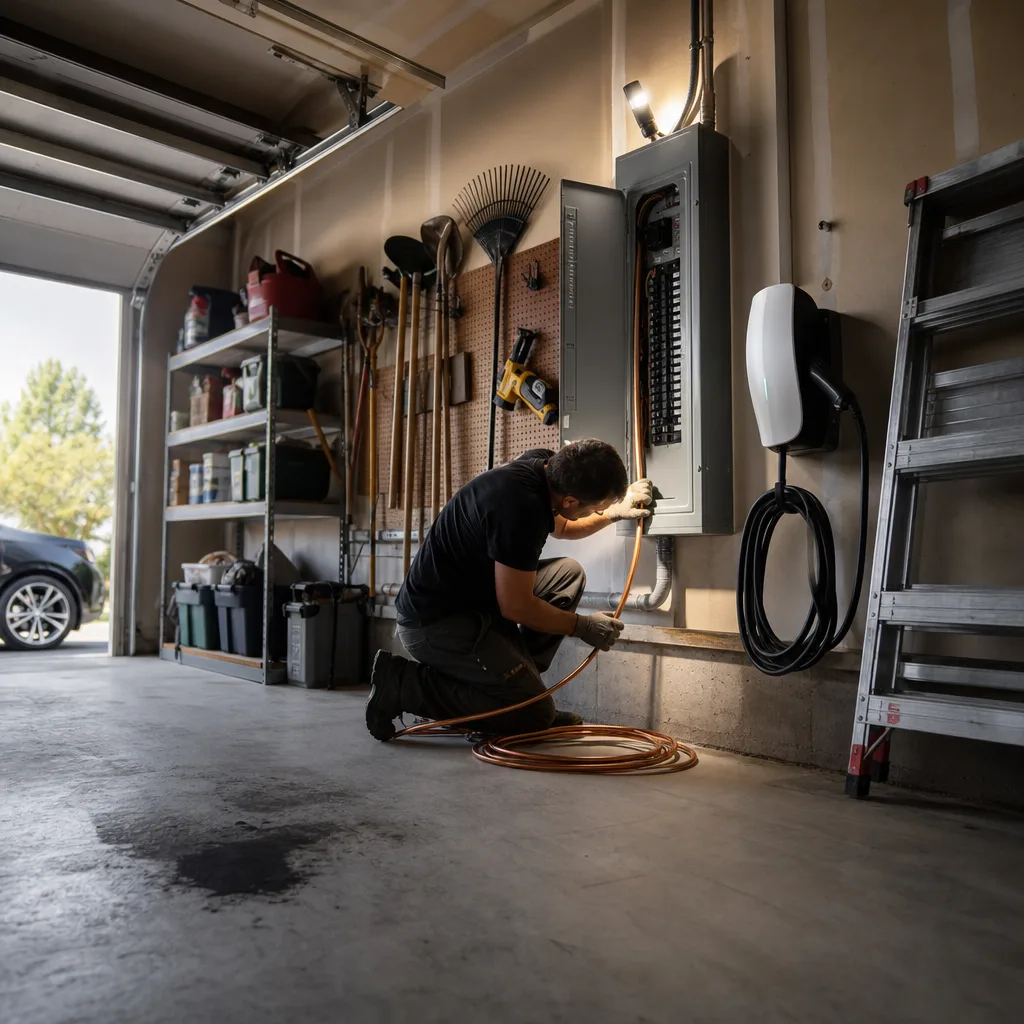
The charger is the part you see on the wall. The part that matters most is the wiring behind it. A Level 2 charger pulls a lot of power for hours at a time, often overnight. That’s why it needs its own circuit run straight from your electrical panel, not a share of a circuit that already feeds your garage lights or a freezer.
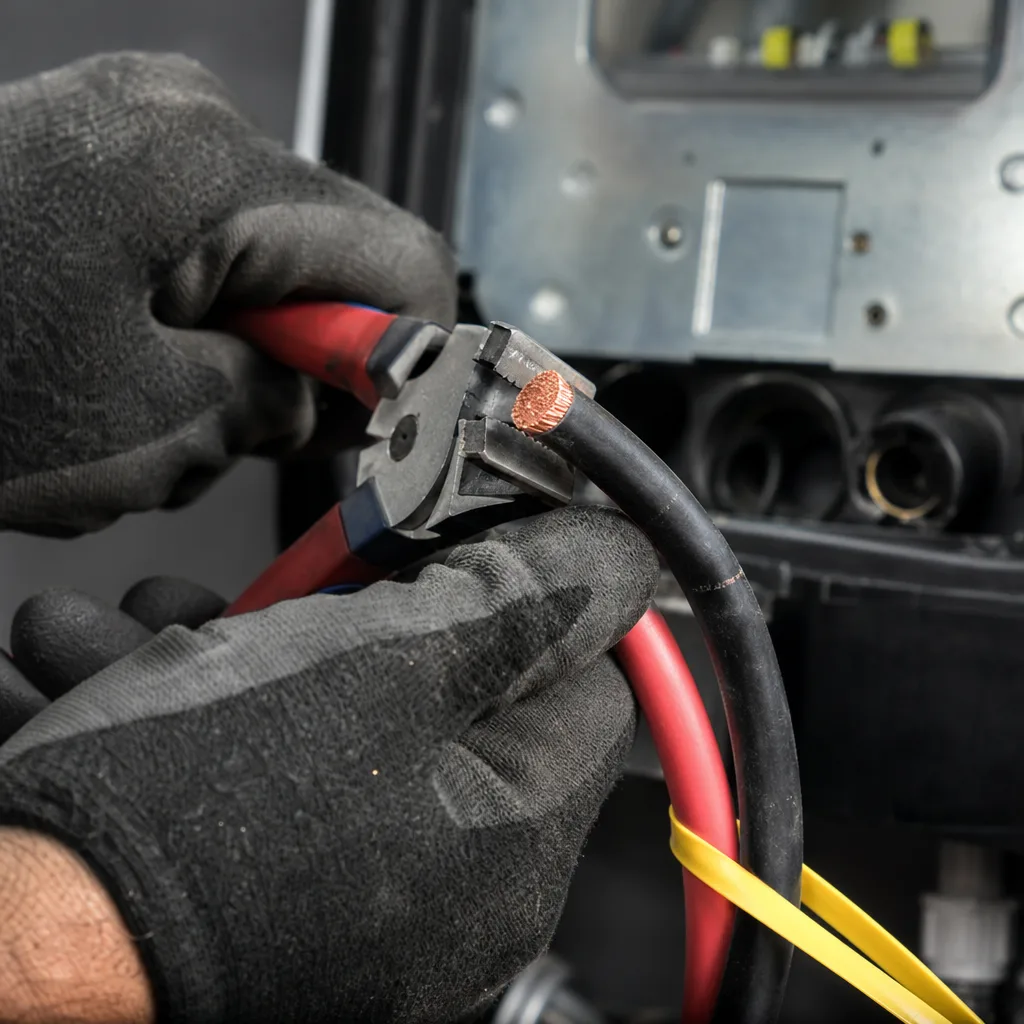
Here’s what comes with our standard install:
- A dedicated circuit from your panel to the charger location
- Professional installation by our licensed and insured team
- Mounting the charger where you want it
- Startup and testing, so you know it’s charging right before we leave
Most of these jobs finish the same day. You can usually plug in that night.
Some items aren’t part of the standard price. We’d rather you hear that now than see it as a surprise later. These cost extra:
- The charger itself, if you aren’t supplying your own
- Panel upgrades, if your current panel doesn’t have room or capacity for a new circuit
- Trenching, if the charger needs power at a spot away from the house, like a detached garage or the end of a driveway
- Code corrections, if older wiring needs fixing to bring the work up to code
- Permits, unless your estimate says they’re included
Our EV charger jobs typically range from $500 to $2,500. Where yours lands depends on a few things: how far the charger sits from your panel, whether your panel has the capacity or needs an upgrade, the amperage of the charger you pick, how the wire has to route through walls or conduit, any code upgrades, and permits.
Here’s an example. Say your panel is on the garage wall and you want the charger a few feet away. That’s a short, simple run. Now say your panel is on the far side of the house and is already full. You’ll need more wire, more routing, and maybe a panel upgrade first. It’s the same charger, but the job is very different.
That’s why we look at your panel and your garage before we give you a number. You get upfront flat-rate pricing that you approve before any work starts, so no meter is running. Our service-call fee is $26 to $99, and it’s credited toward the work if you go ahead with Xtreme Air Services.
If the total includes a panel upgrade and runs higher than you planned, flexible financing is available on qualifying installations and larger jobs, on approved credit. If your panel does need work, it’s the same team handling it, since electrical panel upgrades are one of the services we already offer.
What Drives Your Installation Cost Up or Down
You have more say over your price than you might think. A few choices you make before we ever show up can move your total up or down. Here’s how each one works, so you can decide what’s worth paying for.
Start with where you want the charger. Every extra foot between your panel and the charger means more wire. The wire for a Level 2 circuit is thick and costs more than standard house wire. If you park on the side of the garage closest to the panel, that’s often the easiest way to keep the run short. If the far wall works better for how you park every day, that’s a fair reason to spend a little more. Just know that’s where the extra cost comes from.
Next is amperage. A bigger charger isn’t always better for you. Your car can only take in power so fast, and that limit is set by the car itself, not the charger on the wall. If your car can’t use a higher-amp charger, you’d be paying for a heavier circuit and wire that never get used. Check your owner’s manual or the maker’s website for your car’s max charging rate before you buy. We’re happy to look at it with you and match the circuit to what your car can use.
Amperage matters for another reason too. EV charging runs at full power for hours, so the circuit has to be sized with extra room built in. A higher-amp charger needs a bigger breaker, and that’s often what decides whether your current panel has enough capacity left or needs an upgrade.
Routing is the factor that’s hardest to guess from a photo. An open, unfinished garage wall is quick to work in. A finished garage, a run through the attic in July, or wire that has to sit in conduit along an outside wall all add time. That’s one reason we’d rather see your space in person before we give you a number.
A few small things you can do to keep the job simple:
- Clear a path to your panel and the spot where you want the charger
- Have your charger on hand, or tell us the model you plan to buy
- Snap a photo of your panel label so we can get an early read on capacity
- Know your car’s max charging rate
If you’re getting more than one quote, ask every contractor the same questions. Is the permit included or extra? Does the price cover a circuit sized for the charger I’m buying? If my panel can’t handle the load, will you tell me before any work starts? Is the charger part of the price, or am I buying it myself? A quote that answers those questions in writing is easy to compare side by side. A single number with no breakdown isn’t.
With us, those answers are part of the upfront flat-rate price you approve before we start, so you’ll know exactly which of these factors you’re paying for and why.
Checking If Your Panel Can Handle a Level 2 Charger
The big question behind most EV quotes is simple: does your panel have enough power left over? A lot of homes do. Some don’t. You can get a decent early read on your own in about five minutes.
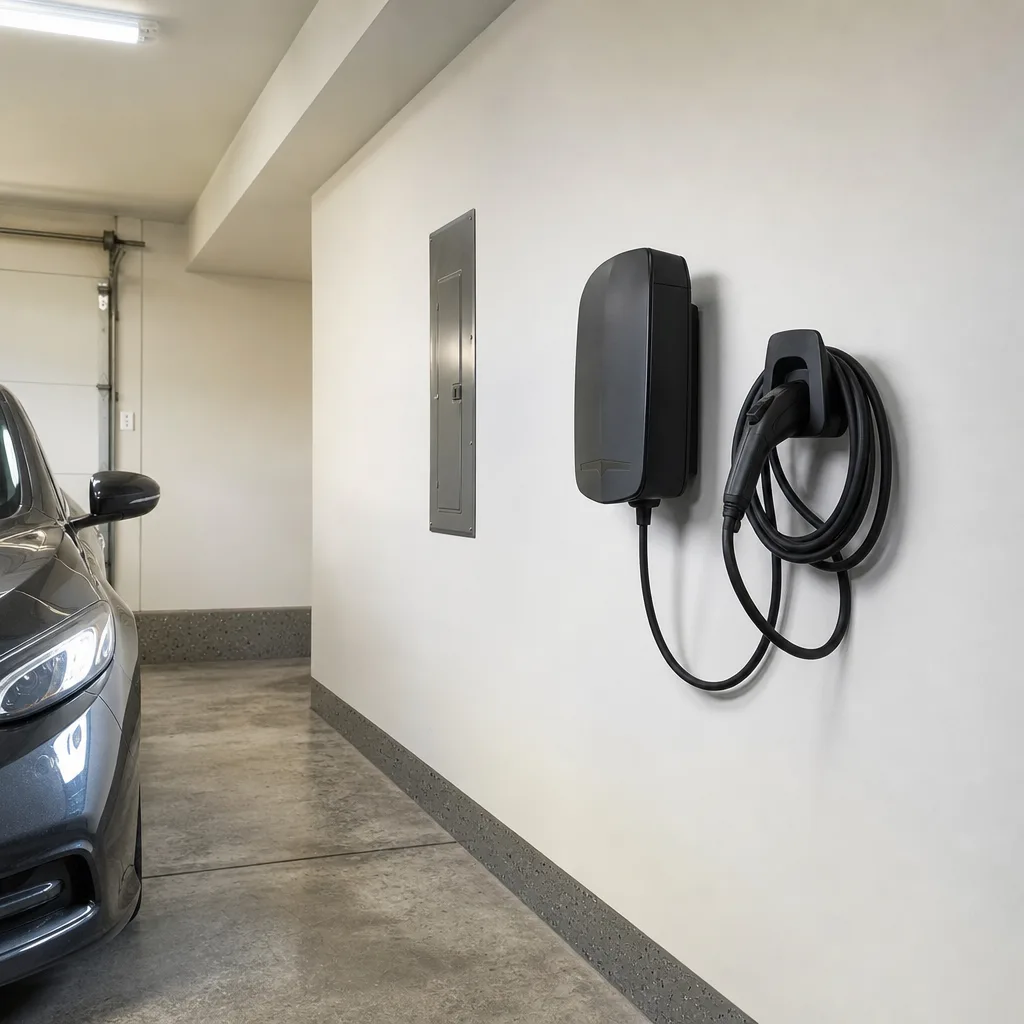
Start by finding your main breaker. It’s usually the large switch at the top of the panel, and it has a number stamped on it, like 100, 150, or 200. That’s your home’s total service in amps. A 200-amp panel often has room for a charger. A 100-amp panel in a house with a lot of electric appliances is where things get tight.
Next, look for empty slots. Open spaces are a good sign, but they don’t tell the whole story. A panel can have empty slots and still be close to its limit, because what counts is how much power your home already uses at the same time. That’s why an electrician runs a load calculation. It adds up your big appliances to see what’s left for the car.
These are the loads that eat up the most capacity:
- Central air conditioning or a heat pump, which runs hard through a Texas summer
- An electric range or oven
- An electric clothes dryer
- An electric water heater
- A pool pump, hot tub, or spa
- A second AC unit or a workshop with heavy tools
If your home runs on gas for heat, cooking, and hot water, you’ve likely got more room than a home that’s all electric. If you’ve got most of that list on electric and a 100-amp panel, plan on a closer look.
A tight panel doesn’t always mean a new panel. Here are the real options, from smallest to biggest:
- Turn the charger down. Many Level 2 chargers can be set to a lower amp level. That means a smaller circuit and slower charging, and slower charging is often still plenty to refill your car overnight.
- Use a charger with load management. Some chargers can sense your home’s power use and slow down when the AC and dryer are running.
- Add a subpanel. If your main panel has the capacity but not the space, a subpanel can add room for new circuits.
- Upgrade the panel. If the capacity just isn’t there, this is the safe fix. If your home’s incoming service also needs to get bigger, the utility, Oncor, has to be part of that step.
Here’s the honest part. If you drive 30 or 40 miles a day, you may not need a high-amp charger at all. A smaller circuit that fits your current panel could cover you just fine. We’d rather tell you that than sell you an upgrade you don’t need.
If the panel does need work, the cost and financing details above still apply. The panel repair, the subpanel, or the upgrade can be handled by the same crew that installs your charger, so you’re not juggling two contractors for one garage.
Not sure what your EV charger installation project needs? Ask us.
Call Today, Get Service Today. Xtreme Air Services — North Plano is ready to help.
Level 1 vs. Level 2 Charging: Do You Need an Electrician at All
You might not need us at all. Every EV comes ready to charge on a regular household outlet, and for some drivers that’s all they’ll ever need. Before you book any install, figure out which kind of driver you are.
Level 1 charging uses the cord that usually comes with your car and plugs into a standard 120-volt outlet, the same kind you’d plug a lamp into. It’s slow. You get a few miles of range back for every hour it’s plugged in. That sounds bad until you do the math for your own week. If your car sits in the garage for 10 or 12 hours a night and you only drive a short loop to work, school, and the store, a slow overnight top-off can cover what you used that day.
Level 1 is often enough if:
- You drive a plug-in hybrid with a small battery that refills overnight on a regular outlet
- Your daily driving is short and steady, and you rarely take long trips
- You have a working outlet in the garage or carport near where you park
- You can charge at work or at public chargers when you need a fast boost
If that’s you, try Level 1 for a few weeks before you spend money on anything. Follow your owner’s manual on what kind of outlet and cord setup the carmaker allows. It’s a good idea to know what else is on that outlet’s circuit, too. If the garage freezer or a shop vac shares it, you may trip the breaker. And if the plug feels warm, fits loosely, or the outlet looks discolored, have that outlet checked before you keep using it. That’s a quick repair, not an EV charger install.
Level 2 runs on 240 volts, the same kind of power your electric dryer or range uses. It charges many times faster than a regular outlet, so most cars can go from low to full overnight. That’s where an electrician comes in, because Level 2 needs a new dedicated 240-volt circuit run from your panel.
Level 2 usually makes sense if:
- You have a long daily commute and Level 1 can’t catch up overnight
- Two EVs share the same garage and the same nights
- You drive a full battery-electric car and want to start every day with a full charge
- You don’t have reliable charging at work or close to home
Some Level 2 chargers plug into a 240-volt outlet instead of being wired straight in. That doesn’t let you skip the electrician. The outlet still needs its own circuit, sized for the charger, and outlets that see heavy daily charging have to be rated for that kind of use. Plugging a charger into whatever 240-volt outlet happens to be in the garage, like an old dryer outlet, isn’t something we’d recommend without having that circuit checked first.
Here’s a simple test. Charge on Level 1 for two weeks and watch your battery. If you’re waking up with enough range for the day, you’re set, and you’ve saved yourself the install. If you keep starting the morning lower than you’d like, that’s your sign that Level 2 is worth it.
Watch Our Video
See How We Handle EV charger installation in Plano
Xtreme Air Services — North Plano
Permits and Code Requirements for EV Charger Wiring
A new 240-volt circuit for a Level 2 charger is real electrical work, and in Plano that kind of work is normally permitted and inspected through the city. It can feel like red tape. It’s the step that protects you, because a city inspector who doesn’t work for us checks that the job was done right.
In Texas, electrical work like this has to be done by an electrician licensed through the Texas Department of Licensing and Regulation, or TDLR. That’s the first thing to ask any installer. If someone offers to wire your charger “without the paperwork” to save you a little money, that’s a good reason to keep looking.
Here’s why the permit matters to you, not just to the city:
- Safety. A charger can pull full power for hours every night. An inspection catches a loose connection or wrong-sized wire before it has months to heat up behind your garage wall.
- Selling your home. Buyers’ inspectors often spot a charger and ask whether it was permitted. Unpermitted work can turn into a repair request or a sticking point at closing.
- Insurance. If something ever goes wrong, you’ll want a record showing the work was licensed and inspected.
So what does an inspector look at? On a typical EV circuit, they’ll check things like these:
- The wire size matches the breaker, and both match the charger you’re using
- The circuit is dedicated to the charger, with nothing else tied into it
- Proper grounding and tight, clean connections at the panel and the charger
- The breaker is labeled in your panel so anyone can find it later
- Conduit and weather-rated boxes and covers wherever the wiring runs along an outside wall or carport
- Shock protection where code calls for it, which often applies to plug-in chargers on a garage outlet
- A charger listed by a recognized testing lab, mounted securely and installed the way the maker’s instructions say
That last point is worth a minute before you buy. Low-cost chargers sold online without a safety listing can be a problem at inspection. Look for a listing mark on the box or in the product details. If you’re not sure, send us the model and we’ll take a look.
If your home needs a bigger electrical service and not just a new circuit, Oncor gets involved too, since it’s the utility that delivers power to homes in Plano. That adds a step and some scheduling, so it’s better to know early. Most standard installs never get to that point.
One more local wrinkle. Many Plano neighborhoods have an HOA. A charger inside your garage usually isn’t an issue. If you want it mounted on an outside wall or out by the driveway, check your HOA rules first so you don’t have to move it later.
As we covered in the pricing section, your estimate will say clearly whether the permit is included. Either way, you’ll know before we start, and you won’t be left wondering whether the work behind your wall will pass.
Frequently Asked Questions
Common questions about EV charger installation
How long does a home EV charger installation take?
Most home EV charger installs finish in one day. Once the dedicated circuit is run from your panel to the charger, our team mounts, connects, and tests it before leaving, so you can usually plug in that same night. Jobs take longer only if a panel upgrade or trenching is needed first.
Can I install my own EV charger to save money?
You shouldn’t wire a Level 2 charger yourself, because it needs a dedicated 240-volt circuit run by a licensed electrician. In Texas, that work has to be done by someone licensed through the Texas Department of Licensing and Regulation. A Level 1 charger, which plugs into a regular outlet, doesn’t need an electrician at all, so try that first if your driving needs are light.
What happens if my electrician finds a problem with my panel during the EV charger quote?
You’ll hear about it before any work starts, not after. If your panel is already full, warm, buzzing, or tripping breakers, that’s a panel issue separate from the charger itself. We can often add a subpanel or turn the charger’s amperage down to fit your existing panel, instead of jumping straight to a full panel upgrade.
Ready to Get Started?
Call (469) 527-5131 Today, Get Service Today.