


AC Replacement in Dallas: Know Before You Buy
An honest read on whether it's time to replace, what a standard replacement includes, and the permit step explained.
What’s Covered on This Page
- Signs Your System Has Reached the End of the Road
- When You Don’t Need Full Replacement
- What to Check Before You Hire Anyone for AC Replacement
- What Drives the Cost of a New AC System
- What Happens During Your Replacement, Start to Finish
- Why did my AC just stop working out of nowhere?
- What is the $5000 rule for HVAC?
- How do I know if I’m getting a fair AC replacement quote in Texas?
Signs Your System Has Reached the End of the Road
No single sign means your AC is done. It’s the pattern that tells you. A system can be noisy and still have years left. Another can look fine and be costing you more every month than it’s worth. Here’s what to look for when you’re deciding whether to fix it or move on.
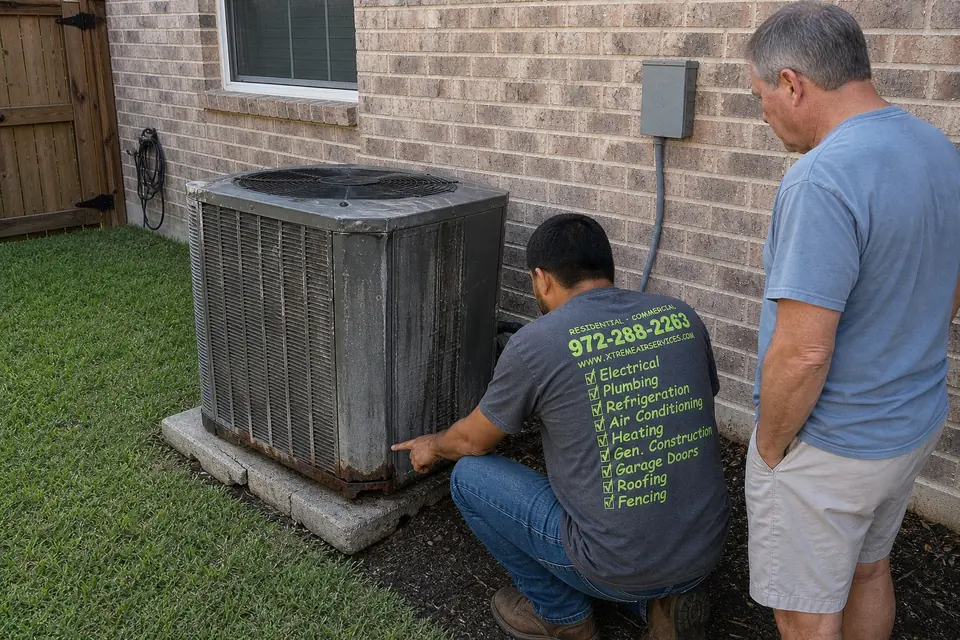
- It’s well into its teens. Age alone doesn’t kill an AC, but an older unit has worn parts everywhere. Fixing one part often just moves the next breakdown up the line.
- You’re calling for repairs every summer. If you’ve paid for a capacitor, then a fan motor, then a leak repair in a short stretch, you’re paying installment fees on a system that’s wearing out.
- A big-ticket part has failed. A dead compressor or a leaking coil on an older system is a turning point. That repair can cost a large share of what a new system costs, and it goes into equipment that’s still old.
- It runs on R-22 refrigerant. Many older systems use R-22, which isn’t made anymore. What’s left is limited and expensive, so every recharge costs more and doesn’t fix the leak causing it.
- Your electric bills keep creeping up. If your usage is climbing while your habits haven’t changed, your system is working harder to do the same job.
- It can’t keep up on hot afternoons. On a 105-degree day, the attic above many Dallas homes gets far hotter than that. A tired system running in that heat may run all day and still never reach the temperature you set.
- Your house feels damp or clammy. A healthy AC pulls moisture out of the air. When the house feels sticky even when it’s cool, the system isn’t doing its full job.
- Some rooms never get comfortable. Hot back bedrooms and a cold living room can mean the system is worn out or sized wrong for your home.
Picture this. It’s late July, and your AC quits for the third time since spring. The tech finds a leak, and your system is old enough that it still uses R-22. You can pay to find and fix the leak, then pay again to refill it with a refrigerant that keeps getting harder to buy. Or you can put that money toward a system that will carry you through the next stretch of Texas summers. When you’re facing that kind of choice, replacing is usually the smarter move.
The opposite is just as true. If your system is fairly young and a capacitor or fan motor gives out, that’s a normal repair. Fix it and keep it running. A good technician should tell you that plainly, even when it means a smaller job.
If you’re stuck between the two, it helps to add things up. Count the repairs you’ve paid for lately. Look at what the next repair would cost. Then compare that to the cost of a new system that should cool your home better and use less power. When the old system keeps losing that comparison, it’s done.
When You Don’t Need Full Replacement
A lot of ACs that seem dead aren’t. Before anyone talks to you about a new system, make sure the problem is really the system. Some of the most common causes of a warm house cost little or nothing to fix.
Start with the easy stuff you can check yourself:
- The thermostat. Make sure it’s set to cool and set below the room temperature. If the screen is blank, it may just need new batteries.
- The air filter. A filter packed with dust can choke airflow so badly that the system runs and runs but barely cools. It can even cause the indoor coil to freeze over.
- The breaker. A tripped breaker can shut down the outdoor unit while the fan inside keeps blowing. If it trips again right after you reset it, stop and call a technician.
- The outdoor unit. Grass clippings, leaves, and cottonwood fluff can coat the outside coil, so the unit can’t get rid of heat. Keep a couple of feet clear around it.
If those all check out, there are still problems that feel like a failing AC but don’t call for a new one.
A clogged drain line is a big one. Your AC pulls water out of the air, and that water drains out through a small pipe. When that pipe clogs, a safety switch can shut the whole system off to keep water from overflowing into your attic or ceiling. A drain line cleaning gets you cooling again.
Hail damage can look worse than it is. After a North Texas storm, the thin metal fins on your outdoor unit can end up flattened. Light damage can often be straightened or cleaned. Only serious coil damage points toward a bigger repair.
Ducts can be the real culprit. Many Dallas homes built from the 1950s through the 1990s have ductwork running through a hot attic, and older ducts can leak or pull loose at the joints. When that happens, cold air you already paid for gets dumped into the attic. The AC can be healthy and the house still won’t cool. Duct repair or duct sealing fixes the leak. A new AC hooked to the same leaky ducts won’t.
One problem room doesn’t always mean a whole new system, either. A garage you turned into an office, a sunroom, or an upstairs bedroom that bakes all afternoon is often better served by a ductless mini-split or a zoning system than by replacing everything.
And sometimes the right answer is simply to wait. Say your system is older but runs fine, your bills are steady, and nothing has failed. You don’t have to replace it just because of its age. Keep up with a yearly tune-up, watch for the signs above, and plan ahead. Planning a replacement on your own schedule beats doing it in a rush on the hottest week of the year.
A good technician will tell you which of these you’re dealing with. If the fix is a filter, a drain line, or a duct repair, that’s what you should hear.
What to Check Before You Hire Anyone for AC Replacement
A new AC is only as good as the crew that puts it in. The same equipment can cool your home well for years or struggle from day one, depending on how it’s sized and installed. Before you sign anything, with us or anyone else, check these things.
- A Texas HVAC license. In Texas, air conditioning contractors are licensed by the Texas Department of Licensing and Regulation (TDLR). Ask for the license number and look it up yourself. Ours is HVAC License #TACLA29023C.
- Proof of insurance. Ask for it in writing. If a worker gets hurt in your attic or something gets damaged, you don’t want that bill landing on you.
- A real sizing check, not a guess. Bigger isn’t better. An oversized unit cools fast, shuts off, and leaves the house damp. An undersized one runs all afternoon and never catches up. Ask how the size was chosen. A cooling load calculation looks at your square footage, insulation, windows, and how much sun your home takes. Simply copying the size of your old unit isn’t enough.
- Matched indoor and outdoor parts. Your outdoor unit and the indoor coil are built to work as a pair. Ask whether the quote replaces both. Pairing a new outdoor unit with an old coil can cut efficiency and cause problems later.
- A look at your ducts. In older Dallas homes with ductwork running through a hot attic, a good quote should say what shape the ducts are in. If nobody climbs up to look, ask why.
- Who handles the permit. Ask whether the contractor pulls the permit and whether it’s in the price or added on top.
Next, get every quote in writing and line them up side by side. A low number can be low because it leaves things out. Check what each one covers. Our quotes include equipment and materials, professional installation, standard connections, startup and testing, and haul-away of the old unit. Duct, electrical, or plumbing changes, code corrections, and permits aren’t included unless the quote says so. Whoever you hire, you should know what’s in and what’s out before the work starts.
Ask about efficiency in plain terms, too. SEER2 is the efficiency rating on a new AC. A higher number means it uses less electricity to cool the same space. Higher-SEER2 systems cost more up front, so ask the contractor to explain what the upgrade means for your bills and comfort in a home like yours.
Last, pay attention to how you’re treated. A good contractor answers your questions without rushing you, puts the price in writing, and doesn’t push you into the biggest system on the truck.
That’s the standard we hold ourselves to. Xtreme Air Services is a licensed and insured Trane Comfort Specialist with background-checked technicians, upfront pricing, and a 4.8-star reputation across more than 2,900 reviews. Financing is available on qualifying installations, on approved credit.
Call 469-269-6373
Thinking about AC replacement? Let’s talk.
Call Today, Get Service Today. Xtreme Air Services — Oak Lawn is ready to help.
What Drives the Cost of a New AC System
Here’s the straight answer. Most AC replacements we quote fall between $5,000 and $12,000. Our most common job, a standard like-for-like swap that uses your existing connections with no major changes, runs $6,400 to $9,200. That covers the equipment and materials plus professional installation, startup, and testing.
That’s a wide range, and it should be. Two houses on the same street can need very different systems. The three things that move the price the most are system size, efficiency, and how hard it is to get to the equipment.
- Size. AC systems are measured in tons. A ton is how much heat the system can pull out of your home in an hour, not how much the unit weighs. A bigger home, or one that takes a lot of afternoon sun, needs more tons, and more tons cost more. This is why the sizing check matters so much. You don’t want to pay for capacity you don’t need.
- Efficiency. A higher SEER2 rating costs more up front and uses less power every month after that. The right level depends on how long you plan to stay and how hard your system works in a Dallas summer.
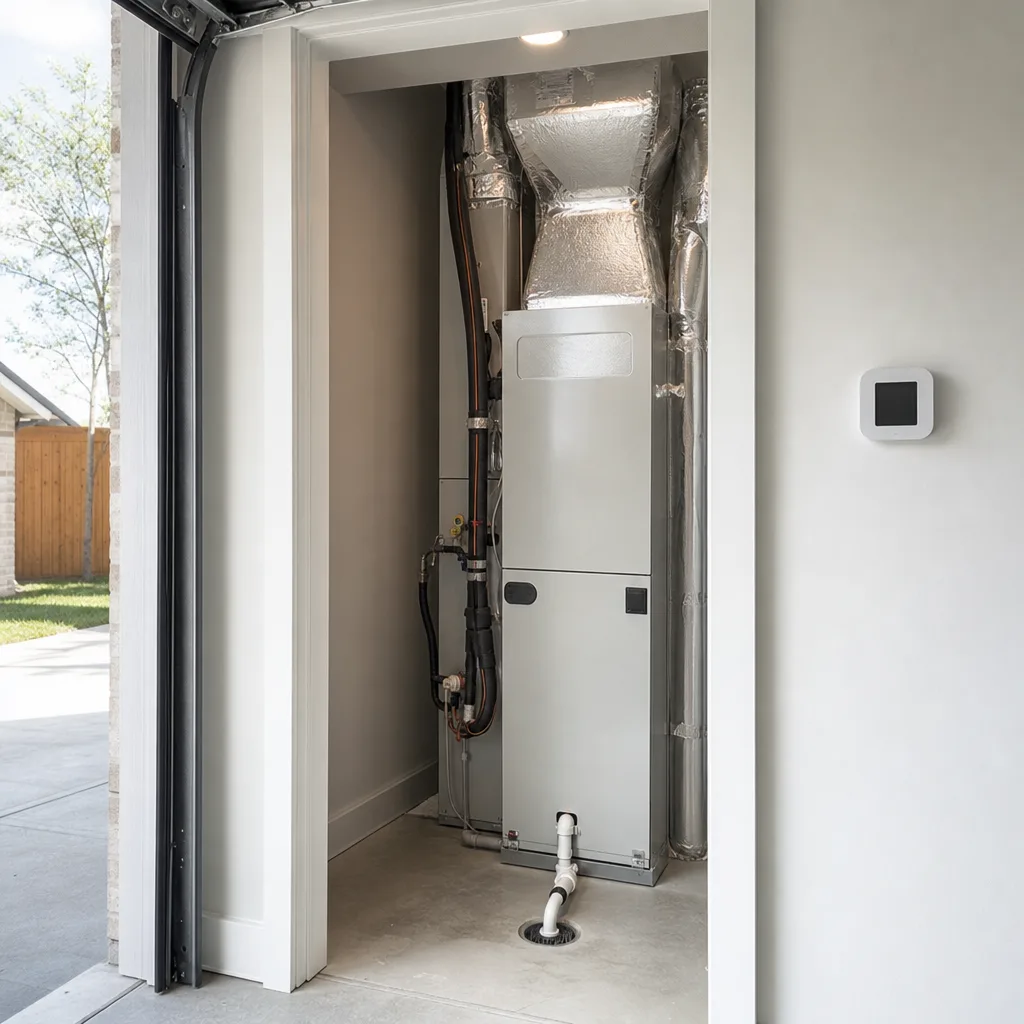
- Access. A unit in an easy hall closet is a simpler job than one tucked into a tight, low attic where every part has to be carried up a pull-down ladder. In July, that attic can be dangerously hot to work in, and it takes more time and care to do the job safely.
- Brand and model. Within any brand, there’s a range from basic single-stage units to quieter variable-speed systems that run longer at low power and do a better job pulling humidity out of the air.
- What’s already in your house. The condition of your ductwork, wiring, refrigerant lines, and drain line matters. If they’re in good shape and match the new equipment, the job stays close to a straight swap. If they’re worn out or the wrong size, they may need work.
- Code upgrades and permits. Codes change. An older Dallas home that’s had the same system for many years may need updates to meet current rules before a new system can go in.
- Custom fabrication. Sometimes a new indoor coil doesn’t line up with the old metal box it sits on. A sheet metal piece has to be built to connect them, and that adds labor and materials.
Most of these are things nobody can see from the driveway. That’s why a fair quote starts with someone looking at your system, your attic, and your ducts in person. As we covered above, duct, electrical, and plumbing changes, code corrections, and permits are priced separately unless the quote says otherwise. That way you see exactly what each piece costs instead of paying for a padded flat number.
If a technician comes out first to figure out what’s wrong, there’s a $26 to $99 service-call fee. That fee is credited toward the repair if you go ahead with us. If the price lands higher than you planned, flexible financing is available on qualifying installations and larger jobs, on approved credit.
The goal isn’t the lowest number or the biggest system. It’s the right system for your home, at a price you understand before any work starts.
Watch Our Video
See How We Handle AC replacement in Dallas
Xtreme Air Services — Oak Lawn
What Happens During Your Replacement, Start to Finish
Once you’ve decided to replace, the hard part is over. Here’s what a proper job looks like from the first visit to the moment cold air comes out of your vents. Knowing these steps helps you spot a rushed install before it costs you.

1. The look and the written price. A technician checks your system, your attic or closet, and your outdoor unit. Then you get a price in writing. With us, that price is upfront and approved by you before any work starts. Nothing gets torn out until you’ve said yes.
2. Getting your home ready. You don’t have to do much, but a few things make the day go smoother:
- Clear a path to the indoor unit, whether it’s in a hall closet, the garage, or up the attic ladder.
- Move cars, grills, or patio furniture away from the outdoor unit.
- Keep pets in a closed room, since doors will be opening and closing all day.
- Plan to keep the house as cool as you can that morning, because the AC will be off while the work is done.
3. Taking out the old system. The refrigerant in your old unit has to be pulled out with recovery equipment. It should never be let out into the air. Then the old outdoor unit and indoor coil come out. Haul-away of the old unit is included in our quotes, so you’re not left with a dead condenser on the side of the house.
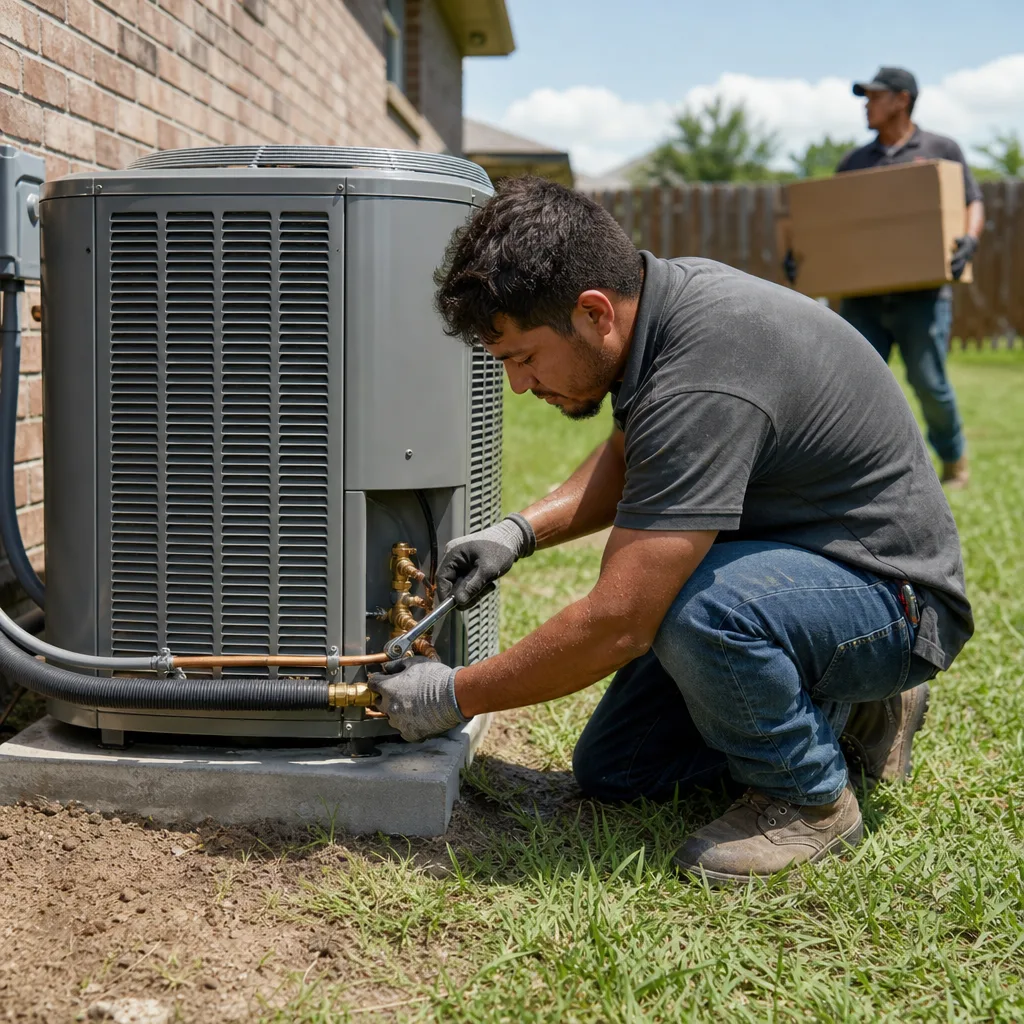
4. Setting the new equipment. The outdoor unit goes on a level pad. That matters around Dallas, where clay soil swells and shrinks with the weather and can tip a pad over time. The new indoor coil goes in, and the refrigerant lines, drain line, and wiring get hooked up.
5. The steps you can’t see. This is where good installs and bad ones split apart. After the copper lines are joined, they should be pressure tested to make sure nothing leaks. Then a vacuum pump pulls all the air and moisture out of the lines. Moisture left inside can damage a brand-new system from the inside. Skipping this step saves an hour and can cost you years.
6. Startup and testing. Startup and testing are part of every replacement we quote. The system gets turned on and checked. That includes the refrigerant charge, the airflow, the temperature of the air coming out of your vents, and whether the drain line carries water away like it should. Your thermostat gets set up to work with the new system.
Many straight swaps finish in a single day. Jobs that need duct, electrical, or custom metal work can take longer, and your quote should say so up front.
Before the technician leaves, walk through a few things with them:
- Is the house starting to cool, and is the air from the vents clearly colder than the room?
- Is water dripping from the drain line outside once the system has run a while?
- What filter size does the new system take, and how often should you change it?
- Do you have the model numbers and paperwork for your new equipment?
- If a permit was pulled, what happens next with the inspection?
A good technician will be glad you asked. If you get short answers or none at all, that tells you something about the job too.
Call 469-269-6373
Frequently Asked Questions
Common questions about AC replacement
Why did my AC just stop working out of nowhere?
A sudden shutdown usually means a tripped breaker, a clogged drain line, or a part like a capacitor failing all at once. Capacitors and fan motors often fail without warning, even on a system that seemed fine the day before. Check your breaker and thermostat batteries first. If the breaker trips again after you reset it, or the drain line is backed up, that calls for a technician rather than a guess.
What is the $5000 rule for HVAC?
The $5000 rule is a simple way to decide between repairing or replacing your AC. Multiply the age of your system by the cost of the repair. If that number is above $5,000, replacement usually makes more financial sense than fixing it. A 12-year-old system needing a $900 repair, for example, comes out to $10,800, which points toward replacing. It’s a guideline, not a hard law, but it helps when you’re weighing a big repair bill against a new system.
How do I know if I’m getting a fair AC replacement quote in Texas?
A fair quote spells out exactly what’s included and is based on a real look at your home, not a phone estimate. It should cover equipment, labor, startup and testing, and haul-away, with duct work, electrical changes, or permits priced separately if needed. Get more than one quote and compare what each one covers, not just the bottom-line number. A quote that skips a cooling load calculation or doesn’t mention your ductwork is worth a second opinion.
Ready to Get Started?
Call (469) 269-6373 Today, Get Service Today.