


Central Air Conditioning Repair in Dallas: Fixed Right, Priced Straight
Central AC problems diagnosed and fixed right the first time, with clear pricing on what drives the cost.
What’s Covered on This Page
- What’s Really Wrong With Your Air Conditioner
- Act Now or Wait: Reading Your AC Symptoms
- Checks You Can Make Before You Call
- How a Repair Visit Works, Start to Finish
- What a Repair Costs and What’s Included
- How fast can you get a technician to my house in Dallas?
- Will I get charged extra for a weekend or nighttime AC repair?
- Do I have to pay the diagnostic fee even if I don’t get the repair done?
- What if the technician finds more than one broken part during the repair?
What’s Really Wrong With Your Air Conditioner
When your house keeps getting warmer and the thermostat won’t budge, it’s easy to picture a brand-new system and a giant bill. That’s usually not where this ends. Central air conditioning repair mostly means finding the one part that quit, fixing or replacing it, and making sure everything runs right again. At Xtreme Air Services, most of our calls are a single common failure fixed on the first visit.
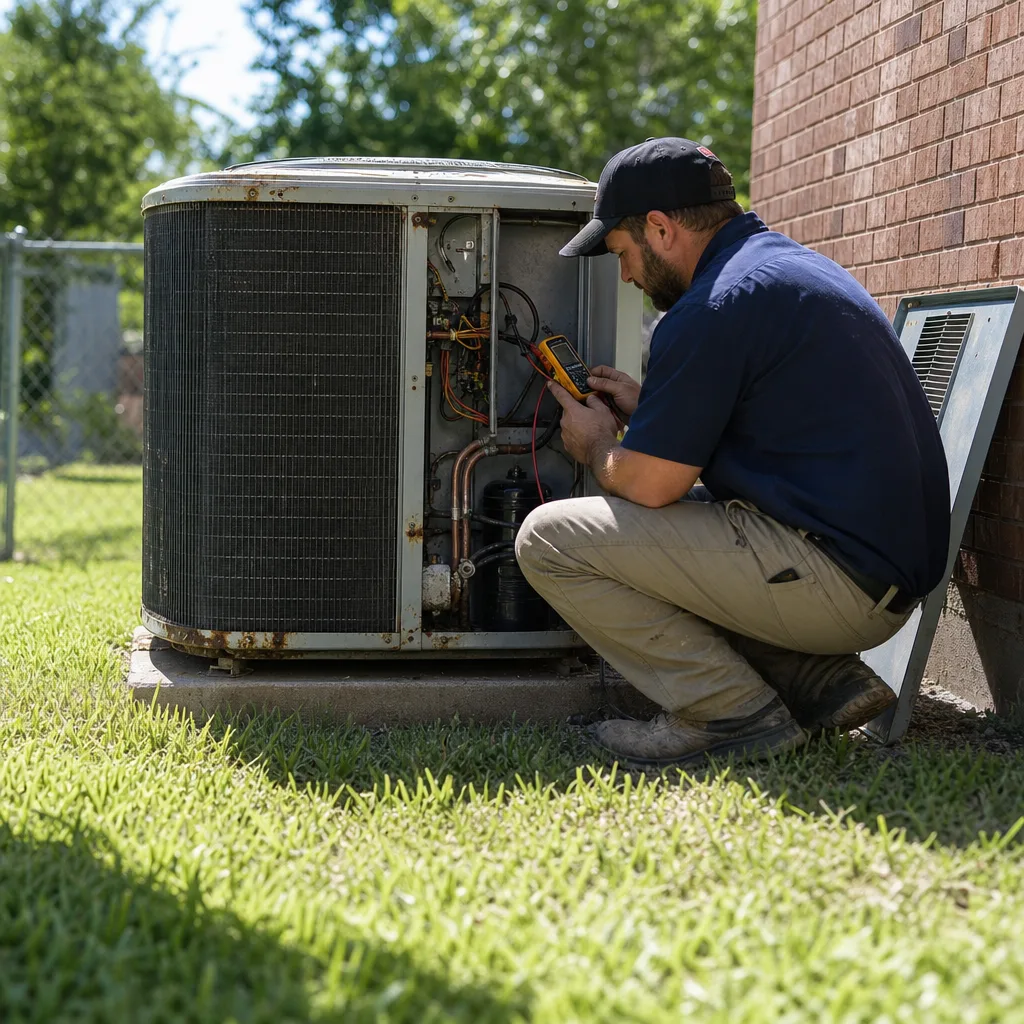
Your AC is a team of parts working together. When one stops doing its job, the whole system acts up in a way that points to the culprit. Here’s what different symptoms usually mean:
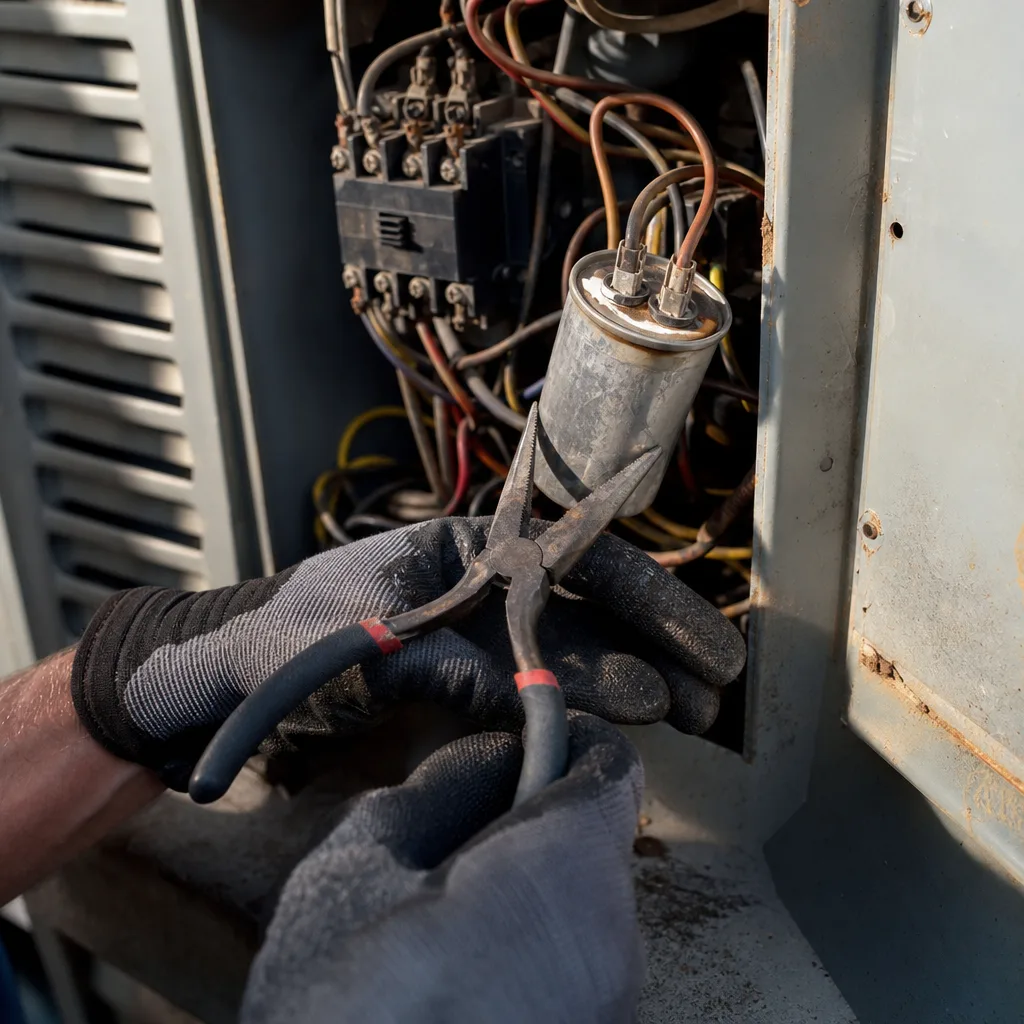
- Warm air from the vents, but the fan inside is running: The outdoor unit may not be starting. A failed capacitor is a common cause. It’s a small part that gives the motors a kick to get going. It can also be a refrigerant leak or a condenser coil caked with dirt and cottonwood fluff.
- Outdoor unit hums but the fan blade doesn’t spin: This often points to the capacitor or the outdoor fan motor.
- Ice on the copper lines or the indoor coil: A frozen coil usually means low refrigerant, a clogged air filter, or a blower that isn’t moving enough air. Once the ice melts, the cause is still there.
- Weak airflow from every room: This can be a dirty filter, a struggling blower motor, or an iced-over evaporator coil blocking the air.
- Water stains on the ceiling, or a system that shuts off on its own: The condensate drain line may be clogged. Many systems have a safety switch that turns the AC off when water backs up.
- Nothing happens at all: Check the thermostat, a tripped breaker, a drain safety switch, or a failed circuit board.
- Clicking, buzzing, grinding, or squealing: Buzzing often means an electrical part is failing. Grinding or squealing usually points to a motor or bearing wearing out.
In many Dallas homes, the indoor half of the system sits in the attic. That space gets brutally hot in summer, which is hard on motors, capacitors, and wiring. The drain line and pan are up there too, right above your ceiling. A clogged line can turn into a water stain before you notice the AC acting strange. If your system lives in the attic, a ceiling spot near the air handler is worth taking seriously.
Some symptoms overlap. Warm air could be a $20 part or a refrigerant leak, and from the hallway you can’t always tell which. That’s why the first step on our end is finding the failed part, not guessing. Once our licensed and insured technician knows what’s wrong, you’ll hear it in plain English, along with what it takes to fix it. You decide before any work starts.
So when you call, tell us what you’ve noticed. Is the outdoor unit running? Do you see ice? Is there water where it shouldn’t be? Did it make a new noise before it quit? Those details help us come prepared and get your home cool again faster.
Act Now or Wait: Reading Your AC Symptoms
Not every AC problem needs a technician today. Some take five minutes to fix yourself. Some can wait a few days for a scheduled visit. A few mean you should turn the system off now. Here’s how to tell which one you’re dealing with.
Before you call anyone, check these things yourself:
- Thermostat: Make sure it’s set to Cool and the set temperature is below the room temperature. If the screen is blank or dim, put in fresh batteries.
- Breaker: Look in your panel for a tripped AC or air handler breaker. Reset it once. If it trips again, leave it off. That second trip is telling you something.
- Air filter: Pull it out and hold it up to a light. If you can’t see light through it, replace it. A clogged filter can cause weak airflow and even a frozen coil all by itself.
- Outdoor unit: Clear away grass clippings, leaves, and anything stacked against the sides. The unit needs room to breathe.
- Ice on the lines: Switch the system off at the thermostat and let the ice melt for a few hours. Running it while it’s frozen only makes things worse.
If one of those fixes it and the AC keeps cooling normally, you’re done. You don’t need us. If the ice comes back or the breaker trips again, the simple fix didn’t reach the real cause.
Some problems can wait for a weekday. Maybe your AC still cools, but not quite like it used to. Maybe it runs a little longer than last summer, or your bill crept up. That’s worth a visit, but not an emergency. Also keep in mind that on a 100-degree Dallas afternoon, a healthy system can run almost nonstop and still fall a few degrees behind. If the house catches up by evening, the system may be doing exactly what it was built to do.
Turn it off and get help today if you notice any of these:
- A burning smell, smoke, or scorch marks near the indoor or outdoor unit
- Loud buzzing or humming from the outdoor unit while the fan won’t spin
- A breaker that trips again right after you reset it
- Water dripping through the ceiling or pooling around the air handler
- No cooling at all while someone in your home is elderly, very young, or sick, and the house is climbing into the 80s
Buzzing with no fan deserves a special mention. Every time the system tries and fails to start, it puts strain on the compressor, the most expensive part of your AC. A weak capacitor caught early is a small repair. Left alone through a few days of hard starts, it can take a much bigger part down with it. Shutting the system off protects that one-part fix.
The same goes for water. A clogged drain line in an attic system is a simple repair. A soaked ceiling is a second problem stacked on top of the first one.
Checks You Can Make Before You Call
You’ve already looked at the thermostat, the breaker, and the filter. If the AC still won’t cool, a few more safe checks can sometimes bring it back. If they don’t, they help you tell us exactly what’s going on.
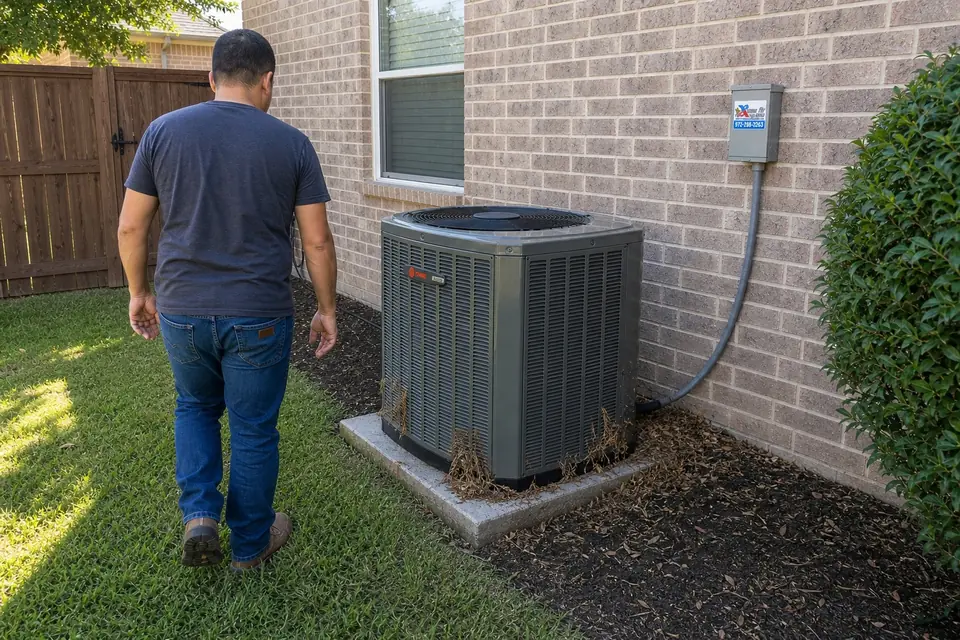
- The outdoor disconnect: Look for a small gray box on the wall near your outdoor unit. Inside is a pull-out block or a switch. If someone mowing or trimming bumped it, the unit won’t get power. Make sure it’s pushed in or switched on. Don’t open anything else on that box.
- The indoor unit’s door: Most air handlers and furnaces have a safety switch that keeps the blower off if the front panel isn’t snapped tight. If someone recently changed the filter, press the panel firmly into place.
- The drain pan and float switch: If your system has a pan under the indoor unit and it’s holding water, a clogged drain line has likely tripped the safety switch and shut the AC off. That’s the cause, not a dead system. Leave it off and tell us what you saw.
- Whole house or one room: If only one bedroom is warm, check that its supply vent is open and nothing is blocking the return grille. A single hot room is often an airflow or duct problem, not a failed part.
If your air handler is in the attic, go up early in the morning. A Dallas attic in July can get dangerously hot by midafternoon. Stay on the walkway or the joists and watch your footing. One wrong step can put a foot through your ceiling.
Know where to stop. Don’t take panels off the outdoor unit, poke at wiring, or touch the capacitor. A capacitor can hold a strong electrical charge even with the power off. Don’t add refrigerant from a store-bought kit, either. If the system is low, it’s leaking, and a kit doesn’t fix the leak.
Before you pick up the phone, take a minute to gather a few details:
- The model and serial number from the metal label on the outdoor unit. A phone photo works fine. It tells our technician the brand, size, and rough age, which helps them bring the right part.
- About how old the system is, if you know.
- Anything that happened right before it quit, like a thunderstorm, a power flicker or Oncor outage, recent hail, or other work done on the system.
- Where the indoor unit sits: attic, closet, or garage.
It also pays to check who’s coming to your home. In Texas, air conditioning contractors are licensed through the Texas Department of Licensing and Regulation (TDLR), and you can look up any license number on its website. Ours is HVAC License #TACLA29023C. Whoever you call, ask for the price of the repair before the work starts, and ask what that price includes. A good company will answer both questions clearly.
Have questions? We’re happy to help.
Call Today, Get Service Today. Xtreme Air Services — Oak Lawn is ready to help.
How a Repair Visit Works, Start to Finish
When your AC quits, the hardest part is not knowing what happens next. How much will it cost just to have someone look? Will you get a price before they start? What if they find a second problem? Here’s how a repair visit with Xtreme Air Services goes, step by step, so none of it catches you off guard.
- You call and talk to a real person. We answer the phone around the clock. Tell us what you’ve noticed, and we’ll get a technician to you the same day. If your AC dies on a Saturday night, you won’t pay extra for it. There’s no extra charge for nights or weekends.
- A licensed technician shows up at your door. Every technician is licensed, background-checked, and drug-tested. You’re letting someone into your home, and you should feel good about who it is.
- The technician finds the failed part. That’s the diagnosis. The service-call fee runs $26-$99, and it’s credited toward the repair if you go ahead with us. So if you approve the fix, that first charge isn’t money lost.
- You hear what’s wrong and what it costs, before anything gets fixed. You’ll get a plain-English explanation and an upfront flat-rate price. No meter running, no hourly surprises. If you say yes, the work starts. If you want to think it over, that’s your call.
- The repair gets done. Your price covers the diagnosis, the labor, and the standard replacement part.
- The system gets tested and the area gets cleaned up. Before the technician leaves, your AC is tested to confirm it runs correctly, and the work area is cleaned up.
Sometimes the technician finds more than one problem. A failing part can wear out the parts around it, and an older system may have a few things going at once. When that happens, you won’t see it slipped into the bill. Extra failed parts, major components like a compressor or coil, code upgrades, and permits aren’t part of the standard repair price. If one of them comes up, it gets quoted separately so you can decide on each one. On larger repairs and replacements, financing is available if that helps.
After the visit, give the system a little time and check it yourself. On a Dallas summer afternoon, a house that’s climbed into the high 80s won’t drop to 72 in twenty minutes, so don’t panic if it takes a while to catch up. What you’re looking for is cool air at the vents, the outdoor fan spinning, and no new noises or water where it shouldn’t be. If your system sits in the attic, the attic heat makes it slower to pull the house down. Steady progress over the next few hours is a good sign.
That’s the whole visit. You know the fee up front. You approve the price before work starts. Every added part gets its own decision. Nothing about it should feel like a gamble.
Watch Our Video
See How We Handle Central air conditioning repair in Dallas
Xtreme Air Services — Oak Lawn
What a Repair Costs and What’s Included
Here’s the number you came for. Central air conditioning repair with Xtreme Air Services typically runs $150-$700. The most common job is finding the one failed part, fixing or replacing it, and checking that the system runs right. That usually costs $150-$400.

That’s a long way from the price of a new system. It’s also why the first step is always a diagnosis, not a sales pitch. Most AC problems are one part, and one part has a one-part price.
Your price depends on what broke. These are the things that push it up or down:
- How bad the failure is: A burned-out capacitor and a leaking coil can cause the same warm air from your vents. They aren’t the same repair.
- Part cost and availability: Some parts are small and easy to find. Others cost more, or take longer to get in.
- Your equipment’s age and brand: Parts for older or less common systems can cost more and be harder to track down.
- More than one failed part: A part that struggled for weeks can wear out the parts around it. Each one adds to the job.
- Time of day: This one won’t change your price with us. There’s no extra charge for nights or weekends, so a Sunday night breakdown costs the same as a Tuesday morning one.
Notice what’s not on that list: how long the technician spends in your attic. With upfront flat-rate pricing, you’re paying for the repair, not the clock. If the attic is 130 degrees and the job runs slow, that’s on us, not you.
Say your outdoor unit hums but the fan won’t spin. If it’s caught early, that’s often a capacitor and a quick fix near the low end of the range. If the system kept trying to start for a few days, the fan motor may be done too. Now it’s two parts, and the price reflects both. You’d see each one and approve each one before any work starts, the same way the visit is laid out above.
When you get a quote, from us or anyone else, read it with three questions in mind. What part failed, and why? Does this price include the part, the labor, and testing afterward? And is anything else on the system close to failing, so you’re not surprised next month? An honest company answers all three in plain words. If the answer is a shrug or “we’ll see,” keep asking.
If the repair turns out to be a major part like a compressor, or your system is old enough that fixing it doesn’t make sense anymore, we’ll tell you that straight. You’ll get the repair price and the honest picture, and the choice stays yours. Financing is there for those bigger jobs if it helps.
Call 469-269-6373
Frequently Asked Questions
Common questions about Central air conditioning repair
How fast can you get a technician to my house in Dallas?
We send a technician out the same day you call, any day of the week. We answer the phone around the clock, so even a Saturday night breakdown gets a same-day visit instead of a wait until Monday.
Will I get charged extra for a weekend or nighttime AC repair?
No, you won’t pay extra for nights or weekends. A Sunday night breakdown costs the same as a Tuesday morning one, so there’s no reason to put off calling just because it’s after hours.
Do I have to pay the diagnostic fee even if I don’t get the repair done?
Yes, the diagnostic visit has a fee, but it’s credited toward your repair if you decide to move forward. The service-call fee runs $26-$99, and that first charge isn’t lost money if you approve the fix.
What if the technician finds more than one broken part during the repair?
You’ll get a separate price and a separate yes-or-no decision for each additional problem. A part that’s struggled for a while can wear out nearby parts, so it’s common to find a second issue, but nothing gets added to your bill without you approving it first.
Ready to Get Started?
Call (469) 269-6373 Today, Get Service Today.