


EV Charger Installation in Dallas: Know What’s Included Before You Book
Level 2 home chargers wired on their own circuit, with your panel checked first so the charger runs at full speed.
What’s Covered on This Page
- Deciding Between Level 1 Charging and a Dedicated Level 2 Circuit
- What a Panel Check Tells You Before Any Circuit Work Starts
- What’s Included in a Dedicated Circuit Installation and What Isn’t
- Why a Permit and a Licensed Electrician Are Required in Dallas
- How a Same-Day Installation Appointment Works
- Are there any incentives for installing an EV charger in Texas?
- Can I just plug my EV straight into a 240-volt outlet without a dedicated charger unit?
- How much does it cost to charge an electric car for 300 miles at home?
Deciding Between Level 1 Charging and a Dedicated Level 2 Circuit
Most EVs come with a cord that plugs into a standard 120-volt outlet. That’s Level 1 charging. It’s slow, often just a few miles of range for every hour plugged in. But slow isn’t always a problem. If your car sits in the garage for 10 or 12 hours each night, that time adds up.
Here’s the honest answer: some folks don’t need us for this. If you mostly drive to work and back, run errands around town, and rarely take long trips, try Level 1 for a few weeks first. Watch your battery each morning. If it’s back where you need it, you’ve saved yourself the cost of an install.
Level 1 starts to fall short in a few common situations:
- You have a long commute, like a daily drive across Dallas and back on the highway, and the car doesn’t recover overnight.
- Two drivers share one EV, so it doesn’t sit still long enough to catch up.
- You come home low and need to head right back out the same evening.
- Your garage outlet shares a circuit with a freezer, shop tools, or a garage door opener, and the breaker keeps tripping while the car charges.
- You’re planning on a second EV down the road.
Level 2 runs on 240 volts, the same kind of power your dryer or range uses. It charges several times faster than Level 1, so a near-empty battery can usually be full again overnight. To do that safely, the charger needs its own dedicated circuit run from your electrical panel. That circuit is what you’re really paying for. It means the charger isn’t fighting your other appliances for power.
Your panel is the big question mark. Many newer homes have room to spare. Some older Dallas homes were built long before anyone pictured a car plugging into the garage, and their panels may be close to full or running near their limit already. That doesn’t mean you can’t get Level 2. It means someone needs to look at your panel’s capacity before you buy a charger, so you know whether it fits as-is or needs more work first.
A quick way to decide: think about your worst normal day, not your average one. If Level 1 can’t cover that day, a dedicated Level 2 circuit will save you stress every week. If it can, stick with what you have. You can always add Level 2 later when your driving changes.
One more tip. If you’re already shopping for a Level 2 charger, hold off until you know what your panel can support. Charger amperage, the distance from your panel to where you park, and how the wire gets routed all shape the job. Knowing those details first keeps you from buying a charger that’s bigger than your home can use.
What a Panel Check Tells You Before Any Circuit Work Starts
A panel check answers one question before anyone buys parts or drills a hole: can your home safely feed a car charger as it is today? It’s the step that keeps the price you hear at the start close to the price you pay at the end.
Here’s what a licensed electrician looks for when they open your panel:
- Your panel’s total size. Most homes have a main breaker rated at 100, 150, or 200 amps. That number is the ceiling for everything in your house combined.
- What’s already using that power. Central AC, an electric range, an electric dryer, and an electric water heater are the big draws. In a Dallas summer, your AC may run for hours each day, so it counts heavily.
- Open breaker spaces. A charger needs room for its own breaker. A panel with no empty slots isn’t a dead end, but it changes the plan.
- The panel’s condition. Scorch marks, rust, loose wires, or two wires crammed under one breaker are things to fix before you add a big new load.
- The path to where you park. How far the garage or driveway is from the panel, and whether wire can run through an attic, along a wall, or in conduit outside.
Put those together and you’ll usually land in one of three places.
Your panel fits as it is. There’s room and enough spare capacity, so the job is a straight install. For the most common job, a Level 2 home charger on a dedicated circuit from the panel, mounted, connected, and tested, our price is $900 to $1,700, and most jobs finish same-day.
It fits with a smaller charger setting. Many Level 2 chargers can be set to draw fewer amps. You’ll charge a bit slower, but for a lot of drivers it’s still plenty overnight, and it can keep you from needing panel work at all. This is why we said earlier to wait on buying a charger until you know your numbers.
It needs more work first. Some older Dallas homes have smaller panels that are already close to full. In that case you may need a subpanel or a panel upgrade before the charger goes in. That’s a separate job, and you should know about it up front, not halfway through.
Knowing what’s included matters just as much. Our install price covers the dedicated circuit, professional installation, mounting, startup, and testing. It doesn’t include the charger if you don’t supply it, panel upgrades, trenching, code corrections, or permits unless stated. Distance from the panel, charger amperage, and how the wire gets routed also move the price up or down, and a panel check puts real numbers on all of that.
If you’d like us to take a look, there’s a $26 to $99 service-call fee, and it’s credited toward the work if you go ahead with Xtreme Air Services. If the check shows you need a bigger job like a panel upgrade, flexible financing is available on qualifying installations and larger jobs, on approved credit.
What’s Included in a Dedicated Circuit Installation and What Isn’t
You’ve already seen the short version of what our install price covers. Here’s what those lines mean when it’s your garage, your panel, and your car.
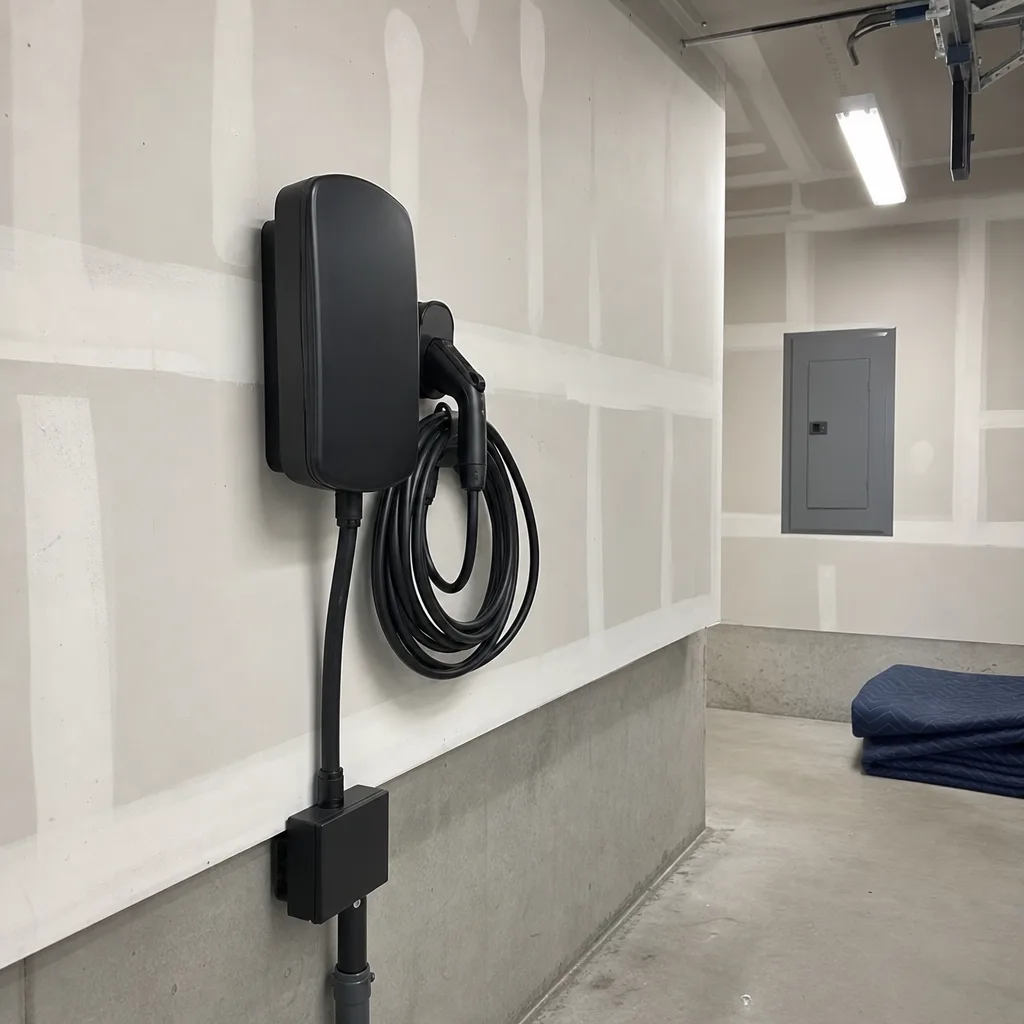
The included part is the core of the job. A new circuit runs from your panel to the spot where you park, used only by the charger. The charger gets mounted, connected, and tested before we call it done. When you walk out to your garage that evening, it should be ready to plug in. For a straightforward setup, most jobs finish the same day.
The excluded items aren’t hidden fees. They’re the parts of a job that change a lot from one house to the next. Here’s how each one tends to show up:
- The charger itself. You can buy your own and we’ll install it, or you can work it out with us before the visit. Either way, check the charger’s amp rating and whether it plugs in or hardwires, because that shapes the circuit.
- Panel upgrades. If the panel check showed your home is short on room or capacity, a subpanel or panel upgrade is its own job. You’ll hear about it before any circuit work starts.
- Trenching. If you want to charge at a detached garage or out at the end of the driveway, the wire may need to go underground. Digging through North Texas clay is real work, and it’s priced on its own.
- Code corrections. Many Dallas homes built between the 1950s and 1990s have wiring that’s fine for everyday use but needs fixing before a big new load is added. Those fixes are separate from the charger circuit.
- Permits. These aren’t part of the base price unless your quote says so. Read that line closely.
Picture two quotes sitting on your kitchen counter. One is a few hundred dollars lower. Look closer and it may leave out the permit, or assume a short wire run when your panel is on the far side of the house. The cheaper number isn’t always the cheaper job. What matters is whether each quote covers the same work.
Before you hire anyone, ask these questions and get the answers in writing:
- Is the charger included, or am I supplying it?
- Is the circuit sized for my charger’s full amperage or a lower setting?
- Where exactly will the charger mount, and what path will the wire take to get there?
- Are permits included in this price?
- Does anything in my panel or wiring need to be fixed first, and what does that cost?
If every answer is clear before work starts, the price you agreed to is the price you pay. That’s the whole point of knowing what’s in the box and what isn’t. You get to decide on each extra with real numbers in front of you, not find out about it halfway through the install.
Not sure what your EV charger installation project needs? Ask us.
Call Today, Get Service Today. Xtreme Air Services — Oak Lawn is ready to help.
Why a Permit and a Licensed Electrician Are Required in Dallas
An EV charger isn’t like plugging in a lamp. It pulls a big load of power for hours at a time, often all night, every night. That’s why the City of Dallas treats a new charger circuit as real electrical work that needs a permit, and why Texas requires that work to be done by a licensed electrician.
Think about how your other big appliances run. Your dryer works hard for maybe an hour, then shuts off. A car charger can run near its full rating from the time you get home until morning. Any weak spot in the circuit, like a loose connection, wire that’s a size too small, or a breaker that doesn’t match the wire, gets hot. In a Dallas garage that’s already sitting at well over 100 degrees in August, that extra heat has nowhere to go.
A permit means someone besides the installer looks at the work. A city inspector checks that the wire, breaker, and protection match what the charger needs. It’s a second set of eyes on a circuit you’ll trust with your car and your garage every night.
It also protects you down the road in ways that are easy to miss:
- Insurance. If something ever goes wrong, an insurer may ask whether the work was permitted and inspected. Unpermitted wiring can make a claim harder.
- Selling your home. Buyers’ inspectors look closely at garages and panels. A permitted, inspected charger circuit is one less question at closing.
- Code changes. Electrical code has added specific safety rules for EV charging, such as certain protection on charging outlets. A licensed electrician working under a permit has to meet the current rules, not the ones from when your house was built.
In Texas, electricians are licensed through the Texas Department of Licensing and Regulation, also called TDLR. That license means the person has passed testing and works under rules the state enforces. Your handy brother-in-law may be great with tools, but a 240-volt circuit feeding a car isn’t the place to find out what he doesn’t know.
Here’s the honest part. The permit can add a little time and some cost to your job, and as we covered above, it isn’t in the base price unless your quote says so. Some installers skip it to come in lower. That lower number can cost you later, when an inspector, an insurer, or a buyer asks for paperwork you don’t have.
Before anyone touches your panel, ask a few simple questions:
- What’s your electrical license number? You can look it up on the TDLR website in a couple of minutes.
- Will a permit be pulled for this job, and is it in this price?
- Who schedules the inspection, and what happens if the inspector asks for a change?
- Are you insured if something gets damaged during the work?
Xtreme Air Services is a fully licensed and insured electrical contractor, and our technicians are background-checked. You should be able to ask us every one of those questions and get a straight answer before work starts. If any installer dodges them, that tells you what you need to know.
Watch Our Video
See How We Handle EV charger installation in Dallas
Xtreme Air Services — Oak Lawn
How a Same-Day Installation Appointment Works
Once your panel has been checked and you know the plan, the install itself is usually the easy part. For the most common job, a Level 2 charger on a dedicated circuit from your panel, most jobs finish the same day. You can head to work with a regular garage and come home to a charger on the wall.
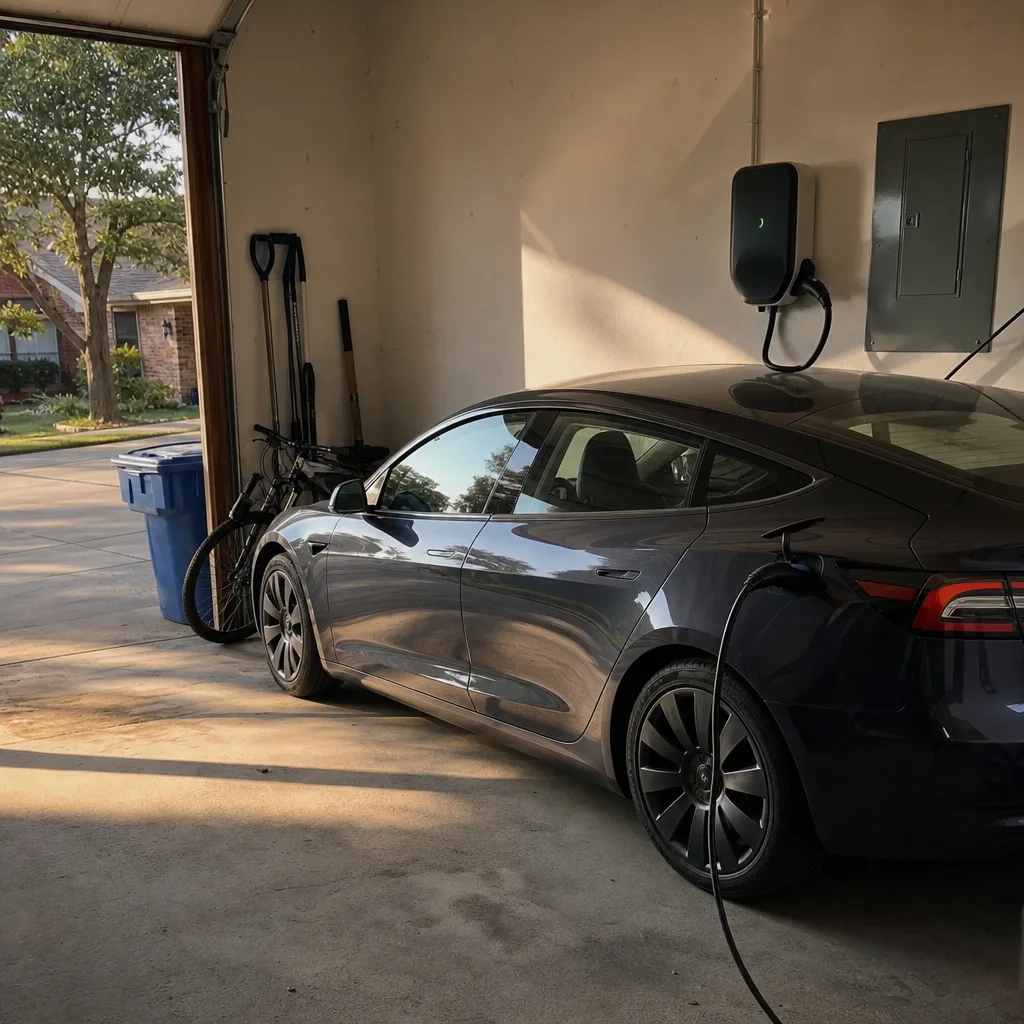
A few minutes of prep on your end helps the day go smoothly:
- Clear the wall where the charger will go, plus a path to your panel. Move bikes, shelves, and storage bins out of the way.
- Know which side of the car your charge port is on, and how you usually park. The charger should sit where the cable reaches without stretching across the floor.
- If you’re supplying the charger, keep it in the box with the manual, and have it on hand before the visit.
- If your charger connects to an app, have your Wi-Fi name and password ready. Check that the signal reaches the garage.
- Make sure the attic access is clear if the wire might run overhead.
Here’s what generally happens during the install. A new breaker goes into your panel. Wire runs from that breaker to the charger, through the attic, along the wall, or in conduit, depending on the route you agreed on. The charger is mounted and connected. Power to the panel has to be shut off while the breaker goes in, so plan on the house being without electricity for part of the visit. If you work from home, keep your laptop charged.
In a Dallas summer, attic work is slow, hot work. Afternoon attic temperatures can climb well past what’s safe to stay in for long, so a long overhead wire run can take more time in July than it would in March. That’s a normal part of working in North Texas, not a sign something’s wrong.
Before anyone packs up, the charger should be started up and tested. Here’s how you can check the work yourself:
- Plug in your car and confirm it starts charging. Your dashboard or app should show the charge rate.
- Look at the new breaker. It should be clearly labeled for the charger.
- Check that the charger is mounted firmly and that the wire or conduit is secured along its whole path.
- Ask what amperage the charger is set to, so you know what speed to expect.
- If a permit was part of your quote, ask when the city inspection will happen. It may be scheduled for a later date.
There shouldn’t be any surprises on the bill. With upfront pricing, you approve the price before work starts, and the only extras are the ones you said yes to after the panel check.
Xtreme Air Services is a licensed and insured electrical contractor. North Texas families have given us a 4.8-star rating across more than 2,900 reviews. If you’re ready to stop waiting on a slow overnight charge, call us and talk to a real person about your garage, your panel, and your car.
Call now
Frequently Asked Questions
Common questions about EV charger installation
Are there any incentives for installing an EV charger in Texas?
Texas doesn’t offer a statewide rebate for home EV chargers, but check with Oncor Electric Delivery for any current efficiency or off-peak charging programs. Some utilities run limited-time offers for Level 2 charger owners, so it’s worth a quick call before you install. A federal tax credit may also apply depending on current IRS rules, so check with your tax preparer.
Can I just plug my EV straight into a 240-volt outlet without a dedicated charger unit?
No, you need a Level 2 charging unit between the outlet and your car, not a direct plug-in. Your EV’s charging cord is built for either a standard 120-volt outlet or a compatible charger, not a bare 240-volt outlet. A licensed electrician needs to install the dedicated circuit and the charger together so the amperage, breaker, and wire all match.
How much does it cost to charge an electric car for 300 miles at home?
It depends on your car’s efficiency and your electricity rate from Oncor, but most EVs use roughly 25 to 35 kilowatt-hours to cover 300 miles. At typical North Texas residential rates, that usually lands somewhere between $3 and $6, far less than a tank of gas. Charging overnight on a dedicated Level 2 circuit also means you’re not paying any premium for speed.
Ready to Get Started?
Call (469) 269-6373 Today, Get Service Today.