


What to Expect During Water Heater Installation: Common Questions and Issues
The sizing, permit, venting, and location problems that turn a straightforward water heater swap into a bigger job – and how we spot them first.
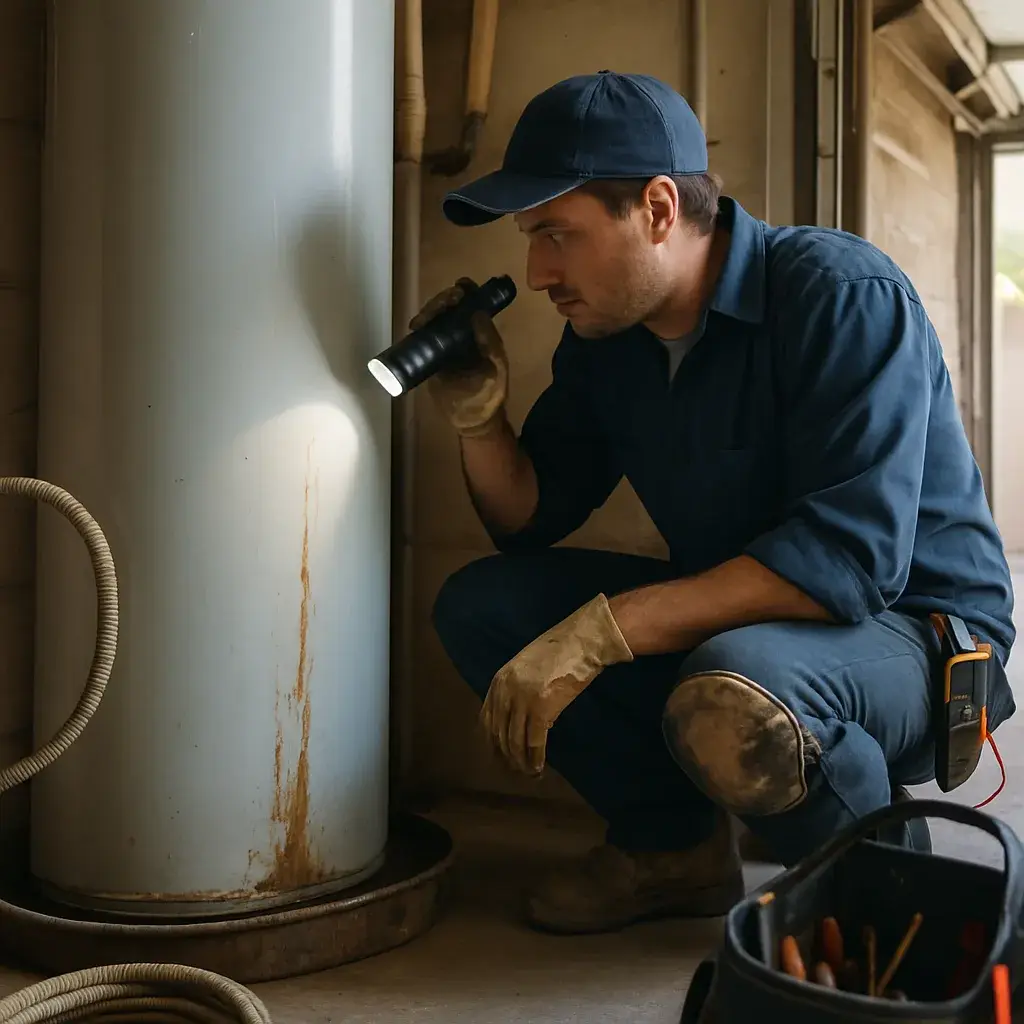
What’s Covered on This Page
- The Questions and Issues People Ask About Most Before Water Heater Installation
- A New Water Heater Sized Like the Old One Doesn’t Always Match Household Demand
- Permits and Code Corrections Can Apply Even on a Straightforward Swap
- Where the Water Heater Is Located Can Change What the Job Involves
- Switching to Tankless Involves More Than Swapping the Unit Itself
The Questions and Issues People Ask About Most Before Water Heater Installation
Tank or tankless comes up on almost every call. A standard tank replacement is the simplest path. It usually connects to your existing gas or electric lines, so it’s faster. A tankless unit runs longer and takes up less space. But it often needs different venting or a bigger gas line. So it’s not always a straight swap. We install both gas water heaters and tankless units. We’ll tell you plainly if your home’s setup makes one option more work than the other.
Sizing is the second big question. A tank that’s too small runs out of hot water during showers. One that’s too big wastes energy heating water you don’t use. We size based on your household’s actual demand. We don’t just swap in whatever number matches the old tank. The old one may have been undersized to begin with, we’ve noticed.
Permits come up more than people expect. Sunnyvale sits across the Dallas and Kaufman county line. Which side your property falls on affects which office handles inspection. We pull permits and schedule inspections when the job needs them. You won’t track down a county office.
People also ask what happens to the old tank. Haul-away of the old unit is part of the installation. So you’re not left figuring out how to move a waterlogged 50-gallon tank yourself.
Financing is a common question too. A water heater failing often isn’t planned for. We offer flexible financing on qualifying installations, subject to credit approval. The timing of a failure doesn’t have to dictate the decision.
One thing worth knowing: if your existing gas line, electrical circuit, or venting doesn’t meet current code, that correction is separate work. It’s not part of the installation itself. We’ll flag it during the visit rather than quietly fold it in or skip past it.
We also handle water heater repair and water tank repair if something needs attention down the road. That’s good to know regardless of who installs the unit.
A New Water Heater Sized Like the Old One Doesn’t Always Match Household Demand
This catches a lot of homeowners off guard. Your old 40-gallon tank did the job for years. So it feels right to put in another 40-gallon tank and move on. But a lot changes in a house over 10 or 15 years. Maybe a teenager now takes longer showers. (We’ve noticed this pattern a lot.) Perhaps you added a second bathroom. Or you finished out the garage with a laundry setup. The household may have grown from three people to five. The old unit was sized for a different version of your home, and matching it exactly won’t account for that.
We size a replacement around how your household uses hot water now. We don’t just guess based on old usage. That means looking at the number of bathrooms. We also consider whether showers tend to overlap in the morning. We check how the washing machine and dishwasher run. And if the kitchen sees a lot of hot water use for cooking or cleanup. A gas water heater recovers hot water faster than an electric one. So the right call depends partly on fuel type. We handle both gas water heater installation and standard electric setups. For households with high or spread-out demand, tankless water heater installation is worth a look. It delivers hot water on demand instead of holding a fixed tank volume. Where the unit sits matters too. Water heaters go in the attic in a lot of homes here, and a taller or wider tank has to fit through the opening and into the framed space that’s already there.
This isn’t about upselling a bigger tank for the sake of it. Sometimes the original size was right. Then a like-for-like water tank installation is the correct call. Other times, a household outgrew its equipment years before the failure that finally forced the replacement conversation. We walk through actual usage with you before we quote anything. A tank that runs out of hot water halfway through a shower isn’t a small annoyance. It’s a daily frustration in your own home.
If you want the full rundown on what we look at, how installation day works, and what’s included, our main service page for water heater installation covers that from start to finish.
A slightly larger tank almost always costs less upfront than switching to tankless. But tankless tends to save more over time on households that use a lot of hot water. Which one makes sense depends on your usage, your fuel type, and sometimes your gas line capacity. That’s a real tradeoff, not a one-size answer.
Permits and Code Corrections Can Apply Even on a Straightforward Swap
Many homeowners think swapping out a water heater is a quick job with no paperwork. Sometimes it is. But the plumbing code changes over time. If your current water heater was put in a while ago, the new one has to meet today’s rules.
Sunnyvale sits across the line between Dallas County and Kaufman County. Where your property falls can change which permit office handles the paperwork. We’re licensed through the Texas Department of Licensing and Regulation (HVAC License #TACLA29023C, Master Plumber Larry Breedlove License #M-15878). Pulling the right permit and scheduling the inspection is how we do the job to code. It’s not an extra step we skip.
This is where a simple swap can get a code correction. An older gas water heater might vent through a setup that no longer meets current standards. Some installs now need a drain pan with a proper drain line, or an expansion tank on the cold supply. A seismic-style strap might be called for depending on placement. None of these are unusual. But they’re also not always there on a unit installed ten or fifteen years ago.
- Venting that doesn’t match current clearance or termination rules
- Missing or undersized expansion tank on a closed system
- No drain pan or drain line where one’s now required
- Electrical or gas connections that predate current code
- Combustion air supply that doesn’t meet today’s spec for the space
Our flat-rate installation price covers the equipment, standard connections, startup, and testing. But duct, electrical, or plumbing modifications and any code corrections aren’t part of that base price. Not unless we’ve already included them in your written quote. If we find something that needs to be brought up to code during the visit, we’ll point it out. We price it separately before we touch it. You’ll make your decision with the full picture.
This is also why we won’t do a labor-only install on equipment bought somewhere else. We can’t verify what we didn’t source. And a code issue tied to that equipment becomes a harder problem to sort out later.
Not sure what your Water heater installation project needs? Ask us.
Call Today, Get Service Today. Xtreme Air Services is ready to help.
Where the Water Heater Is Located Can Change What the Job Involves
Most homes in Dallas and the surrounding area don’t have basements. So your water heater usually ends up in one of three spots: the garage, the attic, or an interior closet. Older slab-on-grade ranch homes (think 1950s through 1990s) tend to put the tank in the garage or a small hall closet. Newer subdivisions, built into the 2000s, often use attic installs to free up living space. Each location changes what our technicians need to do on the job.
- Garage installs: This is usually the easiest access. Gas units need to sit up off the floor per code. Garages store fuel and flammable items, and vapors from a floor-level unit could ignite.
- Attic installs: We need a drain pan under the tank. It needs a line running to the outside. A leak in an attic doesn’t just make a puddle; it comes through your ceiling.
- Interior closets: Combustion air and venting clearances matter here. Older closets built for a smaller tank sometimes can’t fit today’s standard sizes without some rework.
- Slab-on-grade homes with the unit set directly on a garage floor slab: We check for proper elevation and secure connections. North Texas clay soil shifts foundations over time.
Attic jobs almost always take longer than garage jobs. Getting a tank up through an attic hatch, over ceiling joists, and set on a stand isn’t something you rush. And we certainly wouldn’t want our crew rushing either. If your attic access is small or the walkway boards don’t reach the unit, expect us to spend extra time protecting your insulation and ceiling drywall while we work.
Closets present their own challenges. Many older Dallas-area homes have a water heater closet sized for a smaller tank than what’s sold today. When that happens, the swap isn’t purely like-for-like. It can mean adjusting venting, gas or electrical connections, or even the closet framing itself. We won’t know for certain until a technician looks at it. Two closets that look identical from the hallway can have very different pipe runs behind the wall, by the way.
None of this changes whether we get the job done right. It changes how long it takes. It also affects what our technician needs to plan for before touching the first fitting. If you’re trying to figure out the cost based on your setup, our pricing page breaks down what drives the range for different jobs.
Switching to Tankless Involves More Than Swapping the Unit Itself
Going tankless isn’t just a simple swap. Many homeowners are surprised by this. A tank water heater and a tankless unit use gas, air, and power differently. The pipe, vent, and wiring behind the wall often need work too. It’s not just the appliance in front of it.
The gas line is what we look at first. Tankless units fire at a much higher rate to heat water on demand. A gas line sized for an old tank can be too small for a tankless unit. That means upsizing a run of pipe. It’s a Gas line installation job in its own right, not some hidden add-on.
Venting is the second piece. Standard tanks vent one way. Most tankless units need a different venting setup. It has to be built for their exhaust temperature and airflow. Some homes also need an electrical outlet added near the unit for the control board and igniter. This falls under Electrical wiring installation. None of this is unusual. It’s just part of doing a tankless conversion correctly.
- Gas line sizing checked against the new unit’s demand, upsized if needed
- Venting changed to match the tankless unit’s exhaust requirements
- Electrical outlet or wiring added for the control board where required
- Permits and inspections handled when the work requires them
We check all three-gas, venting, and power-during the same-day diagnostic visit. We do this before we write a flat-rate quote. That’s when the real scope of a tankless conversion shows up. And it’s why we’d rather look at your setup in person than quote a tankless swap over the phone. If you want to see how these factors move the total cost, our water heater installation pricing page breaks down what drives the price up or down.
This is also where we’re direct about limits. If your gas meter or line can’t support a tankless unit’s demand without a bigger upgrade than makes sense for your home, we’ll tell you that plainly. We won’t install a unit that struggles to keep up.
Ready to Get Started?
Call 972-288-2263 Today, Get Service Today.