


Water Heater Installation: Repair or Replace – How We Help You Decide
How we decide between repairing a water heater and replacing it – what the tank body tells us, and what a failed part costs instead.
What’s Covered on This Page
- What Decides Repair vs. Replace
- When We’d Recommend a Repair
- When We’d Recommend a Replacement
- What’s Included When You Replace It
- How We Help You Decide
- How do you decide between a repair and a full replacement before you even come out?
- What’s the biggest mistake homeowners make when weighing repair against replacement?
- At what point would you tell me to replace instead of taking a repair payment?
- How does the repair-versus-replace math work?
- Will you install a water heater I bought somewhere else?
- Does financing cover a repair, or only a full installation?
What Decides Repair vs. Replace
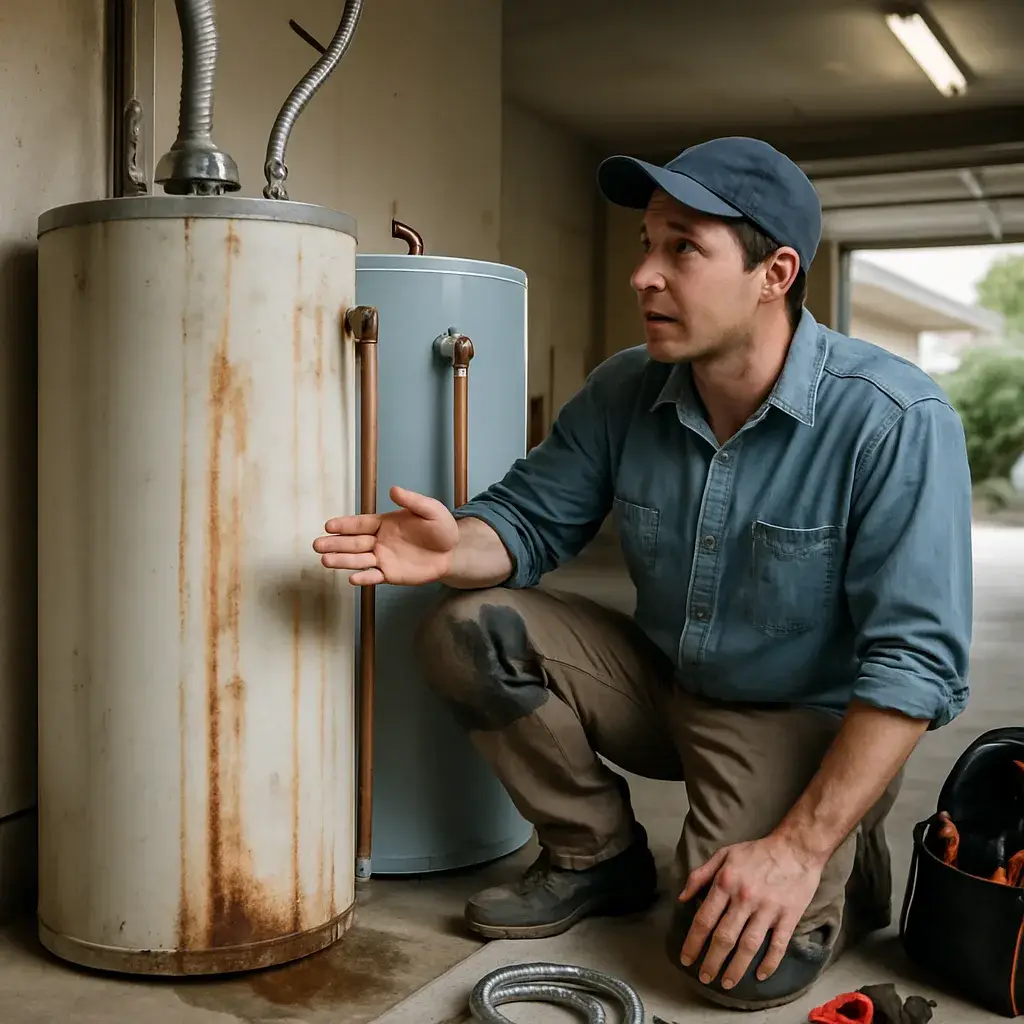
The tank itself is the dividing line. If water is coming from the tank body, not a fitting or valve, that tank is done. Steel tanks corrode from the inside. Once they’re leaking, there’s no patch that holds. If the problem is a part attached to the tank, like a thermostat, a heating element, a gas valve, or a pilot assembly, that’s usually a repair. And it’s much cheaper than a full replacement.
- Age of the unit: most tank water heaters last 8 to 12 years. Repair dollars spent on a unit near the end of that range often don’t make sense.
- Where the failure is: tank corrosion means you replace it. A failed component usually means a repair.
- Repair cost versus installation cost: a full installation costs $1,700 to $2,600 for a standard job. We weigh the repair bill against that number.
- Whether the home’s connections meet current code, since a replacement sometimes triggers needed upgrades a repair wouldn’t.
- Tank versus tankless, since a failing tank unit is a natural point to ask if a tankless setup fits your home better.
We charge a $26 to $99 service-call fee to come out and look at it. That fee gets credited toward the repair if you move forward with us. That visit is where we tell you plainly which category your unit falls into, not a guess over the phone.
If your unit is three years old and the igniter failed, we’re not going to talk you into a new installation just because it’s a bigger job for us. We’ll fix the part. On the other hand, if you’re calling because of a slow leak at the base of a ten-year-old tank, spending money on a repair rarely buys you much time before it fails again. We’ll tell you that too, even when it means a smaller ticket that day.
Installations larger than a like-for-like swap, ones needing new venting, gas line work, or electrical changes, cost more than the standard range. Financing is available on qualifying installations if that helps the decision.
When We’d Recommend a Repair
A repair makes sense when the tank is sound. The problem is usually just one part acting up. We can often fix a bad thermostat, a failed heating element on an electric unit, or a pilot or ignition issue on gas during the same visit. Leaking fittings or worn valves are also common fixes. If your tank holds water without rust streaks or a wet base, that’s a good sign it has more life left.
Age also matters. A unit under 8 to 10 years old with a single failed part is a good repair candidate. Beyond that age, the tank itself starts wearing out from the inside. A repair then won’t buy you much time before something else breaks. Water is hard across the Metroplex, and the sediment it leaves in the bottom of a tank shortens that window. On a unit at the top of that age range, we’d rather talk about replacement than a second repair.
- The tank shows no rust-colored water, corrosion, or moisture pooling at the base
- Only one component has failed
- The unit is younger than roughly 8 to 10 years old
- The repair cost is clearly less than a new install
- The unit has been maintained and hasn’t had repeated failures
Our diagnostic visit finds the actual root cause first. We don’t guess. We explain it in plain language before anything gets fixed. You’ll get a written, flat-rate quote before we touch the unit. You’re deciding with a real number in hand, not an estimate that grows later.
Our service-call fee runs $26 to $99. We credit that amount toward the repair if you move forward with us. That’s true whether the fix is a quick part swap or something more involved. If you’re weighing a repair against starting fresh, our water heater installation service page breaks down replacement costs.
We won’t talk you into a repair just because it’s the smaller ticket. If the tank is old, has spot corrosion, or has needed more than one fix, we’ll say so plainly. We’ll walk you through why a repair likely won’t hold.
When We’d Recommend a Replacement
We lean toward replacing a water heater when the tank itself is leaking, not just a fitting. A leaking tank means the steel inside has failed. That’s not something a part can fix. If we see rust weeping from the bottom seam in your attic or garage, that unit is done.
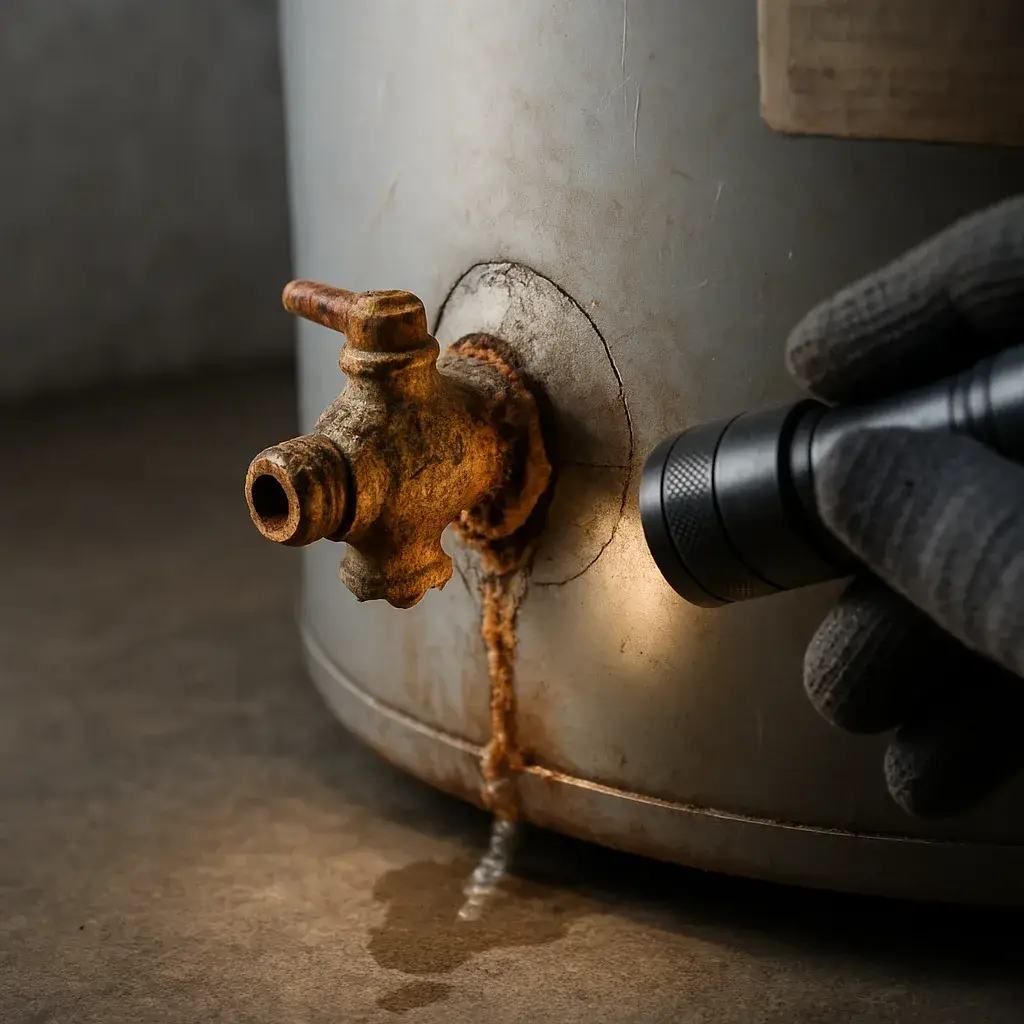
Age also matters. A standard tank water heater in a North Texas attic works extra hard. Attic temperatures here swing from extreme summer heat to winter freezes. That stress builds up over the years. When an old unit has a major issue, like the heating element housing or the tank lining, we usually suggest a new installation. Patching an aging unit often leads to another problem soon after.
Cost is a big part of this decision, and we lay it out clearly. Our call-out fee is $26 to $99. We credit that toward your repair if you move forward with us. A standard, like-for-like installation usually costs $1,700 to $2,600. This covers the equipment, professional installation, startup, testing, and hauling away the old unit. If a repair estimate gets close to a good chunk of that replacement cost on an older unit, replacing it often makes more financial sense long-term. (Who wants to pay twice?)
- Tank is leaking from the shell or bottom seam, not just a valve or fitting.
- Unit is old enough that finding matching parts is slow, or the part itself is discontinued.
- You’ve already had one or more repairs, and the next issue is unrelated to the last one.
- Repair cost approaches a large share of a new like-for-like install.
- You want to move to a tankless setup, which is a replacement decision, not a repair.
We generally don’t install a water heater you’ve bought elsewhere. Our workmanship guarantee covers equipment we source and stand behind. Sizing, brand, and efficiency choices adjust the price within that $1,700 to $2,600 range. Things like ease of access and any necessary code corrections also play a part. We’ll walk you through the specific numbers for your unit and your home before we schedule anything. Financing is also available on qualifying installations if that helps.
Not sure what your Water heater installation project needs? Ask us.
Call Today, Get Service Today. Xtreme Air Services is ready to help.
What’s Included When You Replace It
A standard water heater installation runs from $1,700 to $2,600. That covers a typical like-for-like job. It uses your existing connections, of course. This price includes the equipment, materials, installation labor, startup, testing, and hauling away your old tank. We don’t charge extra for testing the unit. We make sure it’s working right before we leave. And you’re not left with a dead tank in your garage.
That price doesn’t cover any changes to your current setup. If your gas line, electrical circuit, or plumbing needs modification to fit the new unit, that’s a separate line item. Code corrections are also extra. If your current install isn’t up to code, we have to fix that. It’s part of any legal replacement, and it adds to the job. Permits aren’t in the base price either, when your job requires one.
The price range depends on a few things. Tank size and capacity matter, for example. A 40-gallon tank costs less to install than an 80-gallon unit. Efficiency rating also plays a role. A higher-efficiency tank often costs more upfront. Brand and model shift the number. And how easy the old unit is to get to. A tank in an easy-access closet is different from one crammed in an attic. We see that often in older Sunnyvale or Mesquite homes. Any custom fabrication for venting or piping pushes the price up.
- Included: new equipment and materials, professional installation, standard connections, startup and testing, haul-away of your old unit
- Not included: duct, electrical, or plumbing modifications beyond standard hookups
- Not included: code corrections needed to bring an old install up to current requirements
- Not included: permits, unless we’ve stated they’re part of your quote
- A $26 to $99 service-call fee applies for the visit, and it’s credited toward the job if you move forward with us
We give you the written, flat-rate number before anyone touches your water heater. You see the total and any repair-or-replace tradeoffs in one place. Larger installs get scheduled at a time that works for you. We don’t rush those same-visit. On qualifying installations, financing is available on approved credit. That makes sense if spreading out the cost works better than paying it all at once.
How We Help You Decide
If the tank itself is leaking, or it’s past the 8 to 12 year mark, we’re going to talk replacement. That’s typical for tank water heaters in North Texas. If it’s just a part, like a thermostat, heating element, or a bad valve, repair usually makes more sense if the tank is sound.
Age is the first thing we look at. Hard water across the DFW area speeds up sediment buildup inside a tank. That sediment shortens the life of heating elements and the tank lining. A 10-year-old unit with a failed part is a different conversation than a 3-year-old unit with the same failed part. The part still costs the same.
Cost is the second factor, and this is where the numbers matter. A standard, like-for-like water heater installation using existing connections typically falls between $1,700 and $2,600. The full range lands between $1,200 and $3,500. This depends on tank size, efficiency, and how much plumbing work is needed. If a repair is going to cost close to that same range, replacing usually gets you more life for the money. Plus, you get a fresh manufacturer’s equipment warranty on the new unit.
We’ll also ask what you want out of the next unit. Some homeowners stick with a standard tank. Others move to a tankless water heater installation for space savings and on-demand hot water. Or you might switch to a gas water heater installation if that fits your home’s setup better. None of these are automatic upgrades. They’re a fit question, based on your household and your existing gas or electric service.
- Age of the current unit and if it’s near or past typical tank life
- If the tank itself is leaking, or if it’s a repairable part failing
- Cost of the repair compared to the typical $1,700 to $2,600 replacement job
- Efficiency and capacity needs, including tank versus tankless
- Condition of existing connections-modifications add cost beyond standard installation
We won’t repair a cracked or actively leaking tank. There’s no fix for that, only a replacement. Outside of that, we’ll lay out both options on the visit. Sometimes a repair really is the right call, especially on a newer unit with a single failed part.
If we come out for a service call, that $26 to $99 call-out fee gets credited toward the repair if you move forward with us. Before any installation work starts, you get a written, flat-rate price. It spells out repair-or-replace options plainly, plus financing if that helps on a larger job. No work happens without your sign-off on the number first.
Frequently Asked Questions
Common questions about Water heater installation
How do you decide between a repair and a full replacement before you even come out?
We can’t make that call over the phone. During the visit, we check whether water is coming from the tank body or from an attached part, then weigh the repair cost against a full installation, which runs $1,700 to $2,600 for a standard job. A leaking tank almost always means replacement. A failed thermostat, element, or igniter is usually a repair. We give you a flat-rate quote before we touch anything.
What’s the biggest mistake homeowners make when weighing repair against replacement?
Many assume age alone should decide it, but where the failure sits matters more. A tank under 8 to 10 years old with one failed part is usually worth repairing, even if it’s not brand new. A tank leaking from the shell needs replacing no matter how young it is. We also watch whether the failed part is still available, since a discontinued or hard-to-find part can tip the decision toward replacement.
At what point would you tell me to replace instead of taking a repair payment?
We’d say replace once the tank shell itself is leaking, once repair estimates get close to the $1,700 to $2,600 replacement range, or once you’ve already had more than one unrelated repair on the same unit. We’d rather tell you that plainly than collect a smaller repair fee today and have you calling again soon after.
How does the repair-versus-replace math work?
We compare your repair estimate directly against the cost of a full installation, which runs $1,700 to $2,600 for a standard tank swap. Our service-call fee is $26 to $99, and we credit that toward the repair if you move forward with us. If the repair bill starts closing in on a large share of that installation range, replacement usually makes more financial sense.
Will you install a water heater I bought somewhere else?
Generally, no. We source the equipment ourselves so our workmanship guarantee applies to the unit we install. If you’re set on a specific model you found elsewhere, we won’t be the right fit for that particular job, but we’re happy to help you pick equipment within the $1,700 to $2,600 range for a standard installation.
Does financing cover a repair, or only a full installation?
Financing applies to qualifying installations and larger jobs, on approved credit. It’s not typically the route for a smaller repair, since most repair bills are already well under the cost of a new installation. If your situation is closer to a full replacement, financing can make that $1,700 to $2,600 range easier to manage.
Ready to Get Started?
Call 972-288-2263 Today, Get Service Today.