

Federal law requires a professional asbestos inspection before any renovation or demolition that will disturb building materials. Under NESHAP (40 CFR Part 61), owners and operators must thoroughly inspect the affected facility for asbestos-containing materials (ACMs), including Category I and II nonfriable materials, before work begins. OSHA’s construction standard (29 CFR 1926.1101) adds worker-safety obligations on top of that. Skip the inspection and you are not just taking a health risk — you are in violation of federal law before the first wall comes down.
The health stakes are serious. Asbestos fiber inhalation causes asbestosis, lung cancer, and mesothelioma, and symptoms can take decades to appear. That long latency is exactly why inspections matter: by the time anyone gets sick, the exposure happened years ago during a renovation nobody documented.
Immediate actions for facility managers:
- Stop and schedule a pre-construction asbestos survey before any work disturbs walls, ceilings, floors, or mechanical systems.
- Preserve schedule windows for sampling, lab analysis, and any required abatement.
- Notify all contractors not to disturb suspect materials until the survey is complete.
Before the survey, confirm:
- The inspector holds current state asbestos inspector certification.
- The lab is accredited for bulk asbestos analysis (NVLAP or state equivalent).
- The survey scope covers all areas the remodel will touch, including concealed spaces.
Pro Tip: Build at least two to three weeks of lead time into your project schedule for sampling and lab turnaround. If lab analysis cannot be completed before work starts, the legal default is to presume the material contains asbestos — which means regulated disposal costs apply automatically.
Table of Contents
- Which federal and state rules require asbestos inspections?
- When does a facility actually need an asbestos inspection?
- What does an asbestos inspection actually include?
- Who is qualified to perform an asbestos inspection?
- What to do when asbestos is found
- Notifications, permits, and recordkeeping you cannot skip
- How inspections affect timelines, budgets, and common mistakes
- How to integrate an asbestos inspection into your renovation workflow
- Key Takeaways
- The inspection step most facility managers underestimate
- Xtremeairservices can help you coordinate inspection and renovation
- Useful sources for facility managers
- FAQ
Which federal and state rules require asbestos inspections?
NESHAP under 40 CFR § 61.145 is the baseline federal standard. It requires owners and operators to inspect the affected portion of any facility before demolition or renovation that will disturb building components. The rule covers all regulated asbestos-containing material (RACM) and both Category I and Category II nonfriable ACM. Failure to inspect is a federal violation, full stop.
OSHA’s 29 CFR 1926.1101 runs parallel. Building and facility owners must identify all thermal system insulation, sprayed or troweled surfacing materials, and resilient flooring installed before 1981 at any worksite. They must notify prospective employers bidding on the work, employees in adjacent areas, and all tenants who will occupy spaces containing ACM. Employers who discover asbestos on a job site must notify the building owner and other on-site employers within 24 hours of its presence, location, and quantity.
State agencies implement and often extend these federal requirements. Florida DEP, for example, requires written surveys or certifications before issuing demolition or renovation permits. North Carolina’s Division of Public Health requires an accredited asbestos professional to inspect before any demolition begins, and state permits are separate from local building permits. Checking your specific state’s environmental agency requirements is not optional — some states impose stricter thresholds than the federal baseline.
Who is legally responsible? The owner or operator of the facility carries the primary duty to arrange and fund the inspection. Contractors share responsibility for following the results. If a contractor disturbs ACM without proper notification or controls, both the owner and the contractor face enforcement exposure.
Regulatory citation to keep on file: 40 CFR Part 61, Subpart M (NESHAP); 29 CFR 1926.1101 (OSHA Construction Asbestos Standard). State-level implementers vary — confirm your state environmental agency’s specific permitting and notification requirements before project kickoff.
Documentation the owner must produce: a written survey report, chain-of-custody lab paperwork, NESHAP notification receipts, and any state permit confirmations. These records are your legal defense if enforcement or litigation follows.
When does a facility actually need an asbestos inspection?
The trigger is disturbance of building materials, not the age of the building. NESHAP does not set a construction-date cutoff. Asbestos has never been fully banned in the United States, and some products still in use today can contain it.
Common project triggers that require an inspection:
- Full or partial demolition of any structure
- Renovation that will disturb walls, ceilings, floors, or roofing
- Removal or replacement of pipe insulation, duct wrap, or mechanical equipment
- Major HVAC, electrical, or plumbing upgrades that require opening building cavities
- Intrusive maintenance work, such as cutting into fire-rated assemblies or removing ceiling tiles at scale
Timing is where most facility managers get into trouble. Ordering a survey after bids are out — or worse, after a contractor has mobilized — turns a manageable cost into an emergency. Treating asbestos inspections as optional leads to expensive surprises; early surveys let managers budget for abatement and prevent project stoppages.
Survey must be complete before:
- Issuing the bid package to contractors
- Submitting for building permits
- Contractor mobilization and site setup
- Any demolition or intrusive work begins
Allow a minimum of two to three weeks for a full-access survey, destructive sampling where needed, and lab turnaround. For large or complex facilities, four to six weeks is more realistic.
What does an asbestos inspection actually include?
A professional asbestos survey is not a quick visual check. It is a structured process that produces a legally defensible inventory of every ACM in the areas the project will affect.
The three survey types
Management survey: Used during normal building occupancy to identify ACMs and inform an ongoing asbestos management plan. Covers accessible areas and is minimally intrusive. This type is appropriate for routine maintenance planning, not for a remodel that will open walls or remove structural elements.
Refurbishment/demolition survey: Required before any renovation or demolition that will disturb the building fabric. This survey is intrusive — it may require opening wall cavities, lifting floor coverings, and removing ceiling tiles to access concealed materials. The area must be vacated during the survey, and the surveyor must confirm it as fit for reoccupation before anyone returns.
Pre-construction/project-design survey: A targeted version of the refurbishment survey, scoped specifically to the areas a planned project will affect. It feeds directly into abatement cost estimates and project design.
| Survey Type | Purpose | Intrusiveness | When Required | Area Access |
|---|---|---|---|---|
| Management | Ongoing ACM management plan | Low | Normal occupancy | Accessible areas only |
| Refurbishment/Demolition | Identify all ACMs before structural work | High | Before any renovation or demolition | Full building or affected zone; vacated |
| Pre-Construction/Design | Inform project scope and abatement costs | Moderate to high | Before bids and permits | Project-specific areas |
What the on-site process looks like
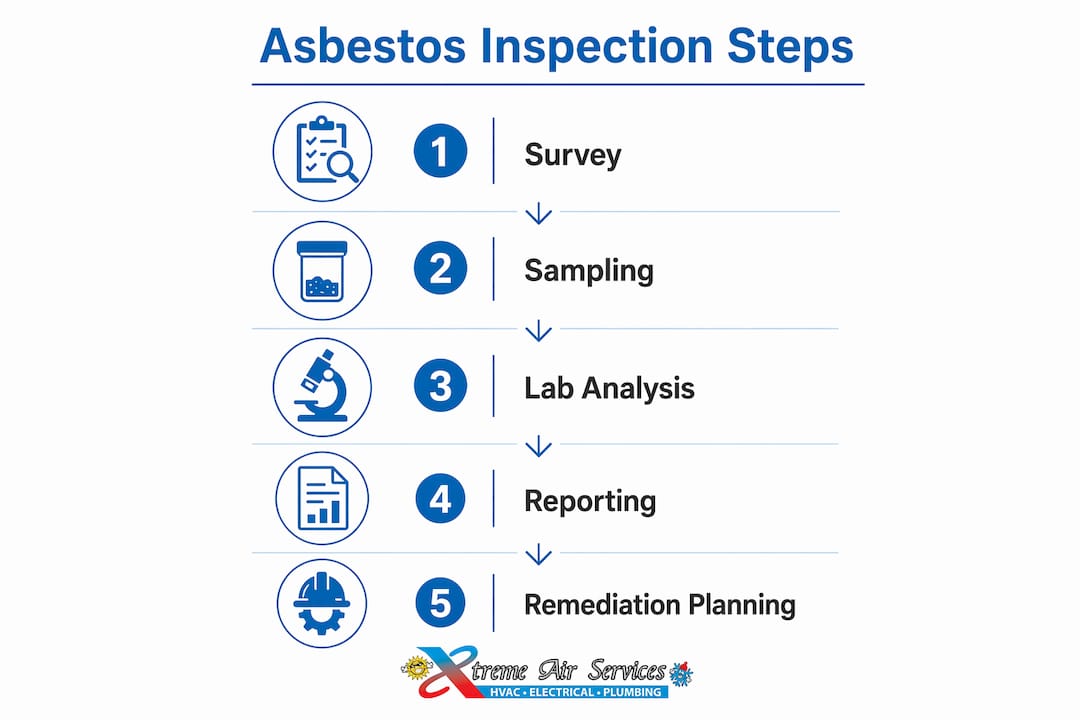
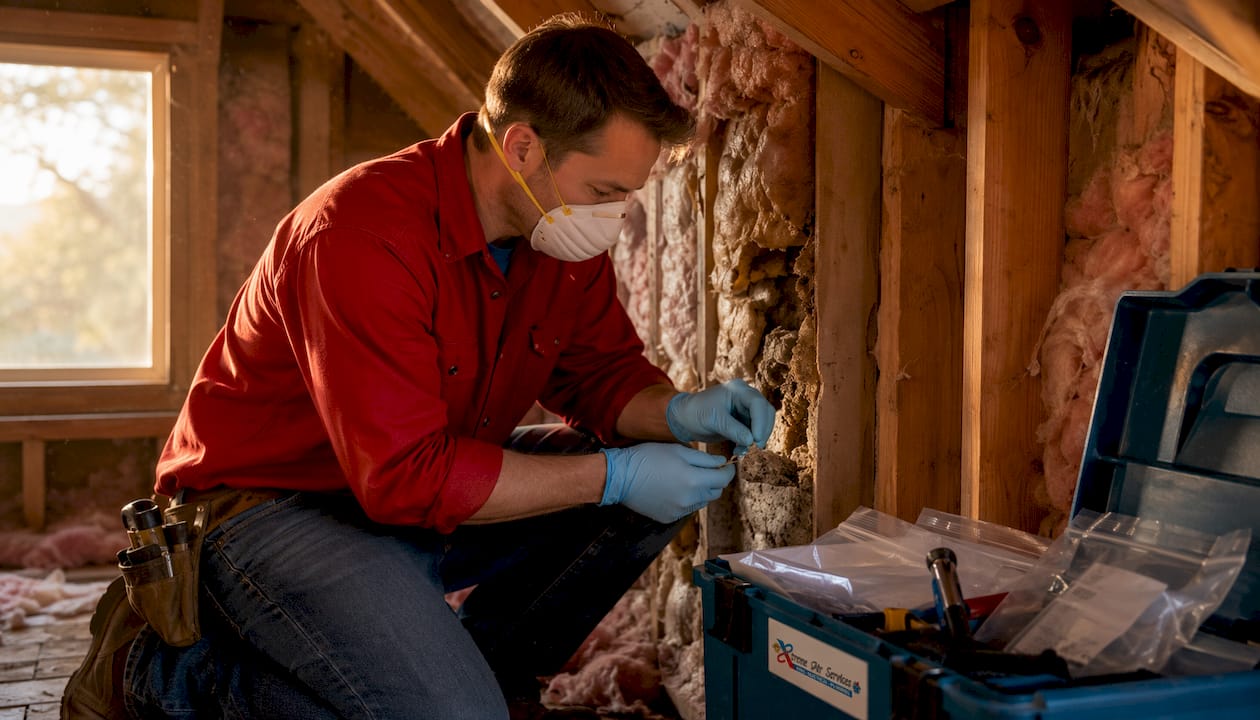
The inspector walks the facility, identifies suspect materials, and collects bulk samples using destructive access where necessary. A professional pre-construction survey involves walk-throughs, bulk sampling, and a report that inventories ACM locations, amounts, and condition. Samples go to an accredited lab for polarized light microscopy (PLM) analysis, which is the standard method for bulk asbestos identification.
A completed inspection report should include:
- Inventory of all ACMs with exact locations, quantities, and condition ratings
- Photographs of each identified or presumed material
- Lab results with chain-of-custody documentation
- Recommended response actions: remove, encapsulate, or manage in place
- Estimates useful for abatement planning and contractor scoping
Pro Tip: Insist that the surveyor’s scope explicitly covers concealed spaces the remodel will reach — wall cavities, above drop ceilings, below raised floors, inside mechanical chases. Any area the inspector cannot access must be presumed to contain asbestos, which drives regulated handling costs whether or not asbestos is actually there.
Who is qualified to perform an asbestos inspection?
Not every contractor or home inspector is qualified. Using an unqualified inspector produces a report that will not satisfy NESHAP, state permitting offices, or your insurance carrier.
Required credentials to verify before hiring:
- State asbestos inspector certification — most states require inspectors to hold a current state-issued license. Confirm the license is active and covers the type of survey you need.
- EPA/AHERA accreditation — for federally regulated facilities, inspectors must meet EPA-accredited training requirements under AHERA (40 CFR Part 763).
- Laboratory accreditation — the lab analyzing bulk samples must hold NVLAP accreditation (National Voluntary Laboratory Accreditation Program) or an equivalent state-recognized accreditation for asbestos bulk analysis.
- Liability insurance — the inspector should carry errors-and-omissions coverage specific to environmental consulting.
Questions to ask prospective inspectors before signing a contract
- Does your scope include destructive sampling in concealed spaces the remodel will affect?
- What is your lab’s turnaround time, and will you provide written confirmation of that commitment?
- How do you handle areas you cannot access during the survey?
- Can you provide your current state license number and the lab’s NVLAP certificate?
- Who holds the chain-of-custody documentation, and how is it transferred to us?
Survey reports form essential documentary evidence if health claims or regulatory disputes arise after construction. A report from an accredited inspector and an accredited lab is defensible in court and in front of a regulator. A report from an uncredentialed inspector is not. That distinction matters when an enforcement audit or a personal injury claim arrives years after the project closes.
What to do when asbestos is found
Finding asbestos does not automatically stop a project. It changes how the project proceeds.
Manage in place vs. abatement
Manage in place is appropriate when ACMs are intact, in good condition, and the renovation will not disturb them. The owner documents the location and condition, monitors the material periodically, and restricts access. This is the lower-cost option and is often the right call for materials in areas outside the remodel scope.
Abatement (removal or encapsulation) is required when the renovation will disturb ACMs, when materials are in poor condition and friable, or when demolition will affect the area. Only licensed abatement contractors may perform this work. After abatement, clearance testing verifies that airborne fiber levels are below re-occupancy thresholds before workers or occupants return.
When asbestos is discovered mid-project, OSHA requires notification to the building owner and all other on-site employers within 24 hours. That clock starts the moment discovery occurs — not when the paperwork is convenient. Emergency work stoppages, contractor workflow disruptions, and insurer notifications can follow immediately.
Contractor coordination best practices
Separate the abatement scope from the general construction scope in your bid documents. Abatement contractors work under different regulatory requirements, use different PPE and decontamination protocols, and must complete and clear their work before general trades can re-enter the affected area. Mixing these scopes in a single contract creates liability confusion and scheduling conflicts.
Pro Tip: A limited-scope inspection that excludes concealed spaces is more dangerous than no inspection at all. It gives a false sense of clearance while leaving legally presumed asbestos in areas workers will open. Require full-access surveys, and if access is genuinely impossible, document it and stage the survey as demolition progresses.
Notifications, permits, and recordkeeping you cannot skip
Federal and state rules impose specific paperwork milestones. Missing one can void your compliance position even if the physical work was done correctly.
Required notifications and permits:
- NESHAP pre-demolition/renovation notification to the EPA or delegated state/local authority before work begins (required when RACM thresholds are met)
- State environmental agency notification or permit — state agencies implement and sometimes extend federal rules; some require written surveys or certifications before issuing permits
- Local building permit asbestos declaration — local permits are separate from state permits; satisfying one does not satisfy the other
- OSHA notifications to employees, tenants, and other employers as required by 29 CFR 1926.1101
Records to retain after the project:
- Signed asbestos survey report with inspector credentials
- Lab results and chain-of-custody documentation
- NESHAP notification receipts and any state permit confirmations
- Contractor abatement records, waste manifests, and disposal receipts
- Clearance testing results and re-occupancy certificates
Retain these records for the life of the building. Enforcement actions and personal injury claims can arrive years after project completion. An accredited inspection report shows proactive stewardship and provides defensible records for enforcement audits or litigation. Without them, the presumption shifts against the owner.
How inspections affect timelines, budgets, and common mistakes
The cost of a proper asbestos inspection is modest compared to what happens when asbestos is discovered after demolition begins. Emergency abatement, work stoppages, regulatory notifications, and potential fines can dwarf the original project budget.
Typical schedule impacts to plan for:
- Survey scheduling and site access: 3–7 days
- Lab turnaround for bulk samples: 5–15 business days (standard); 24–48 hours (rush, at higher cost)
- Abatement mobilization and execution: varies by scope, typically 1–4 weeks
- Clearance testing and re-occupancy verification: 1–3 days after abatement
If lab turnaround time is shortened or access is restricted, the legal safe default is to presume asbestos presence. That presumption drives regulated handling and disposal rules that increase cost and complexity. Presuming asbestos raises handling and disposal to RACM standards, which are significantly more expensive than ordinary construction waste disposal.
Common mistakes facility managers make:
- Treating the inspection as a checkbox rather than a project-planning input
- Restricting surveyor access to “non-sensitive” areas, leaving concealed spaces uninspected
- Failing to build lab turnaround time into the project schedule
- Issuing contractor bids before the survey is complete, then scrambling when ACM is found
- Bundling abatement scope into the general contractor’s bid instead of separating it
Mitigation strategies that actually work: Stage renovation work so abatement in one zone can proceed while planning continues in others. Include an asbestos contingency line in the project budget — typically 5–15% of the renovation cost in older buildings. Require pre-bid surveys as a condition of issuing bid documents. For phased commercial renovation, this staging approach also minimizes occupant disruption.
Pro Tip: Budget for possible asbestos issues before bids go out, not after. An asbestos contingency written into the contract protects both the owner and the contractor from scope disputes when hidden ACM surfaces during demolition.
How to integrate an asbestos inspection into your renovation workflow
Getting the sequence right is what separates a smooth project from a costly one. Here is the operational order that works:
- At project planning stage: Commission the pre-construction or refurbishment/demolition survey as soon as the project scope is defined. Do not wait for design drawings to be finalized.
- Before issuing bid documents: Confirm lab results are in hand. Include the survey report and ACM inventory in the bid package so contractors can price abatement accurately.
- Before permit application: Attach the survey report and any required NESHAP notification receipts to the permit application. Some jurisdictions will not issue permits without them.
- Before contractor mobilization: Confirm abatement scope is contracted separately, the abatement contractor holds current state licensure, and a pre-mobilization safety briefing covers ACM locations with all trades.
- After abatement: Obtain clearance testing results and a re-occupancy certificate before general trades re-enter the affected area. Coordinate post-abatement HVAC clearance to verify duct systems were not contaminated.
Coordination tips: Include the inspection scope explicitly in the bid package as a separate line item. Confirm lab turnaround commitments in writing before the survey begins. Brief all trades on ACM locations at the pre-construction meeting — not just the abatement contractor.
For professional inspections across trades, coordinating safety checks before mobilization is standard practice in well-run facilities programs.
Pro Tip: Use the completed inspection report to create a standalone asbestos work package — a document that maps every ACM location to the project scope and specifies the required response action. Require every subcontractor to sign off on it before mobilization. That signature is your documentation that each trade understood the hazard before touching the building.
Key Takeaways
Facilities must complete a professional asbestos inspection before any renovation that disturbs building materials because federal NESHAP rules, OSHA worker-safety standards, and state environmental requirements all mandate it — and late discovery triggers regulated disposal costs, work stoppages, and enforcement liability.
| Point | Details |
|---|---|
| Federal law mandates inspection | NESHAP (40 CFR § 61.145) requires inspection of all affected areas before demolition or renovation that disturbs ACMs. |
| Schedule surveys early | Allow two to six weeks for survey access, lab turnaround, and any abatement before contractor mobilization. |
| Use certified inspectors and accredited labs | State-licensed inspectors and NVLAP-accredited labs produce reports that hold up in permitting, enforcement, and litigation. |
| Retain all documentation | Survey reports, lab results, NESHAP notifications, abatement records, and clearance certificates must be kept for the life of the building. |
| Xtremeairservices coordinates inspection timing | Xtremeairservices integrates asbestos inspection scheduling with HVAC, electrical, and remodeling scopes to keep Dallas-area projects on track. |
The inspection step most facility managers underestimate
The conventional wisdom treats asbestos inspections as a compliance hurdle — something you do to satisfy the permit office and move on. That framing misses the real value.
An inspection report is a project-management tool. It tells every trade on your job site exactly where the hazardous material is, what condition it is in, and what they are and are not allowed to do near it. When that information is in the bid package from day one, contractors price the work accurately, abatement gets scheduled without disrupting the critical path, and nobody is surprised when a wall cavity opens up. When it is missing, every trade is working with incomplete information, and the first person to hit an unexpected ACM becomes the trigger for a cascade of notifications, work stoppages, and emergency costs.
The facilities that handle this well treat the survey report the way a structural engineer treats a soil report — as foundational project data, not a box to check. That shift in framing changes how the whole project runs. It also protects the facility manager personally: a documented, proactive inspection is the clearest evidence that reasonable steps were taken to identify and control the hazard. Without it, the legal presumption runs the other way.
Xtremeairservices can help you coordinate inspection and renovation
When a remodel touches HVAC, electrical, and structural systems at the same time, coordinating an asbestos inspection with every trade scope is genuinely complicated. Xtremeairservices handles that coordination for Dallas-area facility owners and managers — scheduling inspection timing around HVAC, electrical, and remodeling work so abatement and clearance testing do not create gaps in the project timeline.

Xtremeairservices provides pre-renovation coordination, referrals to licensed abatement contractors, permit-assistance support, and post-abatement HVAC clearance services to verify duct systems are clean before re-occupancy. For facilities that also need electrical work during the remodel, the team coordinates electrical services in Dallas alongside the abatement schedule to avoid re-entry conflicts. Contact Xtremeairservices to get your inspection timeline built into the project plan before bids go out.
Useful sources for facility managers
These are the primary references to bookmark and cite when working with contractors, permitting offices, and legal counsel:
- 40 CFR § 61.145 (NESHAP): The federal regulation that mandates pre-renovation and pre-demolition asbestos inspections. This is the citation your permit office and legal team will ask for.
- OSHA 29 CFR 1926.1101: The construction industry asbestos standard covering worker protection, notification duties, and competent-person requirements.
- ATSDR: Health effects of asbestos: CDC/ATSDR public health guidance on asbestosis, lung cancer, and mesothelioma — the health evidence base for why inspections are required.
- EPA: Asbestos laws and regulations: Overview of federal asbestos rules, including NESHAP, AHERA, and the Toxic Substances Control Act (TSCA).
- Florida DEP: Asbestos FAQ: Example of state-level implementation; useful for understanding how states extend federal requirements and what certifications and permits they require.
- ASTM E2356-18: Standard guide for asbestos surveys — the technical standard inspectors follow for pre-construction and project-design surveys.
- HSE: Arrange an asbestos survey: UK Health and Safety Executive guidance on survey types and the duty to manage; widely referenced for survey methodology even in U.S. practice.
- Contractor site safety coordination: Practical contractor safety workflow guidance relevant to abatement site setup and multi-trade coordination.
FAQ
Should you test for asbestos before any renovation?
Yes. Federal NESHAP rules require inspection before any demolition or renovation that will disturb building materials, and OSHA imposes parallel worker-safety obligations. Skipping the test exposes the facility owner to federal violations and potential work stoppages.
What does an asbestos inspection consist of?
A certified inspector conducts a visual walkthrough, collects bulk samples from suspect materials using destructive access where needed, and sends samples to an accredited lab for analysis. The final report inventories ACM locations, quantities, condition, and recommended response actions.
What is the purpose of a refurbishment and demolition survey?
A refurbishment/demolition survey identifies all ACMs in areas that will be disturbed by structural work, so they can be safely removed before renovation or demolition begins. It is intrusive by design and must be completed in a vacated area, with a fit-for-reoccupation confirmation before re-entry.
What happens if asbestos is found during a remodel?
Work in the affected area must stop. OSHA requires the building owner and all on-site employers to be notified within 24 hours. A licensed abatement contractor must then remove or encapsulate the ACM before general trades can re-enter, followed by clearance testing to confirm safe fiber levels.
What is the legal default if sampling is not completed before work starts?
If lab analysis cannot be completed before work begins, the material must be presumed to contain asbestos. That presumption triggers regulated asbestos-containing material (RACM) handling and disposal requirements, which are significantly more expensive than standard construction waste disposal.