

What Are the Most Common Emergency HVAC Service Problems?
Why an air conditioner stops cooling, why capacitors fail with almost no warning, why ice forms on an evaporator coil, and why a furnace quits producing heat – what each symptom usually traces back to.
What’s Covered on This Page
- What Counts as an Emergency HVAC Service Call
- Why Air Conditioners Stop Cooling
- Why AC Capacitors Fail
- Why Ice Forms on an Evaporator Coil
- Why a Furnace Stops Producing Heat
- Related Links
- How do I know if my AC or furnace problem is a true emergency or something that can wait?
- If the technician finds another problem while fixing the emergency, will you push extra repairs on me?
- Why do capacitor failures happen with so little warning?
- Can older ductwork make a breakdown feel worse than it is?
- Do North Texas summers and winters really make these breakdowns more common?
What Counts as an Emergency HVAC Service Call
Not every AC or furnace problem needs a same-day visit, but some do. A system that stops cooling on a hundred-degree Sunnyvale afternoon falls into that category fast. So does a furnace that won’t fire during a February cold snap. Anything that smells like gas near the furnace, sparks or smokes at the unit, or floods the attic or a closet with water also makes the list. Those are the calls we treat as urgent.
- No cool air during high heat, especially with young kids, older adults, or pets in the home
- No heat during a freeze warning
- A burning smell, sparking, or a breaker that keeps tripping at the unit
- Water leaking or pooling from the indoor unit onto ceilings, floors, or closets
- A gas odor near the furnace
- A system that shuts off completely and won’t restart
Many of these failures show up on the extremes. North Texas summers push compressors hard for months at a stretch. A sudden winter front can stress an ignitor or blower motor that was fine the week before. Attic-mounted systems here also deal with big temperature swings. And condensate lines can back up in humid stretches, which is usually what’s behind water showing up where it shouldn’t.
When you call, you talk to a real person, not a queue. We set a same-day appointment window whenever we can. A licensed technician comes out, finds the actual cause, and explains it before touching anything. You get a written flat-rate quote before any work starts, so you know the full cost and your options upfront. You can see the full breakdown of typical repair costs and what drives them on our HVAC pricing guide.
If the visit turns up something outside the emergency itself (like duct sealing that would help the system run steadier long term), we’ll mention it once and let you decide. We’re not going to build a pitch around a breakdown call.
Why Air Conditioners Stop Cooling
Most no-cool calls we get trace back to one of five things. These are a failed capacitor, a refrigerant leak, a dirty or frozen coil, a worn-out blower motor, or a bad electrical connection. Any one of these can leave a system running but not cooling the house.
Capacitors take the hardest hit in North Texas. They start the compressor and fan motors. Attic-mounted units here can sit in 130 to 150 degree heat all summer. That heat wears down a capacitor faster than it would in a milder climate. It’s one of the more common single-part failures we see on a service call.
Refrigerant leaks show up as a system that runs but never quite cools the house. Or it used to keep up and now can’t. Refrigerant doesn’t get used up in a sealed system. If a unit is low, there’s a leak somewhere. Topping it off without finding that leak just means the same call again down the road. Finding and sealing the actual leak point is part of what a refrigerant recharge visit should include.
- Dirty condenser coils outside restrict heat transfer, especially near mowed lawns or cottonwood trees that shed into the fins
- Frozen evaporator coils usually mean restricted airflow or low refrigerant. Running the system while it’s frozen can push the compressor toward failure.
- Worn blower motors move less air, so vents feel weak even though the outdoor unit sounds fine
- Faulty sensors or electrical connections can shut a system down or cause it to run in short, inefficient bursts
Older homes built in the 1970s through 1990s around Sunnyvale and the surrounding Metroplex often have undersized or leaky ductwork. This makes any one of these problems feel worse than it is. A technician doing an AC not cooling diagnosis checks the whole path, not just the outdoor unit, before pointing to a cause.
If the failure turns out to be bigger than a single part, our emergency HVAC service page covers what a same-day diagnostic and repair visit looks like from the first call to the finished job.
Why AC Capacitors Fail
A failed capacitor usually shows up the same way. The outdoor unit hums but the fan won’t spin. Or the whole system tries to start and then clicks off. Some homeowners hear a faint buzzing from the condenser right before it happens. Others get no warning at all. The AC just doesn’t turn on one afternoon.
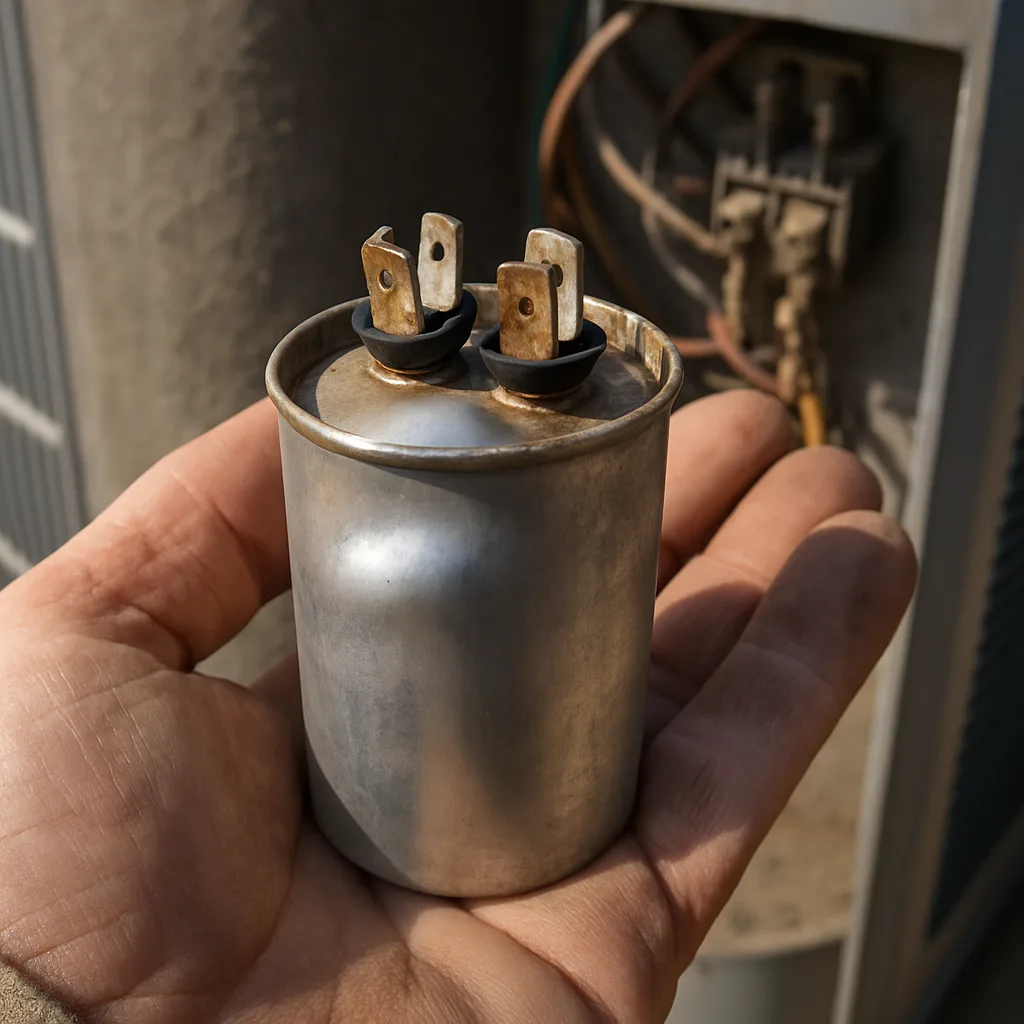
The capacitor’s job is simple. It stores a jolt of electricity and uses it to kick the compressor and fan motor into motion. That part works hard every time your system cycles on. In North Texas, that can mean dozens of cycles a day once summer heat sets in. Heat is the main stress. Capacitors are rated for a range of temperatures, and when the outdoor unit sits in full Texas sun for months, that heat wears down the internal components faster than it would in a milder climate. Power surges during storm season add more strain, especially after the grid takes a hit from high wind or hail.
Age plays a role too, but not in a predictable way. We’ve seen capacitors go out in three years and others last well past ten. A unit that runs constantly, sits in direct sun, or pulls a little extra load from a dirty coil will generally wear a capacitor down faster than one that runs in the shade with clean coils. There’s no exact mileage marker where you can say a capacitor is due, which is part of why it tends to fail without much warning.
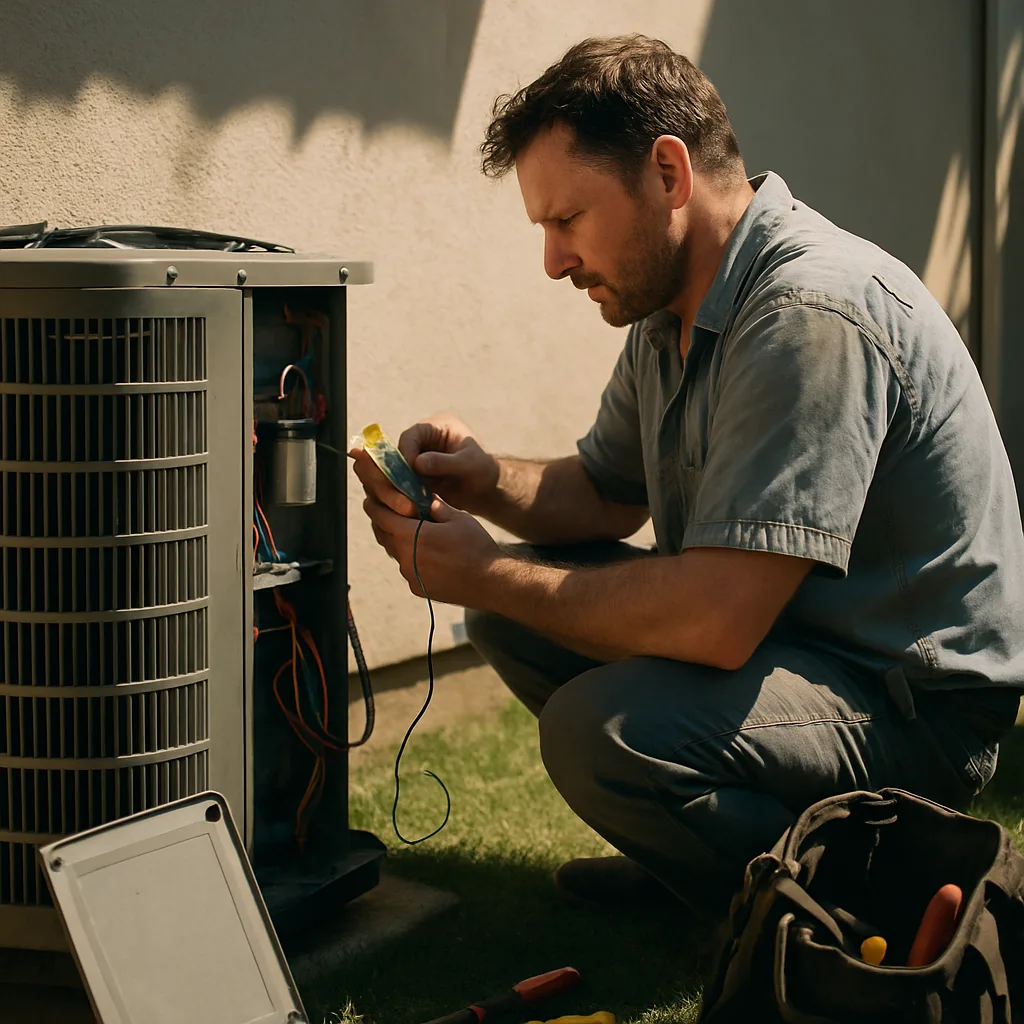
When we get a call for a system that won’t start, checking the capacitor is one of the first things a technician does. It’s a fast test with the right equipment. If the capacitor is bad, AC capacitor replacement is usually a same-visit fix once we confirm nothing else in the electrical circuit was affected. That diagnostic step matters, because a capacitor can look fine and still be reading well outside its rated range. Or a bad capacitor can be a symptom of a separate electrical issue that needs its own repair.
This is one of several electrical and mechanical failures we cover under our Emergency HVAC service. It’s a good example of why we run a full diagnostic instead of swapping the first part that looks worn.
Have questions? We’re happy to help.
Call Today, Get Service Today. Xtreme Air Services is ready to help.
Why Ice Forms on an Evaporator Coil
A frozen evaporator coil shows up as ice on the copper lines outside the unit. You might also notice weak or warm airflow from the vents, or water pooling near the indoor equipment. It’s one of the calls we get most on hot North Texas afternoons. It almost always comes down to one thing: something is stopping warm air from moving across that coil the way it’s supposed to.
The coil needs steady airflow to stay above freezing. Cut that airflow down with a clogged filter, closed vents, a dirty coil, or a failing blower motor, and the coil gets too cold. Moisture in the air freezes right onto it. The ice buildup chokes off airflow even more. It feeds on itself pretty fast once it starts.
Low refrigerant is the other common driver. When the charge drops, the temperature inside the coil drops with it. The coil runs colder than it should even with good airflow. Refrigerant doesn’t get used up in a sealed system. So low charge almost always means a leak somewhere in the lines or the coil itself.
- Restricted airflow from a dirty filter, blocked return, or closed supply vents
- A blower motor that’s slowing down or not running at full speed
- Low refrigerant from a leak in the coil or line set
- A dirty evaporator coil that can’t transfer heat properly
- Running the system on a mild day when it can’t cycle off enough to stay balanced
Here’s the part a lot of homeowners don’t hear until later: refilling refrigerant without finding the leak just buys a few weeks before the coil freezes again. If the charge is low, we look for where it’s escaping before we add anything back. That’s slower than a quick top-off, but it’s the only way the fix holds.
When we get a frozen coil call, the diagnosis starts with an AC not cooling check: airflow first, then refrigerant, then the blower and coil condition. From there the fix might be evaporator coil cleaning, blower motor repair, or frozen coil repair once the ice has cleared and the system is running again.
You can read more on our emergency HVAC service page about how a same-day call typically works from the first phone call to the finished repair.
Why a Furnace Stops Producing Heat
A furnace usually stops making heat for one of a handful of reasons. Most of them show up the same way: the blower runs, air comes out of the vents, but it’s room temperature or cold. That’s different from the whole system being dead, and it points us toward specific parts instead of a guess.
The flame sensor is one of the most common culprits. It’s a small metal rod that tells the furnace a flame is burning. Over a season or two it can build up a thin layer of residue. Once that happens, the furnace can shut the burners off within seconds of starting, because the sensor can’t confirm the flame is there. This is a normal part of furnace aging in North Texas homes that run heat for a few cold snaps each winter, not for months straight like colder climates.
A failed ignitor is another frequent cause. Older systems use a pilot light, but most furnaces installed in the last couple decades use an electric ignitor that glows or sparks to start the burners. Ignitors are a wear part. They cycle on and off every time the heat kicks on, and after enough cycles the element can crack or burn out.
A control board that isn’t sending the right signals can also stop heat production, even though the furnace still runs a fan. Control boards manage the sequence between the thermostat call, the ignitor, the gas valve, and the blower. If one of those steps doesn’t fire correctly, the board can shut things down as a safety measure rather than push heat with a step missed.
A dirty filter causes more no-heat calls than people expect. When airflow gets restricted, the furnace can overheat internally and trip a limit switch. This shuts the burners off to protect the heat exchanger. The blower keeps running, so it feels like the system is working, but no warm air follows.
Thermostat settings and wiring account for a smaller share, but they’re worth ruling out early since they cost nothing to check: a thermostat set to “fan” instead of “auto,” a dead battery, or a loose low-voltage wire behind the wall plate can all mimic a bigger furnace problem.
We also test for carbon monoxide and check the heat exchanger any time a furnace won’t fire correctly. This is a safety step, not an upsell. On a diagnostic visit, a technician checks the flame sensor, ignitor, control board, filter, and gas valve in sequence rather than swapping parts at random.
Frequently Asked Questions
Common questions about Emergency HVAC service
How do I know if my AC or furnace problem is a true emergency or something that can wait?
An emergency is when your home’s comfort or safety is at real risk right now. That includes no cooling in extreme heat, no heat during a freeze, a gas smell, water pooling from the unit, or a burning smell. Weaker signs, like uneven airflow in one room, usually can wait for a regular appointment. If you’re not sure, call and let a technician make that judgment rather than guessing on a hundred-degree afternoon.
If the technician finds another problem while fixing the emergency, will you push extra repairs on me?
If we find something outside the original emergency, like ductwork that’s making the system work harder than it should, we’ll mention it once and let you decide. We won’t build a sales pitch around a breakdown call. Our job on that visit is to find the actual cause, explain it, and give you a written flat-rate quote before touching anything else. Any additional work is always your choice, not ours.
Why do capacitor failures happen with so little warning?
Capacitors wear out from heat, not from a predictable number of years. Attic-mounted units in North Texas can sit in 130 to 150 degree heat all summer, and that heat breaks down the internal parts faster than it would in a milder climate. Power surges from storms add more strain. Some capacitors last three years, others last past ten, which is part of why they tend to fail without much warning.
Can older ductwork make a breakdown feel worse than it is?
It can. Homes built from the 1970s through the 1990s around Sunnyvale and the surrounding Metroplex often have undersized or leaky ductwork. That can make a single failed part, like a capacitor or a dirty coil, feel like a bigger problem than it is. A technician checks the whole air path during an emergency visit, not just the outdoor unit, before pointing to a cause.
Do North Texas summers and winters really make these breakdowns more common?
Yes, and the two halves of the system suffer differently. The furnace and air handler sit up in the attic, which can hold 130 to 150 degree heat all summer, so the blower motor and the wiring around it age faster than the calendar suggests. The compressor outside gets pushed hard for months at a stretch instead. Either way we treat emergency calls the same any day of the week, with no extra charge for nights or weekends.
Ready to Get Started?
Call 972-288-2263 Today, Get Service Today.