


Emergency HVAC Service in Allen: What Happens When You Call
Real emergencies handled fast – with simple checks to try first and the cost explained before anyone is dispatched.
What’s Covered on This Page
- What Counts As a True HVAC Emergency
- Simple Checks Before You Call It an Emergency
- What Happens When a Technician Arrives
- What an Emergency HVAC Visit Costs
- How to Verify a Contractor Before You Let Them In
- Can I run my AC on low while I wait for a technician?
- What should I do if I smell gas near my furnace?
- Is it normal for my attic unit to cause bigger problems in Allen homes?
What Counts As a True HVAC Emergency
Not every hiccup needs a technician tonight. The real question is simple: what happens if you wait? If the answer is “we’ll be a little uncomfortable,” you can probably book a regular visit. If the answer is “someone could get sick” or “something could get damaged,” that’s an emergency.
These are the signs that shouldn’t wait:
- Your AC is out during a Texas summer heat spell, and the house keeps getting hotter. This matters most if you have a baby, an older family member, or anyone with a health condition at home.
- Your heat is out during a hard winter freeze, and the indoor temperature keeps dropping.
- You smell burning, hot plastic, or electrical odors from the unit or the vents.
- Your carbon monoxide alarm goes off, or you smell gas near a gas furnace. Get everyone out of the house first. A gas smell is a job for your gas company or 911 before it’s a repair job.
- Water is dripping through your ceiling or pooling around the indoor unit. In many Allen homes, the air handler sits in the attic, so a clogged drain line can soak drywall and insulation fast.
- The outdoor unit is buzzing, clanking, or grinding loudly, or the breaker trips again right after you reset it.
- You see ice on the refrigerant lines or the outdoor unit in summer. Running the system longer won’t fix it, and it can harm the compressor.
Some problems feel urgent but are often easy to check yourself:
- The thermostat screen is blank. Try fresh batteries first.
- The system won’t start. Check whether the breaker tripped. If you reset it once and it holds, you may be fine. If it trips again, stop and call.
- Airflow feels weak. Look at your air filter. A clogged one can choke airflow and make the system run poorly.
- One room is warmer than the rest, but the rest of the house is comfortable. That’s worth a normal service call, not a midnight one.
- The system runs but struggles a bit on a mild spring day. Schedule a visit soon, before the real heat shows up.
Timing in North Texas changes the math. A system that’s just limping along in April can quit completely in July, when your attic gets far hotter than outside and the AC is working its hardest. When a cold front drops temperatures overnight, a weak furnace or heat pump gets tested all at once. If your system is showing early signs before one of those swings, getting it looked at now usually means a smaller fix and less stress.
If you’re still not sure, describe what you’re seeing when you call, and we’ll tell you whether it needs same-day service or can wait for a regular appointment. Because there’s no extra charge for nights or weekends, you don’t have to wait until Monday just to save money.
Simple Checks Before You Call It an Emergency
Before you pick up the phone, give yourself five minutes. A system that seems dead is sometimes just a switch, a setting, or a safety device doing its job. You don’t need tools for any of these checks, and you won’t need to open up the equipment.
- Check the thermostat mode and setting. Make sure it’s on Cool or Heat, not Off or Fan Only. Set the temperature a few degrees below the room temperature for cooling, or a few degrees above it for heat, so the system has a reason to start. If you have a smart thermostat, check whether it lost Wi-Fi or is following an old schedule someone set.
- Wait a few minutes. Many systems pause on purpose after a power blip or a reset to protect the compressor. Give it about five minutes before you decide it’s not responding.
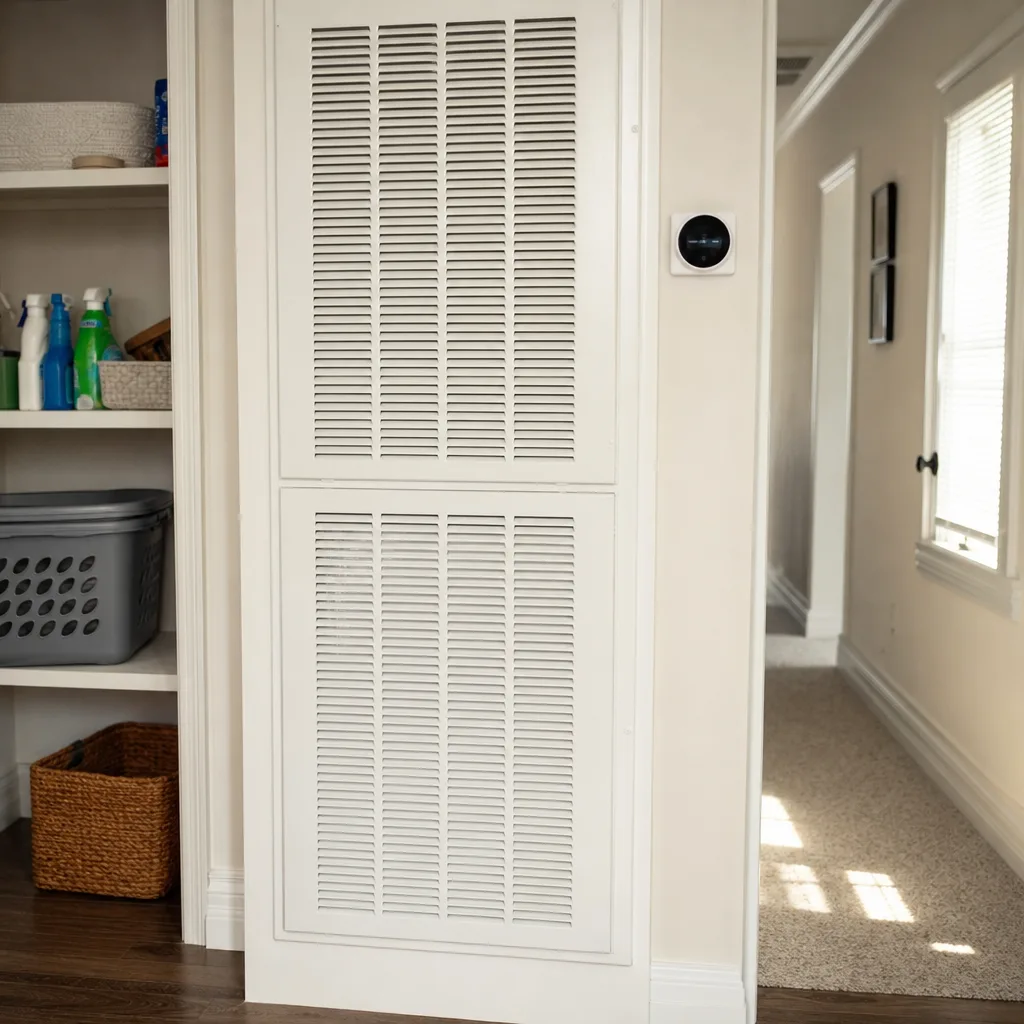
- Look for the indoor switch. Your furnace or air handler often has its own power switch that looks like a regular light switch. It’s usually mounted on the wall near the unit or up in the attic. It’s easy to flip off by accident when someone’s storing boxes up there.
- Look at the outdoor shutoff. Most outdoor units have a small gray box on the wall nearby. Lawn crews, pets, and kids sometimes bump it. If the cover is hanging open or the box looks knocked around, don’t reach inside. Just mention it when you call.
- Check the furnace panel door. Many furnaces won’t run unless the front panel is fully seated, because a safety switch keeps the unit off when the door is loose. If you changed the filter yesterday and the heat quit today, check this first.
- Check for water in the drain pan. Many systems have a small float switch that shuts the AC off when condensation backs up. That switch is protecting your ceiling. If you see standing water in the pan under the indoor unit, a clogged drain is likely the reason the system stopped, not a failed compressor.
If one of these gets you running again, you’re done, and you just saved yourself a service call. If the system starts and then shuts off again, stop restarting it. Cycling a struggling system over and over can turn a small repair into a bigger one, just like the repeat breaker trip covered above.
There are also some things you shouldn’t try at home. Don’t take the cover off the outdoor unit, touch the wiring or capacitor, or use a store-bought refrigerant kit. Those parts carry high voltage, and refrigerant work belongs with a licensed technician. If the drain pan is full, a wet towel and a bucket will protect your floor or attic for now. Clearing the line and resetting the safety switch properly is part of the repair.
If you’ve worked through this list and the system still won’t run, you haven’t wasted your time. You’ve ruled out the easy causes, and that’s useful information for the technician. Tell us what you checked when you call, and we’ll start from there instead of from scratch.
What Happens When a Technician Arrives
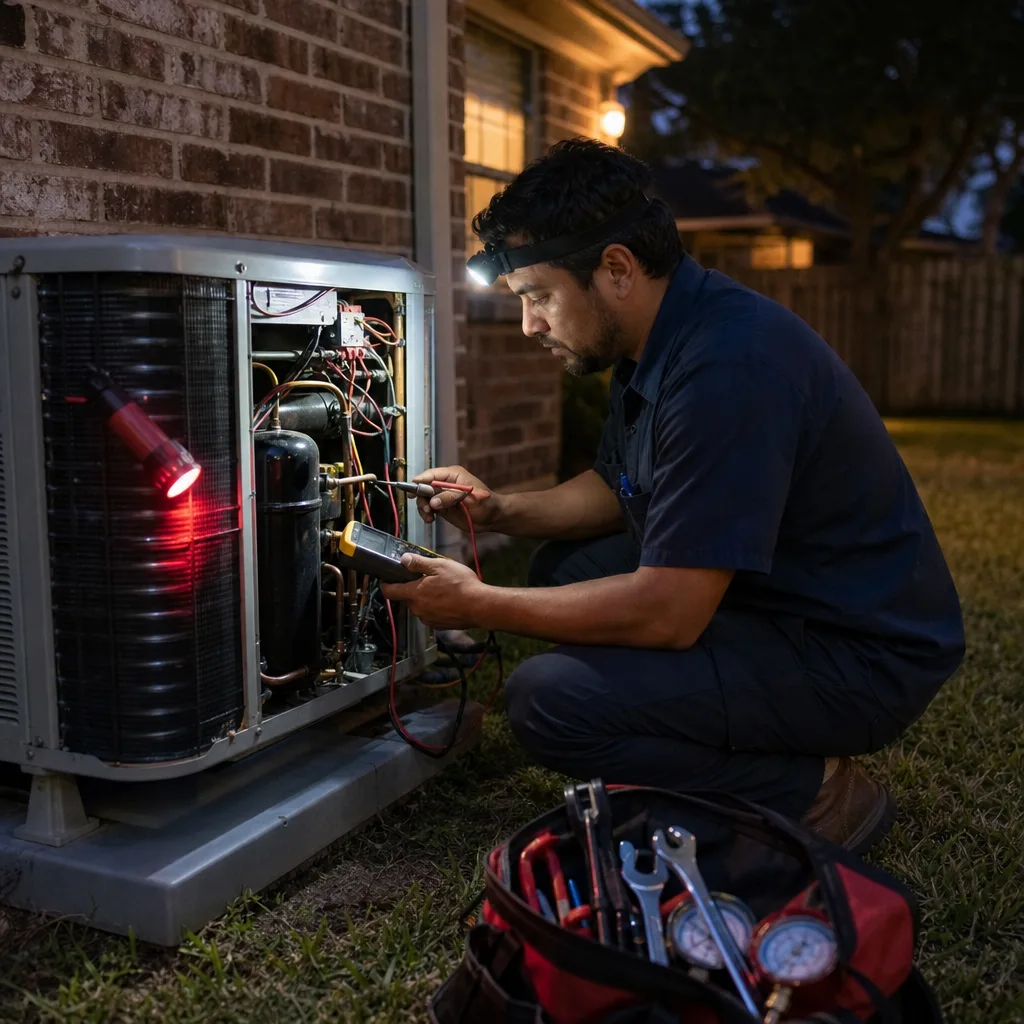
When your AC quits on a hot night, the visit itself shouldn’t add to the stress. The job comes down to three steps: find the part that failed, fix or replace it, and make sure the whole system runs right before anyone packs up. You’ll know the price before any work starts.
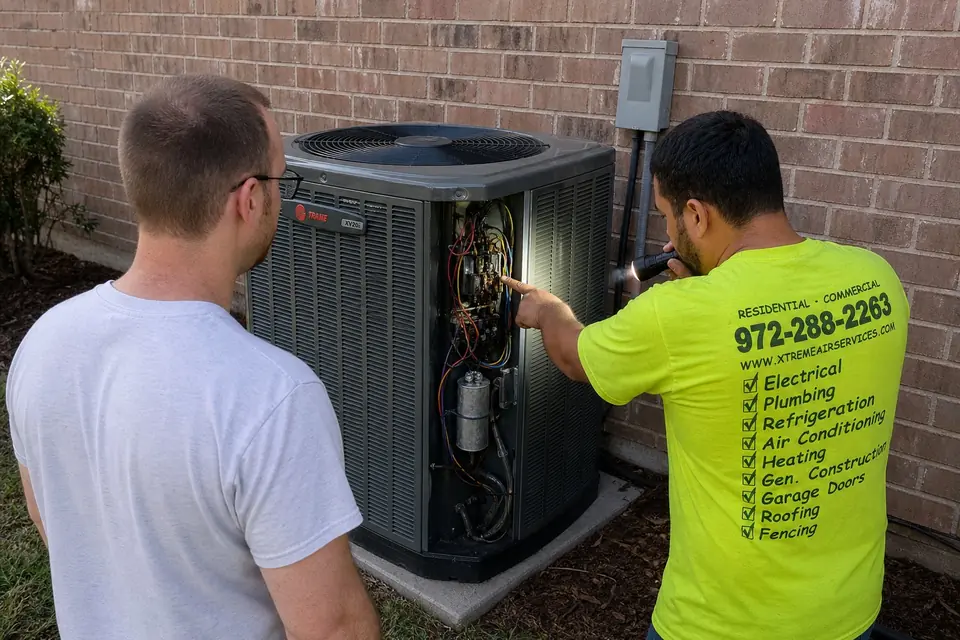
The person at your door is one of our licensed and insured technicians. Every one of them is background-checked and drug-tested. That matters when someone’s walking through your house late at night or climbing into your attic while your kids are asleep.
Diagnosis starts with what you already know. Tell the technician what you noticed and which of the simple checks you tried. That narrows the search fast. From there, the technician tests the parts most likely to cause what you’re seeing. Here’s where the search usually goes:
- Outdoor unit humming but not running: the capacitor, a small part that gives the motors a kick to start, and the contactor, the switch that turns the unit on.
- Indoor fan running but blowing warm air: refrigerant levels, a frozen coil, or the outdoor unit not getting power.
- Nothing running at all: the thermostat wiring, the control board, and the safety switches, including the float switch in the drain pan.
- Heat that won’t come on: the ignitor, the flame sensor, or a furnace control board.
In many Allen homes, that work happens in the attic, where the air handler and drain line often sit. On a summer afternoon, it can get far hotter up there than it is outside. A good technician takes the time to check carefully anyway, because a rushed guess can mean a second visit.
Once the problem is found, you get a clear explanation and a flat-rate price. You approve it before any repair starts, so there’s no meter running. If you go ahead with the repair, the service-call fee of $26 to $99 is credited toward it. Because there’s no extra charge for nights or weekends, a repair at 10 p.m. on a Saturday is priced the same as one on a Tuesday morning.
Most calls turn out to be a single common failure that gets fixed on the first visit. For a standard repair, your price covers:
- Diagnosis
- Labor
- The standard replacement part
- Testing and cleanup
Some things aren’t part of that price. If a second part has also failed, if a major component like a compressor needs replacing, or if a code upgrade or permit is needed, you’ll get a separate quote. Nothing gets added without your okay. Bigger repairs and replacements can also be financed. Smaller fixes like this usually aren’t.
The repair isn’t the last step. The technician runs the system and checks that it’s cooling or heating the way it should. Then the work area gets cleaned up. That last test is the difference between a system that’s running when the truck pulls away and one that’s fixed.
Have questions? We’re happy to help.
Call Today, Get Service Today. Xtreme Air Services — Allen is ready to help.
What an Emergency HVAC Visit Costs
Most emergency HVAC repairs from our team cost $200 to $525. Across all our emergency calls, the typical range is $200 to $900. Where your bill lands depends on what broke, not on what time you called. A 2 a.m. repair is priced the same as a weekday one.
So what pushes a repair toward the low end or the high end? A few things:
- How bad the failure is. One worn-out part, like a capacitor that won’t start the outdoor fan, is a quick swap. A problem that has been building for weeks takes more time to track down and fix.
- Part cost and availability. Some parts are common and inexpensive. Others cost more, and a hard-to-find part can mean waiting for it to arrive.
- Your equipment’s age and brand. Parts for an older system or a less common brand can be pricier or harder to get than parts for a newer one.
- Whether more than one part failed. A part that dies can strain the parts around it. If a second piece went down too, that adds to the repair.
When a bill climbs past that typical range, it’s usually because a major component like the compressor has failed. That kind of job gets its own quote, as covered above. If you get a big quote on an older system, ask the technician whether repair still makes sense or whether replacement is worth a look. A good technician will walk you through both options and let you decide. Financing is available for those larger jobs.
Pricing works differently from one company to the next, and the biggest surprises on emergency bills usually come from how the price is built, not the repair itself. Some companies bill by the hour, so the clock runs while a technician climbs into a hot attic or waits on a part. Others add overtime or holiday rates once the sun goes down. Before you let anyone start work, ask these questions:
- Is there a trip or service-call fee, and does it count toward the repair?
- Do you charge a flat price for the job, or by the hour?
- Is there an extra charge for nights, weekends, or holidays?
- What does the price include: diagnosis, labor, the part, testing?
- Will I see and approve the full price before you start?
Clear answers to those five questions tell you a lot about who you’re letting into your home. Fuzzy answers tell you even more. You already know ours. The fee and the price are set before anything gets fixed, and you’re the one who says yes.
If your AC or heat quit today, call and talk to a real person on our team. Tell us what you’re seeing and what you’ve already checked. We’ll get a licensed and insured technician headed to your Allen home with same-day service, and you’ll know the price before any work begins.
Watch Our Video
See How We Handle Emergency HVAC service in Allen
Xtreme Air Services — Allen
How to Verify a Contractor Before You Let Them In
In Texas, HVAC contractors need a license from the Texas Department of Licensing and Regulation, or TDLR. Checking that license takes about two minutes on your phone. It’s the fastest way to know who you’re letting into your home, especially late at night.

Emergencies are exactly when people skip this step. You’re hot and tired, and you just want someone to show up. That’s also when a door-knocker after a North Texas hail storm, or a company you’ve never heard of, can rush you into a decision you’d never make on a calm afternoon. A few quick checks protect you.
- Get the license number and look it up. Ask for it on the phone. A real company will give it to you right away. Enter it in TDLR’s online license search and make sure the name matches the company and the license is active.
- Ask if they’re insured. If a technician gets hurt in your attic or something in your home gets damaged, insurance keeps that from becoming your problem.
- Ask who’s coming. Find out whether the company screens the people it sends into homes. You should feel comfortable with the answer before anyone knocks.
- Ask about refrigerant certification. Federal rules require anyone who handles refrigerant to be EPA certified. If your problem might involve refrigerant, it’s a fair question.
- Check reviews on more than one site. Look for a long, steady record of recent reviews, not a handful. Pay attention to how the company responds when someone’s unhappy.
- Look for a company name on everything. A marked vehicle and a written estimate with the company’s name, address, and license number are basic signs of a real business.
Some warning signs mean you should slow down, even with the AC out:
- They want cash only, or full payment before any work starts.
- They push a whole new system before they’ve tested anything.
- They won’t put the price in writing.
- They tell you the price goes away if you don’t sign right now.
Any one of those is enough reason to thank them and call someone else. A broken AC is miserable, but a bad contractor can cost you far more than one hot night.
Here’s our information, so you don’t have to dig for it. Xtreme Air Services holds HVAC License #TACLA29023C. We’re licensed and insured, and every technician we send is background-checked and drug-tested. We’re a Trane Comfort Specialist with a 4.8-star reputation across 2,900+ reviews on Google, Angi, and HomeAdvisor. Our Allen office is at 1333 W McDermott Dr, Suite 200. Look any of it up before you call. We’d rather you check.
Call 469-299-8996
Frequently Asked Questions
Common questions about Emergency HVAC service
Can I run my AC on low while I wait for a technician?
No, keep it off if the system is cycling on and off or tripping the breaker repeatedly. Running a struggling system over and over can turn a small, cheap fix into a bigger repair. If it starts and quickly shuts off again, stop restarting it and call instead.
What should I do if I smell gas near my furnace?
Get everyone out of the house right away and call your gas company or 911 before calling for repair. A gas smell is not something to wait on or troubleshoot yourself. Once everyone is safe outside, you can call us to get a technician scheduled.
Is it normal for my attic unit to cause bigger problems in Allen homes?
Yes, because many Allen homes have the air handler and drain line up in the attic, a clogged drain can soak drywall and insulation fast if it’s not caught early. On hot summer afternoons the attic also runs far hotter than outside, which stresses the equipment more. That’s why water around the indoor unit or ceiling stains should get checked quickly.
Ready to Get Started?
Call (469) 299-8996 Today, Get Service Today.