


A/C System Installation in Carrollton: Get the Right Size, Done Right
New AC systems sized to your Carrollton home and installed right – with an honest look at whether a repair still makes sense.
What’s Covered on This Page
- Correct Sizing Decides Whether Your New AC Works
- Signs Your System Needs Full Replacement, Not Another Repair
- When Repair Beats Replacement
- What Happens During Your Installation
- What Drives Installation Cost Up or Down
- How long does a new AC installation take from start to finish?
- Do I need a permit for a new AC installation in Carrollton?
- Can I just replace the outdoor unit instead of the whole system?
Correct Sizing Decides Whether Your New AC Works
Here’s the part a lot of folks don’t expect. Brand and efficiency matter, but they can’t make up for a system that’s the wrong size for your home. AC size is measured in tons, which describes how much heat the system can pull out of your house in an hour. If you pick the wrong number, even a high-efficiency system will feel off.
Bigger isn’t better. Here’s what happens when the size misses in either direction:
- Too big: The system blasts cold air, hits the thermostat setting fast, and shuts off. It doesn’t run long enough to pull moisture out of the air, so the house feels cool but sticky. All that starting and stopping also wears parts faster, and you paid more for equipment you didn’t need.
- Too small: On a 100-degree afternoon, it runs and runs without ever reaching your setting. Your bills climb, the system works under constant strain, and the back bedrooms stay warm.
So why not just match the old unit? Because nobody may have checked whether the old unit was the right size in the first place. Your home may also have changed since it went in. New windows, added attic insulation, a room addition, or a closed-in patio can all shift how much cooling your house needs. A rule of thumb based on square footage is only a rough guess.
A proper cooling load calculation looks at how your specific house gains heat. That includes:
- Square footage and ceiling height
- How much insulation is in your attic and walls
- The number and size of your windows, and which way they face
- Shade from trees, and how much afternoon sun hits the house
- Air leaks around doors, attic hatches, and recessed lights
- Where your ductwork runs and what shape it’s in
That last one matters here. North Texas summers push attic temperatures far above the outdoor reading, and in many homes the ducts run right through that attic. Heat soaking into those ducts is part of the load your system has to handle, so a good calculation counts it.
Sizing also isn’t always the answer to a comfort problem. Say your downstairs stays cool but the upstairs bedrooms hit 80 by late afternoon. It’s tempting to think a bigger unit will fix that. Sometimes the real issue is airflow or duct design, and a bigger unit just makes the downstairs colder. In that case, duct repair or a zoning system may do more for you than extra tonnage.
Cooling load calculation is one of the services we offer, so you can ask us to size your system from your home’s numbers rather than a guess. Size also affects your price, since equipment capacity is one of the factors that moves an install up or down. Whoever you hire, ask how they came up with the size they’re quoting. If the answer is “that’s what you had,” ask to see the math.
Signs Your System Needs Full Replacement, Not Another Repair
Not every breakdown means you need a new system. Sometimes a repair is the smart move, and you should know when that’s true. Other times you’d just be paying to keep an old system limping along through one more Texas summer. Here’s how to tell the difference.
Replacement usually makes more sense when you see more than one of these:
- Your system is somewhere past 12 to 15 years old. Parts are wearing out together, so fixing one often means another fails soon after.
- You’ve paid for repairs more than once in the last couple of summers, and the bills keep getting bigger.
- The compressor has failed. It’s the heart of the outdoor unit and one of the most expensive parts to replace. On an older system, that money is usually better spent on new equipment.
- Your system uses R-22 refrigerant. It isn’t made new in the U.S. anymore, so a leak on one of these units gets costly to recharge, and it’ll only get harder from here.
- Your energy bills keep climbing even though your habits haven’t changed. An aging system loses efficiency a little at a time.
- The house never feels quite comfortable anymore. It runs nonstop on hot afternoons, rooms stay warm, or the air feels damp.
A simple gut check can help. Multiply the age of your system by the repair quote. If the number lands near or above $5,000, many homeowners decide replacement is the better use of their money. It’s a rough guide, not a rule, but it keeps you from sinking money into a system near the end of its life.
Now for the other side. A repair is often the right call when your system is fairly young and the problem is a single part. A failed capacitor, a bad contactor, a clogged drain line, or a worn fan motor can usually be fixed for a fraction of what a new system costs. If your AC is 7 years old and has run fine until now, fixing it and moving on is the honest answer.
There’s one more trap to watch for. If someone offers to swap only the outdoor unit on an older system, ask questions. The indoor coil and the outdoor unit are designed to work as a matched pair. Pairing a brand-new outdoor unit with a tired old coil can cost you efficiency, comfort, and reliability, and it can leave you paying for another repair sooner than you’d like.
Picture this. It’s July, the AC quit, and the repair quote is for a compressor on a 14-year-old system that already needed refrigerant twice. That’s a clear case for replacement. If the same system just needs a new capacitor, fix it and get through the summer while you plan ahead.
If you’re not sure which camp you’re in, have a technician look before you decide. Our service call runs $26-$99, and that fee is credited toward the repair if you go ahead with Xtreme Air Services. You’ll get a straight look at what’s wrong and what each option costs before any work starts. If replacement does come out ahead, that’s when the sizing work above matters most.
When Repair Beats Replacement
Sometimes the honest answer is that you don’t need a new system at all. A warm house in July feels like an emergency, and it’s easy to jump straight to the biggest fix. But plenty of “dead” air conditioners are working fine and just need something small.
Before you price out new equipment, rule out the simple stuff. These are safe for you to check yourself:
- The thermostat. Make sure it’s set to Cool, the set temperature is below the room temperature, and the batteries aren’t dead. A blank screen can look like a broken AC.
- The air filter. A filter packed with dust chokes airflow. The system runs, but very little cool air reaches your rooms. Swapping in a clean filter costs a few dollars.
- The breaker. Look for a tripped breaker for the indoor or outdoor unit in your panel. If you reset it and it trips again, leave it off and call a pro. A breaker that keeps tripping is telling you something.
- The outdoor unit. Grass clippings, leaves, or a shrub pressed against the coil can keep it from shedding heat. Keep a couple of feet of open space around it.
Don’t open electrical panels on the units or try to add refrigerant yourself. That’s where a quick check turns into a safety problem.
Next, think about what’s bothering you. Some comfort problems feel like a failing AC but come from somewhere else in the house. A new outdoor unit won’t fix any of these:
- Leaky ducts. In a lot of North Texas homes, the ducts run through an attic that gets brutally hot in summer. If a joint has pulled apart, you’re cooling the attic instead of your bedroom. Duct sealing or duct repair can fix that.
- One room that never cools. That’s usually airflow or duct layout, not system size. A zoning system can help when upstairs and downstairs never agree.
- Sticky, damp air in a home that’s otherwise cool. A dehumidifier or a closer look at how the system runs may solve it for far less than a new unit.
- A system that’s just dirty. Dirty coils and a clogged drain line can make a healthy AC cool poorly or shut itself off. A tune-up and coil cleaning bring a lot of systems back to normal.
Waiting can also be the right call. If your system is older but still cooling the house and the latest fix was small, you don’t have to replace it this week. Fix what’s broken, get through the summer, and plan the replacement on your own timeline. Shopping in the spring or fall, instead of during a heat wave, gives you room to compare options, ask about sizing, and look at financing without the pressure of a 95-degree living room.
Here’s a common example. The upstairs bedrooms in your two-story home run hot every afternoon, and you figure the AC is giving out. It turns out the system cools fine, and a crushed duct in the attic is starving those rooms of air. Fixing the duct solves the real problem, and you keep the system you already paid for.
A new AC is a big purchase. It should solve a problem that only a new system can solve.
Have questions? We’re happy to help.
Call Today, Get Service Today. Xtreme Air Services — Carrollton is ready to help.
What Happens During Your Installation
Install day is where the sizing work pays off or gets wasted. A correctly sized system can still run poorly if the refrigerant lines leak, the charge is off, or the drain is set up wrong. Here’s what a careful installation looks like, so you know what you’re paying for and what to ask about.
A straightforward like-for-like replacement often fits in a single day. Attic access, the condition of your ductwork, or electrical updates can stretch it out. Those changes count as modifications and aren’t part of a standard swap, so they should be spelled out before work starts.
- Taking out the old system. The refrigerant in your old unit has to be recovered with the right equipment, not released into the air. Then the old outdoor unit and indoor coil come out. Haul-away of the old unit is included with our installations, so it doesn’t end up on your curb.
- Setting the new equipment. The outdoor unit goes on a level pad with room around it to breathe. The new indoor coil goes in as a matched pair with that outdoor unit.
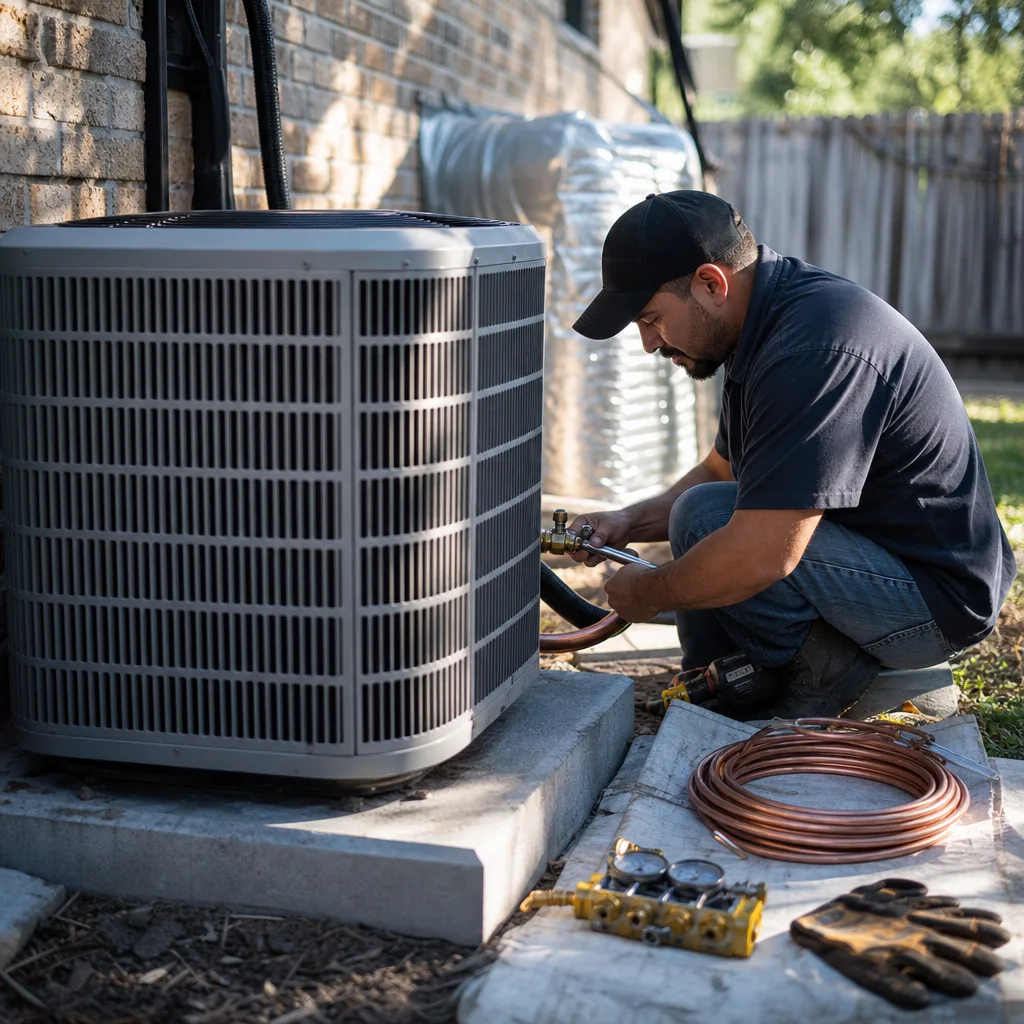
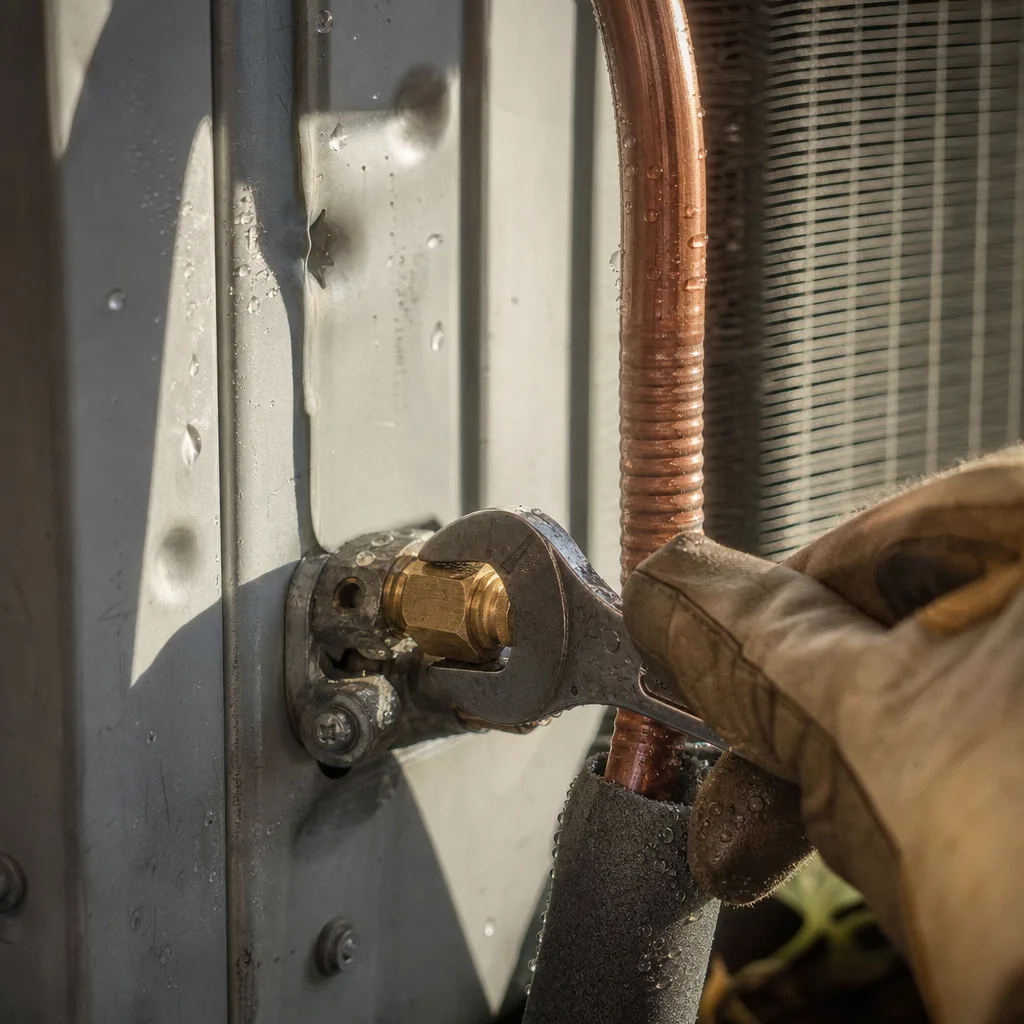
- Connecting the refrigerant lines. The copper lines are joined and sealed. The installer then pressure tests the system to make sure nothing leaks before any refrigerant goes in.
- Pulling a vacuum. A vacuum pump draws air and moisture out of the lines. Moisture left inside can damage the system over time, so this step shouldn’t be rushed.
- Setting the refrigerant charge. The system gets the amount of refrigerant it’s designed for. Too much or too little hurts cooling and makes parts work harder.
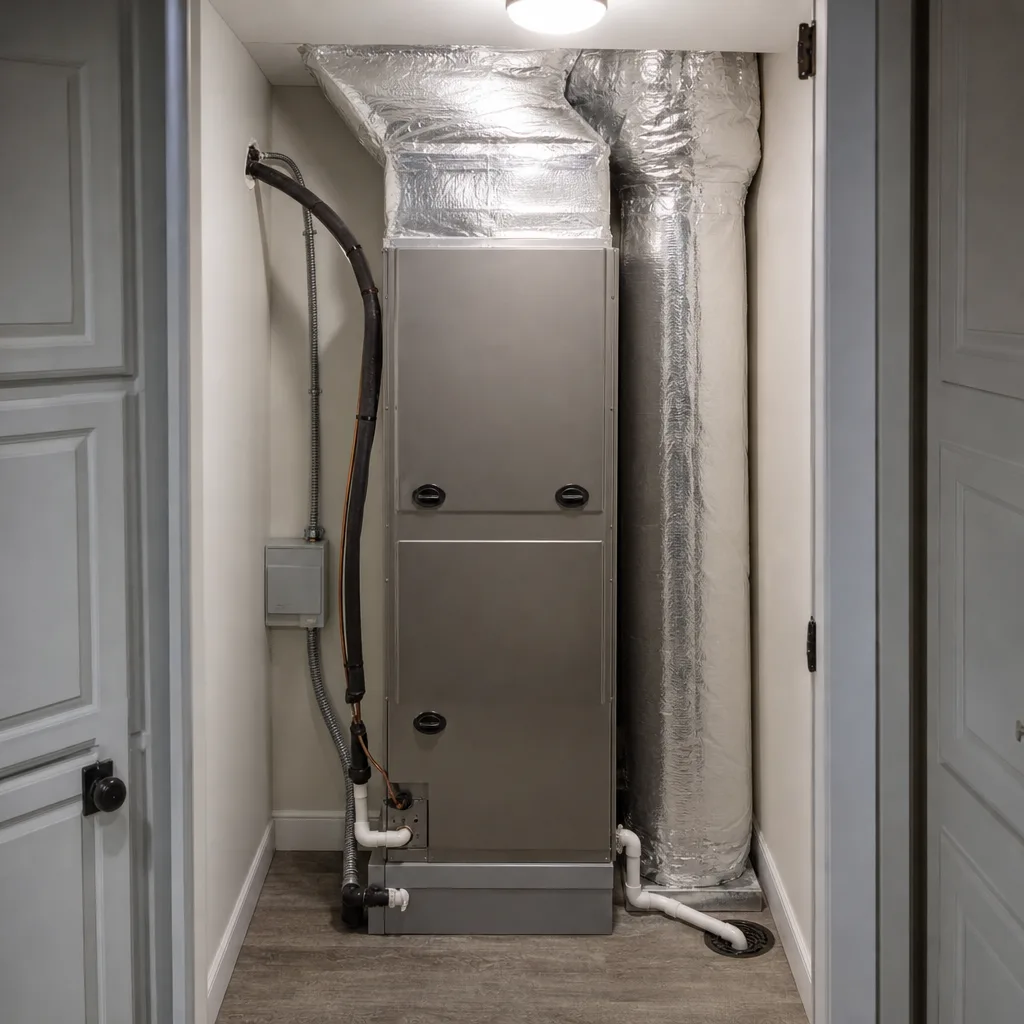
- Hooking up the drain. Your AC pulls a lot of water out of the air in a humid Texas summer. In a lot of North Texas homes the indoor unit sits in the attic, right above your ceilings, so the drain line and the overflow protection need to be set up right.
- Wiring and thermostat. The electrical connections and the thermostat get hooked up so the indoor and outdoor parts talk to each other.
Then comes startup and testing, which is included in our installation. This is the step that tells you whether the job worked. A good installer runs the system and checks real numbers, like the temperature difference between the air going into the system and the air coming out of your vents, airflow, and refrigerant pressures. A system that just turns on and blows cold air hasn’t been proven yet.
You can help the day go smoothly, too. Clear a path to the attic hatch and the indoor unit, move anything stored near the outdoor unit, and keep pets in a closed room. If your attic is packed with holiday boxes, moving them ahead of time saves time and keeps your things out of the way.
Last, ask whether your job needs a permit and who’s pulling it. Permits aren’t included in a standard installation unless they’re listed on your quote, so it’s worth getting that answer in writing up front.
Watch Our Video
See How We Handle A/C system installation in Carrollton
Xtreme Air Services — Carrollton
What Drives Installation Cost Up or Down
Most A/C system installations with Xtreme Air Services fall between $5,500-$13,000. Our most common job is a standard like-for-like replacement that uses your existing connections with no major changes. That job runs $7,000-$10,000 and covers the equipment, materials, professional installation, startup, and testing.
Where your home lands in that range depends on a few things you can see and ask about:
- Size and efficiency. A bigger system costs more, which is one more reason the sizing math above matters. Efficiency is rated by SEER2, which works like miles per gallon for your AC. A higher number means lower power bills each summer, but the equipment costs more up front.
- Brand and model. A basic single-stage unit runs at full blast or not at all. A variable-speed system adjusts its output, so it runs longer at a gentler pace, pulls more moisture out of the air, and keeps rooms more even. That comfort costs more.
- Ease of access. In a lot of North Texas homes, the indoor unit sits in a tight attic that gets brutally hot in summer. A cramped attic or a long carry slows the work and can add cost.
- Condition of your ductwork, wiring, and plumbing. If the ducts are crushed or leaking, or the electrical feeding the unit needs updating, that work sits outside a standard swap.
- Code upgrades and permits. Older setups sometimes need changes to meet current code. Permits aren’t included unless your quote lists them.
- Custom fabrication. If the new equipment doesn’t line up with your existing ducts or platform, parts may need to be built to fit.
Here’s what you get in a standard installation. The equipment and materials, professional installation, standard connections, startup and testing, and haul-away of your old unit are all included.
Some things aren’t included unless your quote says they are. Duct, electrical, and plumbing modifications are extra. So are code corrections and permits. We’d rather you hear that now than be surprised on install day.
So how do you compare two quotes fairly? Line them up item by item. Check that both list the same size, the same SEER2 rating, and the same included work. A lower price that leaves out the matching indoor coil, the startup testing, or the haul-away isn’t really lower. Ask each company the same questions: What size is this, and how did you get it? What’s not included? Is the price fixed, or can it change once work starts?
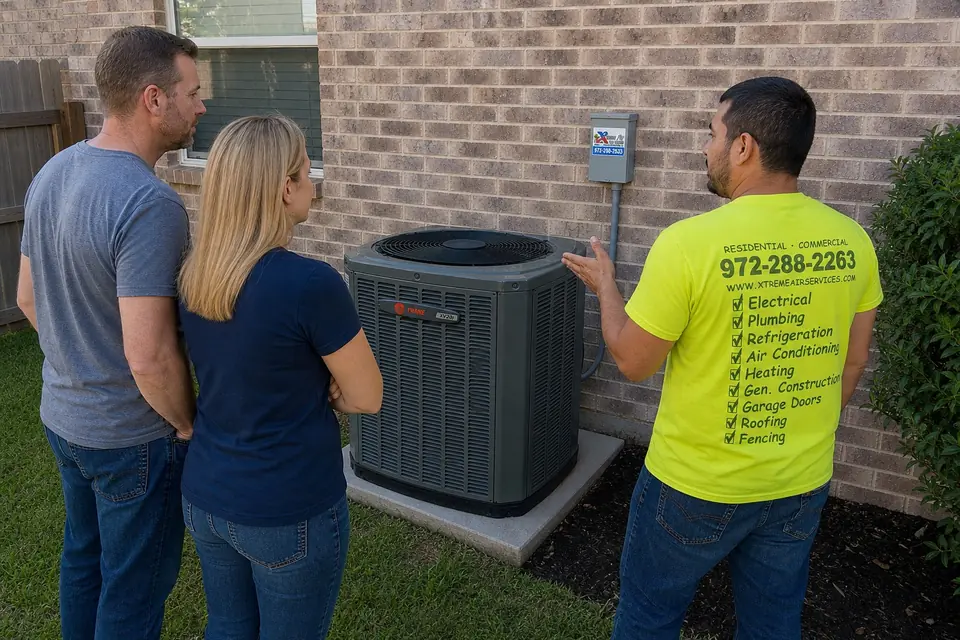
With us, you get upfront flat-rate pricing that you approve before any work starts. There’s no meter running, so a tricky attic doesn’t turn into a surprise on the final bill. As a Trane Comfort Specialist with licensed and insured technicians, we’ll walk you through the options at your kitchen table and let you decide.
If the total is more than you planned to spend at once, flexible financing is available on qualifying installations and larger jobs, on approved credit. That can let you choose the system that fits your home instead of the one that fits this month’s budget.
Call 469-269-6099
Frequently Asked Questions
Common questions about A/C system installation
How long does a new AC installation take from start to finish?
A standard like-for-like replacement often fits into a single day. If your attic access is tight, your ductwork needs repair, or your electrical panel needs updates, the job can stretch longer since those extra steps aren’t part of a standard swap. Ask upfront whether your home needs any of those changes so you can plan your day around it.
Do I need a permit for a new AC installation in Carrollton?
It depends on your project, so ask your installer to confirm before work starts. Permits aren’t included in a standard installation unless they’re listed on your quote, and getting that answer in writing upfront avoids surprises later. Code upgrades on older setups can also trigger permit requirements, so it’s worth checking both at the same time.
Can I just replace the outdoor unit instead of the whole system?
You can, but it’s often a mistake on an older system. The indoor coil and outdoor unit are built to work as a matched pair, and pairing new outdoor equipment with a tired old coil can cost you efficiency and comfort. It can also leave you facing another repair sooner than you’d want, so ask questions before agreeing to a partial swap.
Ready to Get Started?
Call (469) 269-6099 Today, Get Service Today.