


Electrical Panel Replacement / Upgrade in Allen
Panel upgrades for homes that have outgrown their power, done by licensed electricians with the permit pulled.
What’s Covered on This Page
- Signs Your Panel Needs Replacing, Not Just a Repair
- When a Full Panel Replacement Isn’t Needed
- What’s Included in a Panel Replacement Quote
- Permits, Utility Coordination, and Licensing in Allen
- Choosing the Right Panel Size: 100A vs. 200A
- Can I upgrade my own electrical panel myself?
- What is the 80% rule for electrical panels?
- Is there a federal tax credit for upgrading an electrical panel?
Signs Your Panel Needs Replacing, Not Just a Repair
Not every panel problem means you need a new panel. Here’s the honest version. Say one breaker trips now and then when the microwave and the vacuum run at the same time. That’s often just too much on one circuit, not a bad panel. A single worn-out breaker can be swapped out. A loose connection can be tightened. Those are panel repair jobs, and they cost a lot less than a replacement.
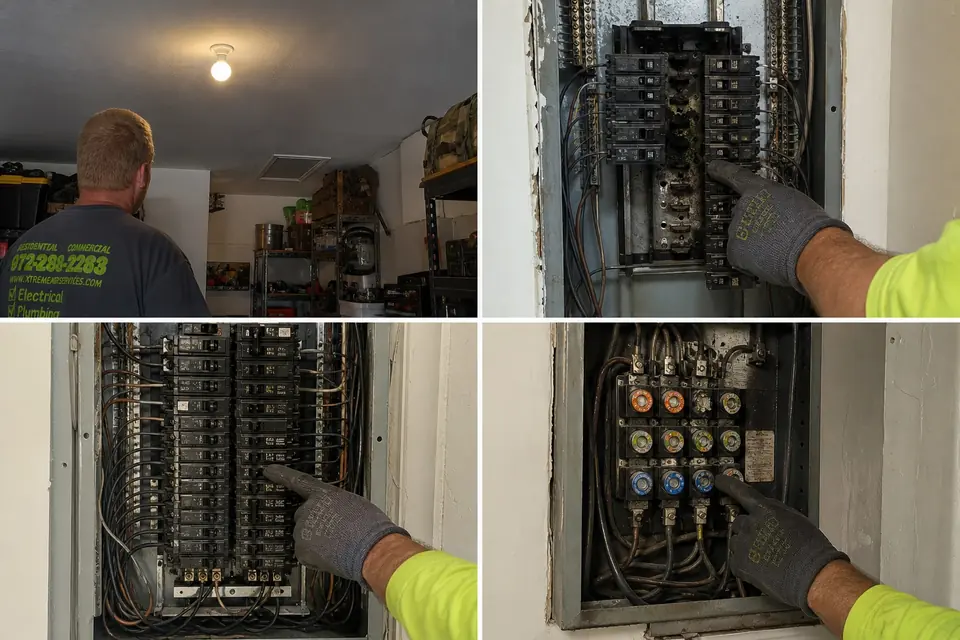
Replacement makes sense when the problem is the panel itself, or when the panel can’t keep up with your home anymore. These are the signs that point that way:
- Scorch marks, melted plastic, or a burning smell near the panel. Heat damage usually means trouble inside the panel, not just one part.
- A panel cover that feels warm, or a buzzing or crackling sound coming from the box.
- Rust or corrosion inside the panel. Moisture and metal don’t mix, and corroded parts don’t hold a good connection.
- Breakers that trip on lots of different circuits, or breakers that won’t stay reset.
- Lights that dim or flicker every time your AC or another big appliance kicks on.
- Fuses instead of breakers. Fuse boxes were built for homes with far fewer appliances than you likely run now.
- No open spaces left, or doubled-up breakers squeezed in to make room for new circuits.
That last one matters more than most people think. A panel can work fine and still be the wrong size for your home. Maybe you’re adding an EV charger, a hot tub, a bigger AC system, or a shop in the garage. Each of those needs its own circuit and real capacity behind it. Some older panels are smaller, like 100 amps, and just weren’t built for that kind of load. That’s why the most common panel job we do is a 200-amp upgrade with new breakers and proper grounding. It gives your home room for what you run today and what you add next.
You can’t always tell from the outside. A panel can look clean with the door shut and still have worn breakers, loose lugs, or weak grounding behind the cover. A licensed electrician can open it up, check each part, and tell you plainly whether you’re looking at a fix or a replacement.
If a repair will do the job safely, that’s what you should get. If your panel has hit its limit, a repair just puts off the same problem and costs you twice.
When a Full Panel Replacement Isn’t Needed
A new panel is a big job, and it’s not always the right one. Plenty of homes with an electrical problem don’t need a new panel at all. Here’s when you can skip it, go smaller, or just wait.
Your panel is already the right size and in good shape. If you have a 200-amp panel with no heat marks, no rust, and breakers that stay put, and you aren’t adding anything big, there’s no reason to swap it. Age by itself isn’t a reason. A sound panel that fits how you use power can keep doing its job.
You need more spaces, but not more power. Some panels have plenty of capacity left but no open slots. In that case, a subpanel can be the better fix. A subpanel is a smaller box fed from your main panel. It gives you room for new circuits in a garage, a workshop, or an addition, and it often costs less than a full replacement.
You’re adding one new appliance. An EV charger, a hot tub, or a window unit for the garage each needs its own circuit. If your panel has an open space and enough capacity, a dedicated circuit is all you need. A licensed electrician can run a load calculation, which is a simple tally of what your home uses at its busiest, to tell you if the panel can handle it.
The problem is the appliance, not the panel. If the same breaker trips every time one thing runs, like a space heater, an old freezer, or a hair dryer, that device may be the cause. Try it on a different circuit. If it trips there too, the appliance likely needs repair or replacing, not your panel.
An outlet keeps cutting out. A GFCI outlet is the kind with test and reset buttons, found in kitchens, bathrooms, garages, and outdoors. It shuts off when it senses a problem, and it can also wear out over time. A faulty GFCI outlet is a small, simple fix that has nothing to do with your panel.
You want protection, not more power. If storms and power surges are your worry, a whole-house surge protector may be the answer. It installs at your panel and helps shield your AC, TV, and other electronics. You don’t need a new panel to get one, as long as yours has room.
- Panel is 200 amps, clean, and not acting up: leave it alone.
- Out of slots but not out of power: ask about a subpanel.
- Adding one big appliance: ask about a dedicated circuit and a load calculation.
- One device trips the breaker everywhere: check the device first.
- Worried about surges: a whole-house surge protector may cover it.
You can also wait if you’re planning a remodel or a big purchase, like a new AC system or an EV, in the next year or so. Holding off lets you size one upgrade for everything at once, instead of paying twice. If you can’t tell which of these fits your home, an electrical safety inspection gives you a clear answer before you spend money on the bigger job.
What’s Included in a Panel Replacement Quote
Once you know you need a new panel, the next question is simple: what’s this going to cost, and what am I paying for? Here’s the plain answer, so you can read any quote, ours included, with clear eyes.
Our most common panel job is replacing an aging or undersized panel, usually with a 200-amp upgrade. That job typically runs $2,100 to $3,300. Across all the panel replacements and upgrades we do, the typical range is $1,500 to $4,500. Where your home lands depends on what we find when we open things up.
When we quote a panel replacement, these are included:
- The new panel and the materials to install it
- Professional installation
- New breakers
- Grounding
- Startup and testing once it’s in
- Hauling away your old panel
These aren’t included unless your quote says they are:
- Service-entrance or meter work done by the utility company
- Rewiring circuits in your walls
- Code corrections elsewhere in your home
- Permits
That second list is where surprise costs usually come from on any electrical job. So ask about each item before you sign. If your meter base is old or the utility needs to cut and restore power at the meter, that’s work they handle, and you’ll want to know about it up front. The same goes for permits. Ask whether the permit is in the price or separate, so you know the full number.
The price can move up or down for these reasons:
- Panel amperage. A bigger panel costs more than a smaller one.
- The panel brand.
- The condition of your meter and service. Worn equipment may need attention.
- Grounding upgrades, if your current grounding isn’t up to par.
- Circuit count. More circuits mean more breakers and more time.
- Ease of access. A panel in an open garage wall is quicker than one boxed in by cabinets or finished drywall.
- Utility coordination.
- Code upgrades needed to bring the install up to current rules.
- Permits.
There’s a $26 to $99 service-call fee to come out and look at your panel. If you go ahead with the work with Xtreme Air Services, that fee is credited toward the job. You’re not paying twice to find out what you need.
A panel is a real expense, and it often shows up at a bad time. That’s why we offer flexible financing on qualifying installations and larger jobs, on approved credit. If the upgrade makes sense but the timing doesn’t, ask about it when you call.
Whoever you hire, a good quote should answer these questions before any work starts:
- What amperage is the new panel, and why is that the right size for my home?
- Is the permit in this price?
- Does my meter or service need utility work, and who sets that up?
- Are any code corrections or rewiring needed, and what do they cost?
- Is the old panel hauled away?
- Is this price approved before you start, or can it change once you begin?
We give you upfront pricing before any work begins, so you see the number and say yes or no first. No meter running, no surprises when the job’s done. If a straight answer on these questions is hard to get from anyone, that tells you something too.
Have questions? We’re happy to help.
Call Today, Get Service Today. Xtreme Air Services — Allen is ready to help.
Permits, Utility Coordination, and Licensing in Allen
A new panel isn’t just a swap between you and your electrician. Three outside pieces are part of the job: the City of Allen, your power company, and the state license behind the person doing the work. Knowing how each one fits keeps your project on schedule and makes sure the finished panel is something you can trust.
Start with the permit. Replacing a panel is the kind of electrical work cities like Allen expect to be permitted and inspected. That’s not red tape for its own sake. An inspector checks the work with fresh eyes. They look at grounding, breaker sizing, and how the panel ties into your service. You already know to ask whether the permit is in your price. Also ask who pulls it and who schedules the inspection, so nothing falls through the cracks.
Skipping the permit can come back on you later. When you sell your home, a buyer’s inspector may spot a newer panel with no permit on file. That can stall a sale or turn into a repair request. A permitted, inspected panel avoids that question.
Next is the utility. Oncor Electric Delivery owns the lines that run to your home and the meter on your wall. To swap a panel safely, power has to be cut ahead of it. That often means pulling the meter, and the meter is Oncor’s equipment. So your panel job may need a time slot from Oncor to disconnect and reconnect your service. Work on the service entrance or meter falls on the utility side, which is why it isn’t part of a standard panel quote.
Here’s what that means for your day:
- Plan for your power to be off for part of the job. Ask how long so you can work around it.
- Think about the fridge, the freezer, and anyone at home who relies on medical equipment.
- In summer, try to pick a cooler morning. Your AC will be off while the power is out.
- If your meter base is rusted or damaged, ask early. Utility work can affect your timeline.
Last is licensing. In Texas, electricians are licensed through the Texas Department of Licensing and Regulation, also called TDLR. A panel connects straight to your home’s main power, so this isn’t a job for a handyman or a friend who’s good with tools. Ask for the electrician’s license number. You can look it up on the TDLR website in a couple of minutes. Ask about insurance too, so you’re protected if anything goes wrong while someone is working in your home.
Xtreme Air Services is a licensed and insured electrical contractor. Our technicians are background-checked. The most common panel job we do is a 200-amp upgrade with new breakers and proper grounding, and it’s inspected and tested before we call it done. You get upfront pricing before any work starts, and you’ll know exactly what the permit and utility pieces mean for your home.
Call now
Watch Our Video
See How We Handle Electrical panel replacement / upgrade in Allen
Xtreme Air Services — Allen
Choosing the Right Panel Size: 100A vs. 200A
Amps tell you how much power your panel can hand out at one time. Think of it like the width of a pipe. A 100-amp panel can feed a lot, but when your AC, oven, dryer, and water heater all pull at once, a wider pipe keeps things running without tripped breakers, dimming lights, or a hot panel.

Not sure what you have now? Open your panel door and look at the big breaker at the top, called the main breaker. The number stamped on it, usually 100, 150, or 200, is your panel’s size. If there’s no main breaker and you see fuses, you already know the answer: it’s time to upgrade.
100 amps can still be enough for some homes. It usually works when all of these are true:
- Your home is on the smaller side.
- Your furnace, water heater, stove, and dryer run on gas, not electricity.
- You have one AC system, not two.
- You aren’t planning an EV charger, pool, hot tub, or shop.
200 amps is the better fit when your home leans electric. That means a heat pump instead of a gas furnace, an electric water heater, an electric range, two AC units, or a big garage you use. In North Texas, your air conditioning is often the largest load in the house, and it runs hard for months. A panel that’s barely keeping up in July has no room for anything new.
Here’s a simple way to picture it. Two families live on the same street. The first has a gas furnace, gas water heater, and a gas stove, and they drive gas cars. A healthy 100-amp panel may serve them fine. The second family switched to a heat pump, has an electric water heater, and just ordered an electric car. That home needs the room a 200-amp panel gives. Same street, same size house, different answer.
Size for where you’re headed, not just where you are. The jump from 100 to 200 amps usually costs far less than doing a panel twice. If you think you’ll add an EV charger, a standby generator, or an addition in the next several years, tell your electrician now. A load calculation, like the one covered above, puts real numbers behind the choice so you’re not guessing.
Some larger homes, especially ones with several big electric loads, may need more than 200 amps. That’s less common, and it should only come from a load calculation, never from a sales pitch.
One more thing to keep in mind: the panel is only part of the picture. The wires coming from the utility and your meter have to handle the bigger size too. That’s why a move up to 200 amps can involve the utility-side work we talked about earlier. Ask about it when you get your quote, so the panel you pay for can deliver the power it’s rated for.
The right size is the one that matches how your family uses power today and over the next several years. Bigger isn’t always better, but too small costs you twice.
Frequently Asked Questions
Common questions about Electrical panel replacement / upgrade
Can I upgrade my own electrical panel myself?
No, a panel connects straight to your home’s main power and needs a licensed electrician. In Texas, that means someone licensed through the Texas Department of Licensing and Regulation (TDLR). A panel swap also needs a permit and often utility coordination with Oncor to cut power safely, which isn’t something a homeowner can set up alone.
What is the 80% rule for electrical panels?
The 80% rule means a panel should only run at 80% of its rated capacity for continuous loads, as a safety margin. So a 200-amp panel is meant to reliably carry around 160 amps of continuous load, not the full 200. This is one reason a load calculation matters before adding a big appliance like an EV charger or hot tub, since it shows whether your panel has real room left under that rule.
Is there a federal tax credit for upgrading an electrical panel?
Panel upgrades tied to qualifying energy-efficiency improvements, like adding a heat pump or solar system, can sometimes qualify for federal tax credits. Rules and amounts change, so check current IRS guidance or ask your tax preparer before counting on a credit. If your upgrade is paired with a heat pump or electric water heater, it’s worth asking about at the time you plan the job.
Ready to Get Started?
Call (469) 299-8996 Today, Get Service Today.