


Slab Leak Repair in Plano: Locate, Repair or Reroute, Done Right
Leaks under your slab located and fixed with a spot repair or a reroute – whichever is right for your home.
What’s Covered on This Page
- Know the Signs Before You Call
- Rule Out a Simpler Fix First
- What the Repair Process Involves
- Repair in Place or Reroute the Line: What Drives the Cost
- Why Plano Homes Are Prone to Slab Leaks
- Is a slab leak covered by homeowners insurance?
- What is a slab leak, exactly?
- Does fixing a water meter leak cost the same as a slab leak repair?
Know the Signs Before You Call
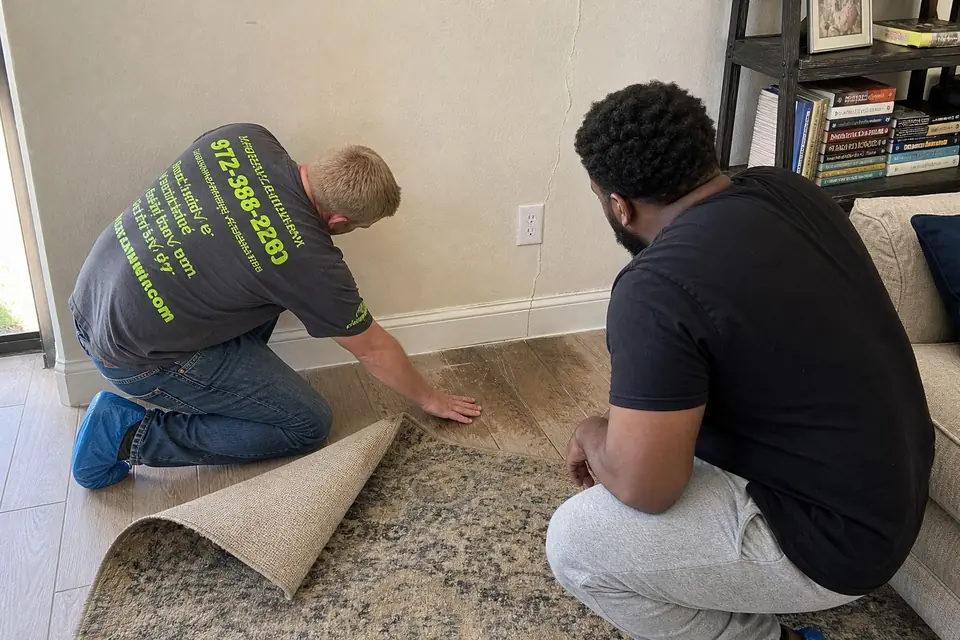
Most slab leaks don’t announce themselves. The pipe is buried under your concrete, so the water soaks into the soil below your home long before you see it inside. What you’ll notice instead are small changes that don’t add up. One clue alone might be nothing. Two or three together are worth a closer look.
- Your water bill jumps, and your habits haven’t changed.
- You hear water running or hissing when every tap, toilet, and appliance is off.
- A spot on the floor feels warm under your bare feet. That often points to a leak on a hot water line.
- Your water heater seems to run all the time, even when nobody’s using hot water.
- Carpet feels damp, wood floors start to cup or buckle, or tile grout stays dark.
- You notice a musty smell or mildew near the base of a wall with no clear source.
- Water pressure at your faucets drops for no obvious reason.
Plano sits on the same expansive clay soil found across North Texas. That clay swells when it’s wet and shrinks when it dries out in the summer heat, so your slab shifts a little through the year. The water and drain lines cast into that slab move with it. That’s why new cracks in your floor or walls, paired with any of the signs above, deserve attention instead of a shrug.
You can do one simple check yourself before you call anyone. Turn off every faucet, appliance, and sprinkler in the house. Then find your water meter, usually in a box near the curb, and look at the small dial or triangle on its face. If it’s still turning when nothing’s running, water is going somewhere it shouldn’t. Write down the reading, wait an hour without using any water, and read it again. A change confirms a leak somewhere on your system.
That meter check tells you a leak exists. It doesn’t tell you where. Plenty of leaks that look like slab leaks turn out to be something simpler, so rule these out first:
- A toilet that runs or refills on its own. Put a few drops of food coloring in the tank. If color shows up in the bowl within 15 minutes without a flush, the flapper is leaking.
- A dripping outdoor faucet or a loose hose connection.
- A broken sprinkler head or an irrigation line leaking out in the yard.
- A leak under a sink or behind the washer that you can see once you open the cabinet or pull the machine out.
If you’ve checked all of those and the meter still moves, or you’ve got a warm floor or the sound of running water you can’t trace, the leak is most likely under the slab. At that point, guessing gets expensive. The goal is to find the exact spot before anyone touches your concrete.
Rule Out a Simpler Fix First
Every sign of a slab leak has a look-alike. Before you plan on concrete work, check whether one of these simpler problems explains what you’re seeing. Some of them you can fix yourself. Others need a different kind of help, and that may not be us.
Your meter moves, but the leak is in the yard. The water line runs from your meter at the curb to the spot where it enters your slab. A leak along that stretch can raise your bill and spin the meter just like a slab leak. Look for a soggy patch of grass, a spot that stays green when the rest of the lawn is brown in August, or a small sinkhole between the street and the house. A yard line leak is a plumbing job, but it means digging in dirt, not opening your floor.
The leak is on the street side of your meter. If water is pooling near the meter box itself, or the leak looks like it’s coming from the city’s side, call your water provider first. That part of the line usually isn’t yours to repair, and you shouldn’t pay a plumber to fix it.
Other signs can have plain causes too:
- Low water pressure all over the house can come from a failing pressure regulator, the bell-shaped valve near where the line enters your home. Replacing it is a much smaller job than slab leak repair.
- A water heater that runs all the time may simply be old, full of hard-water scale, or failing. A water heater check can sort that out before anyone blames a buried pipe.
- A musty smell or a wet spot near an inside closet can come from a clogged AC drain line, especially in summer when your system pulls the most water out of the air.
- Damp carpet along an outside wall after a heavy storm often means rain is getting in from poor grading or a gutter dumping water against the foundation. That’s a drainage fix, not a plumbing one.
- A warm floor right next to the water heater closet, or in a spot that gets afternoon sun, may just be heat from the tank or the window.
Cracks without water signs are a foundation question. Plano’s clay soil moves your slab through wet and dry seasons, so hairline cracks in drywall or tile can show up even when every pipe is fine. If your meter holds still, your bill is normal, and you don’t hear running water, the cracks alone don’t point to a leak. A foundation repair company is the right call there, and it’s fine to keep an eye on things for a while.
A summer bill jump may be your sprinklers. In a Plano July, irrigation can double your water use without anything being broken. Compare the bill to the same month last year before you assume the worst.
If one of these explains everything you’ve noticed, you don’t need slab leak repair. If you’ve ruled them all out and the meter still turns with every tap shut off, that’s when finding the exact spot under your slab becomes the next step.
What the Repair Process Involves
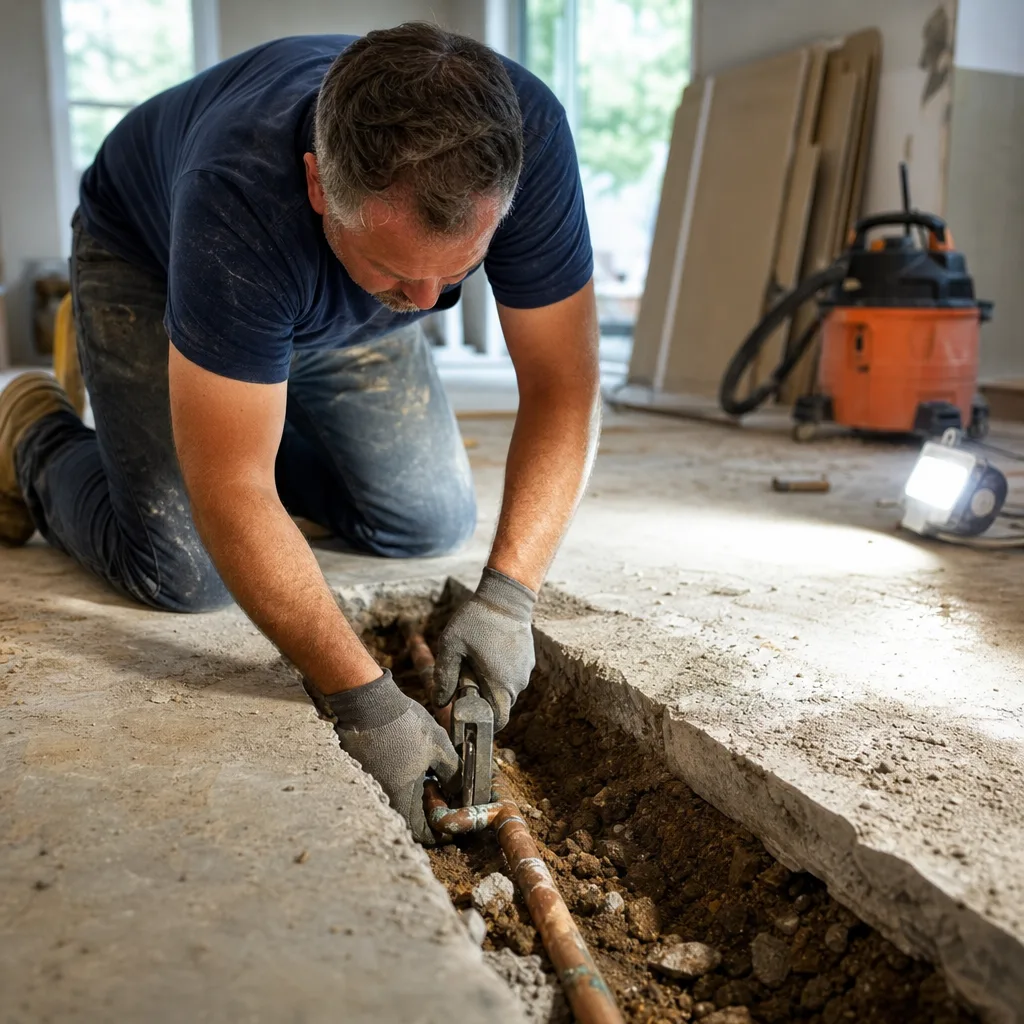
Slab leak repair happens in three stages: find the leak, fix or bypass it, then prove the fix holds. The first stage matters most. A pinpointed leak can mean opening a patch of floor about the size of a doormat. A guessed leak can mean opening the floor in three places.
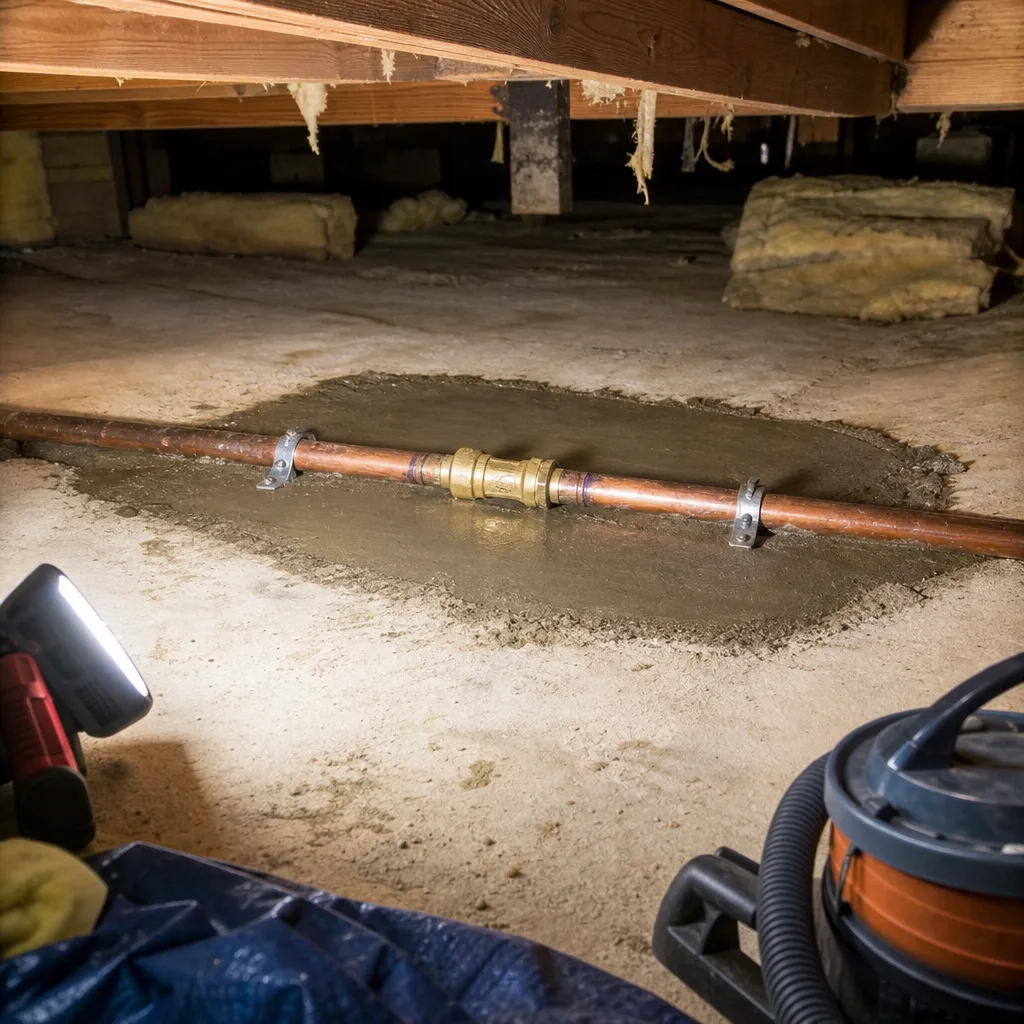
Step one is locating the leak. A good leak locator doesn’t start by breaking concrete. These are the usual tools of the trade:
- Pressure testing. Each line, hot and cold, gets isolated and checked to see which one is losing pressure. That narrows the search right away.
- Acoustic listening. Water forced out of a pinhole makes a sound. Sensitive listening gear placed on the floor can follow that sound to the loudest point.
- Thermal imaging. A leak on a hot water line warms the slab above it, and a thermal camera can show that warm patch even when you can’t feel it.
- Line tracing. This maps where the pipe runs under your floor, so the opening goes on the pipe and not a foot to the side.
Step two is choosing the repair. Once the spot is marked, there are usually two real options. Neither one is right for every house.
A spot repair means cutting a small opening in the slab right over the leak. The damaged section of pipe gets replaced, and the hole gets filled back in. This option makes sense when the leak is in one place, the rest of the line is in good shape, and the spot is somewhere you can live with being opened, like a closet or under tile that’s easy to patch.
A reroute leaves the old pipe under the slab and shuts it off for good. A new line runs a different way, usually up through the walls and across the attic, to reach the same fixtures. This option makes sense when the leak sits under something you don’t want torn up, like hardwood or a kitchen island. It also makes sense when the old line has more than one weak spot, or when a second leak on the same pipe seems likely. Plano’s shifting clay can do that to an aging line. In a North Texas attic that bakes in July and freezes in a hard winter, a rerouted line needs proper insulation and support, so ask how that will be handled.
Before any work starts, you should know which option is planned and why. You should also know roughly how much of your floor is affected. With Xtreme Air Services, the job covers leak location, the repair or reroute, and testing. Slab and flooring restoration, additional lines, and permits aren’t included unless they’re stated on your estimate. Ask about each one up front so nothing catches you off guard.
Step three is testing the fix. A repair isn’t finished when the pipe is connected. The line should be pressure tested again to confirm it holds. Then do the same water meter check you did earlier, with everything in the house shut off. If the dial sits still, the leak is gone. That still dial is the proof you’re paying for, so make sure you see it before the job is called done.
Have questions? We’re happy to help.
Call Today, Get Service Today. Xtreme Air Services — West Plano is ready to help.
Repair in Place or Reroute the Line: What Drives the Cost
Here are the real numbers. Slab leak repair with Xtreme Air Services typically runs $2,000-$6,000. Our most common job, finding the under-slab leak and then repairing or rerouting the line to stop it, runs $2,000-$3,800. Where your job lands in that range comes down to three things: where the leak is and how deep, whether it’s a spot repair or a reroute, and how hard it is to get through the slab.
- Leak location and depth. A leak near an outside wall or under a closet floor is easier to reach than one buried under the middle of the house. Deeper pipe means more digging under the concrete, and that takes more time.
- Spot repair or reroute. A single, easy-to-reach spot on a line that’s otherwise sound usually costs less to fix in place. A reroute often makes more sense when the leak sits under finished flooring or the old pipe has more than one weak spot. It can cost more up front, but it can save you from opening your floor a second time.
- Access through the slab. What’s on top matters. Breaking through concrete under tile in a laundry room is a different job than working under hardwood or cabinets. Furniture, built-ins, and appliances in the way add work too.
Price alone doesn’t settle spot repair versus reroute. The useful question is how likely the same pipe is to leak again. Plano’s clay soil shifts your slab through wet and dry seasons. On an aging line, one pinhole leak can be a sign of more to come. In that case, paying once for a reroute can cost less than two separate spot repairs. If the line is in good shape and the leak is easy to reach, fixing it in place is often the smart, simpler choice. Ask your technician to walk you through both options for your house, not just the one that pays more.
Keep the excluded items from the process section in mind when you compare quotes, especially slab or flooring restoration and permits. A low number that leaves those out isn’t really lower. Ask every company you talk to the same questions:
- Is the price flat-rate, or does it change once the floor is open?
- Is this a spot repair or a reroute, and why that one?
- How will the line be tested before the job is called done?
- Who restores the floor, and is that in this price?
Our service-call fee is $26-$99, and it’s credited toward the repair if you move forward with Xtreme Air Services. You get upfront flat-rate pricing before any work starts, so no meter is running while we dig. Leaks don’t wait for business hours, and you won’t pay extra for nights or weekends. For larger jobs, flexible financing is available on qualifying installations and larger jobs, on approved credit.
Call 469-217-9095
Watch Our Video
See How We Handle Slab leak repair in Plano
Xtreme Air Services — West Plano
Why Plano Homes Are Prone to Slab Leaks
Slab leaks aren’t bad luck. Most Plano homes sit on a concrete slab with the water lines cast right into it or buried in the soil underneath. When something goes wrong with one of those pipes, there’s no crawl space to reach it. A few local conditions make that more likely here than in a lot of other places.

Many Plano homes are reaching the age when pipes wear out. A lot of the city’s houses went up during its big growth years in the 1970s, 80s, and 90s. Those slab-on-grade homes are now 30 to 50 years old. Pipes buried that long have been through decades of ground movement, pressure changes, and hot and cold cycles. Age alone doesn’t mean your line will fail, but it does mean the odds go up.
What’s under your floor depends on when your home was built. Pipe type matters because each one fails in its own way:
- Copper lines, common in older Plano homes, can develop tiny pinhole leaks as the metal thins from the inside over time.
- Some homes from the 1980s and early 90s used polybutylene, a gray plastic pipe known for becoming brittle and cracking with age.
- Newer homes often use PEX, a flexible plastic line with fewer joints. It holds up better, but it isn’t immune. A nick during construction or a bad fitting can still leak years later.
If you don’t know what’s in your walls, look where the water line comes out near your water heater or under a sink. The pipe you see there is usually a good clue to what’s under the slab.
Hot water lines take the most abuse. Every time you run the shower or dishwasher, a hot line warms up and grows a tiny bit longer. When it cools, it shrinks back. Where that pipe touches concrete, gravel, or a steel bar inside the slab, all that back-and-forth rubbing can wear a thin spot over the years. That’s one reason a warm patch on the floor is such a common slab leak sign.
Your slab moves, and your pipes move with it. Plano’s clay soil shifts the slab between wet and dry seasons. That puts the most strain where pipes are locked in place, like the spots where they turn upward through the concrete to reach a sink or tub. A long drought followed by heavy spring rain can stress those points fast.
Uneven watering makes it worse. A yard that gets soaked on one side and baked on the other lets the soil under your foundation dry out unevenly. Keeping moisture steady around the whole foundation in summer helps your slab, and the pipes inside it, stay put.
High water pressure adds steady stress. Pressure that runs too high pushes hard on every joint and weak spot, all day, every day. If your faucets blast or your pipes bang when a valve shuts, have the pressure checked. That’s a small fix that can take strain off a buried line.
None of this means your home is doomed to leak. It does mean that when you call about a possible slab leak, your home’s age, its pipe type, and any past leaks are worth mentioning. Those details help point to the right fix for your house, not just the quickest one.
Frequently Asked Questions
Common questions about Slab leak repair
Is a slab leak covered by homeowners insurance?
Often, part of it is, but it depends on your policy. Many policies cover the cost to access and repair the plumbing itself, since that’s sudden and accidental damage, but they may not cover the water line replacement or the slab leak’s cause if it’s from gradual wear like an aging pipe. Check your policy’s water damage section, and ask your adjuster what’s included before the job starts so you know what you’re paying out of pocket.
What is a slab leak, exactly?
A slab leak is a leak in a water or drain line that runs under or through your home’s concrete foundation. Since the pipe is buried in or under the slab, you can’t see it leaking directly. Instead you notice the side effects, like a warm spot on the floor, a higher water bill, or the sound of running water when nothing’s on.
Does fixing a water meter leak cost the same as a slab leak repair?
No, they’re different jobs with different price ranges. A leak at or near your water meter, between the curb and your house, is usually a yard dig rather than concrete work, so it tends to cost less than cutting into your slab. If your meter dial moves but the leak turns out to be in the yard line instead of under your foundation, you’ve avoided a much bigger job.
Ready to Get Started?
Call (469) 217-9095 Today, Get Service Today.