
Most homeowners assume their HVAC system’s main unit does everything: heating, cooling, filtering, and moving air. That assumption leads to misdiagnosis, wasted money, and repairs aimed at the wrong equipment.
The role of air handler unit is actually distinct from heat or cold generation. Your air handler does not produce conditioned air. It moves and treats air that other equipment has already heated or cooled.
Understanding this one distinction changes how you troubleshoot problems, evaluate repairs, and make upgrade decisions for your home or facility.
Table of Contents
- Key takeaways
- Role of air handler unit: what it actually does
- Types of air handler units and how they fit your system
- Energy efficiency and indoor air quality
- Common issues and air handler maintenance tips
- Choosing the right air handler for your home or facility
- My take on why air handlers get so little respect
- Keep your air handler running at its best
- FAQ
Key takeaways
| Point | Details |
|---|---|
| AHUs don’t generate heating or cooling | Air handlers distribute and condition air using energy from external sources like boilers or chillers. |
| Filtration is a core AHU function | Your air handler filters every cubic foot of air moving through your building, directly affecting indoor air quality. |
| VFDs cut energy costs significantly | Variable frequency drives on AHU fans reduce electricity use by modulating motor speed to match actual demand. |
| Sizing and compatibility matter | Mismatched AHUs waste energy and reduce comfort, regardless of how good the rest of your HVAC system is. |
| Routine maintenance extends AHU life | Regular filter changes and coil inspections prevent the most common and costly AHU failures. |
Role of air handler unit: what it actually does
An air handler moves, filters, and circulates air; it does not create heat or cold on its own. Think of it as the lungs of your HVAC system. It breathes, filters, and circulates.
AHUs regulate and circulate air by drawing in outdoor and return air, filtering it, adjusting temperature through coils, managing humidity, and pushing it through your duct system.
Here is how the process works from start to finish:
- Air intake. The unit pulls in a mixture of return air from inside the building and fresh outdoor air. Dampers control the ratio, and that ratio matters for both air quality and energy consumption.
- Filtration. Before air goes anywhere else, it passes through filters that capture dust, pollen, bacteria, and other particulates. This step is where indoor air quality is won or lost.
- Temperature adjustment. Heating coils (fed by a boiler or heat pump) or cooling coils (fed by a chiller or refrigerant circuit) bring the air to the target temperature. The AHU does not generate that heat or cold. It transfers it.
- Humidity control. Built-in humidifiers or dehumidifiers bring moisture levels into the target range. This is particularly important in climates with extreme seasonal swings.
- Air distribution. The blower fan pushes conditioned air through the duct network at the right pressure and volume to reach every zone in the building.
- Controls and sensors. Modern AHUs include sensors that monitor temperature, humidity, and airflow, feeding data to building controls that adjust operations in real time.
Pro Tip: If your home feels stuffy even with the HVAC running, check the AHU’s return air damper setting before assuming the problem is with your furnace or AC unit. A damper stuck in the wrong position can starve the system of outdoor air without triggering any obvious alarm.
The air handlers do not generate their own heating or cooling. This is the most common misunderstanding that leads homeowners to replace perfectly functional equipment. If your building is not reaching temperature, the problem may be in the chiller, boiler, or refrigerant circuit, not in the air handler itself.
Types of air handler units and how they fit your system
Air handlers come in several distinct types, and each one fits a different building size and purpose. Choosing the wrong type for your application creates problems that no amount of maintenance can fix.
Centralized AHUs vs. terminal units
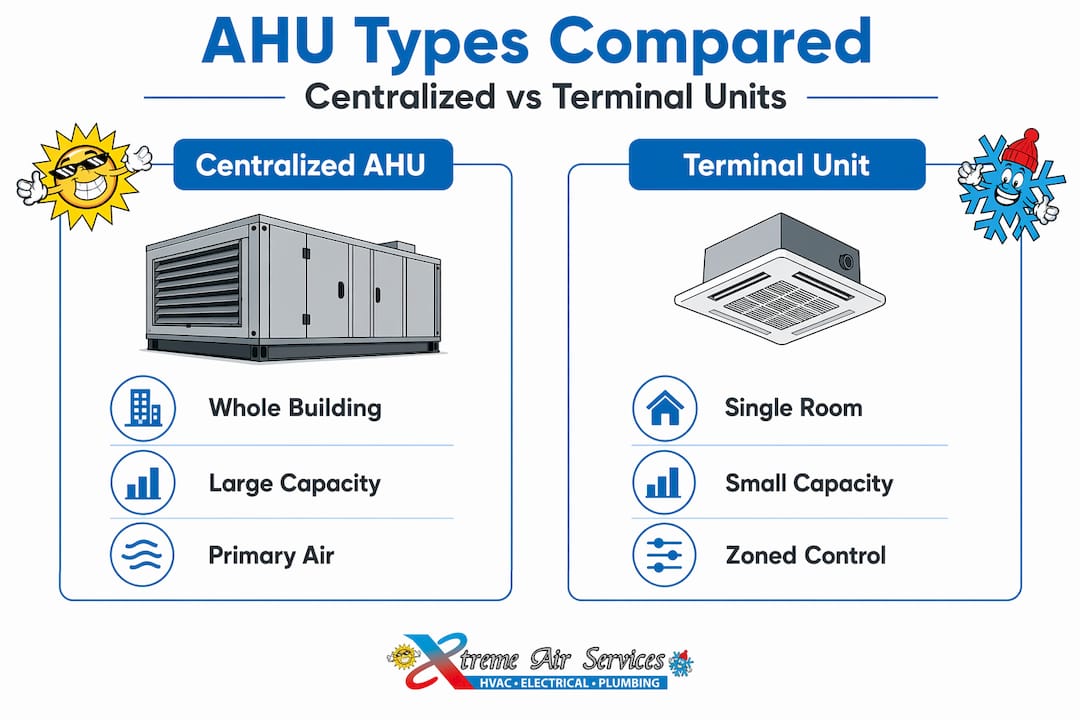
A centralized AHU conditions and distributes air for large zones, while terminal units handle temperature control room by room. The central unit takes on large volumes of air for an entire building or a major section of one. It conditions primary air and delivers it through a main duct system.
Terminal units, including fan coil units, handle final temperature adjustment at the room level. In short, AHUs condition and distribute air for large zones, while FCUs provide localized temperature control.
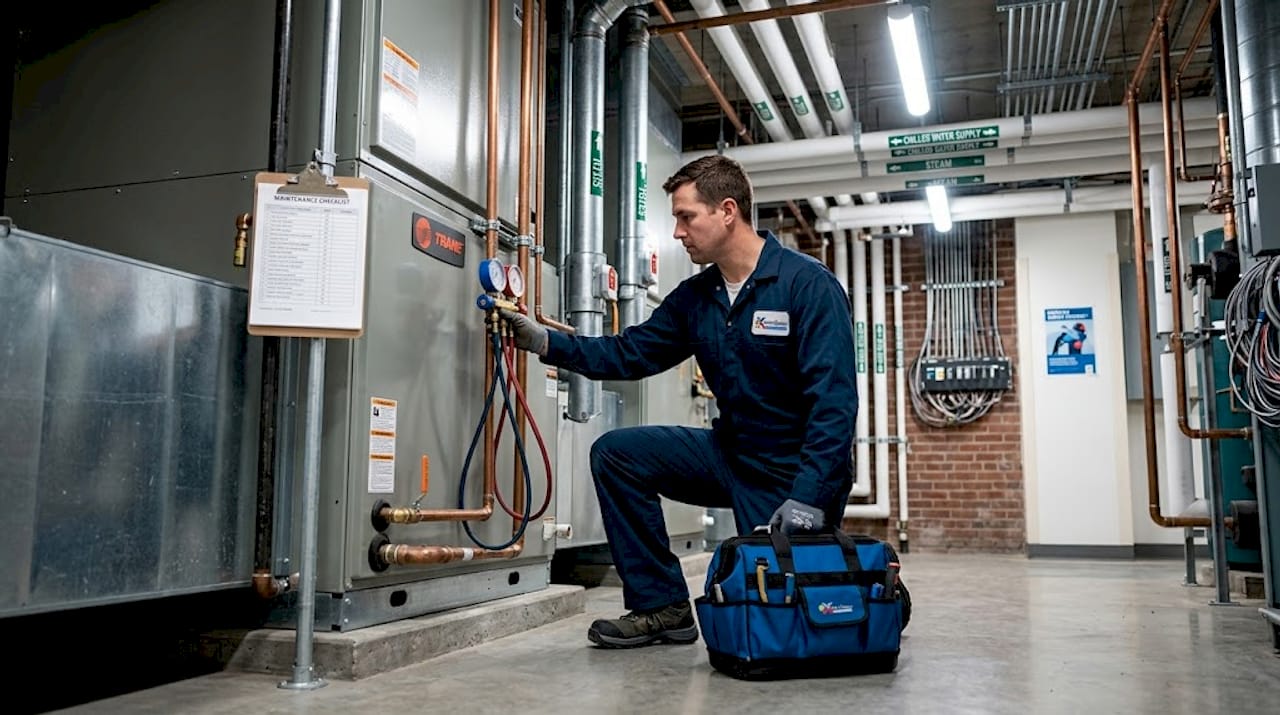
The “primary air plus FCU” model is the workhorse of commercial HVAC. The central AHU handles fresh air conditioning and bulk distribution. Individual FCUs in offices, conference rooms, or hotel rooms let occupants fine-tune their own comfort without disrupting the whole system. It is an efficient split of responsibilities.
Fresh Air Handling Units (FAHUs)
FAHUs are a specialized category built for environments where air quality cannot be compromised. FAHUs emphasize high fresh air intake and advanced filtration for hospitals, pharmaceutical facilities, and labs. They are not designed for general comfort cooling. They are designed for contamination control.
Here is a comparison of the main unit types:
| Unit type | Primary function | Best application | Key feature |
|---|---|---|---|
| Centralized AHU | Large-zone air conditioning and distribution | Office buildings, malls, schools | Handles full filtration and humidity control |
| Fan Coil Unit (FCU) | Local temperature adjustment | Hotel rooms, individual offices | Works alongside AHU for zone control |
| Fresh Air Handling Unit (FAHU) | Maximum fresh air intake and filtration | Hospitals, labs, clean rooms | Prioritizes ventilation over recirculation |
| Residential AHU | Whole-home air distribution | Single-family homes | Paired with furnace or heat pump |
A few practical points to keep in mind when identifying your unit type:
- Residential units are almost always paired with either a furnace or a heat pump, not a standalone chiller.
- FCUs do not replace AHUs. They work alongside them in larger buildings.
- Confusing AHUs with other cooling units like air washers or evaporative coolers leads to costly specification errors in industrial and commercial settings.
Energy efficiency and indoor air quality
The air handler unit purpose becomes most financially significant here, because it shapes both your energy costs and your indoor air quality. That matters to facility managers and homeowners alike.
How AHUs optimize energy use
Dampers and mixing chambers optimize airflow and energy use by blending return air with outdoor air in calculated ratios. On a mild spring day, bringing in more outdoor air reduces the load on your mechanical cooling. On a hot July afternoon, recirculating more conditioned air does the opposite. A well-programmed AHU adjusts this ratio automatically based on outdoor conditions.
Variable frequency drives on AHU fans modulate motor speed instead of running at full power constantly. In buildings where occupancy and heat load fluctuate throughout the day, this single feature can represent a significant portion of total HVAC energy savings.
How AHUs protect indoor air quality
Every breath your building’s occupants take passes through the air handler’s filters. That is not a detail. It is the entire point of the filtration stage. A properly maintained filter removes dust, pet dander, mold spores, volatile organic compounds, and fine particulates from the air supply.
Humidity control adds another layer. Air that is too dry irritates respiratory systems and damages wood flooring and furniture. Air that is too humid promotes mold growth in ducts and walls. The AHU keeps moisture in a range where neither problem takes hold.
The most common energy-efficiency mistakes made with air handlers include:
- Running filters past their rated capacity, which forces the fan to work harder and pulls contaminants through clogged media.
- Leaving dampers in manual override positions after seasonal adjustments.
- Ignoring VFD settings after tenant changes in commercial buildings, leaving fans running at maximum speed for loads that no longer require it.
Pro Tip: Set a calendar reminder every 90 days to check your AHU filter status. Most homeowners wait until they notice a problem, by which point the filter has already been restricting airflow and overworking the fan for weeks.
Common issues and air handler maintenance tips
The most common air handler problems are dirty filters, fouled coils, clogged condensate drains, failing blower motors, and stuck dampers. Routine maintenance prevents nearly all of them.
These problems rarely announce themselves loudly. They creep in gradually as a slow drop in comfort, a creeping rise in energy bills, or a faint noise that gets easier and easier to ignore.
Common AHU issues including noisy fans and reduced airflow increase energy consumption and reduce comfort. Those two symptoms often share the same root cause: a dirty or damaged system working harder than it should to move the same volume of air.
Here are the most practical air handler maintenance tips, in order of frequency and importance:
- Replace or clean filters on schedule. This is the single highest-impact maintenance task you can perform. A clogged filter restricts airflow, forces the motor to draw more power, and allows particulates to bypass filtration and coat your coils.
- Inspect and clean evaporator and heating coils annually. Dust and biofilm on coils reduce heat transfer efficiency. A coil that looks moderately dirty can reduce system capacity noticeably.
- Check drain pans and condensate lines. Clogged condensate drains cause water damage and mold growth inside the air handler cabinet. A quick visual inspection takes two minutes and can prevent a major repair.
- Listen for bearing noise in the blower motor. A squealing or grinding sound during operation means the blower motor bearings are failing. Catching this early means a bearing replacement. Ignoring it means a full motor replacement.
- Verify damper operation at least once per season. Outdoor air dampers that stick open in winter or closed in summer silently wreck both comfort and energy performance.
- Schedule professional inspections annually. Routine maintenance prolongs AHU life and maintains comfort and efficiency. A trained technician can spot refrigerant leaks, electrical issues, and coil fouling that are invisible to the untrained eye.
Stop running the system and call a professional when you notice any of these warning signs:
- Reduced airflow from multiple vents at the same time.
- Ice forming on the unit.
- Water pooling beneath the cabinet.
- A sudden spike in utility bills without an obvious cause.
These are signs that something mechanical has already failed.
Choosing the right air handler for your home or facility
Choosing the right air handler comes down to matching it to your building’s size, system, and air-quality needs. Get this wrong and the unit costs you money every single month it is in service. Proper AHU sizing and compatibility with the overall HVAC system are critical for performance and energy efficiency.
The core factors that determine whether an air handler will perform well in your specific situation include:
- Square footage and zone layout. An undersized unit cannot maintain comfort on peak demand days. An oversized unit short-cycles, which means it does not run long enough to adequately dehumidify the air.
- Compatibility with your heating and cooling source. Air handlers are designed to pair with specific equipment. A unit built for a heat pump will have different coil and control specifications than one built for a gas furnace.
- Fresh air requirements. Commercial and healthcare facilities often have mandatory ventilation rates set by code. Residential homes typically have more flexibility, but tighter modern construction often requires more intentional fresh air provision than older leaky homes needed.
- Filtration level. Standard MERV 8 filters are fine for most homes. Facilities with occupants who have respiratory conditions or that handle sensitive materials may need MERV 13 or better, which requires an AHU cabinet and fan sized to handle the increased static pressure.
- Humidity control capacity. If you are in a high-humidity climate like the Gulf Coast or a very dry climate like the Southwest, built-in humidity management becomes a practical necessity rather than an optional upgrade.
The right unit is always the one that fits your specific building, load profile, and system configuration. Generic sizing charts are a starting point, not a final answer. A load calculation by a qualified HVAC professional is the only way to know for certain.
My take on why air handlers get so little respect
I’ve worked around HVAC systems long enough to know that air handlers are the most underestimated equipment in the entire system. Homeowners obsess over their compressors and furnaces. Facility managers budget for chillers. The air handler sits in a mechanical room or a closet, doing its job quietly, and nobody thinks about it until it fails.
What I’ve seen over and over is that understanding AHUs rely on external energy sources is genuinely useful for diagnosing problems. When a system is underperforming and someone calls convinced the AHU is broken, half the time the actual problem is with the upstream equipment. The air handler is just faithfully distributing the problem.
The maintenance piece is where I see the most avoidable damage. Not catastrophic negligence. Just chronic under-attention to filter schedules and coil inspections. A building that runs clean filters and gets annual coil cleaning will outperform a building with newer equipment that gets ignored. That is not a theory. I’ve seen it consistently.
My honest advice: treat the air handler with the same seriousness you give your furnace or AC unit. It touches every cubic foot of air in your building. Its performance is your air quality, your comfort, and a significant part of your energy bill. Understanding the benefits of air handler units starts with taking them seriously enough to maintain them.
— Xtreme
Keep your air handler running at its best
Your air handler does the daily work that keeps your home or facility comfortable, healthy, and energy-efficient. When it is properly maintained and correctly sized, you feel the difference in your comfort and see it in your utility bills. When it is neglected, every other piece of your HVAC system pays the price.
Xtreme Air Services provides professional HVAC repair and maintenance for homes and businesses across Dallas, Plano, Irving, and Sunnyvale, TX. Whether you need a full AHU inspection, a filter system upgrade, or guidance on replacing aging equipment, the team at Xtreme Air Services has the experience to get your system performing the way it should.
Contact Xtreme Air Services today to schedule a service visit and get a clear picture of where your air handler stands.
FAQ
What is the main role of an air handler unit?
The role of an air handler unit is to move, filter, and condition air throughout a building. It draws in return and outdoor air, filters it, adjusts temperature through coils, controls humidity, and distributes the air through ducts. It does not generate heating or cooling on its own.
How is an air handler different from an air conditioner?
An air conditioner generates cooling through a refrigerant cycle, while an air handler distributes that conditioned air through the building. The two work together, but they are separate pieces of equipment with separate functions.
How often should an air handler be serviced?
Filters should be checked every 60 to 90 days and replaced as needed. A full professional inspection, including coil cleaning and mechanical checks, should happen at least once per year to maintain efficiency and extend equipment life.
Can an air handler work with both a heat pump and a furnace?
Yes. Air handlers are available in configurations compatible with heat pumps, gas furnaces, and electric heat strips. Compatibility depends on coil type and control wiring, so always verify the pairing before purchasing a replacement unit.
What causes poor airflow from an air handler?
The most common causes are a clogged filter restricting air intake, a failing blower motor, dirty evaporator coils reducing airflow through the cabinet, or a duct leak downstream of the unit. A technician can isolate which factor is responsible through airflow measurement and visual inspection.